
TL;DR:
- A municipal asset painting workflow integrates scheduling, surface preparation, inspection data, and maintenance tracking to extend infrastructure lifespan. Proper data management, inspection integration, and adherence to surface prep standards prevent cycle slip, premature failure, and warranty issues. Coordinated digital systems and strict procedural gates are essential for effective, condition-based coating maintenance.
A municipal asset painting workflow is a coordinated system that manages painting schedules, surface preparation, inspection data integration, and maintenance tracking to extend the service life of public infrastructure. Without a structured process, paint cycles that should run every 5 to 7 years routinely slip past 12 years due to lost records and reactive maintenance habits. The industry term for this discipline is protective coatings asset management, and it combines field inspection protocols, digital work order systems, and standards like SSPC-SP10 (near-white metal blast cleaning) to keep municipal assets in compliance and out of premature failure. This guide walks you through every stage of that process.
How to structure a municipal asset painting workflow
The foundation of any effective painting workflow is a well-mapped asset hierarchy. Every surface you manage, whether a water tank, bridge abutment, or municipal building facade, needs its own record that captures the last paint date, coating system used, contractor name, and warranty expiration. Metadata-linked asset records prevent the most common failure mode in municipal programs: cycle slip, where a 6-year recoat schedule quietly becomes a 13-year neglect problem because no one owns the data.

Ad-hoc scheduling through email threads or shared spreadsheets is the single largest source of information loss in municipal painting programs. When a contractor finishes a job and the only record lives in someone’s inbox, that data disappears the moment that person changes roles. A digital asset management platform solves this by tying every painting event to a specific asset ID, not a person or a project folder.
Building your asset hierarchy requires input from multiple departments. Public works, facilities management, and procurement each hold pieces of the picture. Coordinating that data into one system takes effort upfront, but it eliminates the overlapping projects and expired warranty claims that cost cities money every year.
Key metadata fields to capture for each painted asset:
- Asset ID and location (GPS coordinates or facility zone)
- Surface type and square footage
- Last paint date and coating system applied
- Contractor name and license number
- Warranty start date, duration, and claim contact
- Condition score at last inspection
Pro Tip: When onboarding existing assets into a CMMS or asset management platform, start with your highest-risk or highest-traffic assets first. Getting 20% of your portfolio into the system correctly is more valuable than getting 100% in with incomplete records.
How to integrate inspection data and automate work order updates
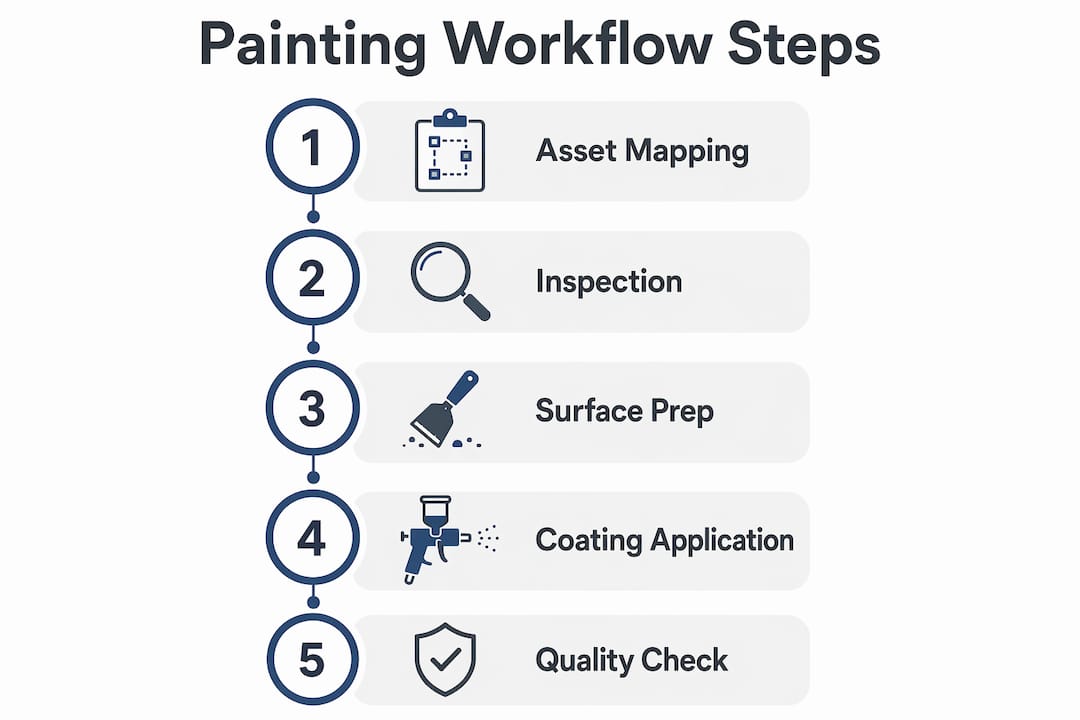
Inspection data that stays inside a field capture tool is only half useful. The real efficiency gain comes when that data flows automatically into your centralized asset management platform and triggers work order updates without manual reconciliation. The City of Lakewood, Colorado, demonstrates this directly: Lakewood’s ITpipes integration with OpenGov allows inspection results to update asset task statuses and share video links in real time, eliminating the manual handoff that typically creates delays and transcription errors.
The steps to build this kind of integrated workflow are sequential and non-negotiable:
- Select a field inspection platform that supports structured data export. ITpipes is purpose-built for infrastructure inspection, but any platform that outputs standardized data formats works.
- Map inspection data fields to asset management fields before you go live. Mismatched field names are the most common reason integrations fail silently.
- Configure automated work order triggers so that an inspection finding above a defined severity threshold automatically generates a work order in OpenGov or your equivalent platform.
- Set closure rules so that when a painting work order is completed and documented, the asset record updates automatically with the new paint date and condition score.
- Audit the integration quarterly to catch any field mapping drift caused by software updates on either platform.
Managing in-house inspection crews and contracted inspectors through the same system is critical. Consistent data capture regardless of who performs the inspection prevents the parallel-process problem, where city staff and contractors maintain separate records that never reconcile.
Pro Tip: Require contractors to submit inspection data through your platform, not their own proprietary system. Make this a contract requirement before work begins, not a negotiation after the fact.
What surface preparation standards apply to municipal painting programs?
Surface preparation is the variable that determines whether a coating lasts 7 years or fails in 2. Coating performance depends primarily on meeting the substrate standard specified in the coating’s technical data sheet, matched to the operating environment. No amount of premium paint compensates for inadequate prep. Insufficient preparation also voids most manufacturer warranties, which means the city absorbs the full cost of premature failure.
The governing standard for steel infrastructure in municipal programs is SSPC-SP10, near-white metal blast cleaning. It requires the removal of all visible rust, mill scale, and contaminants from at least 95% of the surface area. SSPC-SP10 mandates three independent verification checks before coating application proceeds: visual cleanliness assessment against ISO 8501-1 comparators, anchor profile measurement using ASTM D4417 Method C (Testex replica tape), and soluble salt testing using the Bresle patch method.
| Verification step | Method | Tool used | Pass threshold |
|---|---|---|---|
| Visual cleanliness | ISO 8501-1 comparison | Photo comparator | Near-white standard met |
| Anchor profile | ASTM D4417 Method C | Testex replica tape | Per coating TDS spec |
| Soluble salt content | Bresle patch method | Bresle kit | Per coating TDS limit |
These three checks are not post-hoc quality control. They are prerequisites to coating application and must be embedded as mandatory workflow gates. A crew that completes blasting and moves straight to painting without verification is operating outside the standard, regardless of how clean the surface looks to the naked eye.
Timing between preparation and coating is equally critical. Flash rust forms within 30 to 60 minutes after blasting in humid conditions, which is the default environment across much of Florida and the Gulf Coast. Your workflow must either schedule coating application immediately after verified prep or include a defined re-preparation trigger if the window is missed. Leaving this to crew judgment is how coating failures start.
For assets where abrasive blasting is not feasible, such as occupied facilities or environmentally sensitive sites, grit-free mechanical methods like Monti Bristle Blaster or needle gun preparation can achieve SSPC-SP3 or SP11 standards. These methods require the same three-step verification process. Surface prep best practices for municipal assets always specify the method and verification standard in the work order, not just the coating product.
How to schedule and track municipal painting cycles effectively
A proactive painting cycle program sets target recoat intervals of 5 to 7 years per asset and builds automated alerts into the system before those dates arrive. OxMaint CMMS tracks paint cycles, contractor assignments, warranty expiration dates, and condition scores in a single platform, and it detects schedule conflicts before execution rather than after. That conflict detection feature alone prevents the common scenario where two contractors are scheduled to work on adjacent assets simultaneously, creating access and sequencing problems.
Effective cycle tracking requires these operational practices:
- Set automated alerts at 12 months and 6 months before each asset’s target recoat date so procurement can begin contractor selection in time.
- Require photo documentation at project start, mid-point, and completion for every painting work order. Photos tied to asset records create an audit trail that supports warranty claims and budget justifications.
- Track contractor performance scores by asset type and project size. A contractor who consistently delivers on water tanks may not be the right choice for bridge steel.
- Maintain a budget versus actual report for every painting project. Variance data over three or more cycles reveals which asset types are consistently underestimated and allows more accurate future budgeting.
- Log warranty claims with dates, claim contacts, and resolution outcomes. This data is the most persuasive argument for selecting higher-quality coating systems when budget discussions arise.
The most overlooked element of painting cycle management is condition-based adjustment. A target interval of 6 years is a planning assumption, not a guarantee. Annual visual condition assessments, scored consistently using a defined rating scale, allow you to accelerate or defer recoating based on actual asset condition rather than calendar date alone. This approach directs budget toward assets that need it and avoids spending on assets that do not.
Key takeaways
A municipal asset painting workflow succeeds when asset hierarchy data, inspection integration, surface preparation verification, and proactive cycle scheduling operate as a single connected system rather than separate departmental tasks.
| Point | Details |
|---|---|
| Build a complete asset hierarchy | Capture paint date, coating system, contractor, and warranty data for every surface before anything else. |
| Automate inspection-to-work-order flow | Use platforms like ITpipes and OpenGov to eliminate manual data handoffs and reduce reconciliation errors. |
| Treat surface prep as a workflow gate | Embed SSPC-SP10 verification steps as mandatory prerequisites, not optional quality checks after the fact. |
| Schedule coatings within the prep window | Apply coatings before flash rust forms, typically within 30 to 60 minutes in humid climates. |
| Use condition scores to adjust cycles | Annual assessments let you direct budget to assets that need recoating now rather than following calendar dates blindly. |
What most municipal painting programs get wrong
After working on municipal and industrial coating projects across Central Florida for over two decades, the pattern I see most consistently is not a technical failure. It is a data failure. Cities invest in quality coatings and skilled crews, then lose the entire maintenance record when a project manager retires or a department reorganizes. The next team inherits assets with no paint history, no warranty documentation, and no baseline condition scores. They start from scratch, and the cycle slip problem begins again.
The second most common mistake is treating surface preparation verification as a formality rather than a workflow gate. I have seen projects where the prep crew finished blasting on a humid afternoon, the coating crew arrived the next morning, and no one checked for flash rust overnight. The coating went on over compromised steel. Two years later, the city was paying for a full recoat on a job that should have lasted seven years. Embedding the three SSPC-SP10 verification steps as hard stops in the work order, not suggestions in a specification document, is the difference between a coating that performs and one that fails quietly.
The third issue is siloed procurement. Painting contracts and inspection contracts often sit in different departments with no shared data standard. Requiring both to feed into the same asset management platform, as Lakewood did with ITpipes and OpenGov, is the structural fix. It is not a technology problem. It is a contract requirement problem, and it is solvable before the first work order is issued.
— Southernsandblastingandpainting
How Southernsandblastingandpainting supports your painting program
Municipal infrastructure managers working through the complexity of painting workflow optimization need a contractor who understands both the technical standards and the operational requirements of public-sector projects.

Southern Sandblasting and Painting brings 20-plus years of experience in surface preparation and industrial coatings for municipal assets across Central Florida, including water tanks, city infrastructure, and pipelines. The team works to SSPC-SP10 standards, provides full documentation for asset records, and coordinates timing between prep and coating application to prevent flash rust failures. Review the surface preparation workflow guide for a step-by-step breakdown of how professional prep integrates with your existing asset management process. For equipment specifics, the sandblasting equipment guide covers the tools that deliver verified results on municipal steel. Contact Southernsandblastingandpainting to discuss your next project.
FAQ
What is a municipal asset painting workflow?
A municipal asset painting workflow is a structured process that coordinates painting schedules, surface preparation, inspection data capture, and maintenance tracking for public infrastructure assets. It connects field operations to digital asset management systems to prevent cycle slip and warranty loss.
How often should municipal assets be repainted?
Target recoat intervals for most municipal steel and concrete assets run 5 to 7 years, though condition-based assessments can extend or shorten that window. Untracked cycles routinely extend past 12 years when records are lost, accelerating deterioration and increasing repair costs.
What does SSPC-SP10 require for municipal painting projects?
SSPC-SP10 requires near-white metal blast cleaning with three independent verification steps: visual assessment against ISO 8501-1 comparators, anchor profile measurement per ASTM D4417 Method C, and soluble salt testing using the Bresle patch method. All three checks must pass before coating application begins.
How does inspection data integration improve painting workflows?
Integrating field inspection platforms with centralized asset management systems, as the City of Lakewood did with ITpipes and OpenGov, automates work order updates and eliminates manual data reconciliation. This reduces administrative errors and gives managers real-time visibility into asset condition and task status.
Why does surface preparation affect coating warranty validity?
Coating warranties require the substrate to meet the standard specified in the coating’s technical data sheet. If prep falls short of that standard, the manufacturer’s warranty is void, and the city bears the full cost of any premature coating failure.


