
TL;DR:
- Scheduled shutdowns are ideal for coating work because they enable full access, proper sequencing, and quality control. Applying protective coatings during these periods prevents corrosion, extends asset life, and reduces overall project costs. Proper planning, standard adherence, and experienced contractors are essential for successful shutdown coating projects.
Coating work belongs in every scheduled shutdown scope because it is the single maintenance activity that simultaneously protects uptime, cuts long-term asset costs, and prevents the startup failures that derail production the moment a plant comes back online. The access, sequencing, and cure-time control a planned outage provides simply cannot be replicated during live operations. Start now by walking your critical assets with an inspector before the next shutdown window closes, then get a coating contractor on the phone to scope the work while the schedule is still open.
Table of Contents
- Why scheduled shutdowns are the right time for coating work
- The core benefits of applying coatings during a planned outage
- Which assets should you coat during a shutdown?
- Surface preparation: why it drives both cost and performance
- How to choose the right coating system for your shutdown
- Scheduling, sequencing, and cure-time planning
- Safety, ventilation, and regulatory requirements
- Cost drivers and ROI: how coatings pay off during shutdowns
- What happens when you delay or skip coatings during a shutdown
- Pre-shutdown coating checklist: 90/60/30/7 days out
- How Southernsandblastingandpainting approaches coatings during shutdowns
- Key Takeaways
- What shutdown coating projects actually look like in practice
- Southernsandblastingandpainting is ready to scope your next shutdown
- Authoritative sources and standards to consult
Why scheduled shutdowns are the right time for coating work
Most coating failures happen not because the wrong product was chosen, but because the work was squeezed into a window that was too short, too live, or too crowded with competing trades. A planned shutdown eliminates all three problems at once.
Full access to normally live systems. Tanks, vessels, structural steel, and process piping that run continuously under pressure or temperature are simply unreachable during production. A shutdown opens every one of those surfaces to abrasive blasting and coating without hot-work conflicts or process-safety overrides.
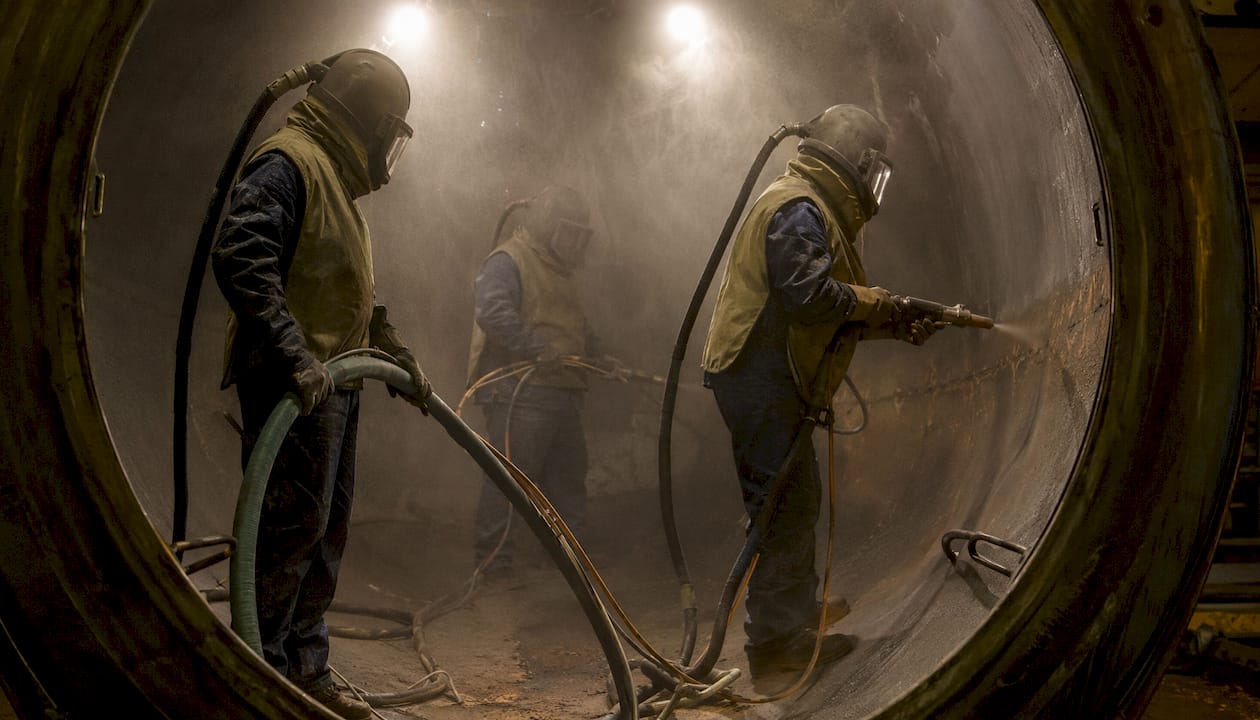
Single mobilization. Contractor mobilization, containment setup, abrasive delivery, and demobilization are fixed costs. Doing all coating work in one outage rather than across multiple reactive callouts cuts those fixed costs to a single occurrence, which reduces total labor and avoids the premium rates that come with emergency scheduling.
Sequencing efficiency. Surface preparation, substrate repairs, primer, intermediate coat, and topcoat each require dry time and inspection before the next step begins. A shutdown gives you the calendar space to run that sequence properly. Trying to compress it into a weekend turnaround almost always means skipping inspection hold-points or applying a topcoat over an under-cured primer.
Quality control access. Inspectors can check dry film thickness (DFT), adhesion, and holiday testing at each coat stage rather than only at final acceptance. That access is what separates a coating that lasts a full maintenance cycle from one that starts peeling in 18 months.
Pro Tip: Bundle mechanical isolation, NDT, and welding repairs into the same permit package as your coating scope. Every time you re-isolate a system for a separate trade, you pay another round of permit overhead and risk breaking the blast-clean surface profile before primer goes on.
The core benefits of applying coatings during a planned outage
Treating protective coatings as a strategic uptime investment rather than a cosmetic line item changes how you budget and prioritize them. The returns are measurable across several dimensions.
Corrosion prevention and fewer emergency repairs. Corrosion is a leading cause of asset failure during inactivity, and moisture ingress during idle periods is a well-documented startup failure mode. A correctly applied coating interrupts that electrochemical process before it starts.
Extended asset life. Coatings applied correctly can extend equipment service life significantly depending on service conditions, which directly defers capital replacement spending. That is not a minor budget line; replacing a large process vessel or structural steel section runs into six figures before you factor in installation and lost production.
Improved startup reliability. Moisture ingress into electrical enclosures, pump housings, and valve actuators during a shutdown is a predictable failure path. A sealed, properly coated surface closes that path before the plant restarts.
Lower total project cost. Surface preparation is the largest single cost in any coating project. Doing it once, correctly, during a planned outage costs far less than doing it twice reactively. A preventive painting program consistently reduces annual maintenance painting needs compared with reactive repainting.
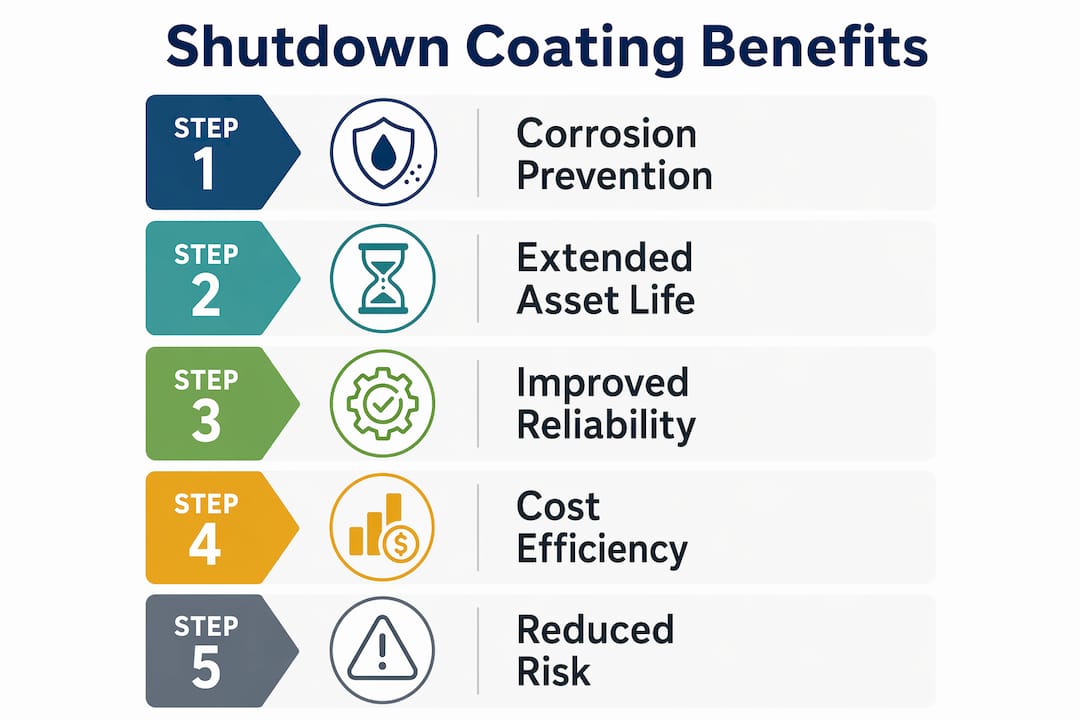
The protective coating advantages for facility managers extend well beyond corrosion control: reduced insurance risk, cleaner regulatory compliance records, and easier asset valuation all follow from a documented coating history.
Which assets should you coat during a shutdown?
Not every surface needs attention in every outage. Prioritize by consequence of failure, access difficulty, and current coating condition.
High-priority areas:
- Structural steel (columns, beams, grating supports) exposed to process chemicals or outdoor weathering
- Tanks and vessels, both interior linings and exterior surfaces, especially carbon steel in immersion or splash-zone service
- Process piping, particularly insulated lines where corrosion under insulation (CUI) is a known risk
- Pumps, valves, and rotating equipment bases where surface rust accelerates seal wear
- HVAC units in industrial settings, which corrode rapidly in humid or chemically aggressive plant environments
- Concrete floors, secondary containment berms, and trenches where chemical spills or forklift traffic degrade the surface
Quick wins versus long-lead projects. Structural steel touchups and floor recoats are typically quick wins: low permit complexity, fast cure times, and high visibility to safety auditors. Interior tank linings are long-lead: they require confined-space permits, multi-coat systems with extended cure windows, and post-application holiday testing. Identify which category each scope item falls into at the 90-day planning mark so you can sequence them without creating a bottleneck.
Pro Tip: Combine tank interior lining with any mechanical inspection of the same vessel. The confined-space entry permit, gas monitoring, and ventilation setup are already in place. Adding the coating scope to an existing entry costs a fraction of opening a separate permit.
The benefits of coating water tanks and pipelines are particularly well-documented: interior linings prevent product contamination, reduce corrosion-driven wall loss, and extend hydrostatic test intervals.
Surface preparation: why it drives both cost and performance
Surface preparation is the most expensive part of any industrial painting project and the primary determinant of whether a coating lasts its rated service life or fails prematurely. That relationship is not a rule of thumb; it is the consistent finding of coating failure analyses across industries.
Why prep dominates cost. Labor hours for abrasive blasting, containment erection and disposal, abrasive consumables, soluble salt testing, and waste handling routinely account for the majority of total project cost on a steel substrate. The coating material itself is often a small fraction of the invoice.
Typical preparation steps:
- Power-tool or abrasive blast cleaning to remove mill scale, rust, and existing failed coatings
- Blast profiling to achieve the anchor profile specified by the coating manufacturer (typically 1.5–3.0 mils for epoxy systems)
- Soluble salt testing (Bresle patch or equivalent) to confirm chloride levels are within specification
- Spot repairs to pitted or corroded substrate before priming
- Dew-point monitoring and, where needed, active dehumidification to keep the steel surface temperature at least 5°F above the dew point
Standards that govern this work. SSPC (now AMPP) surface preparation standards, including SP 6 (Commercial Blast), SP 10 (Near-White Blast), and SP 5 (White Metal Blast), define the cleanliness levels required for different service environments. ISO 12944 provides the corrosivity category framework (C3 through CX) that links environment to required prep level and coating system. Specifying the correct standard in your RFP is not optional; it is the single most enforceable quality control tool you have.
Industry failure analysis consistently shows that inadequate surface preparation accounts for the majority of premature coating failures. An incorrect specification or insufficient prep can create a false sense of protection, where corrosion accelerates beneath a failed film and remediation costs more than the original application would have. (Source)
Pro Tip: Schedule blast cleaning and primer application in the same work shift whenever possible. Freshly blasted carbon steel can begin to flash-rust within hours in humid conditions. Humidity control using desiccant dehumidifiers during the shutdown is often more critical to coating success than product selection.
The surface prep best practices that experienced contractors follow are worth including verbatim in your specification documents and RFP packages.
How to choose the right coating system for your shutdown
Coating selection is a matching exercise: service environment on one side, coating chemistry on the other. Getting it wrong does not just waste money; it can accelerate the corrosion you were trying to stop.
Decision axes to work through:
- Corrosivity category (C3 moderate, C4 high, C5 very high, CX extreme per ISO 12944)
- Chemical contact or immersion service (acids, alkalis, hydrocarbons, water)
- Operating temperature range (some epoxies soften above 250°F; silicone-modified systems handle higher ranges)
- Abrasion or impact exposure
- UV exposure for exterior topcoats
- Required service life and next planned maintenance interval
| Coating type | Best uses | Cure / dry-time notes | Key limitations |
|---|---|---|---|
| Waterborne epoxy | Interior steel, moderate environments, low-VOC requirements | Faster recoat in warm conditions; sensitive to cold | Lower chemical resistance than solvent-borne |
| Solvent-borne epoxy | Immersion, chemical exposure, structural steel | Longer recoat window; requires ventilation | Higher VOC; slower in cold/humid conditions |
| Polyurethane topcoat | UV-exposed exteriors, color retention | Fast dry; apply over cured epoxy intermediate | Not for immersion; sensitive to moisture during cure |
| Zinc-rich primer | Cathodic protection of carbon steel | Must cure fully before topcoat; check zinc content | Requires near-white blast (SP 10 minimum) |
| Elastomeric / concrete systems | Floors, containment, concrete substrates | Longer cure before foot traffic | Limited chemical resistance without topcoat |
Short shutdown windows favor fast-cure waterborne systems or moisture-tolerant epoxies that allow recoat within 4–8 hours at 70°F. Long encapsulation projects (tank interiors, buried piping) justify solvent-borne high-build systems with longer cure windows because the service life payoff is greater.
Inspection and test points to write into the specification: DFT at each coat stage, adhesion pull-off testing (ASTM D4541) on representative areas, and holiday (spark) testing on immersion linings. These are not optional extras; they are the only way to verify the system was applied correctly before you close up the asset.
For a deeper look at industrial coating types and their recommended applications, that resource maps coating chemistry directly to service conditions.
Scheduling, sequencing, and cure-time planning
A coating scope that is not sequenced correctly will either delay the shutdown restart or produce a failed coating. Both outcomes cost more than the coating itself.
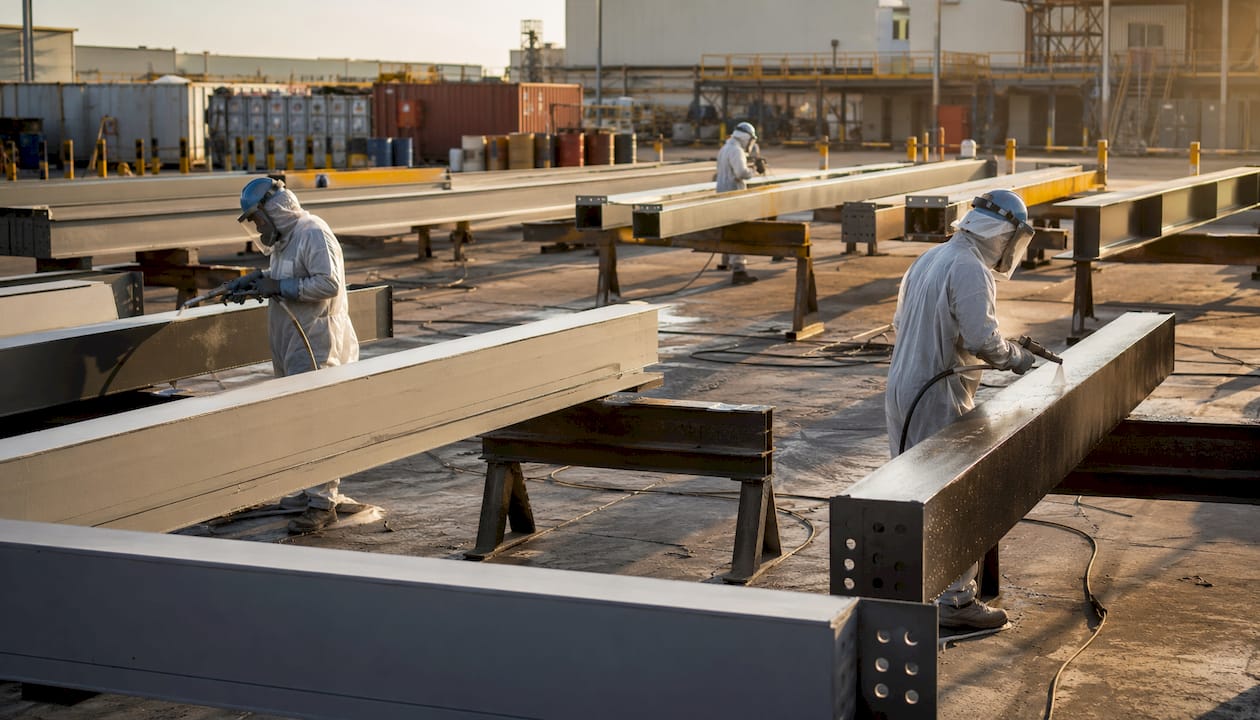
Sequence the substrate work first. Welding repairs, mechanical corrections, and NDT must be complete before blast cleaning begins. Any post-blast welding recontaminates the prepared surface and requires re-blasting.
Cure-time factors that affect your schedule:
- Ambient temperature: most epoxy systems have a minimum application temperature of 50°F; cure times roughly double for every 18°F drop below the manufacturer’s stated temperature
- Relative humidity: above 85% RH, many coatings will not cure correctly; solvent-borne systems are particularly sensitive
- Film thickness: a high-build epoxy applied at 20 mils DFT takes significantly longer to cure than the same product at 8 mils
- Ventilation: confined spaces require forced-air ventilation to remove solvent vapor and supply fresh air; inadequate ventilation slows cure and creates safety hazards
Scheduling tips for planners:
- Build a 20% contingency buffer into every cure-window estimate; weather and temperature swings inside a plant during a cold-weather shutdown are common
- Run parallel tasks where the sequence allows: blast one area while primer cures on another
- Place inspection hold-points in the schedule as hard stops, not suggestions; skipping them is how rework happens
- Confirm the coating contractor’s mobilization date at least 30 days out and lock in the dehumidification equipment rental at the same time
Coordination with mechanical, electrical, and NDT trades is where shutdown coating scopes most often slip. A single unresolved isolation prevents the blast crew from starting, and every day of delay compresses the cure window at the back end of the shutdown. Assign one person the authority to resolve trade conflicts in real time.
Safety, ventilation, and regulatory requirements
Coating work during shutdowns involves confined spaces, flammable solvents, and airborne particulate. Each of those hazards has a specific regulatory framework that applies regardless of project size.
Core safety controls:
- Confined space entry: OSHA 29 CFR 1910.146 requires a written permit program, atmospheric testing, and an attendant outside the space for any permit-required confined space entry
- Respiratory protection: OSHA 29 CFR 1910.134 governs respirator selection, fit testing, and medical evaluation; solvent-borne coatings and abrasive blasting both require supplied-air or air-purifying respirators with appropriate cartridges
- Fall protection: OSHA 29 CFR 1926.502 applies to any work at heights above 6 feet; coating crews working on elevated structural steel or tank exteriors must have a documented fall protection plan
- Hot work coordination: blasting and coating near welding or cutting operations requires a hot-work permit and a fire watch; solvent vapors and abrasive dust are both ignition risks
Ventilation and environmental controls. Solvent-borne coatings release volatile organic compounds (VOCs) that are regulated under EPA National Emission Standards and state air-quality rules. Many states have adopted stricter VOC limits than the federal baseline; confirm the applicable limit for your facility’s air permit before specifying a high-VOC product. Abrasive blasting generates particulate that must be contained and collected; spent abrasive containing lead paint or other hazardous materials is a RCRA-regulated waste and requires manifested disposal.
Permit and waste disposal. Contaminated runoff from wet blasting or pressure washing must not enter storm drains. Establish a containment and collection plan before work begins, and confirm your waste disposal contractor is licensed for the specific waste streams your project will generate.
OSHA’s silica standard (29 CFR 1910.1053 for general industry) applies when blasting with silica-containing abrasives; many contractors have shifted to steel grit, garnet, or coal slag to manage this exposure.
Cost drivers and ROI: how coatings pay off during shutdowns
The financial case for shutdown coatings is straightforward once you separate the cost of doing it right from the cost of not doing it at all.
Primary cost drivers in a coating project:
- Surface preparation (typically the largest single line item: labor, containment, abrasive, waste disposal)
- Environmental controls (dehumidification, ventilation equipment rental)
- Coating material (primer, intermediate, topcoat; high-performance systems cost more per gallon but last longer)
- Labor and contractor mobilization
- Inspection and testing (DFT gauges, adhesion testers, holiday detectors)
How planned application lowers per-unit costs. A single mobilization during a shutdown amortizes fixed setup costs across a larger scope. Bulk material purchasing for a planned project costs less per gallon than emergency orders. Optimized surface preparation, done once to the correct standard, eliminates the rework cycle that reactive painting almost always triggers.
ROI framing for operations and finance teams. The three numbers that move budget conversations are: avoided unscheduled downtime cost (production loss per hour times expected hours of reactive repair), deferred capital replacement value (replacement cost of the asset times years of life extension), and reduced maintenance frequency (fewer coating cycles over a 20-year horizon). A correctly specified and applied coating can extend maintenance-free service life significantly, which means fewer contractor mobilizations and less cumulative labor cost over the asset’s life.
The preventive coatings program financial case is well-documented: planned painting consistently costs less per square foot than reactive repainting when you account for the full scope of mobilization, prep, and lost-production costs.
What happens when you delay or skip coatings during a shutdown
Skipping coatings during a planned outage does not defer the cost. It converts a predictable, budgeted expense into an unpredictable, larger one.
Corrosion accelerates during inactivity. Equipment that sits idle in a humid environment without protective coatings corrodes faster than equipment in continuous service, because process heat and fluid flow that normally limit moisture contact are absent. Moisture ingress during lay-up is a documented cause of startup mechanical failures, seal failures, and electrical faults.
The compound cost of reactive repairs:
- Emergency contractor mobilization at premium rates (nights, weekends, expedited scheduling)
- Overtime labor for production staff waiting on repairs
- Expedited material orders at above-catalog pricing
- Extended production loss while repairs are completed
- Potential regulatory notifications if a coating failure leads to a containment breach or environmental release
Small visible failures hide larger substrate damage. A patch of surface rust on a tank exterior often signals active corrosion beneath an adjacent area of apparently intact coating. By the time the visible failure is large enough to trigger a work order, the substrate damage typically requires weld repairs or plate replacement in addition to recoating. That is a three-to-five-times cost multiplier compared with catching the same area during a planned inspection and recoating it before the substrate is compromised.
The stakeholder conversation. When you are making the case to fund coating work in a shutdown budget, the most persuasive framing is not the cost of the coating. It is the cost of the production day lost when a corroded pump seal fails on startup, or the cost of replacing a structural steel member that was $8,000 to recoat and $80,000 to replace.
Pre-shutdown coating checklist: 90/60/30/7 days out
Use this timeline to scope, procure, and sequence coating work before the shutdown window opens.
90 days before shutdown:
- Walk all critical assets with a coating inspector; document condition with photos and DFT readings
- Rank assets by failure consequence and current coating condition; build a prioritized scope list
- Draft a preliminary scope of work including surface prep standard, coating system type, and estimated square footage
- Issue a request for qualifications to coating contractors; verify SSPC QP 1 certification, safety records, and relevant project experience
- Place long-lead material orders for specialty coatings (tank linings, high-temperature systems) that have 6–8 week lead times
60 days before shutdown:
- Finalize the coating specification: prep standard (SSPC SP level), DFT per coat, coating product and batch requirements, inspection hold-points
- Award contractor slots and execute contracts; confirm insurance certificates and safety plan submissions
- Initiate permit applications for confined space, hot work, and any air-quality notifications required by your facility permit
- Confirm isolation plans with operations: which systems must be depressurized, drained, and locked out before coating work begins
30 days before shutdown:
- Confirm contractor mobilization logistics: equipment staging area, abrasive delivery, containment material storage
- Schedule mock-up or test patches on representative surfaces to verify coating adhesion and appearance before full application
- Arrange dehumidification and ventilation equipment rentals; confirm delivery dates align with the blast-and-coat sequence
- Finalize PPE requirements and site-specific safety orientation for all coating contractor personnel
7 days before shutdown:
- Stage all coating materials on-site; verify batch numbers, shelf life, and storage conditions
- Conduct a pre-job site briefing with the coating contractor, operations, and safety: review scope, sequence, hold-points, and emergency procedures
- Confirm inspection hold-points with the QC inspector and document who has authority to release each hold-point
- Verify cure and inspection windows against the shutdown schedule; flag any conflicts with other trades to the shutdown coordinator
Pro Tip: Run a trial patch on the highest-risk surface at the 30-day mark, not the day the shutdown starts. If adhesion or cure behavior is unexpected, you have time to adjust the specification before the full scope is committed.
For ongoing inspection cadence after the shutdown, the maintenance intervals guide provides a practical framework for scheduling follow-up inspections.
How Southernsandblastingandpainting approaches coatings during shutdowns
Southernsandblastingandpainting brings more than 20 years of industrial surface preparation and coating experience to shutdown projects across Central Florida, serving municipal water systems, airports, pipelines, and heavy industrial facilities.
Core capabilities for shutdown coating projects:
- Abrasive blasting to SSPC SP 6, SP 10, and SP 5 standards on structural steel, tanks, piping, and concrete
- Industrial-grade coating application: zinc-rich primers, high-build epoxies, polyurethane topcoats, and immersion-grade tank linings
- Containment and environmental controls for blasting particulate and solvent emissions
- Confined-space entry programs compliant with OSHA 29 CFR 1910.146
- QC documentation: DFT records, adhesion test results, and photographic inspection reports at each hold-point
What this means for your shutdown budget. A single mobilization, a documented prep standard, and verified DFT records reduce the probability of premature coating failure and the rework cost that follows. Southernsandblastingandpainting’s regional presence in Central Florida also means faster mobilization and lower travel costs than out-of-market contractors.
Pro Tip: Ask any coating contractor you are evaluating for their QP 1 certification number and their last third-party audit date. AMPP QP 1 certification requires documented quality procedures, trained applicators, and periodic audits. It is the baseline credibility check for industrial coating work.
The role of coating contractors in protecting assets during shutdowns goes well beyond applying paint; it includes specification review, schedule coordination, and post-application documentation that supports warranty claims and future maintenance planning.
Key Takeaways
Coating work scheduled during planned shutdowns is the most cost-effective way to protect industrial assets, extend service life, and prevent startup failures that erode production uptime.
| Point | Details |
|---|---|
| Shutdowns enable proper prep | Full access and sequencing control allow surface preparation to be done once, correctly, to SSPC/AMPP standards. |
| Coatings extend asset life 10–20 years | Correctly applied coatings can extend equipment service life by 10–20 years, deferring capital replacement costs. |
| Skipping coatings multiplies costs | Reactive repairs carry premium mobilization rates, overtime labor, and expedited materials on top of production losses. |
| Start planning 90 days out | Asset surveys, contractor prequalification, and long-lead material orders all require a 90-day lead time minimum. |
| Southernsandblastingandpainting | Provides shutdown coating services in Central Florida with 20+ years of experience, AMPP/SSPC-standard prep, and full QC documentation. |
What shutdown coating projects actually look like in practice
The gap between a well-written shutdown coating specification and a successful project execution is almost always filled by decisions made in the first 48 hours on-site. That is where the real complexity lives.
The most common surprise is substrate condition. An asset that looked like a touchup job in the pre-shutdown walk frequently reveals active corrosion, pitting, or previous coating layers that were applied over inadequate prep once the blast crew gets into it. The right response is not to panic and compress the scope; it is to have a pre-agreed change-order process with the contractor so the additional prep can be authorized and executed without losing the cure window.
Humidity control is the second place where shutdown coating projects go sideways. A plant that runs hot during production can drop to ambient temperature quickly once systems are shut down, and in Florida’s climate that ambient temperature often comes with 80%+ relative humidity. Desiccant dehumidifiers staged inside the work area before blasting begins are not a luxury; they are the difference between a primer that cures overnight and one that stays tacky for three days, compressing every subsequent coat window.
Stakeholder communication matters more than most planners expect. Operations teams watching a shutdown clock get nervous when they see a coating crew waiting on a cure window instead of applying material. A simple daily status update, showing which hold-points have been released and what the next 24-hour sequence looks like, keeps the conversation factual and prevents last-minute pressure to skip inspection steps. Scope creep runs in the opposite direction: once a shutdown is open and access is easy, every department wants to add work. A written scope freeze at the 7-day mark, with a formal change-order process for additions, is the only reliable way to protect the original schedule.
Southernsandblastingandpainting is ready to scope your next shutdown
When your next planned outage opens up, the coating scope should already be written, the contractor should already be booked, and the materials should already be on-site. That level of preparation is what separates a shutdown that comes in on schedule from one that extends by a week because a primer coat failed inspection.

Southern Sandblasting and Painting handles the full shutdown coating workflow for industrial and municipal clients across Central Florida: abrasive blasting to SSPC standards, high-performance coating application, containment, environmental controls, and complete QC documentation. With 20+ years of experience on water tanks, pipelines, structural steel, and critical infrastructure, the team knows how to fit coating work into tight shutdown windows without cutting corners on prep or inspection.
Request a shutdown-scope assessment or site visit by contacting Southernsandblastingandpainting through the services page. Every project includes a pre-job site assessment, a written coating specification, and documented inspection records at each hold-point, backed by safety programs compliant with OSHA and EPA requirements.
Authoritative sources and standards to consult
When preparing specifications, RFP documents, or internal maintenance procedures for shutdown coating work, these are the primary references that carry weight with contractors, inspectors, and regulators.
- AMPP (formerly SSPC/NACE) Surface Preparation Standards — SP 1 through SP 21 define cleanliness levels for steel and other substrates. SP 6, SP 10, and SP 5 are the most commonly specified for industrial coating work. Include the applicable SP number in every coating specification you issue; it is the most enforceable quality requirement in the document.
- ISO 12944 — The international standard for corrosion protection of steel structures by protective paint systems. Parts 1–9 cover corrosivity categories (C1–CX), system selection, application, and inspection. Use it to match your facility’s environment to the correct coating system and service life expectation.
- ASTM D4541 — Standard test method for pull-off strength of coatings. Specify minimum adhesion values in your coating specification and require contractor-submitted test results at each coat stage.
- OSHA 29 CFR 1910.146 — Permit-required confined space standard. Any coating work inside tanks, vessels, or enclosed structures requires a written permit program, atmospheric monitoring, and an attendant. Reference this standard in your contractor safety requirements.
- EPA National Emission Standards / State VOC Regulations — Federal and state VOC limits govern solvent-borne coating products. Confirm the applicable limit for your facility’s air permit before specifying a coating system; some high-performance products exceed state thresholds and require a permit modification or a reformulated product.
- ASTM D7091 — Standard practice for nondestructive measurement of dry film thickness. Require DFT measurements at a minimum frequency of one reading per 100 square feet, or per the coating manufacturer’s recommendation, whichever is more frequent.
Include these standards by number in your RFP documents and coating specifications. A contractor who cannot demonstrate familiarity with AMPP SP standards and ISO 12944 corrosivity categories is not qualified for industrial shutdown coating work. The surface preparation standards resource provides additional context on how these standards apply to Florida’s specific climate and infrastructure conditions.


