

OSHA blasting compliance means meeting every applicable federal standard before, during, and after a blasting operation, and having documented evidence ready when a compliance officer walks onto your site. The governing standards are 29 CFR 1910.94 (abrasive blasting ventilation), 29 CFR 1910.134 (respiratory protection), 29 CFR 1910.1053 (respirable crystalline silica), 29 CFR 1910.109 (explosives storage in general industry), and 1926 Subpart U (blasting with explosives in construction). Compliance is not a one-time checklist. It is a continuous management program with four categories of evidence an inspector will ask for immediately:
- Written exposure control plan for silica, signed and dated, with a named competent person
- Respiratory protection program including current medical evaluations and fit test records for every blaster
- Blaster competency records showing documented qualifications, training certificates, and demonstrated ability to give orders
- Explosives inventory records including magazine inspection logs and chain-of-custody sheets (for operations using explosive blasting agents)
The employer’s core duty is to run an active safety program and produce organized, current documentation on demand. A folder of outdated records or a program that exists only on paper is the fastest path to a citation.
Pro Tip: Print the four categories above and tape them inside your compliance binder cover. When an inspector arrives, you hand that binder over first, then walk the site. That sequence signals an active program before a word is spoken.
Key Takeaways
OSHA blasting compliance requires a continuous, documented management program mapped to specific CFR standards, with organized evidence ready for inspection at any time.
| Point | Details |
|---|---|
| Written plans are non-negotiable | A written exposure control plan (1910.1053) and respiratory protection program (1910.134) must be current, signed, and on-site. |
| Sample outside the PPE | Breathing-zone cassettes go outside all PPE, within 6–9 inches of the nose and mouth, per OSHA’s sampling guidance. |
| Blaster qualifications stay on-site | Competency records, training certificates, and experience documentation must be available at the job site, not at the home office. |
| Explosives require daily inventory control | Magazine inspection logs and chain-of-custody sheets for every transfer are required under 1926 Subpart U and 1910.109. |
| Southernsandblastingandpainting delivers compliant project handover | Every project includes ventilation logs, SDS records, and organized compliance documentation ready for inspection. |
Table of Contents
- What is OSHA blasting compliance? The standards that apply
- Core employer duties for abrasive blasting operations
- OSHA Subpart U obligations for blasting with explosives
- How to perform exposure monitoring for blasting operations
- Respiratory protection program requirements and blasting-specific PPE
- Required training, qualifications, and the records inspectors expect
- What OSHA inspectors cite most often in blasting jobs
- Are you inspection-ready? A step-by-step blasting compliance checklist
- Pitfalls experienced contractors know to avoid
- Why compliance programs fail when they stop at the checklist
- Southernsandblastingandpainting delivers OSHA-compliant blasting and surface prep
- Primary sources and OSHA references to consult
- Sources
What is OSHA blasting compliance? The standards that apply
Two distinct regulatory tracks govern blasting work, and conflating them is one of the most common compliance errors in the industry. Abrasive blasting (sandblasting, shot blasting, media blasting) falls under general industry and construction standards focused on dust, ventilation, and respiratory protection. Blasting with explosives is governed primarily by 1926 Subpart U, which covers qualifications, storage, transport, and firing procedures. Both tracks can apply on the same job site.
Primary CFR standards and their scope
| CFR Standard | Scope | Who It Applies To |
|---|---|---|
| 29 CFR 1910.94 | Abrasive blasting ventilation, enclosures, dust collection, NIOSH-approved respirators | General industry employers |
| 29 CFR 1910.134 | Respiratory protection program: medical evals, fit testing, training, maintenance | Any employer requiring respirator use |
| 29 CFR 1910.1053 | Respirable crystalline silica: PELs, written exposure control plan, medical surveillance | General industry with silica exposure |
| 29 CFR 1926.1153 | Respirable crystalline silica in construction | Construction employers |
| 29 CFR 1910.109 | Explosives and blasting agents: storage, handling, segregation rules | General industry with explosives |
| 1926 Subpart U | Blasting with explosives: qualifications, transport, firing, misfires | Construction employers using explosives |
OSHA also publishes OSHA Fact Sheet 3697, a concise summary of abrasive blasting controls that compliance officers carry as a field reference. Having a copy in your compliance binder shows inspectors you know what they are looking at.
Abrasive blasting vs. explosive blasting: why the distinction matters
An abrasive blasting operation at a water treatment facility falls under 1910.94, 1910.134, and 1910.1053. A demolition crew using detonators on the same site falls under 1926 Subpart U. The hazards are different, the controls are different, and the documentation is different. Safety managers who manage both types of work on a single project need two separate compliance tracks running in parallel.
Pro Tip: Label your compliance binders clearly: one for “Abrasive Blasting” (1910.94 / 1910.134 / 1910.1053) and one for “Explosive Blasting” (1926 Subpart U / 1910.109). Inspectors appreciate the organization, and you avoid accidentally presenting the wrong records for the wrong standard.
Core employer duties for abrasive blasting operations
The industrial sandblasting guide for facility managers covers operational logistics in depth, but from a compliance standpoint, OSHA’s abrasive blasting requirements break into three layers: engineering controls, operational controls, and written programs.
Engineering controls inspectors look for
Under 29 CFR 1910.94, abrasive blasting enclosures must maintain continuous inward airflow at all openings. That means the exhaust ventilation system must be running before blasting starts and must stay on until the dust settles after blasting stops. Inspectors check this by asking for ventilation run-time logs and by observing whether the system is actually operating during a blast.
Dust collectors must be sized for the enclosure and the abrasive media being used. The exhaust design must prevent recirculation of contaminated air back into the work area. Nozzles and equipment that handle conductive abrasives may require grounding and bonding to prevent static discharge, particularly in enclosed spaces.
- Continuous inward airflow at all enclosure openings (verified by run-time logs)
- Dust collector capacity matched to enclosure volume and media type
- No recirculation of exhaust air into occupied areas
- Grounding and bonding of nozzles and equipment where static hazards exist
- Pre-shift inspection records confirming ventilation system function
Operational controls and housekeeping
Abrasive residue is not just a housekeeping issue. Dry sweeping spent abrasive is prohibited when it creates airborne dust. Wet methods or HEPA-filtered vacuum systems are the accepted alternatives.
Pre-shift equipment checks must be documented. A verbal “looks good” from the crew lead is not evidence. A dated sign-off sheet with the inspector’s name and the items checked is.
Written programs OSHA requires
Three written programs are non-negotiable for abrasive blasting:
- Written exposure control plan (1910.1053 / 1926.1153): names the competent person, lists the tasks that generate silica exposure, and describes the engineering and administrative controls in place.
- Respiratory protection program (1910.134): covers medical evaluations, fit testing, respirator selection, training, maintenance, and recordkeeping
- Hazard communication program (1910.1200): covers safety data sheets (SDS) for abrasive media, coatings, and solvents used on the job
Pro Tip: The most common under-documentation failure in abrasive blasting is the ventilation run-time log. Inspectors know the enclosure needs continuous inward airflow, and they will ask for proof it was running. A simple dated log sheet, signed by the operator at the start and end of each shift, closes that gap completely.
OSHA Subpart U obligations for blasting with explosives
1926 Subpart U covers sections 1926.900 through 1926.914 and contains the operative rules for every phase of explosive blasting: qualifications, storage, transport, loading, firing, post-blast inspection, and misfires. This is the standard inspectors use when they walk a demolition or excavation site where detonators and blasting agents are in use.
Blaster qualifications (1926.901)
The blaster-in-charge must be a qualified person, meaning they can demonstrate the knowledge and ability to perform blasting operations safely. OSHA does not prescribe a specific certification, but inspectors expect documented evidence of competency. That means:
- Course completion certificates from a recognized blasting training program
- Documented work experience in blasting operations
- Demonstrated ability to give orders in an emergency (written or oral evidence)
- Current knowledge of applicable federal and state regulations
Keep these records on-site, not at the home office. An inspector who cannot find blaster qualifications during a site visit will cite the absence immediately.
Storage and magazine controls
29 CFR 1910.109 and 1926 Subpart U both address magazine requirements. Detonators (caps) and primed cartridges cannot be stored in the same magazine as other explosives. Separation distances between magazines and between magazines and occupied structures are specified in the standards and must be measured and documented.
Required magazine records include:
- Daily inventory log showing quantities received, used, and remaining
- Magazine inspection log (condition, lock security, ventilation)
- Chain-of-custody records for every transfer of explosives on-site
- Authorized personnel list with signatures
Transport, loading, and firing
On-site transport of explosives must follow chain-of-custody procedures. Explosives and detonators are transported separately. Loading procedures under 1926 Subpart U require the blaster to verify that all non-essential personnel are clear of the blast area before loading begins.
1926.909 requires a loud warning signal before firing and mandates that the blaster-in-charge confirm surplus explosives are secured before initiating the blast. The signal sequence (warning, all-clear, fire) must be communicated to all workers on-site in advance.
Post-blast inspection and misfires (1926.910, 1926.911)
After every blast, the blaster-in-charge must inspect the blast area for misfires, unstable ground, and hazardous fumes before allowing workers to re-enter. The wait time before re-entry depends on the type of initiating system used. Misfires must be handled by the blaster-in-charge only, using approved procedures. No worker may approach a suspected misfire without authorization.
Pro Tip: Inspectors who arrive shortly after a blast will ask for the post-blast inspection record immediately. A dated, signed form showing the blaster’s name, time of inspection, and findings (including “no misfires”) is the document that keeps a post-blast inspection from becoming a citation.
Required documents for explosive blasting operations:
- Blaster qualification records (on-site)
- Daily explosives inventory ledger
- Magazine inspection log
- Chain-of-custody sheets for all transfers
- Pre-blast warning signal procedure (posted and acknowledged)
- Post-blast inspection records for every blast event
- Misfire log (if applicable)
How to perform exposure monitoring for blasting operations
Abrasive blasting almost always triggers the respirable crystalline silica standard, which requires a written exposure control plan, a designated competent person, and medical surveillance when exposures meet or exceed the action level. The reason abrasive blasting rarely qualifies for objective-data exemptions is straightforward: the process generates high concentrations of respirable dust, and the variables (media type, substrate, enclosure design, airflow) change enough from job to job that historical data from a different site is rarely defensible.
Where to place the sampling cassette
OSHA’s sampling guidance is explicit: the cassette goes outside all personal protective equipment, in the worker’s breathing zone, within a 6–9 inch radius of the nose and mouth. Placing a cassette inside a supplied-air helmet or shroud does not measure workplace exposure. It measures what gets past the respirator, which is a different question entirely and not what OSHA requires.
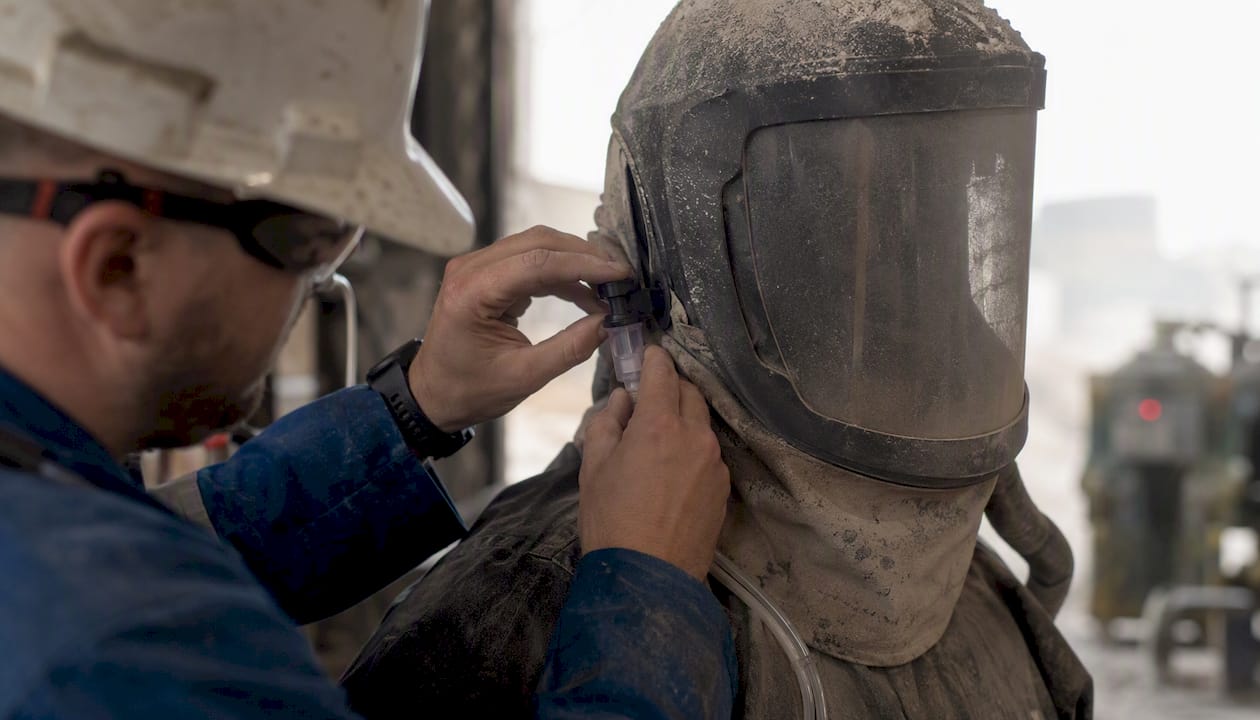
This distinction matters because some employers have tried to use inside-respirator sampling to argue that exposures are low. OSHA does not accept that data as evidence of ambient exposure compliance.
Sampling procedure steps
- Select a NIOSH-approved sampling pump and calibrate it before and after sampling
- Attach the cassette to the worker’s collar or lapel, outside the shroud or helmet, within 6–9 inches of the nose and mouth
- Document the sample start time, end time, flow rate, and worker task during sampling
- Submit the cassette to an accredited industrial hygiene laboratory using chain-of-custody documentation
- Compare results to the OSHA permissible exposure limits and action levels for silica
- Document results, retain lab reports, and update the exposure control plan if controls need adjustment
Sampling data table
| Sample Location | Sample Purpose | Acceptance Criteria | Documentation to Keep |
|---|---|---|---|
| Outside shroud/helmet, breathing zone | Ambient exposure measurement | Below PEL | Lab report, chain-of-custody, pump calibration records |
| Area sample (perimeter) | Background/bystander exposure | Below applicable PEL | Lab report, sample map, date and time records |
| Post-control verification | Confirm engineering controls are effective | Below action level | Lab report, control description, competent person sign-off |
When objective data is used to justify reduced monitoring frequency, that data must come from a comparable operation with the same media, substrate, enclosure, and ventilation design. Abrasive blasting operations rarely meet that bar.
Pro Tip: Chain-of-custody documentation for air samples is the piece most employers lose. Use a pre-printed chain-of-custody form from the lab, photograph the cassette before shipping, and keep a copy of the shipping receipt. An inspector who sees a gap in chain-of-custody will question the validity of the entire sample set.
Respiratory protection program requirements and blasting-specific PPE
The respiratory protection standard at 29 CFR 1910.134 applies any time a respirator is required or permitted in the workplace. For abrasive blasting, that means a full written program, not just a box of respirators in the supply room.
What the written program must include
- Medical evaluation by a licensed health care professional (PLHCP) before any worker wears a respirator
- Fit testing using an OSHA-accepted protocol (qualitative or quantitative) before initial use and annually thereafter
- Respirator selection based on the contaminant, concentration, and work conditions
- Maintenance, inspection, cleaning, and storage procedures
- Training on proper donning, doffing, limitations, and emergency procedures
- Recordkeeping: medical evaluations, fit test results, training dates
Medical evaluations are the most frequently missing element. A worker who has never had a medical evaluation cannot legally wear a respirator under 1910.134, regardless of how long they have been doing the job.
Abrasive blasting respirator requirements
29 CFR 1910.94 requires NIOSH-approved abrasive-blasting respirators (Type CE) where operator exposures may exceed the limits in §1910.1000. Type CE respirators are supplied-air respirators with a hood or helmet designed specifically for abrasive blasting. They provide both respiratory protection and physical protection from rebounding abrasive.
The supplied air must meet Grade D breathing air quality under 1910.134(i). That means the compressor intake must be positioned away from engine exhaust and other contamination sources, and the air supply must be tested periodically. A carbon monoxide monitor or alarm on the compressor line is standard practice.
For sandblasting operations, the safety essentials for sandblasting page covers shroud and supplied-air helmet selection in practical terms. Beyond the respirator, blasters need:
- Heavy-duty protective clothing (leather or canvas) to resist abrasive rebound
- Safety glasses or goggles under the supplied-air helmet for secondary eye protection
- Hearing protection rated appropriately for the noise level of the blasting equipment
- Steel-toed boots and gloves rated for the abrasive and substrate conditions
When can employers reduce respirator requirements?
OSHA’s interpretation on wet abrasive blasting is clear: employers may avoid Type CE respirator requirements only if they document ambient sampling outside the shroud showing exposures below applicable PELs and meet the listed evidentiary criteria. Wet or vapor abrasive systems reduce dust generation but do not automatically eliminate the respirator requirement. The burden of proof is on the employer, and the sampling must be done outside the PPE.
Pro Tip: Never test air inside the respirator to argue that ambient exposure is acceptable. OSHA’s interpretation is explicit: the sampling must be outside all PPE. An inspector who sees inside-respirator data presented as ambient evidence will treat it as a documentation failure, not a compliance success.
Required training, qualifications, and the records inspectors expect
Training documentation is where many otherwise solid programs fall apart during an inspection. The records exist, but they are scattered across three filing systems, two employees’ email inboxes, and a binder that nobody can find in under five minutes. That is a problem.
What training is required
For abrasive blasting operations, required training covers:
- Respiratory protection (1910.134): proper use, limitations, maintenance, and emergency procedures
- Hazard communication (1910.1200): SDS review for abrasive media, coatings, and solvents
- Silica awareness: recognition of silica-generating tasks, exposure controls, and health effects
- Equipment-specific training: operation of blast equipment, ventilation systems, and dust collectors
- Emergency procedures: evacuation routes, spill response, and first aid for blasting-related injuries
For explosive blasting, add:
- Blaster qualification training (1926.901)
- Explosives handling and transport procedures
- Misfire procedures and emergency response
- Pre-blast warning signal protocols
The role of crew safety in sandblasting operations covers pre-task briefings and supervision practices that support training documentation.
Recordkeeping and retention
- Medical evaluations: retain for the duration of employment plus 30 years (OSHA medical records rule, 1910.1020)
- Fit test records: retain until the next fit test or until the worker leaves
- Exposure monitoring reports: retain for 30 years (1910.1053)
- Written exposure control plan: update annually and whenever tasks or controls change
- Training records: retain for 3 years minimum; longer if state plan requirements apply
- Blaster qualification records: retain for the duration of the blaster’s employment on the project
Organize records by employee name and standard. When an inspector asks for the medical evaluation for a specific worker, you should be able to produce it in under two minutes.
What OSHA inspectors cite most often in blasting jobs
Industry reporting on OSHA’s top-cited standards consistently shows respiratory protection and silica-related standards among the most frequently cited, with inspectors increasingly focused on program documentation rather than physical equipment alone. A site with a functioning enclosure and a Type CE respirator on every blaster can still receive multiple citations if the written program is missing or the medical evaluations are expired.
Most-cited standards in blasting operations and common failings
Respiratory protection (1910.134): Missing medical evaluations are the single most common failure. Workers wearing respirators without a current PLHCP evaluation is an immediate citation. Expired fit tests and missing training records follow closely.
Silica (1910.1053 / 1926.1153): Absent or incomplete written exposure control plans, no competent person designation, and missing medical surveillance records when exposures meet or exceed the action level.
Hazard communication (1910.1200): Missing SDS for abrasive media (particularly for media containing crystalline silica), and workers who cannot identify the hazards of the materials they are using.
Ventilation (1910.94): No run-time logs for exhaust ventilation, enclosures that do not maintain continuous inward airflow, and dust collectors that are not maintained or sized correctly.
Explosives (1926 Subpart U / 1910.109): Missing inventory records, inadequate magazine separation distances, and blaster qualification records not available on-site.
The root cause behind most of these citations is the same: treating compliance as a one-time setup rather than an active management program. A written exposure control plan drafted two years ago and never updated is not evidence of compliance. It is evidence that the program stopped.
Practical remedies:
- Schedule quarterly reviews of all written programs with a named responsible person
- Audit medical evaluation expiration dates monthly and schedule renewals 60 days in advance
- Conduct breathing-zone sampling at the start of any new project or when media, substrate, or enclosure conditions change
- Post the SDS for every abrasive media and coating at the work area, not just in the office
Are you inspection-ready? A step-by-step blasting compliance checklist
When a compliance officer arrives, the first 10 minutes set the tone for the entire inspection. Having a designated person who knows the program, knows where the records are, and can walk the inspector through the site without hesitation is as important as the records themselves.
Before the inspector arrives: ongoing readiness steps
- Designate one person as the inspection contact. That person knows the location of every compliance document and has authority to speak on behalf of the employer.
- Keep all compliance binders at the job site, not at the home office. Organize by standard: abrasive blasting, respiratory protection, silica, explosives (if applicable).
- Conduct a pre-shift walkdown every day and document it. Date, name, and findings on a sign-off sheet. This creates a paper trail showing the program is active.
- Verify ventilation is running before blasting starts. Log the start time.
- Confirm magazine is locked and inventory is current (for explosive blasting operations).
When the inspector arrives: what to show first
- Introduce the inspection contact immediately. Do not let crew members speak to the inspector without the contact present.
- Present the compliance binder for the relevant standard first (abrasive or explosive, depending on the inspection trigger).
- Offer a site walkthrough with the contact leading. Point out engineering controls, PPE in use, and posted SDS before the inspector asks.
- Have the following documents ready to hand over on request:
- Written exposure control plan (current, signed, dated)
- Respiratory protection program with current medical evaluations and fit test records
- Exposure monitoring reports with chain-of-custody documentation
- Training records for all workers on-site
- Blaster qualification records (if explosive blasting)
- Explosives inventory and magazine inspection logs (if applicable)
- Ventilation run-time logs for the current project
Pro Tip: Conduct a mock inspection walkdown quarterly. Have your safety officer play the role of the compliance officer and ask for every document on the checklist. The gaps that surface in a mock inspection are far less expensive than the gaps that surface in a real one.
Pitfalls experienced contractors know to avoid
The failures that generate citations in blasting operations are rarely exotic. They are predictable, and they tend to cluster around the same three or four gaps regardless of the employer’s size or experience level.
Where teams typically go wrong
Sampling inside the shroud. A crew runs breathing-zone samples with the cassette clipped inside the supplied-air helmet, gets low numbers, and concludes the operation is compliant. OSHA’s position is that inside-respirator sampling does not represent ambient workplace exposure. When an inspector reviews the sampling methodology and finds cassettes placed inside PPE, the entire monitoring record is called into question.
Missing inventory controls for explosives. A blaster signs out a box of detonators in the morning and returns the unused portion at the end of the day with no written record of quantities used. Over a two-week project, the inventory ledger shows a growing discrepancy between what was received and what is accounted for. That discrepancy is a citation waiting to happen, and in some cases, a law enforcement matter.
Expired medical evaluations. A worker’s medical evaluation expired eight months ago. Nobody noticed because there is no tracking system. The worker has been wearing a respirator every day since. That is a 1910.134 citation for every day the evaluation was expired, in theory, and a real liability if the worker later develops a respiratory condition.
Abrasive media selection without silica risk assessment. A contractor switches from steel shot to a silica-containing abrasive mid-project because it is cheaper and available locally. The exposure control plan still references steel shot. The SDS for the new media is not posted. Three separate violations from one purchasing decision.
Best practices that reliably reduce citations
- Maintain a master tracking spreadsheet for medical evaluation expiration dates, fit test dates, and training renewal dates. Review it monthly.
- Require a written media change request any time the abrasive media changes. Update the exposure control plan and SDS posting before the new media is used.
- Designate a competent person for silica in writing, with the designation document in the compliance binder. The competent person must be able to identify silica-generating tasks and implement controls, not just sign a form.
- Integrate blasting controls into the broader site safety management system. A blasting operation that runs its own safety program in isolation from the general contractor’s site safety plan creates gaps at the handoff points, particularly around emergency procedures and site access controls.
- Schedule a formal program audit every six months. Use the inspection readiness checklist from the previous section as the audit tool. Date and sign the audit results and keep them in the compliance binder.
Pro Tip: The industrial safety best practices for surface prep projects page outlines how proactive walkdowns and documented pre-task checks reduce the gap between what the written program says and what actually happens on-site. That gap is exactly what inspectors are trained to find.
Why compliance programs fail when they stop at the checklist
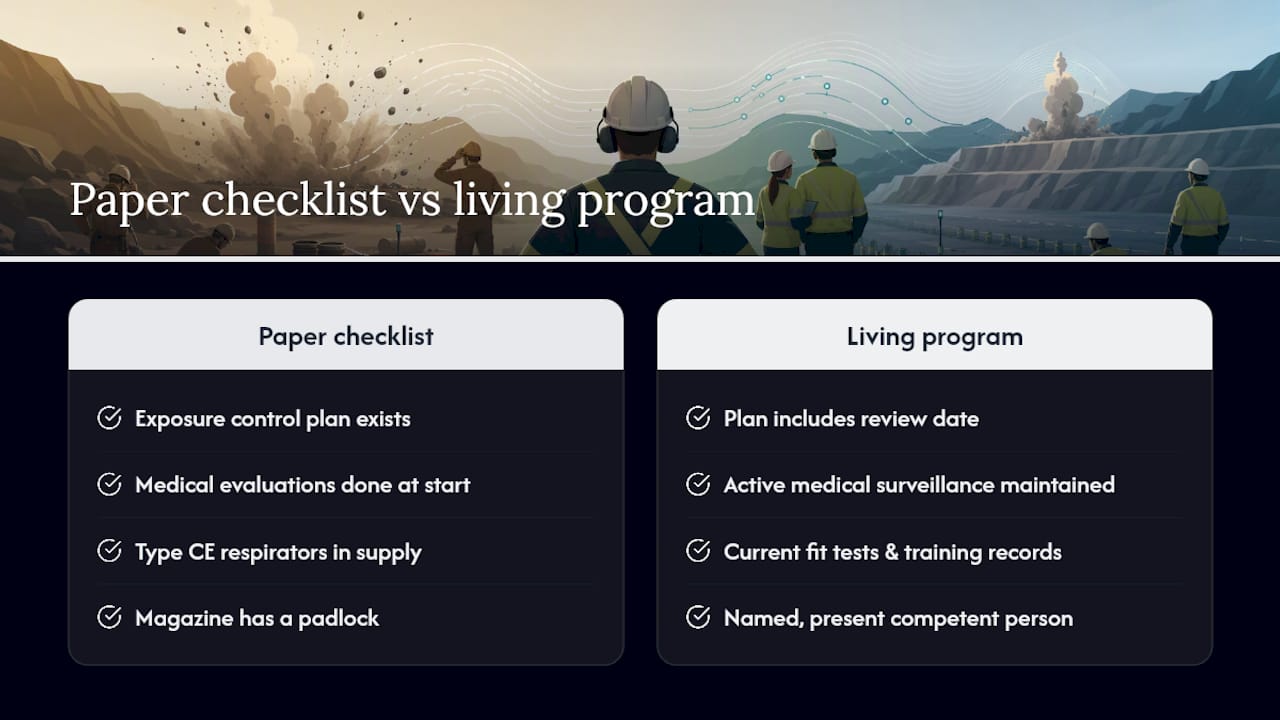
The most dangerous compliance posture in blasting work is the one that looks complete on paper. A written exposure control plan exists. Medical evaluations were done at project start. The Type CE respirators are in the supply room. The magazine has a padlock. On paper, the program is solid. In practice, the evaluations expired three months ago, the ventilation run-time log has not been filled out since week two, and the blaster who was designated as the competent person left the project and was never replaced.
That gap between documented intent and daily practice is where incidents and citations actually come from. OSHA’s enforcement focus has shifted toward program documentation precisely because physical equipment is easier to fix than management systems. An inspector who finds a missing enclosure panel can write one citation. An inspector who finds a respiratory protection program with no active medical surveillance, no current fit tests, and no training records for two of the four workers on-site can write a citation for each worker, each standard, and each day the violation existed.
The checklist in this article is a starting point, not a finish line. The exposure control plan needs a review date. The competent person designation needs to follow the person, not the binder. The ventilation log needs to be filled out every shift, not reconstructed at the end of the week. Compliance that is managed as a living program, with scheduled audits, named responsible parties, and dated evidence of daily activity, is the version that holds up when an inspector arrives unannounced.
Southernsandblastingandpainting delivers OSHA-compliant blasting and surface prep
Twenty years of industrial blasting work teaches you exactly what inspectors look for, because you have been through enough inspections to know. Southernsandblastingandpainting brings that experience to every project: documented ventilation checks before blasting starts, NIOSH-approved Type CE respirators on every operator, breathing-zone sampling placed correctly outside the shroud, and a compliance folder organized by standard that clients can hand to an inspector on arrival.

Every project handover includes the documentation clients need for their own records: ventilation run-time logs, equipment grounding records, SDS for all media used, and a summary of the exposure controls in place. For municipal and industrial clients who face their own compliance obligations, that paper trail is part of what they are paying for. The sandblasting equipment guide covers the equipment standards behind those controls in detail. For clients ready to contract compliant blasting and surface preparation work in Central Florida, the services page is the right starting point. Contact Southernsandblastingandpainting to get a project quote and a compliance-ready approach from day one.
Primary sources and OSHA references to consult
These are the canonical references an inspector will use. Download or bookmark each one before your next blasting project.
- 29 CFR 1910.94 — Ventilation: The primary standard for abrasive blasting enclosures, exhaust ventilation design, dust collection, and NIOSH respirator requirements. Read this before designing or modifying a blasting enclosure.
- 1926 Subpart U — Blasting and the Use of Explosives: Covers 1926.900 through 1926.914, including blaster qualifications, storage, transport, firing procedures, post-blast inspection, and misfires. The primary reference for any operation using detonators or blasting agents.
- 29 CFR 1910.109 — Explosives and Blasting Agents: General industry storage and handling rules, including magazine segregation requirements for detonators and primed cartridges.
- OSHA Fact Sheet 3697 — Protecting Workers from the Hazards of Abrasive Blasting Materials: A concise field reference summarizing employer controls, respirator guidance, and documentation requirements. Inspectors use this; you should too.
- OSHA Standard Interpretation — Abrasive Blasting Monitoring Requirements (1999): Clarifies cassette placement outside PPE in the breathing zone. Essential reading before conducting any exposure monitoring.
- OSHA Standard Interpretation — Respirator Requirements During Wet Abrasive Blasting (2015): Explains the evidentiary criteria employers must meet to justify reduced respirator requirements for wet or vapor abrasive systems.
- Respirable Crystalline Silica — General Industry Information: OSHA’s silica information page identifying abrasive blasting as a high-exposure task and summarizing written plan, competent person, and medical surveillance requirements.
- 1926.909 — Firing the Blast: Procedural requirements for warning signals, surplus explosive security, and blaster responsibilities immediately before detonation.
- OSHA Top 10 Most Cited Standards 2025: Industry reporting on enforcement trends, confirming respiratory protection and silica among the most frequently cited standards and the shift toward documentation-focused inspections.
This article is general information, not a substitute for advice from a qualified lawyer. Consult a qualified legal professional about your own circumstances before acting on anything here.
Sources
- 1926 Subpart U – Blasting and the Use of Explosives | Occupational Safety and Health Administration
- 1910.94 – Ventilation | Occupational Safety and Health Administration
- PDF Protecting Workers from the Hazards of Abrasive Blasting Materials
- Respirator Requirements During Wet Abrasive Blasting | Occupational Safety and Health Administration
- Abrasive blasting monitoring requirements and sampling procedures. | Occupational Safety and Health Administration
- Respirable Crystalline Silica — General industry information (OSHA internal site)


