
TL;DR:
- Media blasting propels abrasive particles at high velocity to clean, texture, or prepare surfaces for coatings, ensuring durability and adhesion.
- Different media types and process parameters are critical to achieving the desired surface profile and cleanliness standards specified for each project.
- Proper verification of both ISO cleanliness grades and surface profiles is essential to prevent premature coating failures and ensure asset longevity.
Media blasting is defined as a surface preparation process that propels abrasive particles at high velocity to clean, strip, or texture a surface for coating adhesion or finishing. The industry also calls it abrasive blasting, and the two terms are interchangeable across commercial, municipal, and industrial contexts. Compressed-air blasting systems and centrifugal wheel machines are the two primary equipment configurations, each suited to different project scales. Common media types include glass beads, aluminum oxide, steel shot, walnut shells, and corn cob. Controlling parameters such as air pressure, nozzle size, standoff distance, and media type determines whether you strip heavy mill scale from a water tank or gently clean a delicate aluminum casting.
What is media blasting and how does it work?
Media blasting works by accelerating abrasive particles through a pressurized system and directing them at a substrate. On impact, those particles dislodge rust, old coatings, mill scale, and other contaminants while simultaneously creating microscopic peaks and valleys on the metal surface. That textured profile is not a side effect. It is the goal. Coatings lock into those peaks mechanically, which is why surface profile directly determines how long a coating system lasts.
Core equipment in the media blasting process
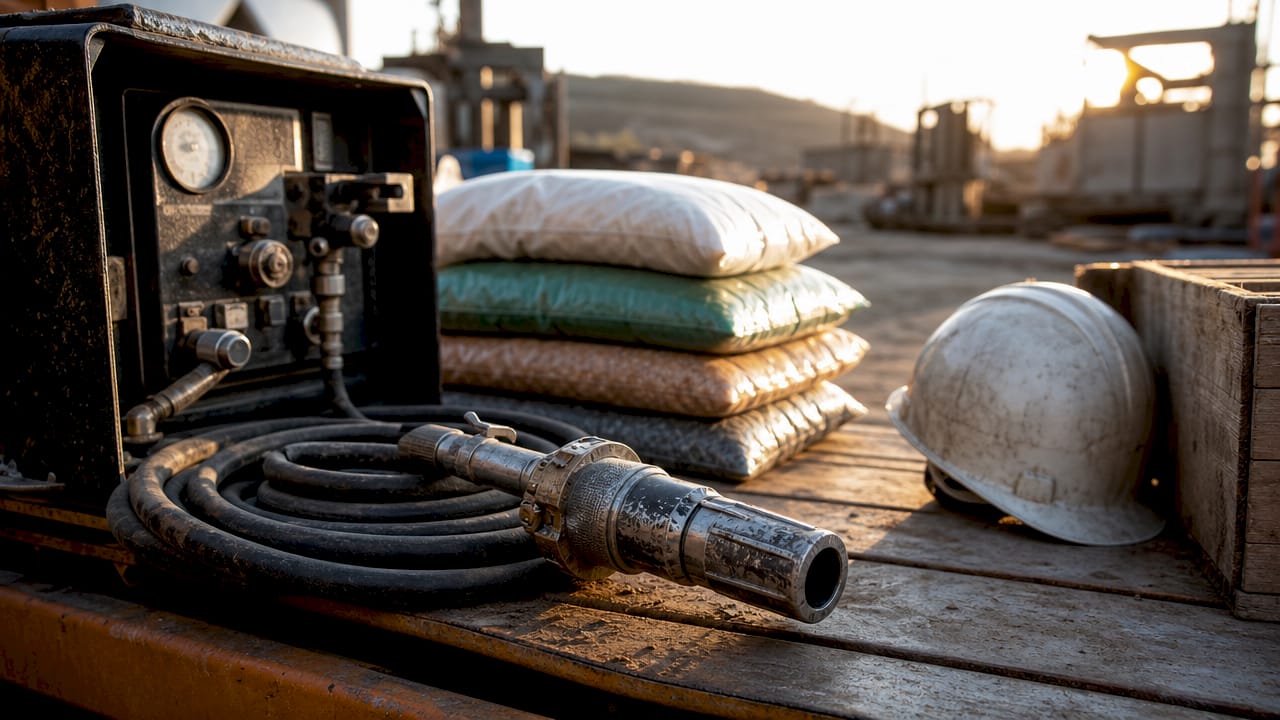
A standard abrasive blasting setup includes four components working together:
- Blast pot (pressure vessel): Holds the abrasive media and feeds it into the air stream at a controlled rate.
- Air compressor: Supplies the volume and pressure of compressed air that drives media velocity. Industrial projects typically require compressors rated at 100 to 185 CFM or higher.
- Blast nozzle: Shapes and focuses the media stream. Venturi-style nozzles increase particle velocity compared to straight-bore designs, making them the preferred choice for heavy-scale removal.
- Abrasive media: The variable that most directly controls surface outcome. Harder, angular media like aluminum oxide cuts aggressively. Softer, rounder media like glass beads produces a smoother, peened finish.
Blasting parameters including air pressure, nozzle size, standoff distance, and media type and size directly control how aggressively the process cleans and what surface texture it creates. A facility manager specifying work on a municipal water tank needs different parameter settings than a fabricator finishing aerospace components. Getting those settings wrong wastes media, damages the substrate, or produces a surface profile that fails the coating inspection.
Pro Tip: Before any blasting begins, confirm the target surface profile in Rz microns and the required ISO cleanliness grade. Those two numbers define your parameter targets and give you an objective pass/fail criterion rather than a subjective visual judgment.
What types of media blasting exist and how do they differ?
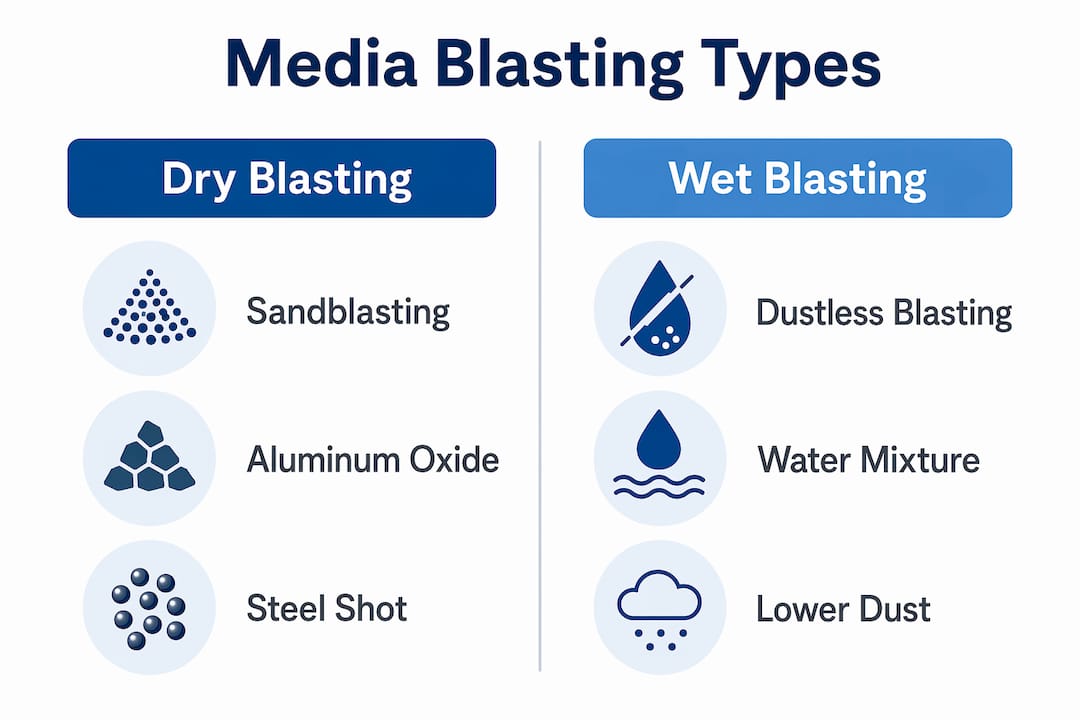
Sandblasting is a subset of media blasting that uses silica sand as the abrasive. Media blasting is the broader category covering glass beads, steel shot, aluminum oxide, corn cob, walnut shells, baking soda, and plastic media. Silica sand carries a documented silicosis risk from respirable crystalline silica dust, which has driven regulatory restrictions in many jurisdictions and pushed industrial operators toward safer alternatives. That shift is one reason the term “media blasting” has largely replaced “sandblasting” in professional specifications, even when the process mechanics are identical.
The second major distinction is dry versus wet blasting. Wet or dustless blasting mixes water with the abrasive stream to suppress airborne dust and control surface temperature during the process. Dry abrasive blasting generates more dust but achieves faster cleaning rates on heavy contamination. Wet blasting is selected where dust control is a regulatory requirement, where adjacent surfaces must be protected, or where the substrate is sensitive to heat buildup.
The table below summarizes the most common media types used in abrasive blasting:
| Media type | Abrasiveness | Dust generation | Common applications |
|---|---|---|---|
| Aluminum oxide | High | Moderate | Steel fabrication, coating prep, aggressive rust removal |
| Steel shot / grit | High | Low | Structural steel, pipelines, heavy industrial equipment |
| Glass beads | Medium | Low | Automotive parts, stainless steel, decorative finishes |
| Corn cob | Low | Low | Wood surfaces, delicate substrates, paint stripping without profile |
| Walnut shells | Low | Low | Soft metals, fiberglass, engine cleaning |
| Baking soda | Very low | Very low | Graffiti removal, food-grade equipment, corrosion-sensitive surfaces |
Choosing the wrong media for a substrate is one of the most common and costly mistakes in surface preparation. Steel shot on aluminum creates excessive profile and can embed ferrous contamination. Baking soda on structural steel leaves a surface too smooth for most industrial coating systems to adhere reliably.
What surface cleanliness and profile standards apply?
ISO 8501-1 defines visual cleanliness grades for blast-cleaned steel surfaces, ranging from Sa 1 (light blast cleaning) to Sa 3 (very thorough blast cleaning). These grades specify how much residual mill scale, rust, and old coating is acceptable on the surface after blasting, assessed visually without magnification. They give inspectors and contractors a shared, objective language for specifying and verifying surface preparation quality.
Here is what each Sa grade means in practice:
| Sa grade | Description | Residual contamination allowed | Typical use |
|---|---|---|---|
| Sa 1 | Light blast cleaning | Loosely adhering mill scale, rust, and coatings removed | Minimal protection environments |
| Sa 2 | Thorough blast cleaning | Most mill scale, rust, and coatings removed; slight discoloration allowed | General industrial coatings |
| Sa 2½ | Very thorough blast cleaning | ~95% clean metal; only slight staining in pits allowed | Most industrial coating systems |
| Sa 3 | Blast cleaning to visually clean steel | Complete removal; uniform metallic appearance | High-performance and immersion coatings |
ISO Sa 2½ is the grade specified for most industrial coating systems, including protective coatings on water tanks, pipelines, and structural steel. Sa 3 is reserved for immersion service or aggressive corrosion environments where any residual contamination would cause premature coating failure.
Surface cleanliness alone does not guarantee coating performance. Anchor profile roughness, measured as Rz (peak-to-valley height) per ISO 8503, determines how well a coating mechanically locks to the substrate. A surface blasted to Sa 2½ but with an Rz too low for the specified primer will still fail prematurely. Practitioners who understand this specify both the Sa grade and the Rz target range as paired requirements, not separate considerations. Visual cleanliness grades help inspectors objectively verify surface prep quality, preventing coating failures caused by residual contaminants.
The practical implication for facility managers and contractors: surface preparation is a two-variable specification. Before any coating goes on, verify both the cleanliness grade and the profile measurement. Skipping either check is where coating failures begin.
What are the benefits and applications of media blasting?
Media blasting is used across aerospace, automotive, metal fabrication, municipal infrastructure, and additive manufacturing. The process handles both heavy-duty cleaning on structural steel and precision finishing on delicate components. That range makes it the default surface preparation method for any project where coating adhesion, corrosion resistance, or surface finish consistency is a performance requirement.
The core benefits of abrasive blasting for industrial and restoration projects include:
- Improved coating adhesion: The anchor profile created by blasting gives primers and topcoats a mechanical grip that smooth surfaces cannot provide. Coatings applied over properly blasted steel consistently outlast those applied over wire-brushed or chemically cleaned surfaces.
- Corrosion resistance: Removing all mill scale, rust, and contamination before coating eliminates the electrochemical sites where corrosion initiates under a coating film.
- Surface finish consistency: Blasting produces a uniform texture across large surface areas, which chemical cleaning or mechanical grinding cannot replicate at scale.
- Substrate versatility: Different media types allow the same process to work on structural steel, aluminum, concrete, wood, fiberglass, and even food-grade equipment.
- Shot peening for metal strengthening: Steel shot blasting at controlled intensity induces compressive residual stress in metal surfaces, which extends fatigue life in aerospace and automotive components. This application goes beyond cleaning into material engineering.
For an industrial surface preparation project on a municipal water tank or airport infrastructure, the sequence is consistent: blast to the specified Sa grade and Rz profile, verify both with inspection tools, then apply the coating system within the recoat window before the fresh surface oxidizes. Delaying coating after blasting, even by a few hours in humid Florida conditions, allows flash rust to form and requires re-blasting.
Restoration projects follow the same logic at smaller scale. An automotive restorer stripping a classic car body to bare metal uses plastic media or walnut shells to remove paint without distorting thin sheet metal. A pipeline contractor preparing a 48-inch diameter pipe for a fusion-bonded epoxy lining specifies steel grit to Sa 2½ with an Rz of 50 to 75 microns. The substrate and coating system dictate the media choice, not the other way around. For guidance on blasting media selection, matching abrasive type to substrate hardness and coating specification is the starting point every time.
Key takeaways
Media blasting achieves durable coating performance only when both the ISO cleanliness grade and the Rz surface profile are specified and verified before any coating is applied.
| Point | Details |
|---|---|
| Core definition | Media blasting propels abrasive particles to clean, strip, or texture surfaces for coating adhesion. |
| Media blasting vs sandblasting | Sandblasting uses silica sand; media blasting covers glass beads, steel shot, corn cob, and more. |
| Two-variable specification | Always specify both ISO Sa cleanliness grade and Rz anchor profile as paired requirements. |
| Sa 2½ is the industrial standard | Most industrial coating systems require Sa 2½, meaning approximately 95% clean metal surface. |
| Wet blasting for dust control | Wet or dustless blasting suppresses airborne dust and is selected where operator safety or regulatory compliance demands it. |
Why the “just blast it” approach fails every time
After more than two decades working on water tanks, pipelines, and municipal infrastructure across Central Florida, the most consistent source of premature coating failure is not poor paint quality or bad weather. It is surface preparation that was specified loosely and verified even more loosely.
Facility managers sometimes approve blasting work based on a visual check that looks clean enough. That judgment is not wrong, but it is incomplete. A surface can look clean and still carry an Rz profile 20 microns below what the coating system requires. The coating goes on, looks fine for six months, then disbonds in sheets because it never had the mechanical grip it needed. The surface profile measurement that would have caught the problem takes about three minutes with a replica tape and a micrometer.
The other pattern worth naming is the assumption that more aggressive blasting is always better. Operators who push air pressure too high or use overly angular media on thinner substrates create excessive profile peaks that punch through thin film coatings, leaving uncoated tips that become corrosion initiation points. The goal is a profile within the specified Rz range, not the highest profile achievable.
Wet blasting deserves more consideration on projects near occupied facilities or in enclosed spaces. Dust suppression is not just a convenience. It is an operator health requirement and, in many project environments, a contract compliance requirement. Treating it as optional is a liability exposure that experienced contractors do not accept.
The practical takeaway: treat media blasting as a controlled, specified process with measurable outcomes. Define the Sa grade, define the Rz range, verify both before coating, and document the results. That discipline is what separates surface preparation that protects assets for 20 years from work that needs remediation in three.
— Southernsandblastingandpainting
How Southernsandblastingandpainting supports your surface preparation projects
Southern Sandblasting and Painting brings 20+ years of industrial surface preparation experience to commercial, municipal, and government projects across Central Florida. From water tanks and airport infrastructure to pipelines and city assets, the team delivers blasting and coating work specified to ISO standards and verified before any coating is applied.
If you are planning a surface preparation project and need to match the right blasting method, media type, and coating system to your asset, the sandblasting equipment guide on the Southernsandblastingandpainting website covers equipment selection and asset protection in practical detail. For facility managers and contractors working through industrial sandblasting requirements, the site also provides guidance on inspection, compliance, and project planning for large-scale work.
FAQ
What is the difference between media blasting and sandblasting?
Sandblasting is a specific type of abrasive blasting that uses silica sand as the abrasive medium. Media blasting is the broader category that includes glass beads, steel shot, aluminum oxide, corn cob, and other abrasives, many of which are safer and more controllable than silica sand.
How does media blasting work on metal surfaces?
Abrasive particles are propelled at high velocity by compressed air or a centrifugal wheel and impact the metal surface, removing rust, mill scale, and old coatings while creating a textured anchor profile that coatings grip mechanically.
Is media blasting safe for operators?
Dry abrasive blasting generates airborne dust that requires respiratory protection and proper ventilation. Wet or dustless blasting suppresses dust and is selected where operator exposure limits or site conditions make dry blasting impractical.
What ISO cleanliness grade is required for industrial coatings?
ISO Sa 2½ is the standard grade specified for most industrial coating systems, requiring approximately 95% clean metal with only slight staining permitted in surface pits. Sa 3 is required for immersion service or aggressive corrosion environments.
What media type should I use for my project?
Media selection depends on the substrate material, the required surface profile, and the coating system being applied. Steel grit suits heavy structural steel preparation, glass beads work for stainless and automotive finishes, and soft media like walnut shells or corn cob are used on delicate substrates where profile creation must be minimized.


