
TL;DR:
- Tank lining involves applying a protective barrier inside storage tanks to prevent corrosion and failure through a strict six-phase process. Proper surface preparation, environmental control, and full curing are essential to ensure long-lasting protection, while incorrect procedures can lead to early failure. The success of tank lining depends more on application quality and environment management than on the coating brand or cost.
Tank lining is defined as the systematic application of an impermeable protective barrier to the interior of a storage tank, designed to prevent corrosion, chemical degradation, and structural failure. The tank lining process explained in full covers six tightly sequenced phases: drainage, surface preparation to SSPC-SP10/NACE No. 2, environmental control, multi-coat application, curing, and 100% holiday testing. Each phase is a dependency. Skip or rush one, and the entire system fails. For municipal water tanks, industrial chemical storage, and fuel containment, this process is the difference between a 20-year asset and a 3-year liability. Southernsandblastingandpainting has executed this process across Central Florida’s critical infrastructure for over 20 years.
What are the main steps in the tank lining process?
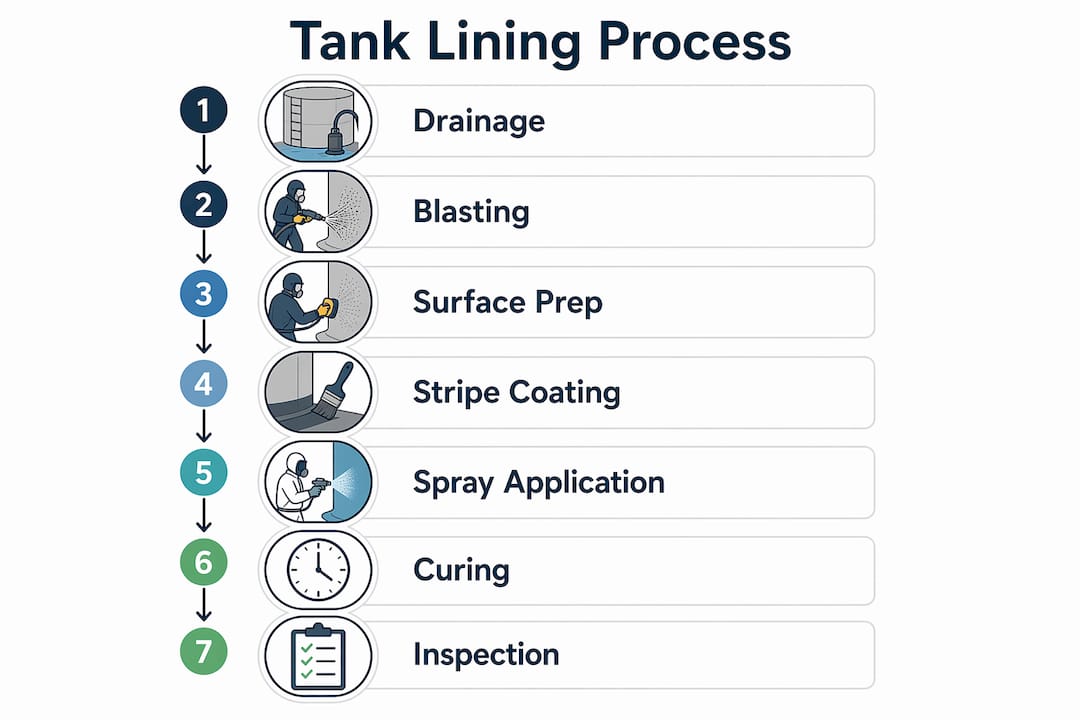
The tank coating process follows a mandatory sequence that cannot be reordered without compromising the final result. Each step builds on the last, and inspectors verify compliance at multiple checkpoints before the next phase begins.
- Drain and clean the tank interior. All product residue, sludge, and loose debris must be removed completely. Residual chemistry from stored product contaminates the substrate and blocks adhesion.
- Blast to SSPC-SP10/NACE No. 2 near-white metal standard. This removes mill scale, rust, and existing coatings down to a near-white finish. The anchor profile target is 2–4 mils, which gives the lining mechanical grip on the steel surface.
- Test and control the environment. Relative humidity and surface temperature must be monitored continuously. Surface temperature must stay at least 3°C above the dew point throughout blasting and application. Failure to hold this margin causes flash rust within minutes.
- Apply stripe coats. Before any spray application begins, stripe coating is applied by brush or roller to all welds, edges, and nozzle areas. Spray mechanisms cannot build uniform film thickness at these stress points. Stripe coating closes that gap.
- Apply primer, intermediate, and topcoat layers by airless plural-component spray. Each coat must reach its specified dry film thickness before the next is applied. Inspectors measure thickness at multiple points per square meter.
- Manage cure phases. Curing follows three distinct stages: handle-cure, service-cure, and full-cure. Curing times range from 3 to 14 days depending on the lining chemistry. Returning the tank to service before full cure causes immediate chemical attack on the lining, even when the surface appears dry.
- Conduct 100% holiday testing. High-voltage DC spark testers scan every square inch of the lining surface. The testing voltage standard is 100 volts per 25 microns of dry film thickness. UV-fluorescent inspection identifies thin spots that spark testing may miss. Every detected pinhole is repaired before the tank returns to service.
Pro Tip: Schedule holiday testing during the same environmental window as application. Temperature swings between application and testing can cause micro-cracking that only appears under voltage.
How to select the right lining system for your tank
Lining selection is not a brand decision. It is an engineering decision based on five core inputs: stored product chemistry and concentration, operating temperature, fill and empty cycle frequency, tank geometry, and substrate material. Getting any one of these wrong produces a lining that fails within 1–3 years regardless of cost.
- Stored product chemistry. A standard bisphenol-A epoxy handles many water and mild chemical applications. Novolac epoxy is required for aromatic solvents, concentrated acids, and high-temperature chemical service. Polyurea linings suit high-impact, high-cycling applications where flexibility matters more than chemical resistance.
- Operating temperature. Every lining system carries a maximum continuous service temperature rating. Exceeding it causes softening, blistering, and delamination. Always verify the temperature rating against peak operating conditions, not average conditions.
- Fill and empty cycle frequency. Frequent cycling creates mechanical stress through expansion and contraction. Rigid epoxy systems can crack under high-cycle conditions. A more flexible lining chemistry may outperform a chemically superior but rigid alternative in these applications.
- Tank geometry. Narrow-diameter tanks, tanks with complex internal structures, and tanks with many nozzles require application methods and lining materials that can reach all surfaces uniformly. Geometry drives both material selection and application technique.
- Substrate condition. Heavily pitted steel requires a higher-build primer to fill surface defects before topcoats are applied. Concrete substrates require different surface prep and lining chemistry than steel.
The chemical resistance guide for the specific lining product must be consulted before specification. Mismatch between lining chemistry and stored product is the leading cause of early lining failure. Over-specifying an expensive novolac system for a water storage tank wastes budget without adding service life.
Pro Tip: Request the manufacturer’s chemical resistance rating at the actual concentration and temperature your tank operates at, not the generic product rating. Generic ratings often assume ambient temperature and dilute concentrations.
Why surface preparation and environmental control determine lining success
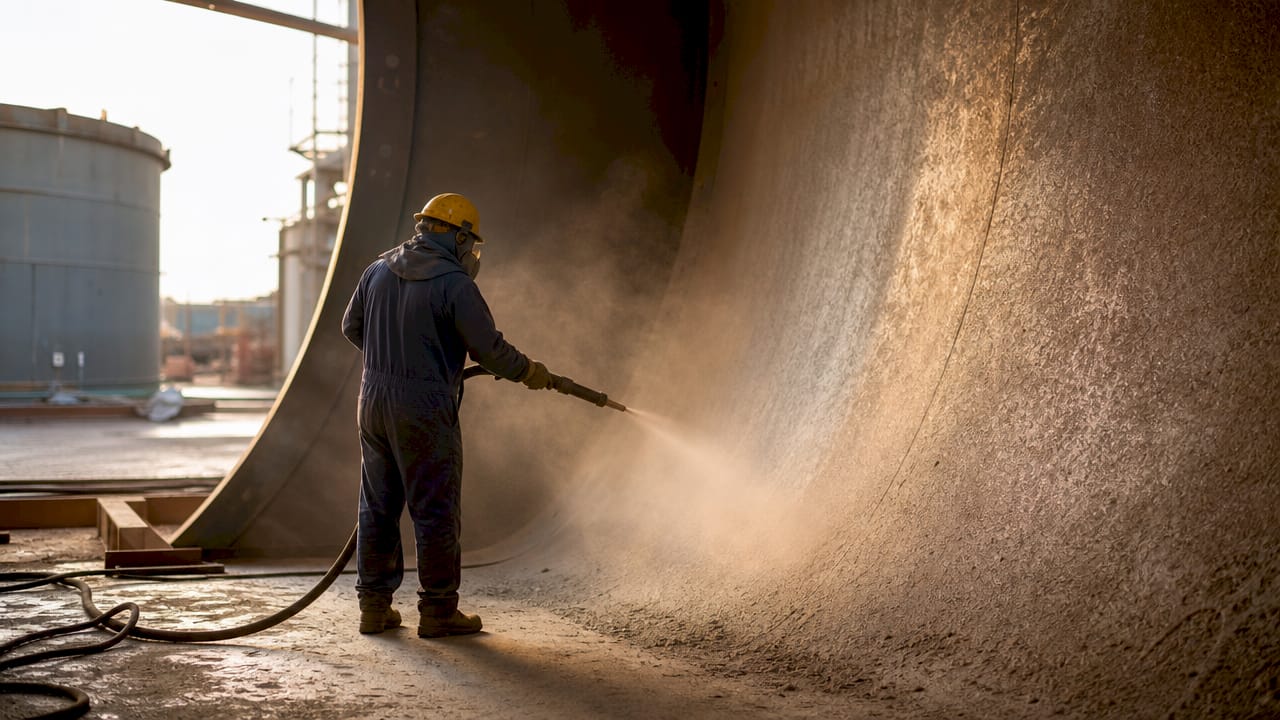
Surface preparation is the single largest variable in lining performance. A correctly specified lining applied to a poorly prepared surface will fail faster than a lower-grade lining applied to a properly prepared one. Installation quality accounts for the majority of lining success in industrial applications.
| Preparation factor | Requirement | Consequence of failure |
|---|---|---|
| Surface cleanliness | SSPC-SP10/NACE No. 2 near-white metal | Adhesion failure, delamination |
| Anchor profile | 2–4 mils | Insufficient mechanical bond |
| Soluble salt contamination | Below 5–10 micrograms per cm² | Osmotic blistering under the lining |
| Surface temperature | At least 3°C above dew point | Flash rust, moisture entrapment |
| Relative humidity | Controlled per product data sheet | Osmotic blistering, adhesion loss |
Flash rust onset can occur within minutes of blasting in humid environments. This is not a theoretical risk. In Florida’s climate, a blasted steel surface left uncoated for 20 minutes on a humid afternoon can develop visible rust that requires re-blasting before any coating proceeds. That re-blast adds cost, time, and scheduling pressure.
Soluble salt testing is a step many projects skip to save time. Salts left on the surface draw moisture through the cured lining by osmosis, forming blisters that lift the coating from the substrate. The soluble salt limit of 5–10 micrograms per cm² is not conservative. It is the threshold below which osmotic blistering risk drops to acceptable levels.
Pro Tip: If flash rust develops after blasting, do not coat over it. Re-blast the affected area to SSPC-SP10 and retest the surface temperature before proceeding. Coating over flash rust guarantees early delamination.
Remediation after inadequate prep costs more than doing it right the first time. Full lining removal, re-blasting, and reapplication on a tank that has already been put back in service requires another full shutdown. For municipal water systems, that means another service interruption.
Best practices for application, curing, inspection, and return-to-service
Application quality depends on technique, equipment, and sequencing. These four areas determine whether a correctly specified lining achieves its rated service life.
Stripe coating and spray application
Stripe coating welds and edges compensates for spray application’s uneven film build at structural stress locations. This step is not optional. Spray guns apply lining material in a fan pattern that thins at edges and corners. Brush or roller application of the stripe coat before spraying fills these gaps and prevents failure initiation at the most vulnerable points.
Airless plural-component spray equipment delivers the most consistent film build across large surface areas. The equipment mixes the two components of the lining system at the spray gun, which is critical for correct chemistry and cure. Single-component spray or brush application on large tanks produces inconsistent thickness and extended cure times.
Curing phases and return-to-service timing
The three cure phases each carry a specific meaning. Handle-cure means the surface can be walked on without damage. Service-cure means the lining can hold product without immediate chemical attack. Full-cure means the lining has reached its final mechanical and chemical resistance properties.
Returning a tank to service at service-cure rather than full-cure is a common field error. The surface feels solid. The lining passes a visual check. But the polymer network is still cross-linking, and exposure to the stored product at this stage can permanently compromise the lining’s chemical resistance. Premature return to service reduces service life even when the lining appears intact.
Inspection and holiday testing protocol
The inspection sequence during application includes:
- Verify surface preparation grade and anchor profile before any coating begins.
- Confirm environmental conditions are within specification at the start of each coat.
- Measure wet film thickness during application and dry film thickness after each coat cures.
- Conduct stripe coat inspection before spray application begins.
- Perform 100% holiday testing after the final coat reaches handle-cure.
- Document all test results and repair all detected pinholes before closing the tank.
API 653 tank inspection standards address lining condition as part of the overall tank integrity assessment. Inspectors look for blistering, delamination, cracking, and holiday defects. A lining that passes holiday testing at installation but shows blistering at the next API 653 inspection indicates a surface preparation or environmental control failure at the time of application.
Industrial coating best practices for tank linings require documentation at every inspection point. That documentation protects the asset owner, supports warranty claims, and provides the baseline for future maintenance decisions.
Key takeaways
The tank lining process succeeds or fails at surface preparation and environmental control, not at the coating selection stage.
| Point | Details |
|---|---|
| Follow the mandatory sequence | Drainage, blasting to SSPC-SP10, environmental control, stripe coat, multi-coat spray, cure, and holiday testing cannot be reordered. |
| Match lining chemistry to service conditions | Stored product, temperature, and cycle frequency determine lining type; mismatch causes failure within 1–3 years. |
| Control the environment continuously | Surface temperature must stay at least 3°C above dew point; flash rust can form within minutes of blasting in humid conditions. |
| Respect all three cure phases | Full-cure, not service-cure, is the correct return-to-service threshold; premature loading shortens lining life. |
| Test 100% of the lining surface | Holiday testing at 100 volts per 25 microns DFT is required; every pinhole must be repaired before the tank returns to service. |
What field experience actually teaches about tank lining projects
The most persistent misconception I encounter is that a more expensive lining system automatically produces a better outcome. Facility managers and procurement teams often specify premium novolac or polyurea systems for applications where a well-applied standard epoxy would perform equally well for a fraction of the cost. The lining must match service conditions, not a budget ceiling.
The second misconception is that localized repair is always the right response to lining failure. When a lining shows isolated blistering or pinhole defects, the instinct is to patch and return to service. But if the root cause is osmotic blistering from soluble salt contamination, patching over a chemically degraded lining system produces another failure at the same location within months. Diagnosing the failure type before committing to a repair method is not optional. It is the only way to avoid repeat shutdowns.
What I have seen consistently across projects is that installation precision outweighs brand choice every time. A mid-tier epoxy system applied with correct surface prep, controlled environment, proper stripe coating, and full cure outperforms a premium system applied carelessly. The coating does not know its price. It responds to the conditions it was applied under.
— Southernsandblastingandpainting
Southernsandblastingandpainting: expert tank lining support in Central Florida
Southern Sandblasting and Painting delivers the full tank lining sequence for municipal and industrial clients across Central Florida, with over 20 years of experience on water tanks, pipelines, and critical infrastructure. Every project begins with blast surface preparation to SSPC-SP10/NACE No. 2 using professional-grade equipment, followed by controlled coating application and documented inspection at each phase.

The team manages environmental controls, stripe coating, multi-coat spray application, and holiday testing as a single coordinated workflow. Clients receive full documentation from surface prep through final inspection. For professionals evaluating sandblasting and coating services for their next tank project, Southernsandblastingandpainting provides the technical depth and field experience that critical infrastructure demands. Contact the team directly through the website to discuss project scope and scheduling.
FAQ
What is the tank lining process?
The tank lining process is the sequential application of a protective coating system to the interior of a storage tank, starting with surface preparation and ending with 100% holiday testing before return to service. Its purpose is to prevent corrosion, chemical attack, and structural degradation.
How long does tank lining take to cure?
Curing time ranges from 3 to 14 days depending on the lining chemistry and ambient conditions. Full-cure, not handle-cure or service-cure, is the correct threshold before the tank is returned to product service.
What is holiday testing in tank lining?
Holiday testing uses a high-voltage DC spark tester to scan 100% of the lining surface for pinholes and thin spots. The standard voltage is 100 volts per 25 microns of dry film thickness, and every detected defect must be repaired before the tank is returned to service.
What causes tank lining to fail prematurely?
The leading causes of early lining failure are incorrect lining chemistry for the stored product, inadequate surface preparation, soluble salt contamination above 5–10 micrograms per cm², and returning the tank to service before full cure is achieved.
What surface preparation standard applies to tank lining?
Tank lining projects require surface preparation to SSPC-SP10/NACE No. 2 near-white metal blast standard, with an anchor profile of 2–4 mils. This level of cleanliness and profile is the minimum required for reliable lining adhesion on steel substrates.
Recommended
- Municipal infrastructure coating explained for durability
- Infrastructure painting: why asset longevity depends on it
- Surface Treatment Process for Durable Infrastructure Results
- Top Pipeline Protection Strategies for Asset Longevity
- Sandblasting Contractor Baldwin Park FL
- Sandblasting Services Oviedo FL


