
Match the coating chemistry to what the containment actually holds, not to what’s cheapest or fastest to install. Novolac epoxy handles continuous immersion in fuels, oils, and most acids. Vinyl ester takes over when oxidizers or chlorinated solvents enter the picture. Polyurea and polyurethane hybrids cure in hours and suit fast-turnaround repairs or irregular geometry. Urethane cement and aggregate-filled mortars survive thermal shock and forklift traffic that would crack a thinner film.
Before calling a contractor, pull three things together:
- Safety data sheets for every chemical the containment area will ever see, including wash-down solutions
- A capacity check confirming the berm, sump, or vault holds the required volume
- A scheduled substrate inspection with moisture testing before anyone quotes a system
Pro Tip: Skip the SDS collection step and you’ll get a generic bid. Bring chemical concentrations and service temperatures, and a contractor can actually recommend a resin instead of guessing.
Key Takeaways
Secondary containment coatings work only when the resin chemistry, film thickness, and surface prep are all verified against the specific chemicals and conditions the containment area faces.
| Point | Details |
|---|---|
| Match chemistry to chemicals | Choose novolac epoxy or vinyl ester for continuous immersion, polyurea for fast turnaround, and urethane cement for thermal shock and abrasion. |
| Specify DFT as a number | Write minimum mils and acceptance tolerances into the spec instead of leaving thickness to the contractor’s discretion. |
| Require immersion test data | Confirm chemical-resistance testing was done at the actual concentrations and temperatures the containment will see. |
| Document QA at closeout | Holiday testing, DFT logs, and cure verification create the audit trail RCRA inspections and permits expect. |
| Southernsandblastingandpainting as your specification-first contractor | Southern tests substrate and chemical exposure before recommending a system, then documents holiday testing and DFT for permit defense. |
Table of Contents
- What Is Secondary Containment, and What Do Regulations Require?
- Which Coating System Fits Your Chemicals and Conditions?
- What Belongs in a Containment Coating Specification?
- How Should Crews Prepare and Apply the Coating?
- How Often Should Containment Systems Be Inspected?
- How Southern Sandblasting & Painting Approaches Containment Coating Projects
- What Drives the Cost of a Containment Coating Project?
- What the Industry Gets Wrong About Coating Selection
- Get a Containment System Built for Florida’s Chemical and Climate Conditions
- Sources
What Is Secondary Containment, and What Do Regulations Require?
Secondary containment is the backup barrier that catches a leak or spill before it reaches soil or groundwater: a concrete berm around a tank farm, a lined sump beneath a pump station, a vault under a fuel dispenser, or a coated pad under drum storage. The concrete or steel structure provides the shape. The coating provides the actual barrier, because bare concrete is porous and will absorb most industrial chemicals over time.
Federal rules set the performance bar rather than naming a specific product. 40 CFR § 261.193 requires containment systems to prevent migration of waste, include leak detection, and allow for timely removal of accumulated liquids. In practice, this means:
- The liner or coating must be sufficiently impervious to the stored materials for the duration they may be held
- The system must have a slope or sump design facilitating detection and removal of liquids
- Materials contacting the waste must be chemically compatible, which must be verified rather than assumed
EPA and RCRA guidance do not mandate specific coating chemistries; the choice, along with demonstrating performance, is the responsibility of the specifier.
Which Coating System Fits Your Chemicals and Conditions?
Five chemistries cover almost every containment scenario a facility manager will face. Here’s how they stack up.
- Novolac epoxy runs 20 to 40 mils in most containment work and is the default choice for continuous immersion in petroleum products, mild acids, and solvents. It’s rigid, tenacious against a wide chemical menu, and has decades of field history in tank farms and refineries. Its weakness is flexibility. On a substrate that moves or cracks, novolac epoxy can crack with it.
- Vinyl ester costs more but earns its place when oxidizers, bleach, or chlorinated solvents are in the mix. According to ArmorThane’s guidance, vinyl ester and novolac epoxy both outperform generic epoxies for continuous immersion, with vinyl ester taking the edge on aggressive oxidizing chemistries.
- Polyurea and polyurethane hybrids cure in minutes to hours instead of days, which matters when a facility can’t afford a week of downtime. The trade-off is that immersion resistance varies significantly by formulation, so ArmorThane notes that speed shouldn’t substitute for checking exposure data against your actual chemicals.
- Urethane cement and aggregate-filled mortar systems run from a sixteenth of an inch up to a quarter inch and are built for mechanical abuse. Loading docks, forklift traffic, and areas that get hit with steam or hot wash cycles need this thickness and hardness, not a thin film. Sherwin-Williams’ technical guidance points to urethane cement and specially formulated novolac blends specifically for zones facing thermal shock.
- Laminate builds using glass-fiber reinforcement, typically 55 to 120 mils, add crack-bridging capacity a straight coating can’t match. They’re the right call over expansion joints, construction joints, and any substrate with a history of movement.
Thickness categories matter as much as chemistry. A 15-mil thin-film system, a 30-mil medium build, a 90-mil laminate, and a quarter-inch mortar system are not interchangeable, even within the same resin family. A thorough coating type comparison helps narrow the field before you write a spec, since DFT drives both cost and service life independent of which resin you pick.
What Belongs in a Containment Coating Specification?
A spec that says “epoxy coating, contractor’s standard system” is not a spec. It’s an invitation to get whatever’s cheapest. Build the document around these five requirements.
- Chemical resistance data. Require immersion test results for the actual chemicals, concentrations, and temperatures the containment will see, not a generic resistance chart. A coating rated for dilute acid at room temperature may fail against the same acid at 140 degrees.
- Minimum DFT, stated as a number. Write “28 to 32 mils DFT, verified by magnetic gauge at intervals per ASTM D7091” instead of “adequate thickness.” Vague language becomes the contractor’s excuse when the film comes in thin.
- Surface preparation targets. Call out the ICRI concrete surface profile (CSP) number, the blast method, and moisture limits before coating. The Tnemec system selection guide ties specific ICRI-CSP targets to specific product families for exactly this reason.
- Termination and transition detail. Cove bases at wall-to-floor joints, sealed pipe penetrations, flexible joint treatment, and drain or flange detailing are where containment systems actually fail. Spell out the method for each.
- QA checkpoints. Holiday testing with a documented pass/fail log, DFT readings at a stated frequency, cure verification before return to service, and proof of applicator experience on containment projects specifically.
Pro Tip: Warranty language that only covers “coating defects” is worthless if a containment failure causes an environmental release. Push for warranty terms that name containment performance, not just coating appearance.
How Should Crews Prepare and Apply the Coating?
Field execution decides whether a well-written spec actually holds up. The sequence matters more than any single product choice.
- Inspect the substrate first. Repair cracks, spalled concrete, and honeycombing with a compatible polymer patch material before any coating goes down. Coating over a bad substrate just hides the problem for a while.
- Abrasive blast to the specified ICRI CSP profile, then remove all dust and blast media. Surface prep best practices call for moisture testing at this stage, since coating over a substrate with excess moisture vapor is one of the more common causes of early delamination.
- Control the application environment. Temperature, humidity, and dew point all affect cure. Apply each lift within the manufacturer’s recoat window and confirm DFT lift by lift rather than waiting until the topcoat is down to find a thin spot.
- Run holiday testing with a wet sponge or high-voltage spark tester depending on film thickness, and document every result. A single pinhole in an immersion coating is a future leak path.
- For polyurea systems, confirm the crew has trained plural-component spray experience. Fast-cure chemistries leave no room to fix a mistake mid-pass the way slower epoxies do.
Skipping steps here is common, and it’s exactly why industry technical guidance treats holiday testing and DFT verification as non-negotiable rather than optional add-ons before sign-off.
How Often Should Containment Systems Be Inspected?
Weekly visual inspections are standard for container storage areas, and EPA’s RCRA model permit guidance treats that cadence as a baseline expectation, not a suggestion. Each inspection should record coating condition, any pooled liquid, cracking, and visible wear at high-traffic zones.
Drainage design and coating performance are linked. A sump with adequate slope and capacity does little good if the coating lining it has started to delaminate at the seams. Watch for:
- Any holiday-test failure discovered after the fact, which triggers immediate localized repair
- Visible delamination, blistering, or chalking, which usually means moisture intrusion or chemical attack has started
- A fixed re-inspection schedule tied to the coating manufacturer’s service-life estimate, not just “when it looks bad”
If liquid does accumulate in a containment structure, RCRA guidance generally expects removal within 24 hours, along with documentation of what was found, how it was tested, and how it was disposed of. Keep those records. They’re what you hand an inspector when someone asks whether the system is actually being managed.
Common Failure Modes and How to Prevent Them
Most containment coating failures trace back to four causes. Inadequate surface prep, meaning a skipped CSP target or ignored moisture reading, tops the list. Chemical mismatch is next: a coating rated for one acid fails against a different one at a higher temperature. Transition and penetration leaks show up at pipe seals and cove bases that got rushed. Mechanical wear in forklift lanes chews through systems specified too thin for the traffic they see.
- Require documented immersion testing for your specific chemicals before approving any system
- Specify reinforcing laminate or flexible sealant at every penetration and joint, not just the floor field
- Put aggregate-filled mortar or a thicker laminate build in any zone with regular vehicle traffic
Pro Tip: If a bid comes in dramatically below the others, ask specifically what CSP level and DFT they priced. Underspecified prep and thickness are the easiest places to cut corners invisibly.
How Southern Sandblasting & Painting Approaches Containment Coating Projects
With more than 20 years serving municipal, industrial, and commercial clients across Central Florida, Southernsandblastingandpainting starts every containment project the same way: assessing substrate condition, running moisture tests, and confirming the existing surface profile before recommending a system. The typical workflow runs blast, repair, prime, base coat or laminate, topcoat, then holiday testing and documentation.
Before hiring any contractor for containment work, ask these questions:
- Do they have documented experience with containment-specific projects, not just general industrial painting?
- Can they produce immersion-test data for the chemicals involved?
- Will they provide holiday-test logs and DFT records as part of project closeout?
What Drives the Cost of a Containment Coating Project?
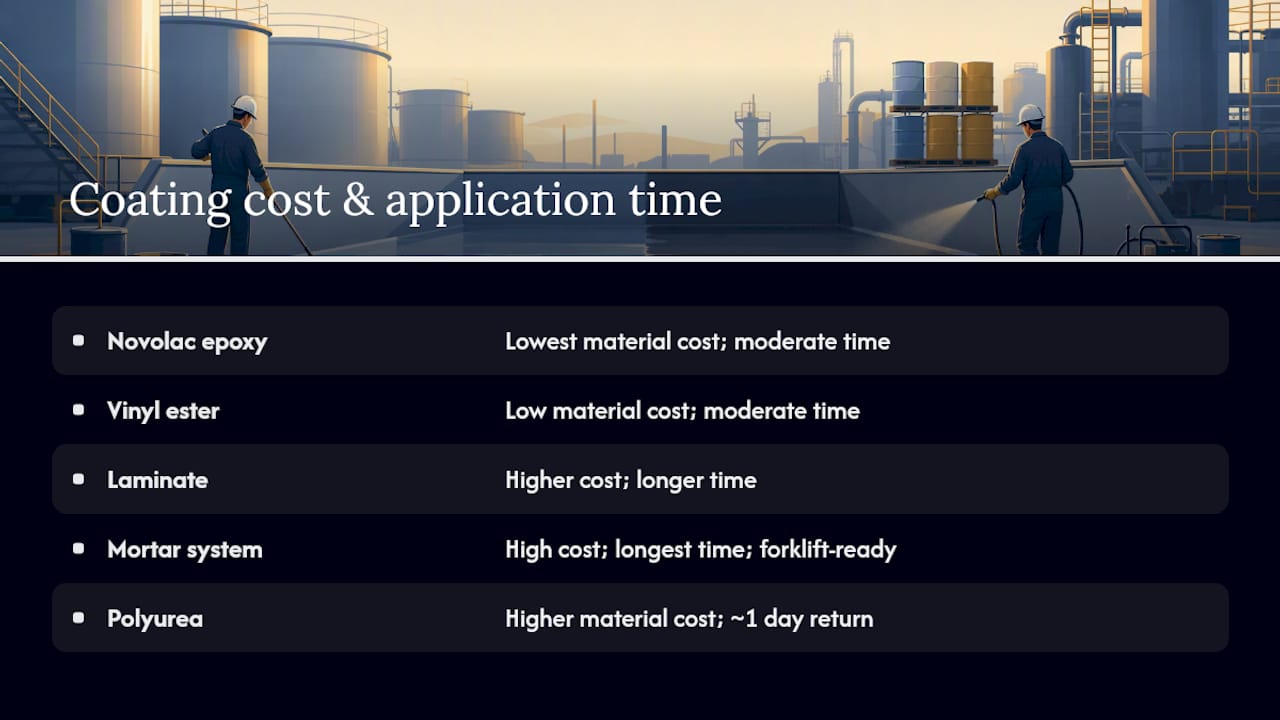
Chemistry is the biggest cost lever. Novolac epoxy runs less per square foot than vinyl ester, and both cost less than a fiber-reinforced laminate build or a mortar system thick enough for forklift traffic. Polyurea systems often carry a higher material cost but can lower total project cost when downtime matters, since a facility loses less revenue from a containment area that’s back in service in a day instead of a week.
Surface preparation is the second major factor, and it’s the one most budgets underestimate. A containment pad with heavy prior contamination, extensive crack repair, or a high moisture reading needs more blasting time and more patch material before a coating can go down. Skimping on this line item to protect the bottom line is how projects end up with early delamination and a second, more expensive repair job within a few years.
Square footage and access complexity round out the estimate. A large open tank farm berm coats faster per square foot than a cramped vault with tight penetrations, multiple pipe seals, and limited crew access. Multiply that by the number of terminations and transitions, since each cove base and penetration seal adds labor time that a flat floor area doesn’t.
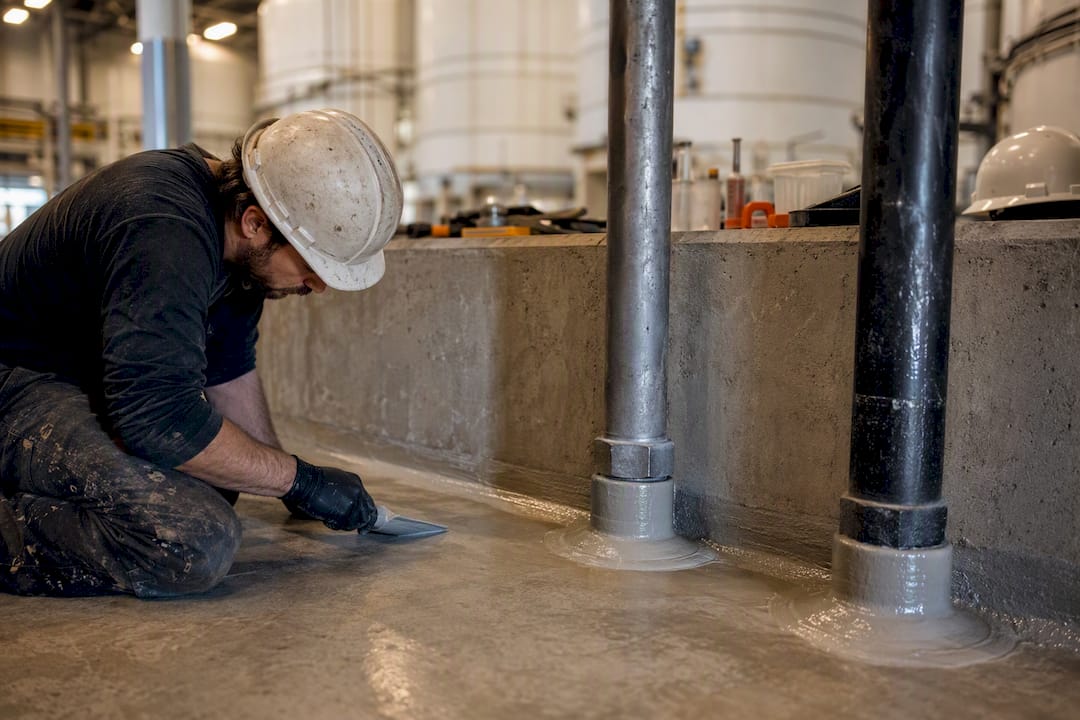
Budget for QA, too. Holiday testing, DFT verification, and documentation take crew hours that some low bids quietly skip. Factor those hours in up front rather than treating them as an add-on, because a coating system that fails inspection or leaks costs far more to fix after the fact than it would have cost to test correctly the first time. A detailed application process guide breaks down where labor hours typically concentrate on a containment job.
What the Industry Gets Wrong About Coating Selection
Most guidance on this topic treats chemistry selection as the hard part and application as an afterthought. That’s backward. The research is consistent: even a premium vinyl ester system fails if the substrate wasn’t tested for moisture, or if the cove base at a wall-to-floor joint wasn’t properly reinforced. Resin selection matters, but it’s the second decision, not the first.
The bigger blind spot is how facility managers treat polyurea’s speed. Fast cure time gets sold as a universal upgrade, when it’s really a scheduling tool that has to be checked against actual immersion data for your chemicals. A polyurea system that cures in two hours and fails at eighteen months because nobody verified its resistance to your specific solvent blend was never a good deal.
If there’s one thing worth prioritizing above all else, it’s this: demand the immersion test data before the color chart. Ask what temperature and concentration a system was tested against, not just what family of resin it belongs to. Everything else, the DFT, the surface prep, the termination details, matters, but chemical compatibility is the one variable that determines whether the whole system holds or fails on day one.
— Results
Get a Containment System Built for Florida’s Chemical and Climate Conditions
Southernsandblastingandpainting is the specification-first alternative to hiring a generalist painting contractor for containment work. Where a general contractor might apply a single coating across an entire facility, Southern scopes each containment area separately, testing substrate moisture and chemical exposure before recommending novolac epoxy, vinyl ester, polyurea, or a mortar system, then documenting DFT and holiday-test results at closeout so you have a defensible record for permit inspections.

That documentation matters as much as the coating itself when a municipal or industrial client faces an audit. Southernsandblastingandpainting has handled surface preparation and protective coating work across water tanks, pipelines, and city infrastructure throughout Central Florida for more than 20 years, and containment coating follows the same rigor: blast to spec, repair the substrate, apply the system in verified lifts, and test before sign-off.
If you’re specifying or budgeting a containment coating project, start with Southern’s services page to request a site assessment and a system recommendation matched to your actual chemical exposure.
Sources
- 40 CFR § 261.193 – Containment and detection of releases. | LII / Cornell
- EPA RCRA Hazardous Waste Model Permit (Guidance)
- Protecting secondary containment areas with robust coating/lining systems | Sherwin-Williams Protective & Marine
- Secondary Containment: Complete 2026 Guide | ArmorThane
- Secondary Containment System Selection Guide | Tnemec


