

Industrial sandblasting typically runs $2 to $9 per square foot, with full project totals for mid-size assets landing between $2,000 and $18,000 depending on scale, access, and coatings involved. Heavier jobs with hazardous coatings, tight geometry, or strict cleanliness specs push well past that. The three factors that swing a quote the most are containment and hazardous-material handling, site access, and the cleanliness standard required (NACE or SSPC level).
- Light-duty prep on open steel: lower cost range
- Standard industrial blasting with containment: mid-range cost
- Heavy-duty jobs with lead paint or confined spaces: higher cost range
Pro Tip: Before you compare a single dollar figure between bidders, request line-item quotes that separate labor, media, containment, and disposal. A number that looks low almost always means something got left off the page.
Key Takeaways
Industrial sandblasting costs hinge on containment, cleanliness specs, and disposal, not just labor and media, and a comparable quote must itemize all four.
| Point | Details |
|---|---|
| Typical cost range | Industrial sandblasting runs $2 to $9 per square foot, with heavy jobs exceeding $16/sq ft. |
| Biggest cost swing | Containment and hazardous-waste handling can double or triple a mobile project’s total cost. |
| Compare bids by line item | Require crew hours, media volume, containment plan, and disposal cost as separate entries. |
| Set cleanliness standards | Contracts should reference a specific NACE or SSPC acceptance level, not vague language. |
| Verify experience before hiring | Southernsandblastingandpainting provides line-item quotes with containment plans backed by 20+ years on municipal and industrial assets. |
Table of Contents
- How Much Does Sandblasting Cost Per Component?
- What Do Sample Sandblasting Projects Actually Cost?
- Per-Square-Foot, Hourly, or Per-Project: Which Pricing Model Wins?
- What Actually Drives Sandblasting Costs Up?
- What Should Your RFP Require for Comparable Bids?
- How Should You Budget for Contingencies and Contract Risk?
- What Should You Verify Before Hiring a Contractor?
- Why Industrial Budgeting Deserves More Scrutiny Than Most Guides Give It
- Ready to Request a Line-Item Sandblasting Quote?
- Sources
How Much Does Sandblasting Cost Per Component?
Every bid breaks down into the same handful of line items, even if contractors package them differently. Knowing the typical range for each one lets you spot a quote that’s missing a piece before you sign it.
- Labor: $60 to $140 per hour per technician, with crews of two to four common on industrial jobs
- Abrasive media: $0.10 to $1.50 per square foot depending on material (sand, garnet, steel grit, or glass abrasive)
- Equipment amortization: $0.05 to $2.50 per square foot, covering compressor rental, blast pots, and hoses
- Containment and dust control: often the single largest swing item, especially on mobile jobs where dust collection isn’t already engineered into the site
- Disposal and hazardous waste handling: $100 to over $1,000 depending on volume and material classification
- Permits, masking, and finish prep: typically smaller line items but easy to overlook in a lump-sum bid
Materials and labor together usually make up the bulk of a large project’s total, with materials running $0.25 to $0.80 per square foot and labor $0.50 to $0.90 per square foot in average bands. When a project requires a specific NACE or SSPC cleanliness level, expect labor and containment costs to climb, since near-white or white-metal finishes demand slower passes and tighter dust control. Third-party coating testing and waste manifests should show up as separate line items, not buried inside a single “labor” number.
What Do Sample Sandblasting Projects Actually Cost?
Per-square-foot bands only tell part of the story. Two 1,000-square-foot jobs can land tens of thousands of dollars apart depending on containment needs, coating type, and access.
Rates in coastal metro regions run 10 to 25 percent higher than in lower-cost inland markets, largely due to labor and disposal fees. On the flip side, very large surfaces often see per-square-foot costs drop as crews hit a rhythm and fixed mobilization costs get spread across more area. Pipelines are the exception: long runs benefit from scale, but confined-space segments can spike the price per linear foot regardless of total length.
Per-Square-Foot, Hourly, or Per-Project: Which Pricing Model Wins?
Contractors quote industrial sandblasting three different ways, and none of them are wrong. The trick is converting each one into a number you can actually compare.
- Per-square-foot pricing is most common for large, uniform surfaces like tanks or floors. It usually bundles labor and media but often excludes containment and disposal as separate line items.
- Hourly pricing fits smaller or irregular jobs where square footage is hard to measure upfront, and it typically runs $45 to $140 per hour depending on crew size and region.
- Per-project (lump sum) pricing works for well-defined scopes but hides the most risk, since you can’t tell what’s included without asking.
To compare fairly, ask every bidder to state crew hours, media type and volume, and whether containment, cleanup, and disposal are included in the base number or billed separately.
What Actually Drives Sandblasting Costs Up?
Some price increases are legitimate. Others are a sign the bid is missing something and the number will climb later.
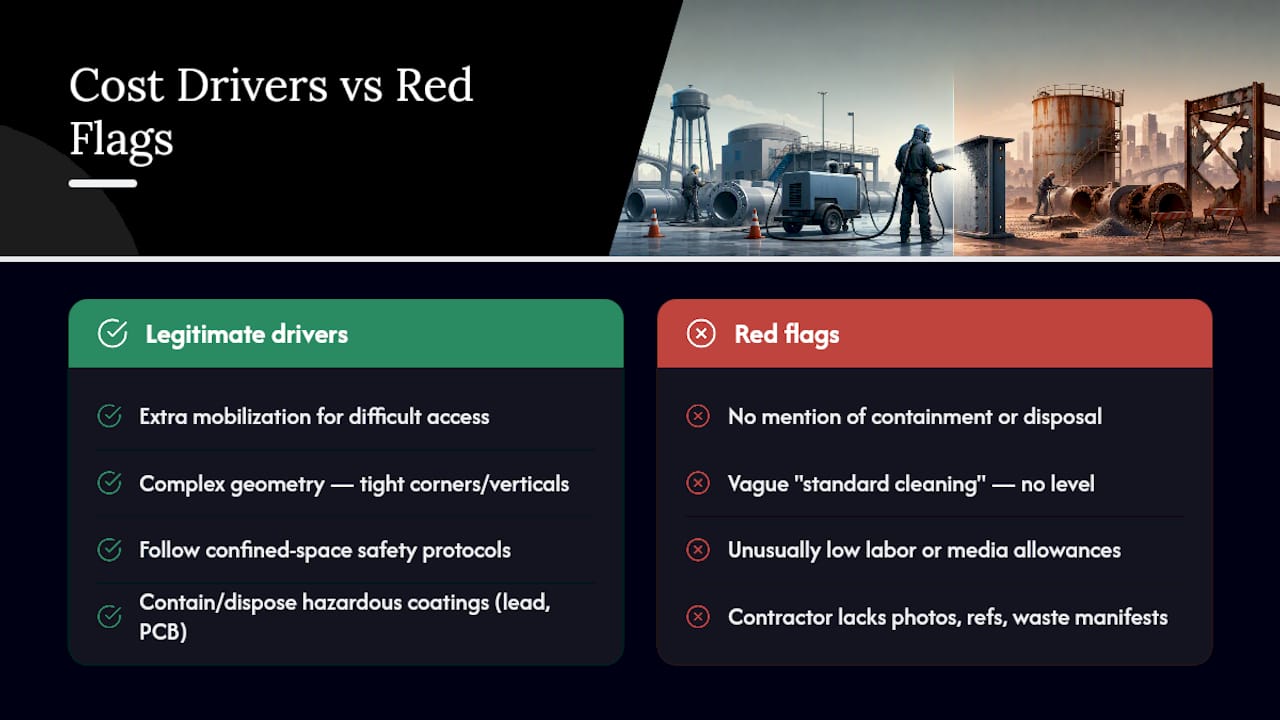
Legitimate drivers include difficult site access requiring extra mobilization, complex geometry with tight corners or vertical surfaces, confined-space safety protocols, and hazardous coatings like lead paint or PCBs that require special containment and disposal permits, often coordinated by experienced demolition and excavation contractors. A required NACE or SSPC cleanliness level also adds real cost since it demands slower, more thorough work.

Red flags look different: a quote with no mention of containment or disposal, a vague reference to “standard cleaning” with no cleanliness level named, unusually low labor or media allowances, or a contractor who can’t produce past project photos, references, or waste manifests on request.
Pro Tip: If a bid comes in 30 percent or more below the others, ask specifically how containment and disposal are handled before you assume you found a bargain.
What Should Your RFP Require for Comparable Bids?
A good request for proposal forces every bidder to answer the same questions in the same format, which is the only way to compare quotes honestly.
Require each bid to include:
- Crew size and estimated labor hours
- Media type, volume, and cost per unit
- Compressor and CFM specifications
- A written containment plan, including negative-air systems if applicable
- A disposal plan with estimated waste volume and cost
- Required permits and who is responsible for securing them
- Certificate of insurance
- Acceptance criteria tied to a specific NACE or SSPC cleanliness level
- Testing procedures and warranty terms
- Proposed schedule, including mobilization timeline
- Weigh compliance with these requirements more heavily than raw price when scoring bids
- Ask directly for photos and references from at least two prior projects of similar size and asset type
- Review our industrial sandblasting guide for facility managers for a deeper look at scope-writing before you send the RFP
How Should You Budget for Contingencies and Contract Risk?
Build a contingency of at least 10 to 20 percent into any industrial sandblasting budget, and push toward the higher end when the asset has unknown coatings, suspected lead paint, or confined-space work involved.
- Schedule blasting and coating application back-to-back to avoid re-contamination of prepped surfaces
- Write measurable acceptance criteria into the contract, referencing a specific NACE or SSPC standard rather than vague language
- Include a holdback (5 to 10 percent) released only after acceptance testing passes
- Require proof of insurance and proper waste-manifest documentation before final payment
What Should You Verify Before Hiring a Contractor?
Southernsandblastingandpainting has spent over 20 years delivering surface preparation and protective coating work on water tanks, pipelines, airports, and theme park infrastructure across Central Florida, projects where a botched containment plan or an underpriced disposal line item turns into a liability fast.
Before hiring any contractor for a project at this scale, request:
- Case-study photos from projects of comparable size and asset type
- References specific to your asset category (tanks, structural steel, pipelines)
- Proof of certifications and current liability insurance
- Copies of past waste manifests showing proper hazardous-material disposal
Compliance with recognized safety and equipment standards isn’t a paperwork formality on projects like these. It’s the difference between a coating system that lasts fifteen years and one that fails in three.
Why Industrial Budgeting Deserves More Scrutiny Than Most Guides Give It
Most cost guides treat sandblasting like a single number you can shop around for, the way you’d compare quotes for lawn care. That framing falls apart the moment you’re dealing with a municipal water tank or a bridge structure with suspected lead paint. At that scale, the line item that matters most isn’t labor or media. It’s containment and disposal, and it’s also the item bidders most often shrink or omit to look competitive.
The conventional advice to “get three quotes and pick the middle one” assumes those three quotes are actually comparable. In this category, they rarely are unless you force it with a detailed RFP. A contractor who prices containment properly will look more expensive on paper than one who doesn’t, right up until the second contractor hits an unplanned disposal fee three weeks into the job.
If you take one thing from this guide, make it this: prioritize the written containment and disposal plan over the bottom-line number. Everything else in a bid is negotiable. That plan tells you whether the number in front of you is real.
— Results
Ready to Request a Line-Item Sandblasting Quote?
Southernsandblastingandpainting has handled surface preparation on water tanks, pipelines, airports, and municipal infrastructure across Central Florida for over two decades, and that field experience shows up in how quotes get built. Rather than a single lump-sum number, you get a breakdown that separates labor, media, containment, and disposal so you know exactly what you’re paying for and can compare it against any other bid on your desk.
A quote request includes a full line-item cost breakdown, a written containment plan specific to your site, and references from comparable past projects. If your asset involves suspected hazardous coatings, ask upfront how containment and material disposal will be handled and documented, that answer alone tells you a lot about who you’re hiring. Visit the sandblasting services page to request a line-item quote for your next project.
Sources
- Sandblasting Cost and Price: Practical Budgeting Across U.S. Jobs 2026 – Current Cost
- Sandblasting Cost: Price Guide for U.S. Buyers 2026 — One and Done Prep
- Rapmaf


