
TL;DR:
- Choosing the right sandblasting contractor is critical for Windermere assets, especially given regional environmental challenges. Proper surface preparation ensures coating longevity, preventing costly premature failures caused by inadequate methods or documentation. Verified procedures, clear standards, and experienced regional providers like Southern Sandblasting & Painting safeguard infrastructure durability and protect budgets over time.
Not every sandblasting contractor delivers the same outcome, and for municipal infrastructure managers and commercial property operators in Windermere, that gap in quality can translate directly into accelerated corrosion, premature coating failure, and budget overruns that compound over time. The assumption that any licensed provider with a blasting rig will do the job is one of the most expensive mistakes you can make when protecting public assets or high-value commercial properties. Choosing the right contractor and the right method from the start is what separates a surface that holds its coating for 15 years from one that starts failing in three.
Table of Contents
- Why sandblasting matters for Windermere commercial and municipal assets
- Methods that matter: Dry vs. dustless sandblasting compared
- What to expect: Sandblasting contractor services, mobility, and workflow
- How to select and evaluate a sandblasting contractor: Critical questions
- Why process and details define long-term project success, not just price or method
- Your next step: Secure the right sandblasting contractor for Windermere
- Frequently asked questions
Key Takeaways
| Point | Details |
|---|---|
| Method selection is critical | The choice between dry and dustless blasting directly impacts safety, durability, and compliance. |
| Ask for more than marketing | Dig into technical details and documentation to prevent costly failures and rework. |
| Mobility enables efficiency | Mobile contractors can minimize disruption and handle projects on your timeline. |
| Details drive results | Clear communication, records, and surface standards are as vital as blasting skill. |
Why sandblasting matters for Windermere commercial and municipal assets
To understand the importance of contractor choice, let’s look at what sandblasting achieves for local infrastructure and property.
Central Florida’s climate is genuinely punishing on exposed surfaces. High humidity, intense UV radiation, salt-laden air from nearby water bodies, and frequent rain cycles create conditions that accelerate oxidation and coating degradation faster than almost any other region in the continental United States. For Windermere, a community defined by its chain of lakes and active waterfront properties, this environmental pressure is even more pronounced.
Sandblasting is not just a cleaning step. It is the foundation on which every protective coating system is built. When done correctly, it removes rust, mill scale, old paint, and surface contaminants while creating a mechanical anchor profile (the microscopic texture that allows coatings to bond firmly to the substrate). When done poorly, even the most expensive industrial coating will delaminate prematurely.
Typical applications in Windermere and the surrounding Central Florida area include:
- Municipal water tanks and elevated storage structures
- Bridges, overpasses, and structural steel components
- Concrete walkways, parking structures, and retaining walls
- Park facilities, playground equipment, and public furniture
- Marine and offshore structures along the lake system
- Commercial facility exteriors, loading docks, and equipment
“Proper surface preparation is the single most critical factor in the performance and longevity of any protective coating system. A coating applied over a poorly prepared surface will fail regardless of its quality or cost.”
JP Sandblasting provides mobile dustless blasting across Central Florida and covers a wide range of facility maintenance applications, which reflects the scope of work that qualified regional contractors are expected to handle. For Windermere assets specifically, reviewing Windermere sandblasting options gives facility managers a clearer picture of what local service coverage looks like.
The financial case for quality surface prep is straightforward. Recoating a water tank that failed prematurely because of inadequate blasting costs two to three times more than doing the job right the first time, when you factor in mobilization, containment, disposal, and lost service time.
Methods that matter: Dry vs. dustless sandblasting compared
Once you understand the need for quality surface prep, the next consideration is which sandblasting method your contractor should use.
Not all blasting is the same. The two primary methods used in commercial and municipal work are dry abrasive blasting and dustless (wet abrasive) blasting. Each has distinct advantages and limitations, and JP Sandblasting specifically offers wet and dry abrasive blasting for mobile and facility maintenance applications, which underscores that qualified contractors are expected to carry both capabilities.
| Feature | Dry abrasive blasting | Dustless (wet abrasive) blasting |
|---|---|---|
| Dust generation | High | Minimal |
| Best for | Heavy rust, exterior steel, open sites | Indoor, occupied, or sensitive areas |
| Environmental risk | Higher containment required | Lower airborne particulate risk |
| Surface profile | Aggressive, deep anchor profile | Controlled, moderate anchor profile |
| Post-blast moisture | None | Slight surface moisture (managed) |
| Regulatory compliance | Requires full containment setup | Easier to manage in populated areas |
| Typical applications | Bridges, tanks, industrial steel | Concrete, wood, marine, urban facades |
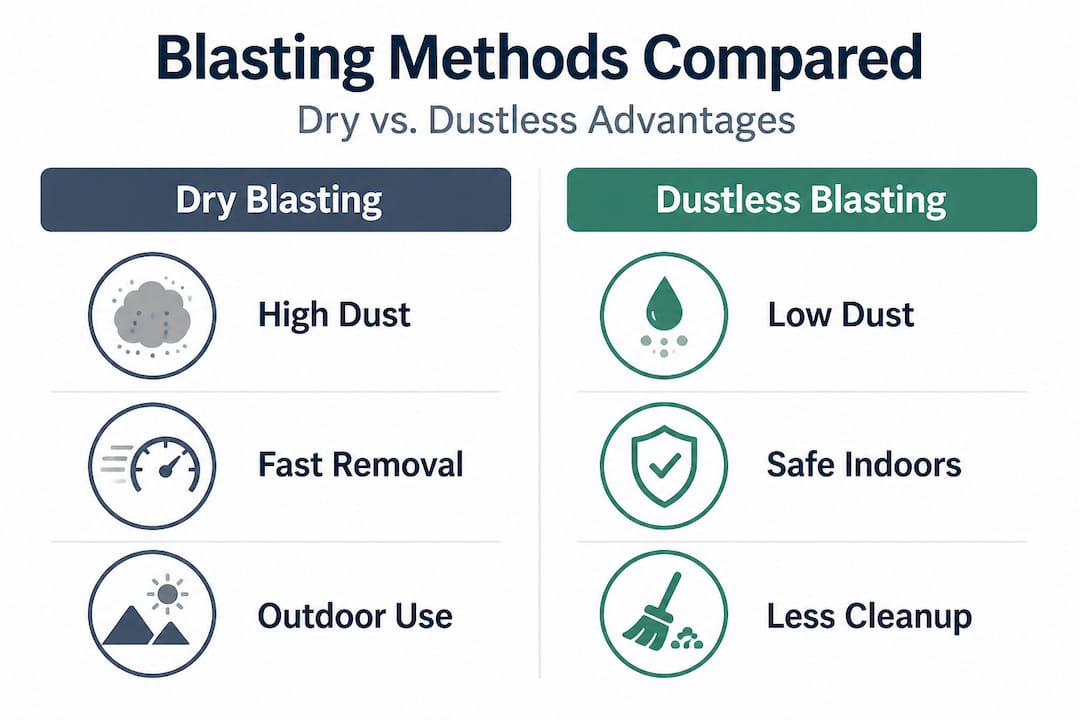
The choice of method matters far beyond convenience. Dry abrasive blasting can be aggressive and generates significant dust, while dustless wet blasting leaves a controlled moisture level and is often better suited for sensitive substrates and occupied or indoor work environments.
For Windermere municipal jobs near residential neighborhoods or active commercial zones, dustless blasting reduces the risk of airborne silica and debris complaints, which matters for both public relations and regulatory compliance. For heavy structural steel on bridges or water tanks in open areas, dry abrasive blasting is typically more efficient and cost-effective.
Pro Tip: Always ask your contractor to specify the method in writing before work begins, and confirm it matches the surface material and job site conditions. A contractor who defaults to one method for every job regardless of context is a red flag.
Understanding where method mismatches cause sandblasting and coating failures can help facility managers set tighter specifications before issuing contracts or approving project plans.
What to expect: Sandblasting contractor services, mobility, and workflow
Knowing what service options exist helps clarify what a contractor should actually deliver in Windermere.
A qualified sandblasting contractor operating in the Central Florida region should offer both fixed facility (in-shop) and mobile blasting services. Glory Sandblasting advertises in-shop and mobile abrasive cleaning plus painting and powder coating services serving the Orlando and Central Florida area, which represents the baseline service range that Windermere project managers should expect from any serious provider.
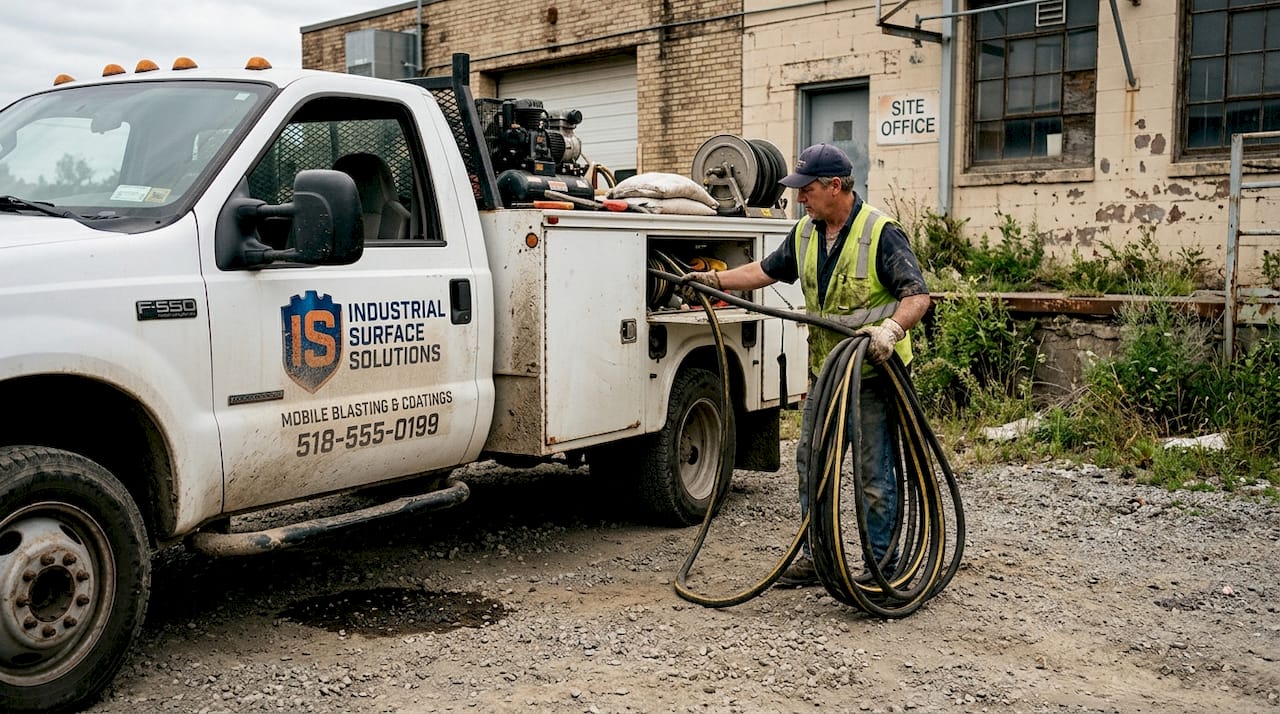
Mobile capability is particularly important for municipal infrastructure work where assets cannot be transported, such as bridges, water tanks, and park structures. In-shop capability is valuable for removable components like gates, railings, equipment housings, and smaller structural parts that benefit from a controlled blasting environment.
Here is a typical workflow you should expect from a professional sandblasting contractor:
- Pre-project site assessment — The contractor evaluates the substrate condition, existing coating system, environmental constraints, and access requirements before committing to a method or timeline.
- Containment and masking setup — Surrounding surfaces, drains, vegetation, and sensitive equipment are protected before blasting begins. This step is non-negotiable on occupied or public sites.
- Abrasive cleaning to specification — The surface is blasted to a defined cleanliness standard (typically SSPC-SP 6, SP 10, or SP 5 depending on the coating system requirements) and a specified anchor profile measured in mils.
- Post-blast inspection and documentation — Profile depth is verified using a surface comparator or profilometer, and cleanliness is confirmed before any coating is applied.
- Priming within the specified window — Priming must occur within the contractor’s stated timeframe after blasting, often within hours in Florida’s humid conditions, to prevent flash rust or surface contamination.
- Final coating application and cure verification — The protective coating is applied to the prepared surface, and cure time is monitored before the asset returns to service.
| Service type | Best suited for | Typical Windermere applications |
|---|---|---|
| Mobile dry blasting | Open exterior structures | Bridges, water tanks, industrial steel |
| Mobile dustless blasting | Occupied or sensitive sites | Park facilities, commercial facades |
| In-shop blasting | Removable components | Gates, railings, equipment parts |
| Combined blast and coat | Full project delivery | Municipal infrastructure contracts |
For projects across the broader service region, reviewing the Orlando sandblasting service area provides context on how regional contractors structure their coverage. You can also explore Windermere painting contractor options for combined surface prep and coating service providers in the area.
How to select and evaluate a sandblasting contractor: Critical questions
Now that you know what a contractor should deliver, here’s how to ensure you’re hiring the best fit for your facility or project.
Price is the wrong starting point. Two contractors can quote the same job at different prices and deliver vastly different outcomes based on the anchor profile they achieve, the cleanliness standard they meet, and how quickly they prime after blasting. Facility operators should ask contractors for specifics beyond marketing, including anchor profile targets, cleanliness standards, profile and roughness verification methods, and post-blast surface protection timing.
Here is a practical checklist of questions to ask before signing any contract:
- What SSPC or NACE cleanliness standard will you meet? (SSPC-SP 10 Near-White Metal is the most common requirement for industrial coatings on steel.)
- What anchor profile depth are you targeting, and how will you verify it? (A profilometer or Testex tape should be standard practice.)
- What abrasive media will you use, and why is it appropriate for this substrate?
- How will you manage dust, runoff, and abrasive containment on this specific site?
- What is your maximum allowable time between blasting and priming?
- Can you provide references from comparable municipal or commercial projects in Central Florida?
- What documentation will you provide at project completion?
Do not overlook these commonly skipped items:
- Proof of liability insurance and workers’ compensation coverage specific to abrasive blasting operations
- Confirmation of OSHA compliance for silica dust exposure (29 CFR 1926.1153)
- Written specification for the coating system to be applied after blasting
- Clear definition of who is responsible for each phase of the project workflow
Pro Tip: Request a written anchor profile specification and a post-blast inspection protocol before work begins. If a contractor cannot provide these, they are likely not working to a standard that will protect your asset long-term.
For projects in the broader metro area, the Maitland service expertise page illustrates how regional specialists approach municipal and commercial surface preparation with defined standards and documentation.
Why process and details define long-term project success, not just price or method
After more than 20 years of working on Central Florida infrastructure projects, from water treatment facilities to lakefront commercial properties, the pattern behind every premature coating failure is almost always the same. It is rarely the blasting method that caused the problem. It is the gap between what was specified and what was actually documented, verified, and communicated in the field.
Facility managers often focus heavily on the technical specs during the bid phase and then step back once work begins. That is precisely when the risk is highest. The anchor profile might be correct on paper but never verified with a profilometer. The priming window might be specified as four hours but stretched to eight because the crew ran short on primer. These are not dramatic failures. They are quiet ones that show up 18 months later as blistering or delamination, long after the contractor has moved on.
For public portfolio managers overseeing multiple assets, the documentation requirement is not bureaucratic overhead. It is your only real protection when a coating fails and you need to determine whether the failure was a material defect, an application error, or a surface prep shortfall. Without post-blast inspection records and profile measurements, that determination is nearly impossible.
The contractors who deliver the best long-term outcomes are not always the ones with the most impressive equipment or the lowest bid. They are the ones who treat every phase of the project as a documented handoff, where each step is verified before the next begins. Asking for that level of process discipline upfront, and walking away from contractors who treat it as unnecessary, is the single most effective thing a facility manager can do to protect their asset and their budget.
Understanding coating failure prevention at a technical level reinforces why documentation and process control are not optional extras but core requirements for any serious infrastructure project.
Your next step: Secure the right sandblasting contractor for Windermere
Ready to put these insights into action? Here’s how to take the next step with confidence.
Windermere’s public and commercial assets deserve contractors who understand the region’s climate demands, regulatory environment, and the specific performance requirements of municipal infrastructure. Working with a team that has deep roots in Central Florida means you are not educating your contractor about local conditions during your project timeline.
Southern Sandblasting & Painting LLC brings over 20 years of specialized experience in surface preparation and industrial coatings across Central Florida’s most demanding environments. Whether you manage water tanks, bridges, commercial facilities, or lakefront infrastructure, our team delivers documented, specification-grade results that protect your assets for the long term. Explore our Orlando sandblasting experts page for a full overview of our capabilities, or review our approach to industrial coatings for infrastructure to see how we protect Central Florida’s most critical assets.
Frequently asked questions
What surfaces can be restored by sandblasting contractors in Windermere, FL?
Sandblasting contractors can restore a wide range of surfaces including concrete, wood, metal, and marine structures. JP Sandblasting lists concrete and wood restoration and marine and offshore coating removal as core service applications.
How do I know which sandblasting method is right for my facility?
Choose based on the material type, site environment, and whether the area is occupied. Dry abrasive blasting suits exterior heavy-duty removal, while dustless wet blasting is better for sensitive substrates and indoor or occupied work environments.
What questions should I ask before hiring a sandblasting contractor?
Ask about anchor profile targets, surface cleanliness standards such as SSPC or NACE ratings, profile verification methods, and the maximum allowable time between blasting and priming. Facility operators should push contractors for these specifics rather than accepting general marketing claims.
Can sandblasting contractors in Windermere handle both mobile and in-shop jobs?
Yes, qualified regional contractors offer both options. Glory Sandblasting advertises in-house and mobile abrasive cleaning services, which reflects the dual capability that Windermere facility managers should expect from any serious provider in the area.
Recommended
- Sandblasting & Painting Contractor in Windermere, FL
- sandblasting services windermere fl – Resources – Southern Sandblasting & Painting LLC
- Sandblasting & Painting Contractor in Conway, FL
- Professional Sandblasting Services in Windermere, FL
- Edgewater Building Cleaning Miami | Drone, No Scaffolding
- Sandblasting Contractor Baldwin Park FL
- Sandblasting Services Oviedo FL


