
Coatings usually do not create first-party coverage for repair costs. That is the short answer adjusters and coverage counsel need to carry into any coating-failure file. The failed coating itself is almost always excluded under faulty workmanship, product defects, or design error provisions. Coverage is restored only when the failure triggers a separate, identifiable peril that damages other property — the ensuing-loss exception — or when a third-party liability claim arises from collateral damage. The role of coatings in insurance claims is therefore less about the coating and more about what the coating’s failure did to everything around it.
Three things typically decide these claims at first notice:
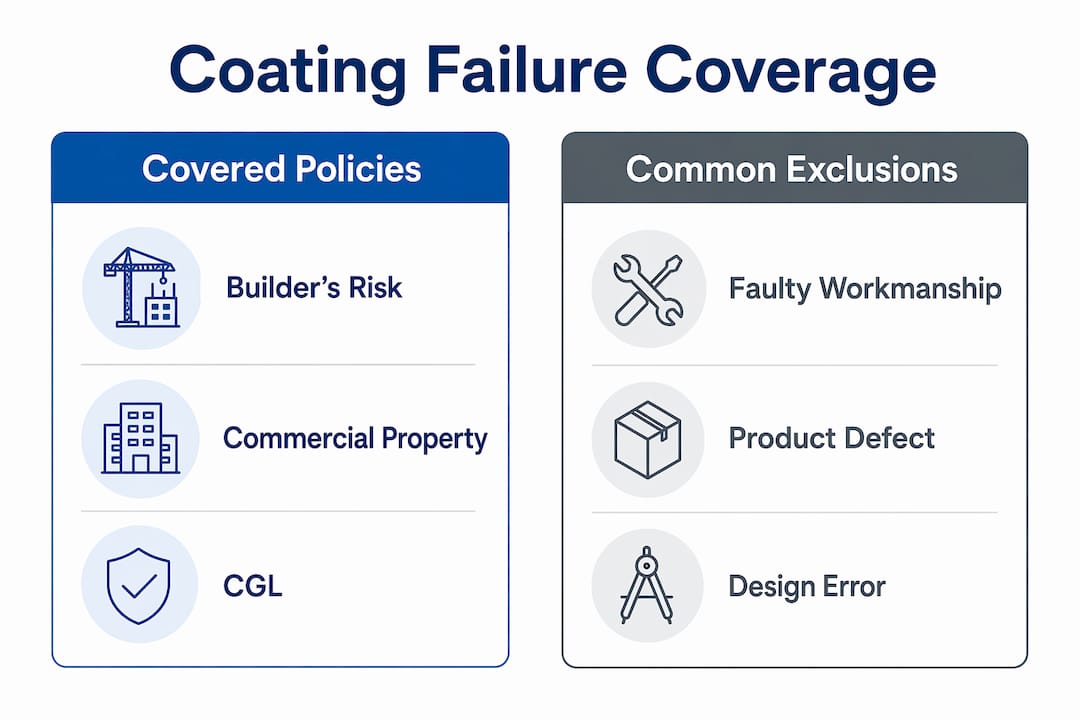
- Policy type and exclusion language: Builder’s Risk/All-Risk policies exclude defective workmanship.pdf) repair costs but may cover ensuing physical damage; CGL policies respond only when the failure constitutes an “occurrence” causing damage to property other than the insured’s own work.
- Ensuing-loss analysis: Courts require a demonstrably separate covered peril — fire, water intrusion, corrosion of adjacent equipment — before the ensuing-loss exception restores coverage.
- Documentation quality: Application records, surface prep logs, and third-party inspection reports are the evidence that separates a covered ensuing-loss claim from a denied workmanship claim.
At first notice, adjusters should immediately secure the coating specification, the blast-profile records, and any available inspection logs before remediation begins. Those documents are often the difference between a recoverable claim and a flat denial.
Table of Contents
- Which insurance policies respond when a coating fails?
- Key exclusions and legal doctrines that decide coating coverage
- What documentary and forensic evidence actually decides these claims
- How adjusters and courts actually resolve coating disputes
- Practical steps for handling a coating failure claim
- Common claim scenarios and likely coverage outcomes
- Key Takeaways
- What the industry consistently gets wrong about coating claims
- How Southernsandblastingandpainting helps reduce coating-related claim disputes
- Authoritative sources for claims handling and underwriting decisions
Which insurance policies respond when a coating fails?
Coating failures can touch several policy types, and each responds differently depending on what the failure actually damaged.
Builder’s Risk / Course-of-Construction (All-Risk). This is the primary policy for construction-phase coating failures. It covers direct physical loss during construction but commonly excludes defects.pdf) in workmanship, materials, or design. The ensuing-loss exception is the only realistic path to recovery, and it requires proof of a separate covered peril. Adjusters should check the declarations for sublimits on soft costs and any endorsements that broaden or narrow ensuing-loss language.
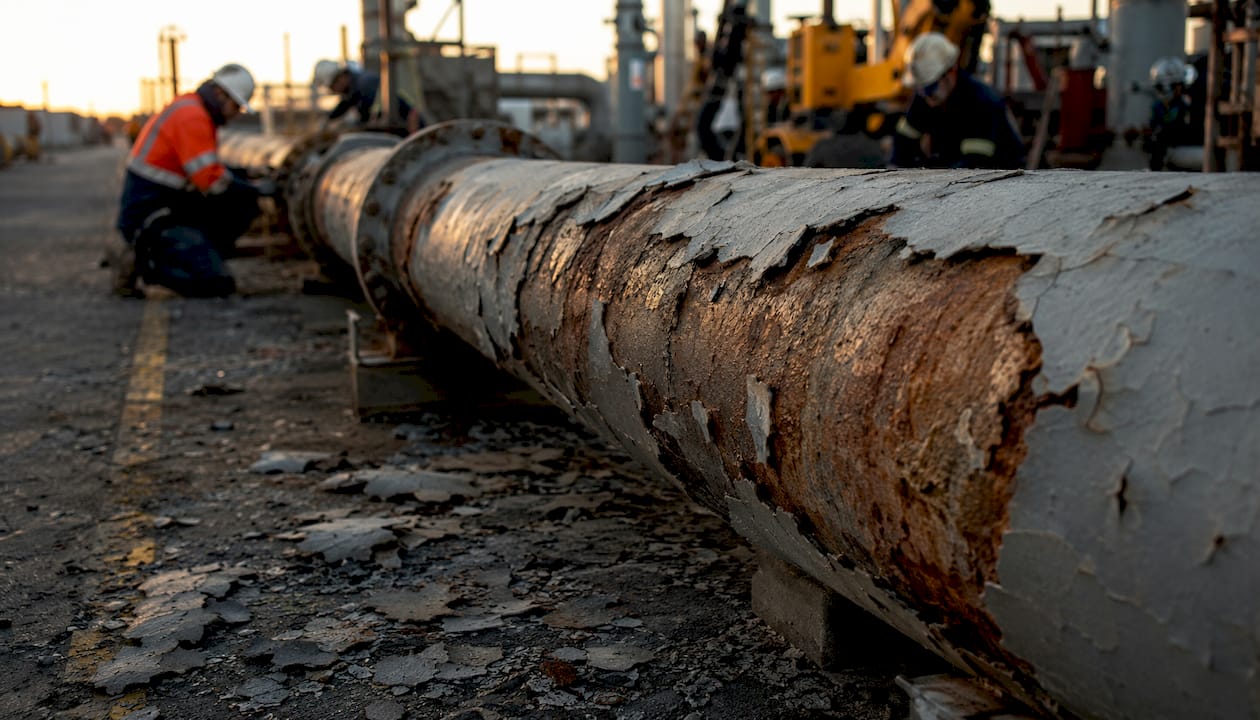
Commercial Property / All-Risk. For operational facilities, a Commercial Property policy covers sudden and accidental physical loss. Coating failures that develop gradually — osmotic blistering, creep corrosion — often run into “wear and tear” or “gradual deterioration” exclusions. Where a coating failure causes a sudden pipe rupture or equipment breakdown, the resulting damage to other property may be covered. Check the policy’s maintenance exclusion and any equipment-breakdown endorsement.
Commercial General Liability (CGL). CGL responds when the insured’s coating work causes property damage to a third party, but only if the damage qualifies as an occurrence under the policy. Courts have consistently held that defective workmanship alone is not an occurrence; coverage requires damage to property beyond the insured’s own work product. The Fletch’s Sandblasting and Painting v. Colony Insurance case is a direct illustration: the court found no covered occurrence where the claim was solely for costs to redo defective surface prep work, because those costs were incurred to repair the insured’s own work rather than to compensate for damage to other property.
Delay in Start-Up (DSU) / Business Interruption. On large capital projects, a coating failure that delays commissioning can trigger DSU exposure. IMIA has documented potential exposures reaching into the hundreds of millions of dollars on refinery and pipeline projects where coating remediation delays start-up by months. DSU coverage is typically sublimited and tied to a physical damage trigger, so the same ensuing-loss analysis applies. Adjusters should map the critical path and quantify the daily DSU rate early.
| Policy | What it typically covers for coating events | Key exclusions / endorsements to check |
|---|---|---|
| Builder’s Risk / All-Risk | Ensuing physical damage from a covered peril; soft costs if endorsed | Faulty workmanship, product defect, design error; ensuing-loss language varies |
| Commercial Property | Sudden accidental loss to other property caused by coating failure | Gradual deterioration, wear and tear, maintenance exclusion |
| CGL | Third-party property damage qualifying as an occurrence | Your-work exclusion; damage limited to property other than insured’s work |
| DSU / Business Interruption | Lost revenue / extra expense during delay caused by covered physical damage | Physical damage trigger required; sublimits common; critical-path dependency |
Relevant clauses appear in the Declarations (covered property, limits, sublimits), the Exclusions section (faulty workmanship, product defect, wear and tear), and any ensuing-loss or soft-cost endorsements. For DSU, the policy schedule and critical-path definition are the first documents to pull.
Key exclusions and legal doctrines that decide coating coverage
The three exclusions that most often bar coating-related claims are faulty workmanship, product defect, and design error. Understanding how courts distinguish them matters because the subrogation target and the coverage path differ for each.
Faulty workmanship covers errors in application: wrong surface profile, inadequate dry-film thickness, application outside the manufacturer’s temperature or humidity window. Courts treat this as a business risk the contractor assumes, not an insurable accident. The Fletch’s decision is explicit: defective surface prep that required rework was not an occurrence under the CGL policy because the damage was to the work itself, not to other property.
Product defect points to the coating manufacturer. If a coating fails because of a formulation problem rather than an application error, the claim shifts toward the manufacturer and potentially toward a products-liability theory. Forensic cross-sections and lab analysis of the coating film are the tools that separate application error from material failure.
Design error arises when the specified coating system was wrong for the service environment — the wrong generic type for immersion service, insufficient film thickness for the corrosivity category. This implicates the specifying engineer and can trigger professional liability coverage rather than property or CGL coverage.
The ensuing-loss exception
The ensuing-loss exception is the most litigated provision in Builder’s Risk policies involving coating failures. The standard language reads roughly: “But if an excluded cause of loss results in a covered cause of loss, we will pay for the resulting loss caused by that covered cause of loss only.” The practical effect is that the cost to fix the defective coating stays excluded, but damage the defective coating caused to other property — substrate corrosion, equipment contamination, water intrusion — may be covered if that damage resulted from a recognized covered peril.
Blaine Construction Corp. v. Insurance Co. of North America, 171 F.3d 343 (6th Cir. 1999), illustrates the doctrine cleanly. A subcontractor improperly installed a vapor barrier; moisture condensed and damaged adjacent insulation. The court held the vapor barrier repair was excluded, but the damage to the non-defective insulation was covered under the ensuing-loss exception. The same logic applies to coating failures: the rework cost is excluded, but corrosion damage to the underlying substrate or adjacent equipment may be covered.
Occurrence timing and jurisdictional variation
For CGL and some property policies, courts also wrestle with when a coating failure “occurred.” The manifestation trigger holds that coverage attaches when damage becomes apparent; the exposure trigger holds that it attaches when the harmful conditions began. Latent coating failures — osmotic blistering that develops over years — can span multiple policy periods, creating disputes over which carrier responds.
Jurisdictional variation is real. Some circuits require a distinct, identifiable covered peril to trigger ensuing-loss; others take a broader view. The Eighth Circuit’s Bob Robison Commercial Heating line of cases is frequently cited for a narrower reading. Local case law is not optional research — it is the threshold question for coverage counsel.
What documentary and forensic evidence actually decides these claims
The single most decisive category of proof in a coating dispute is the application record combined with the pre-application surface preparation documentation. If those records do not exist or are incomplete, the insured’s ability to prove causation collapses, and the insurer’s denial becomes much harder to challenge.
The core evidence checklist:
- Coating specification and technical data sheets: Confirm the specified system, required surface profile (SSPC/NACE blast standards), dry-film thickness, and environmental application limits.
- Pre-application surface prep records: Blast profile measurements (Testex tape or profilometer readings), cleanliness grades, and photographic documentation of the prepared surface before coating.
- Environmental conditions at application: Temperature, relative humidity, dew point, and substrate temperature logs at the time of application. Coating applied outside the manufacturer’s window is the most common application-error finding.
- NDT and adhesion test reports: Pull-off adhesion tests (ASTM D4541), holiday detection results, and dry-film thickness readings taken during and after application.
- Third-party inspection logs: Independent inspector reports, coating inspection records, and any NACE/AMPP CIP-certified inspector sign-offs.
- Maintenance records and P&IDs: Post-commissioning inspection history, repair records, and process-and-instrumentation diagrams showing which systems the coating was protecting.
Forensic outputs that tie failure mode to cause:
Lab adhesion tests on samples cut from the failed area, salt-spray testing of retained coating samples, and microscopic cross-sections of the coating film are the standard forensic toolkit. A cross-section showing poor intercoat adhesion points to application error (surface contamination, inadequate flash time). A cross-section showing intact intercoat adhesion but cohesive failure within the primer points toward a material formulation problem. Failure-mode analysis by a qualified coatings engineer is what converts a disputed claim into a defensible position for either side.
Pro Tip: At first notice, photograph the failed area with a scale reference before any cleaning or remediation. Cut and bag at least three samples (minimum 4-inch squares) from representative failure zones, label them with location and date, and store them in sealed containers. Establish chain-of-custody immediately using a site-logging tool like BRCKS to timestamp photos and maintain a digital evidence trail. Samples destroyed during emergency remediation cannot be recreated.
How adjusters and courts actually resolve coating disputes
The IMIA engineering insurers’ analysis of coating failures on critical infrastructure makes the stakes plain: a single refinery pipe-network coating failure can generate loss potential in the hundreds of millions of dollars, with DSU and business interruption exposure often exceeding the direct repair cost. That scale is what drives the litigation intensity around these claims.

The most common dispute triggers found across cases and engineering reports are consistent: lack of a written coating specification, inadequate surface preparation, no third-party inspection during application, and missing environmental condition logs. When all four are absent, the insurer’s denial is almost automatic, and coverage counsel has little to work with.
Repeated failures across similar structures create a different problem. When the same coating system fails on twin tanks, twin bridges, or twin pipeline segments, underwriters and forensic engineers treat it as evidence of a systemic defect — poor specification, wrong product for the service environment, or a contractor-selection failure — rather than an isolated workmanship event. That reclassification shifts the claim away from an accidental occurrence toward a design or product defect, which changes both the coverage analysis and the subrogation target.
Forensic triage for complex cases:
- Engage a NACE/AMPP-certified coatings engineer within the first week to assess failure mode and preserve samples.
- Commission lab analysis (cross-sections, adhesion, salt-spray) before any remediation proceeds.
- Obtain all application records from the contractor and the coating manufacturer’s technical representative.
- Map the damaged property: distinguish the failed coating area from substrate damage and from damage to adjacent or downstream equipment.
- Engage coverage counsel once the failure-mode analysis is complete enough to evaluate ensuing-loss applicability.
Poor quality control during application — specifically inadequate specification, poor contractor selection, and missing inspection — is consistently identified as the root cause that drives preventable insurance losses. Underwriters who receive detailed coating specs, contractor qualifications, and third-party inspection protocols at submission are increasingly willing to offer broader coverage and lower sublimits for DSU exposure.
Practical steps for handling a coating failure claim
A structured sequence matters because evidence degrades fast and remediation pressure is immediate. Here is the sequence claims teams should follow.
First 72 hours
- Issue a reservation-of-rights letter if coverage is uncertain; acknowledge the claim without waiving defenses.
- Halt destructive remediation until samples are collected and photographed. Document the halt instruction in writing.
- Secure all application records from the contractor: spec sheets, blast-profile logs, environmental condition records, inspection reports.
- Retain a third-party coatings forensic engineer to attend the site before any cleaning or repair begins.
- Notify all potentially responsible parties (coating contractor, material supplier, specifying engineer) to preserve their own records and samples.
- Photograph and video the failure systematically: wide shots showing extent, close-ups showing failure mode, and images of the substrate condition beneath the failed coating.
Mid-phase (days 4–30)
- Commission lab testing: cross-sections, pull-off adhesion, salt-spray, and environmental condition reconstruction from contractor logs.
- Map covered versus excluded property: create a cost-segregation schedule separating the cost to repair the coating itself (excluded) from the cost to repair substrate damage or adjacent equipment damage (potentially covered).
- Evaluate ensuing-loss applicability against the specific policy language and the jurisdiction’s case law.
- Quantify DSU/BI exposure: pull the critical-path schedule, calculate the daily DSU rate, and check the sublimit. On large capital projects, industrial shutdown exposure can dwarf the direct repair cost.
Resolution phase
- Prepare a cost-segregation presentation that clearly allocates each line item to either excluded defective work or covered collateral damage. Insurers respond to specificity; a single undifferentiated repair estimate invites denial.
- Evaluate subrogation: if forensic analysis identifies the coating contractor or material supplier as the responsible party, preserve the evidence trail and engage subrogation counsel early.
- Escalate to senior underwriting when the total exposure — direct repair plus DSU — exceeds the policy’s large-loss threshold. Coverage counsel should be involved before any settlement offer is made on a file of that size.
Common claim scenarios and likely coverage outcomes
Scenario 1: Construction-phase adhesion failure requiring rework only
A coating contractor applies an epoxy primer to structural steel during a commercial construction project. The primer delaminates within 60 days; the only damage is to the coating itself, and the substrate is intact. The contractor must strip and reapply.
Likely coverage verdict: Excluded under the Builder’s Risk faulty workmanship exclusion. No ensuing-loss exception applies because no separate covered peril damaged other property. The CGL policy also provides no coverage because the claim is solely for the cost to redo the insured’s own work, which is not an occurrence causing damage to other property — the Fletch’s fact pattern exactly.
What would change the verdict: Evidence that the delamination caused water to penetrate and damage the structural steel substrate or adjacent materials. That physical damage to other property opens the ensuing-loss analysis.
Scenario 2: Coating failure producing substrate corrosion and equipment damage
A pipeline coating system fails at a processing facility. The failure is not discovered for 18 months; by then, the underlying pipe has corroded through, causing a process fluid release that damages adjacent instrumentation and secondary containment structures.
Likely coverage verdict: The cost to replace the failed coating and the corroded pipe section is likely excluded as defective workmanship or gradual deterioration. The damage to the adjacent instrumentation and secondary containment — property other than the insured’s own work — has a credible ensuing-loss or CGL occurrence argument. Cost segregation is the critical task. Coatings impact on asset longevity is directly relevant to the causation timeline here.
What would change the verdict: A maintenance log showing the coating was inspected and found intact within the past inspection cycle would support an argument that the failure was sudden and accidental rather than gradual, potentially defeating the gradual-deterioration exclusion.
Scenario 3: Repeated failures across twin municipal tanks
A municipality’s two sewage treatment tanks receive the same polyurea coating system from the same contractor. Both fail within 12 months. MDPI research on polyurea failures in municipal tanks shows that repeated failures on similar structures typically indicate poor specification, inadequate surface preparation, or wrong product selection rather than isolated workmanship error.
Likely coverage verdict: The insurer will likely reclassify the claim as a systemic design or product defect rather than an accidental occurrence. That reclassification can defeat both the Builder’s Risk ensuing-loss argument (no accidental peril) and the CGL occurrence argument (no fortuity). The municipality faces extended shutdown costs and doubled remediation expense.
What would change the verdict: Lab analysis showing the polyurea formulation was defective rather than misapplied would shift the claim toward a products-liability theory against the manufacturer, potentially opening a different coverage path and a subrogation target.
Key Takeaways
Protective coatings rarely generate covered repair costs on their own — but the downstream damage they cause when they fail is where coverage decisions and large losses are actually made.
| Point | Details |
|---|---|
| Repair costs are almost always excluded | The cost to fix a failed coating is excluded under faulty workmanship or product defect provisions across Builder’s Risk and CGL policies. |
| Ensuing-loss is the coverage path | Coverage is restored only when the coating failure triggers a separate covered peril damaging other property; cost segregation is mandatory. |
| Documentation decides the outcome | Application records, blast-profile logs, and third-party inspection reports are the evidence that separates a covered ensuing-loss claim from a denied workmanship claim. |
| Twin failures shift the legal theory | Repeated failures across similar structures prompt reclassification as systemic defect, changing both the coverage analysis and the subrogation target. |
| Southernsandblastingandpainting reduces dispute risk | Certified application records, third-party inspection support, and proper surface prep documentation from Southernsandblastingandpainting directly address the evidence gaps that cause claim denials. |
What the industry consistently gets wrong about coating claims
The conventional framing treats coating failures as a documentation problem. Get the paperwork right, the argument goes, and the claim resolves. That is true as far as it goes, but it misses the more important point: the documentation problem is a specification and inspection problem that was created months or years before the claim was filed.
The files that are hardest to resolve are not the ones with missing paperwork. They are the ones where the coating system was wrong for the service environment from day one — wrong generic type, wrong film thickness, wrong surface profile requirement — and nobody with coating expertise reviewed the specification before application began. By the time the failure appears, the forensic record is a story of compounding errors, and no amount of retroactive documentation can change what the cross-sections show.
The practical implication for adjusters and coverage counsel is this: the quality of the pre-loss specification and inspection program is the single best predictor of how a coating claim will resolve. A project with a written spec, certified inspector logs, and environmental condition records at application will almost always produce a cleaner causation analysis and a more defensible coverage position — for both sides. A project without those records is a dispute waiting to happen, regardless of which policy responds.
The other thing the industry underweights is subrogation. When a coating contractor applies a system outside the manufacturer’s environmental limits, or a material supplier delivers an off-spec product, there is a recoverable claim against a third party. Insurers who pay coating-related losses without preserving the forensic evidence for subrogation are leaving money on the table. Engage forensic and legal counsel before remediation begins, not after.
How Southernsandblastingandpainting helps reduce coating-related claim disputes
When a coating failure lands on your desk, the gap between a covered claim and a denied one usually comes down to what was documented before the failure occurred. Southernsandblastingandpainting’s core services — certified surface preparation, industrial coating application, and third-party inspection coordination — are built around producing exactly the records that adjusters and courts rely on.

For insurance professionals and facility managers dealing with active or potential coating disputes, Southern Sandblasting and Painting offers on-site evidence preservation support, adhesion testing coordination, certified application records, and emergency remediation services that keep the forensic chain of custody intact. Every project includes blast-profile documentation, environmental condition logs, and dry-film thickness records — the same documentation checklist that decides coverage outcomes. With 20+ years of experience on water tanks, pipelines, airports, and municipal infrastructure across Central Florida, the team understands what underwriters and forensic engineers need to see.
If you are managing a coating-related claim or advising a client on risk reduction, request a project consultation or review the firm’s surface preparation and coating services to understand how documented, compliant application work reduces your exposure before a claim is ever filed.
Authoritative sources for claims handling and underwriting decisions
| Source | Type | Why it matters for claims and underwriting |
|---|---|---|
| IMIA WGP 126-22 — Coating Failures on Engineering Systems | Engineering insurer technical paper | The most comprehensive industry analysis of coating failure causes, loss potential, DSU/BI exposure, and forensic best practice. Essential reading for large-loss files. |
| AGC — Measure Once, Cuss Twice: Navigating the Faulty Workmanship Exclusion.pdf) | CLE materials / legal analysis | Detailed walkthrough of faulty workmanship exclusion language, ensuing-loss case law (Blaine Construction, others), and practical claim preparation tips for Builder’s Risk files. |
| Lexology — Coverage for Defective Workmanship and Ensuing Loss | Case law summary | Synthesizes judicial interpretations of ensuing-loss provisions across circuits, including the Bob Robison line. Use to assess jurisdictional risk before taking a coverage position. |
| Fletch’s Sandblasting and Painting v. Colony Insurance | Federal district court opinion | Direct authority on CGL occurrence analysis for surface prep and coating contractors; establishes that rework costs for defective workmanship are not a covered occurrence. |
| Wisconsin Court of Appeals — Coating Adhesion Failure as CGL Occurrence (2022AP001877) | State appellate opinion | Illustrates when coating adhesion failures can trigger CGL duty to defend where collateral property damage is demonstrated; useful counterpoint to Fletch’s for occurrence analysis. |
| MDPI — Risk Management for Protective Coating Failures (Polyurea Case Studies) | Peer-reviewed engineering research | Analyzes repeated polyurea failures on municipal tanks; documents how poor specification and supervision magnify losses and how insurers should treat pattern claims. |
How to use these sources in a file: The IMIA paper is the go-to for large-loss quantification and forensic methodology. The AGC materials are the best single resource for Builder’s Risk coverage arguments and claim preparation. The case law sources should be pulled and shepardized for the specific jurisdiction before any coverage position is finalized. The MDPI paper supports the reclassification argument on pattern claims and provides engineering context for forensic reports.
This article is general information for insurance professionals and legal advisors, not legal or coverage advice for any specific claim. Confirm applicable policy language, case law, and regulatory requirements with qualified coverage counsel for your jurisdiction and file.


