
ISO 12944 categories are the classification system that tells you how corrosive an environment is and what coating system it demands, sorted into atmospheric classes C1 through C5 (plus CX for extreme offshore exposure) and immersion classes IM1 through IM4. Every category links to a durability band, L to VH, and a film-thickness range in Part 5. Get the category wrong and you either overspend on an unnecessary system or underprotect an asset that needed more.
TL;DR:
- Correctly classifying a site’s environment as C1 through C5 or CX prevents over- or under-protection, saving costs and avoiding premature failure.
- For submerged or buried steel, use the IM1 to IM4 categories, as atmospheric classifications no longer apply once embedded underwater or underground.
- A durability band like L, M, H, or VH should match the asset’s expected lifespan and maintenance access, with VH systems lasting over 25 years but still needing inspection.
- Specifiers must accurately translate site assessment data into precise coating system requirements, including film thickness and surface preparation standards.
- Reassessing environmental categories over time is essential, as site conditions can change, impacting coating performance and maintenance schedules.
Table of Contents
- What Are the ISO 12944 Corrosivity Categories (C1–C5, CX)?
- Immersion and Buried Categories: IM1 Through IM4
- Durability Bands and Film-Thickness Guidance in Part 5
- Turning a Site Assessment Into an ISO 12944 Specification
- Field Examples: Getting Categories Right on Real Projects
- Standards and Resources Worth Keeping on File
- Ready to Specify a Coating System That Matches Your Category?
- What the Standard Gets Right, and Where Specifiers Still Trip Up
- Sources
What Are the ISO 12944 Corrosivity Categories (C1–C5, CX)?
ISO 12944-2 sorts atmospheric exposure into six bands based on the mass or thickness loss measured on standard steel and zinc specimens over a defined exposure period. That test basis matters because it removes guesswork: a site doesn’t get classified by how it looks, it gets classified by how fast bare metal actually corrodes there.
Here’s how the bands break down in practice:
- C1 (very low): Heated interior spaces with clean, dry air. Think office buildings, climate-controlled warehouses, and equipment rooms.
- C2 (low): Unheated interiors with occasional condensation, plus rural exteriors with low pollution. A dry storage shed away from the coast fits here.
- C3 (medium): Urban and industrial atmospheres with moderate sulfur dioxide, or coastal areas with low salinity. Most manufacturing plants and city infrastructure sit in this band.
- C4 (high): Industrial areas and coastal zones with substantial salinity. Chemical plants, and waterfront facilities without direct spray, land here.
- C5 (very high): Industrial zones with very high humidity and aggressive atmosphere, and coastal or offshore areas with high salinity. This is where most Florida waterfront tanks and pilings end up.
- CX (extreme): Offshore structures in the splash and tidal zone. The 2018 revision split this out from C5 specifically because marine splash conditions and severe onshore industrial exposure were being lumped together despite demanding different systems.
A single site can straddle two categories. An Orlando lift station interior might read C2, while the exterior steel facing a retention pond in salt-laden air reads C4. Specifying by the building instead of by the surface is one of the most common mistakes we see on bid documents.
Immersion and Buried Categories: IM1 Through IM4
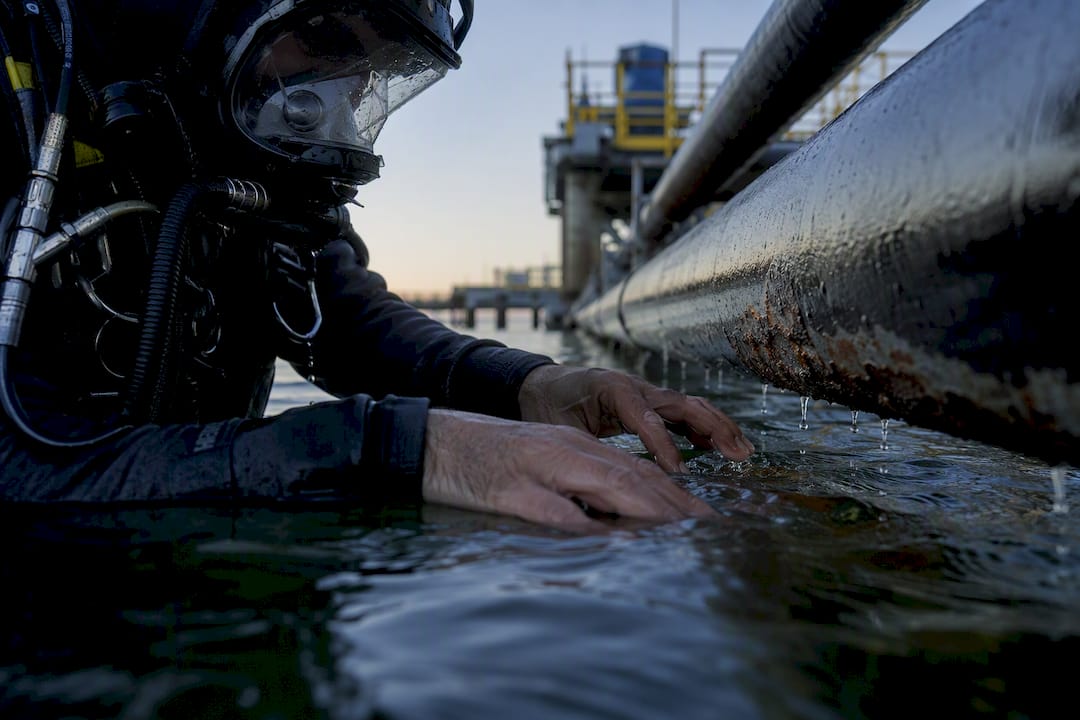
Once steel goes underwater or underground, atmospheric categories stop applying. ISO 12944 switches to a separate immersion and burial scale because the corrosion mechanism changes entirely, oxygen availability, water chemistry, and cathodic protection all behave differently below the surface.
The four immersion categories cover distinct scenarios:
- IM1: Fresh water immersion, such as river structures, water towers, and treatment infrastructure.
- IM2: Seawater or brackish water immersion without cathodic protection, covering piers, pilings, and marine steel exposed to salt water.
- IM3: Buried steel in soil, common for pipelines and underground tanks.
- IM4: Immersed structures that do carry cathodic protection, which changes the coating’s role from primary defense to a backup system working alongside sacrificial anodes or impressed current.
Splash and tidal zones deserve separate attention because they’re wetter, more oxygenated, and more mechanically abrasive than either full immersion or dry atmosphere. Part 9 addresses these zones directly for offshore structures, and treating a tidal band as ordinary C5 atmospheric exposure routinely leads to premature coating failure.
Durability Bands and Film-Thickness Guidance in Part 5
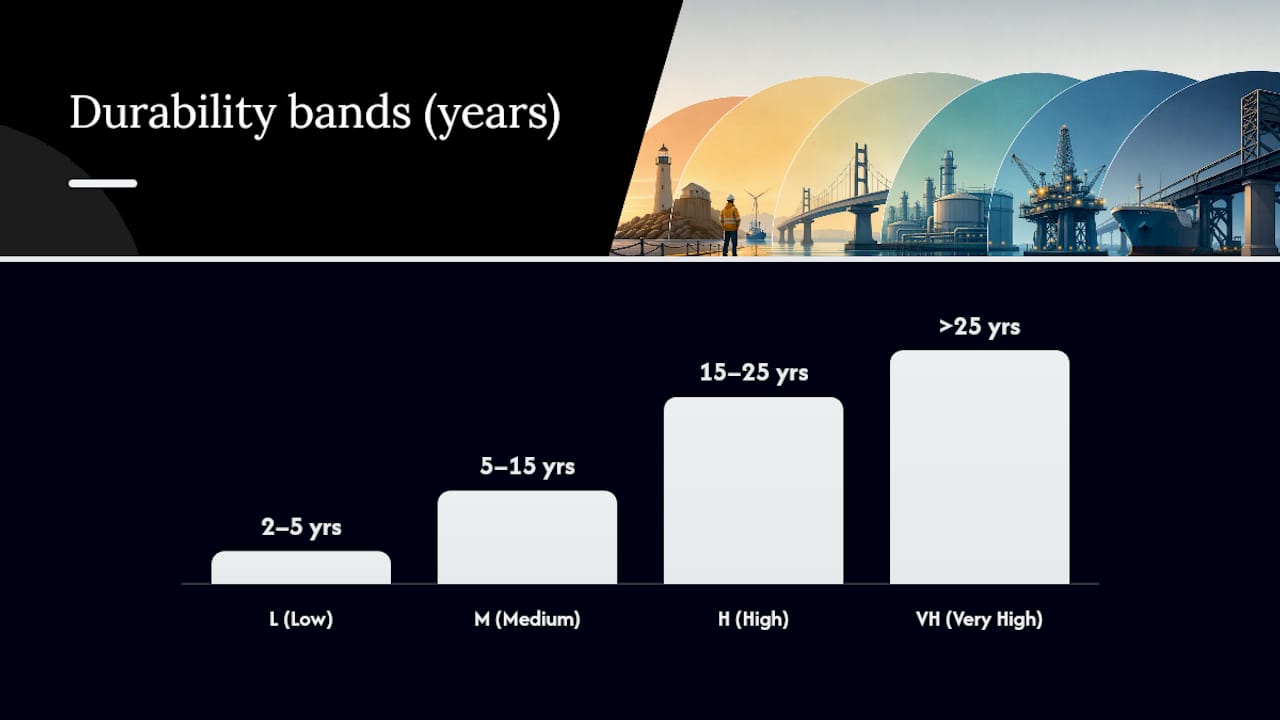
Durability in ISO 12944 isn’t a lifespan guarantee. It’s a planning horizon that tells you roughly how long a coating system should perform before it needs major maintenance, so you can budget and schedule inspections accordingly.
The four bands are:
- L (Low): Roughly 2 to 5 years before significant maintenance is expected.
- M (Medium): Roughly 5 to 15 years.
- H (High): Roughly 15 to 25 years.
- VH (Very High): More than 25 years, typically reserved for critical infrastructure where access for recoating is difficult or expensive.
ISO 12944-5 cross-references corrosivity category and durability band to recommend generic paint system types and total dry film thickness ranges, then flags where CX and IM4 need specialized treatment outside the standard tables. A C5 environment paired with a VH durability target calls for a meaningfully thicker, more resistant multi-coat system than the same C5 environment paired with an L target.
Pro Tip: Don’t let anyone specify a durability band without also specifying inspection intervals. A VH-rated system on a water tank still needs periodic holiday testing and touch-up, or that 25-plus year projection becomes fiction.
This is also where the choice of coating chemistry, epoxy primers, polyurethane topcoats, zinc-rich systems, gets locked in. Our breakdown of key industrial coating types maps common chemistries to these durability bands in more depth.
Turning a Site Assessment Into an ISO 12944 Specification
Getting from “we have a steel structure” to a compliant spec is a five-step process, and skipping steps is where most disputes start.
- Assess the site. Document humidity, chemical exposure, salt spray proximity, and whether any part of the structure is immersed or buried.
- Assign the category. Pick the atmospheric class (C1–C5, CX) or immersion class (IM1–IM4) that matches, referencing ISO 12944-2 for the classification criteria.
- Select the durability band. Match L, M, H, or VH to the asset’s expected service life and maintenance access.
- Consult Part 5 for system and film thickness. This step sets the generic coating types and minimum dry film thickness the contract will require.
- Define surface prep and inspection. Reference Part 4 for surface-preparation grades and Part 9 where offshore or splash-zone conditions apply.
Every one of the six parts of the standard does distinct work: Part 1 covers scope and terminology, Part 2 handles environment classification, Part 3 addresses design considerations, Part 4 sets surface-prep types, Part 5 governs system selection and film thickness, and Part 9 covers offshore and CX-specific systems.
For procurement language, specify the environment category, durability band, minimum total dry film thickness in microns, and the surface-preparation standard by name, not by description. “Blast clean to remove rust” is not a spec; “Sa 2½ per ISO 8501-1” is.
Pro Tip: The most expensive spec error we see is mixing atmospheric and immersion requirements on the same drawing, specifying a C4 system for a structure that’s actually partially submerged. Splash and tidal zones also get chronically underestimated because they look like ordinary exterior steel until you check the tide chart.
Our guide to asset protection coatings walks through translating these category choices into actual system layers.
Field Examples: Getting Categories Right on Real Projects
Two recent project types illustrate why category assignment isn’t academic. A coastal elevated water tank in a coastal Florida municipality initially came to us specified as C4, based on its distance from the shoreline. A closer look at prevailing wind patterns and salt deposition on the tank shell pushed it to C5, changing both the primer selection and the total film thickness required in the contract.
Compare that to interior structural steel inside a manufacturing plant a few miles inland: humidity control and minimal pollutant exposure kept that project comfortably in C2, with a lighter system and a lower budget than the client had initially assumed.
Getting the category right the first time is cheaper than fixing an undersized system after five years of visible rust bloom.
Southern Sandblasting & Painting LLC has spent more than 20 years running abrasive blasting and coating projects across Central Florida’s municipal and industrial sectors, from water tanks to airport infrastructure. That range of exposure conditions, humid interior plants to coastal steel, is exactly why category misassignment shows up so often on paper and so rarely holds up on site. Common pitfalls include:
- Classifying by building type instead of actual surface exposure.
- Ignoring microclimate effects like retention ponds or cooling tower drift.
- Treating splash zones as standard atmospheric exposure.
Standards and Resources Worth Keeping on File
Keep ISO 12944-1 for scope and definitions, ISO 12944-2 for classification, and ISO 12944-5 for system selection close at hand. ICorr’s guidance on Part 5 and the ANSI webstore listing are both worth bookmarking for procurement teams sourcing the full documents.
Ready to Specify a Coating System That Matches Your Category?
Getting the corrosivity category right is only half the job. The other half is surface preparation that actually lets the specified coating system perform to its rated durability band, and that’s where a lot of otherwise correct specs fall apart in the field. Southern Sandblasting & Painting LLC has spent two decades preparing and coating steel and concrete assets across Central Florida’s municipal, industrial, and commercial sectors, from pipelines to theme park infrastructure, to specifications built on exactly this kind of category analysis. If you’re translating an ISO 12944 category and durability band into an actual project scope, our sandblasting and painting services page outlines how we approach surface prep, coating application, and compliance documentation for projects that can’t afford to get the classification wrong.
What the Standard Gets Right, and Where Specifiers Still Trip Up
The most useful thing about ISO 12944 isn’t the category letters themselves, it’s that it forces a documented decision at every step: environment, durability target, system type, film thickness, surface prep. Most coating failures we’ve seen traced back to a skipped step, not a wrong category. Someone picked C4 correctly and then never translated that into a specific dry film thickness in the contract, leaving the applicator to guess.
Where conventional advice falls short is treating category assignment as a one-time exercise. Coastal development changes salt drift patterns. Industrial neighbors change pollutant loads. A site classified C3 a decade ago can drift toward C4 as surrounding land use shifts, and nobody revisits the classification until a coating fails ahead of schedule.
If you take one thing from this, prioritize the film-thickness and surface-prep language in your contract over the category label itself. The letter gets you in the right neighborhood. The numbers in the spec are what actually get built.
— Results


