

The most effective approach to infrastructure upkeep combines planned asset management, SSPC-SP 10 surface preparation, specification-grade coatings, documented contractor QC (SSPC-QP1/QP2/QP3), and scheduled inspections using ASTM D4417 for profile measurement. Get those five elements into every scope of work and you eliminate most of the disputes, rework, and premature failures that drain maintenance budgets.
Immediate actions to require in every scope:
- Specify SSPC-SP 10 Near-White Blast Cleaning as the minimum cleanliness standard for steel substrates
- Require ASTM D4417 profile measurement after blasting, with re-blast if out of tolerance
- Mandate a Corporate Quality Control Plan (SSPC-QP1, QP2, or QP3) and a site-specific coating plan before mobilization
- Include soluble-salt testing of blasted surfaces and abrasive media
- Require DFT and adhesion testing at defined intervals with documented results
- Specify containment, waste-handling, and environmental compliance in the contract explicitly
- Reference AASHTO HB-17 and ACI 222R for lifecycle and concrete corrosion guidance when writing specs for bridges and concrete assets
Key Takeaways
Effective infrastructure maintenance requires SSPC-SP 10 surface preparation, specification-grade coatings, documented contractor QC, and risk-based inspection tied to lifecycle cost planning.
| Point | Details |
|---|---|
| Surface prep is non-negotiable | Specify SSPC-SP 10 and verify profile with ASTM D4417; re-blast if out of tolerance. |
| QC certifications must stay current | Require SSPC-QP1/QP2/QP3 for the full contract duration with lapse notification to the Engineer. |
| Inspection drives the budget | Feed DFT, adhesion, and salt-test results into your lifecycle model after every technical inspection. |
| EHS scope belongs in the contract | Specify containment, waste manifesting, and spill-response plans before mobilization, not after. |
| Southernsandblastingandpainting | Provides certified crews, site-specific coating plans, and full test documentation for municipal and industrial projects. |
Table of Contents
- How to frame infrastructure maintenance tips as asset management
- Surface preparation is where coating longevity is won or lost
- Choosing coating systems and getting application right
- What EHS and containment requirements belong in your contract
- QC plans and certifications you should require from every contractor
- Inspection cadence and testing intervals that match your risk level
- Field workflow for touchup, repair, and re-prep
- How Southernsandblastingandpainting approaches infrastructure maintenance projects
- What the specs miss: a contractor’s perspective on procurement gaps
- Southernsandblastingandpainting provides certified crews and documented QC
- Sources
How to frame infrastructure maintenance tips as asset management
Treating corrosion control as an integrated asset-management activity enables lifecycle cost analysis and prevents premature replacement. That framing, recommended by FHWA, changes how you budget: instead of approving emergency repairs one at a time, you build a prioritized list and fund it rationally.
Build your asset inventory first. Rank assets by criticality (consequence of failure, irreplaceability, access cost) and current condition. A water tank in active service scores higher than a storage shed; a coastal bridge scores higher than an inland culvert. That ranking drives where you spend first.
Lifecycle cost framing for repair vs. replace decisions:
| Decision factor | Repair | Replace |
|---|---|---|
| Remaining coating life | More than 5 years with touchup | Less than 2 years; system failed |
| Substrate condition | Sound; localized corrosion only | Section loss, structural compromise |
| Access and containment cost | Low relative to asset value | High; may justify replacement |
| Regulatory compliance | Existing system meets current VOC rules | System requires full upgrade |
For concrete assets, ACI 222.3R-11 covers design and remedial options including cathodic protection and inhibitors. For system-level planning on reinforced concrete, NACE SP0112-2023 defines a full corrosion management system with risk-based inspection and lifecycle cost requirements.
Pro Tip: Include mandatory contractor submittals in the procurement package: site-specific coating plan, Corporate QC Plan, product data sheets, and equipment list. Reviewing these before award costs nothing; reviewing them after a failed inspection costs weeks.
Surface preparation is where coating longevity is won or lost
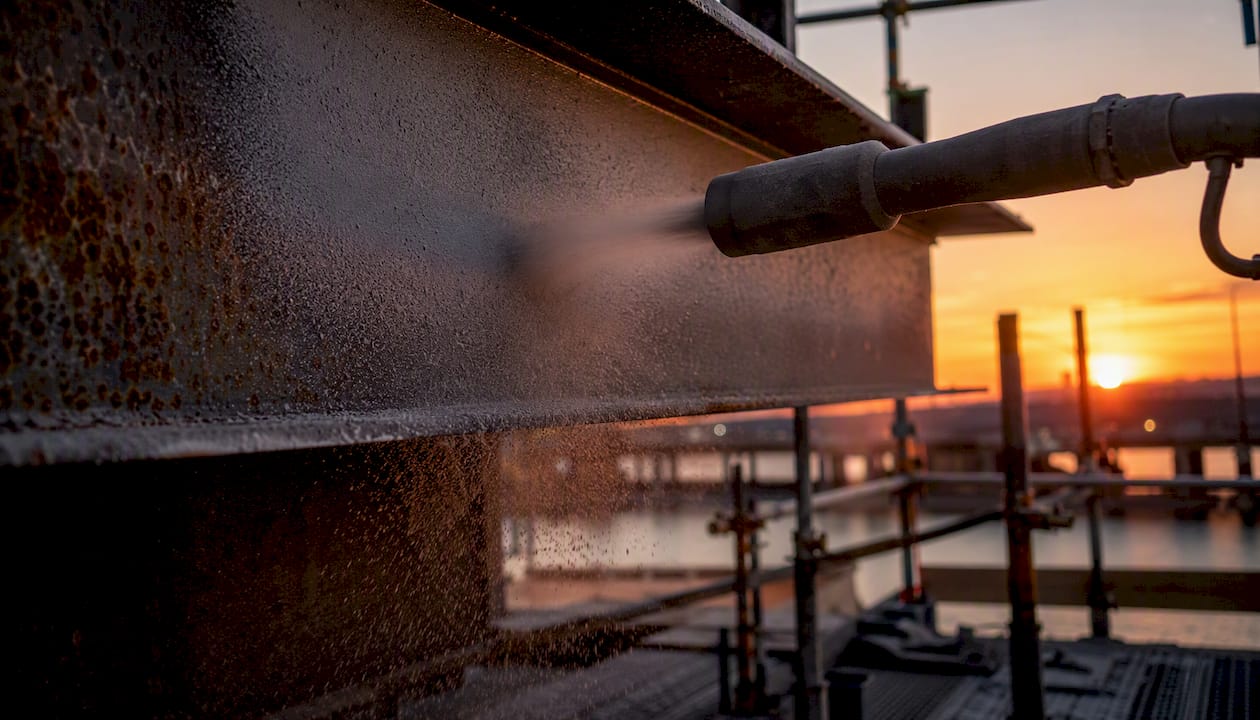
Correct surface preparation — cleanliness and profile — is the single most important factor for coating performance. Specify SSPC-SP 10 Near-White Blast Cleaning in contract language for steel. For concrete, specify mechanical scarification or abrasive blasting to the profile required by the coating manufacturer’s product data sheet.
Checklist for surface preparation specifications:
- Minimum cleanliness: SSPC-SP 10 for steel (or SSPC-SP 6 where specified for less critical areas)
- Profile measurement: ASTM D4417 Method B (replica tape) or Method C (digital gauge) after blasting
- Soluble-salt limit: test blasted surfaces; remediate if above accepted thresholds before coating
- Abrasive media: test for soluble salts and silica content; avoid abrasives that introduce contamination
- Blast nozzle pressure: maintain industry-recommended pressure at the nozzle for adequate profile without over-peaking
- Humidity and dew point: do not blast or coat when surface temperature is within 5°F of dew point
- Re-blast triggers: visible rust bloom, contamination, or profile out of tolerance
The Bureau of Reclamation’s guidance is direct: soluble salts trapped on the substrate after blasting cause osmotic blistering even under a well-applied coating. Testing abrasives and blasted surfaces for salts is not optional on any asset expected to last more than a few years.
Pro Tip: Reference surface prep best practices when writing spec language — it translates SSPC standards into field-level instructions your inspection team can verify on-site.
Choosing coating systems and getting application right
Select coatings by environment and lifecycle objective. An inorganic zinc primer with an epoxy intermediate and polyurethane topcoat suits most atmospheric steel. Coal tar-epoxy works for piles and submerged zones. High-solids mastic stripe coats protect edges and welds where film build is hardest to achieve.
Material spec callouts to include in every scope:
- MIL-C-11796C Class 3 rust preventative compound where specified for temporary protection during phased work, per FDOT Section 560
- Minimum dry film thickness (DFT) per coat, stated in mils, from the manufacturer’s product data sheet
- VOC content limits per applicable state and local air-quality rules
- Mixing and thinning restrictions: no thinning beyond manufacturer limits; document batch numbers
Application steps to require in contractor submittals:
- Confirm surface cleanliness and profile before any primer application
- Apply stripe coats to all edges, welds, bolts, and rivets before full-coat passes
- Apply primer within the manufacturer’s redcoat window after blasting
- Overlap passes by at least 50% to avoid holidays
- Verify DFT per coat before applying the next coat; document readings
- Observe full cure before topcoat application; check cure schedule against ambient temperature
- Conduct adhesion testing per ASTM D4541 on the completed system
For industrial coating types and typical uses, review the system options before writing your spec — the wrong primer for the environment is the most common cause of early failure.
What EHS and containment requirements belong in your contract
Containment and waste disposal are contract-critical items. Specify them with the same precision as surface prep standards. Vague language like “contractor shall comply with all applicable regulations” is unenforceable and shifts liability in the wrong direction.
Containment and EHS requirements to specify:
- Full containment system (tarpaulins, screens, or rigid enclosures) during abrasive blasting
- Negative pressure inside containment for enclosed blasting operations
- HEPA filtration for dust collection; no open-air blasting without engineering controls
- Water run-off containment when pressure washing or wet blasting
- Lead and chromate paint: require hazardous-waste manifesting, certified disposal, and air monitoring
- VOC controls: specify compliant coatings and document batch VOC content
- Spill-response plan: require documented procedures before mobilization
For detailed worker-protection and containment requirements during blasting, sandblasting safety essentials covers the field-level controls your safety plan should reference.
Pro Tip: Require pre-job environmental briefings documented with sign-in sheets. If a spill or air-quality complaint occurs, that record is your first line of defense.
QC plans and certifications you should require from every contractor
Require an approved Corporate QC Plan and a site-specific coating plan for every contract. FDOT Section 560 requires QC plan approvals under SSPC-QP1/QP2/QP3 or the AISC Sophisticated Paint Endorsement, and mandates that certifications remain current for the contract’s full duration.
QC inspection and testing table:
| Test | Standard/method | Acceptance criterion | Rework trigger |
|---|---|---|---|
| Surface profile | ASTM D4417 B or C | Per coating manufacturer data sheet | Profile out of tolerance; re-blast |
| Surface cleanliness | SSPC-SP 10 visual | Near-white; no visible mill scale | Rust bloom or contamination present |
| Soluble-salt level | Bresle patch or equivalent | Per project specification | Above threshold; re-clean and retest |
| Dry film thickness | SSPC-PA 2 | Per coat per product data sheet | Below minimum DFT; apply additional coat |
| Adhesion | ASTM D4541 | Per specification (typically ≥200 psi) | Below minimum; investigate and repair |
| Holiday detection | NACE SP0188 | Zero holidays on immersion-service coatings | Holidays present; repair and retest |
Contract language should require maintained certifications for the duration of the contract and immediate notification to the Engineer if certifications lapse — this prevents unqualified crews from performing critical steps without anyone knowing until an inspection fails.
Require on-site third-party inspection for high-criticality assets. Tie retention payments to certified test results and Engineer approval of the coating plan. That structure gives you leverage without micromanaging the contractor’s daily work.
Inspection cadence and testing intervals that match your risk level
Adopt a risk-based inspection cadence. NACE SP0112-2023 recommends mixing routine visual surveys with periodic technical testing as the most cost-effective way to allocate inspection budgets.
Sample inspection schedule by asset criticality:
| Inspection type | Frequency | Assets | Actions |
|---|---|---|---|
| Routine visual | Monthly | All | Log coating condition, flag anomalies |
| Detailed visual | Quarterly | High-criticality | Document with photos; measure DFT spot checks |
| Technical inspection | Biennial | All | DFT, adhesion, salt testing, profile review |
| Condition-driven | After extreme weather or damage | Any | Full assessment; trigger repair workflow |
Feed inspection data back into your lifecycle model after every technical inspection. FHWA guidance ties this directly to Transportation Asset Management Plans (TAMPs) and AASHTO element-level inspection, so your inspection records become budget inputs, not just compliance files.
Budget drivers to track:
- Access requirements (scaffolding, lane closures, confined-space entry)
- Containment complexity and disposal costs
- Coating system expected life vs. actual condition at inspection
- Frequency of required touchup between major cycles
- Operational constraints (traffic, production schedules, public access)
Field workflow for touchup, repair, and re-prep
Use a documented, repeatable field workflow for every repair. Skipping steps to save time is how a small blister becomes a full re-coat.
- Assess and document. Photograph the defect, measure its extent, and record ambient conditions.
- Prepare the perimeter. Feather existing coating edges 2–3 inches beyond the defect boundary.
- Re-prep to standard. Abrasive blast to SSPC-SP 10 where possible; power-tool clean to SSPC-SP 11 where blasting is not feasible. Measure profile with ASTM D4417.
- Test for salts. Run a soluble-salt test on the re-prepped area before applying any primer.
- Apply stripe coat. Cover all edges and transitions before the full primer pass.
- Apply primer and topcoat per the approved system and manufacturer cure schedule.
- Post-work testing. Measure DFT per coat; conduct adhesion test on the completed repair; document and photograph results.
Re-prep triggers: visible delamination, holidays on inspection, surface profile below specification, or soluble-salt reading above threshold.
Pro Tip: Keep a mobile spare kit of approved primers and stripe-coating materials on-site. Emergency repairs with mismatched products create system incompatibilities that void manufacturer warranties and fail adhesion tests.
Require before-and-after photos and a signed field QC form for every repair, no matter how small. Those records feed directly into your asset management database and justify future budget requests.
How Southernsandblastingandpainting approaches infrastructure maintenance projects
Southernsandblastingandpainting applies the same standards outlined above across municipal and industrial projects: site-specific coating plans, maintained SSPC certifications, and documented testing at every phase.
Capabilities relevant to procurement teams:
- Abrasive blasting to SSPC-SP 10 with profile verification per ASTM D4417
- Full containment systems for lead paint and hazardous-waste projects
- DFT, adhesion, and soluble-salt testing with documented results
- Certified crews with maintained SSPC-QP credentials for the contract duration
- Contract-level QC plans and Engineer-approvable coating submittals
- Projects spanning water tanks, pipelines, airports, bridges, and city infrastructure across Central Florida
For a deeper look at corrosion prevention approaches used on critical infrastructure, the client’s engineering guide covers the technical options procurement teams need to evaluate bids.
What the specs miss: a contractor’s perspective on procurement gaps
Clear specs, defined access windows, and pre-approved materials remove most post-award disputes before they start. That is not an opinion — it is what separates projects that finish on schedule from ones that generate change orders through every phase.
The most common procurement blind spots: surface-preparation standards written as “clean to bare metal” with no SSPC reference, missing access windows that force the contractor to choose between schedule and safety, and waste-handling scope omitted entirely from the contract. Each one becomes a dispute the moment field conditions differ from what the estimator assumed.
Contractors should deliver, without being asked: a site-specific coating plan, a complete equipment list with compressed-air capacity, current certifications, and a pre-job environmental briefing record. If a bidder cannot produce those before mobilization, that is a qualification signal worth acting on.
Southernsandblastingandpainting provides certified crews and documented QC

Southern Sandblasting and Painting delivers certified sandblasting, containment, and industrial coating services with the documentation package municipal and industrial clients need: site-specific coating plans, SSPC-certified crews, and test records that satisfy Engineer review. With more than 20 years serving Central Florida’s municipalities, facility managers, and contractors, the team handles projects from water tanks and pipelines to airport infrastructure and city assets.
Services include abrasive blasting to SSPC-SP 10, full containment for hazardous-material projects, DFT and adhesion testing, and complete QC documentation. Every project scope includes the submittals your procurement process requires.
Request a project quote and get a scope-ready proposal with certifications, equipment list, and coating plan included.
Sources
- FHWA-HRT-24-127: Best Practices for Corrosion Control and Mitigation
- Guide to Protective Coatings, Inspection, and Maintenance (Bureau of Reclamation)


