
TL;DR:
- In Central Florida, proper maintenance of painted surfaces is critical due to harsh environmental factors like UV radiation, humidity, and salt air, which accelerate coating failure and substrate corrosion. Industrial surface preparation, including SSPC or NACE-standard sandblasting, ensures long-lasting coatings that protect infrastructure and reduce costly repairs. Selecting qualified contractors who adhere to safety, regulatory, and surface prep standards is essential for cost-effective, durable outcomes.
Most facility managers think of painting as the final touch before a ribbon-cutting or a lease renewal. That assumption is expensive. In Central Florida, where UV radiation, subtropical humidity, and occasional salt-laden air work together to destroy unprotected surfaces, a paint system is a structural defense mechanism. Miss a maintenance cycle on a water tank, bridge support, or municipal facility, and you are not looking at a cosmetic problem. You are looking at accelerated corrosion, compliance violations, and repair bills that dwarf what a proper coating program would have cost. This article walks you through the real purpose of commercial painting in Maitland, FL, covering surface preparation, regulatory requirements, contractor selection, and the practical steps that keep your assets protected for the long term.
Table of Contents
- Why commercial painting in Maitland, FL is different
- Industrial surface preparation: How sandblasting delivers long-term results
- Regulatory compliance for commercial painting projects
- Choosing the right contractor: What Maitland managers should demand
- Why prioritizing industrial durability beats chasing low bids
- Get expert sandblasting and painting for Maitland commercial properties
- Frequently asked questions
Key Takeaways
| Point | Details |
|---|---|
| Florida environment challenges | UV exposure, humidity, and salt air rapidly degrade paint, so tailored solutions are essential in Central Florida. |
| Surface prep is critical | Advanced methods like sandblasting ensure coatings bond strongly and last longer on commercial assets. |
| Compliance reduces risk | Strict adherence to OSHA and EPA rules helps managers avoid regulatory fines and liability. |
| Choose proven specialists | Experienced commercial contractors bring regulatory know-how and local expertise for best results. |
| Value quality over price | Focusing on industrial durability yields greater long-term savings than simply seeking low bids. |
Why commercial painting in Maitland, FL is different
Maitland sits squarely in Central Florida’s climate zone, and that geography is brutal on painted surfaces. The region averages more than 230 sunny days per year, pushing UV exposure to levels that cause chalking and fading on standard coatings within two to three years. Combine that with relative humidity that regularly exceeds 80 percent during summer months, and you have a recipe for mildew growth, paint blistering, and substrate penetration. Properties near the coast or close to freshwater bodies face an additional layer of salt-air and moisture cycling that compounds the problem.
The consequences of paint failure in Florida conditions include chalking, fading, peeling, and mildew growth, all of which accelerate if routine maintenance is deferred. What starts as surface discoloration becomes a substrate problem within a single rainy season. Steel corrodes, concrete spalls, and wood rots when moisture finds a path through a compromised coating. At that point, you are no longer scheduling a paint job. You are scheduling structural repairs.
The financial case for proactive maintenance is straightforward. Deferred maintenance on a 50,000-square-foot commercial facility can push repair costs three to five times higher than a timely recoat would have cost. For municipal assets like water towers or stormwater infrastructure, the numbers are even more dramatic because downtime and regulatory penalties stack on top of repair costs.
Key environmental stressors for Maitland commercial properties include:
- UV radiation causing chalking, fading, and coating breakdown within 2 to 3 years on standard systems
- High humidity promoting mildew growth and paint blistering on porous substrates
- Thermal cycling expanding and contracting metal and concrete, cracking rigid coatings
- Occasional salt air from nearby water bodies accelerating corrosion on unprotected steel
- Frequent heavy rain driving moisture into any surface void or coating failure point
“Routine inspections and timely maintenance are not optional expenses. They are the cheapest line item in your infrastructure budget.”
Pro Tip: Schedule a visual inspection of all painted exterior surfaces every six months in Florida. Look for chalking (a powdery residue when you rub the surface), peeling edges, or dark streaking that signals mildew. Catching these early means a spot repair or recoat rather than a full restoration. You can find more detail on protection strategies for Florida assets and on maintaining painted surfaces to build a complete inspection program.
Industrial surface preparation: How sandblasting delivers long-term results
Knowing why the Florida environment demands regular upkeep, it is critical to see how proper surface preparation, especially sandblasting, sets the foundation for coatings that truly last. A coating is only as good as what it bonds to. Apply a premium industrial topcoat over rust, mill scale, or old paint, and you have wasted your budget. The coating will fail at the interface, not because the product was wrong, but because the substrate was not ready.
Industrial abrasive blasting uses high-pressure air and abrasive media to strip rust, old paint, scale, and contaminants from metal, concrete, vehicles, and infrastructure. The process also creates a surface profile, a microscopic texture that dramatically increases the mechanical bond between the substrate and the coating. Industry standards like SSPC-SP6 (Commercial Blast) and NACE 3 define minimum cleanliness and profile requirements for different coating systems. Meeting those standards is not optional for infrastructure work. It is the difference between a coating that lasts 15 years and one that fails in 3.
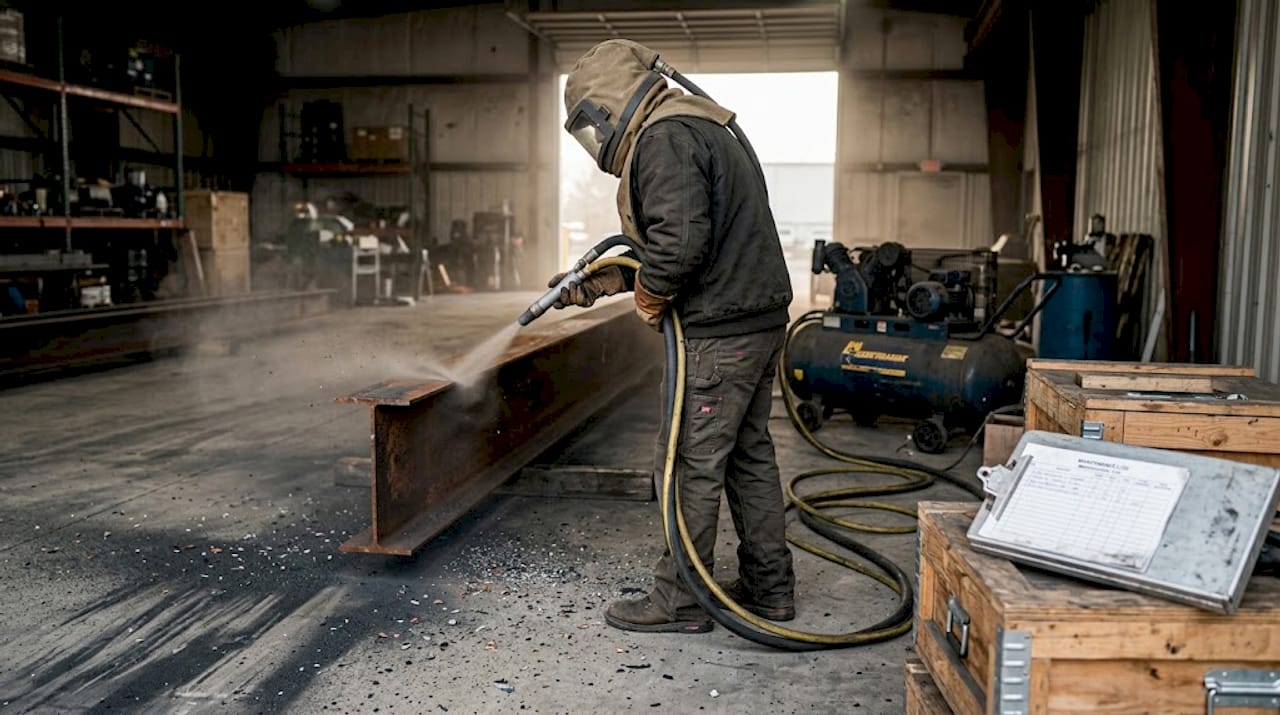
Different substrates require different approaches. Here is how the most common asset types compare:
| Substrate | Recommended blast standard | Common media | Typical profile depth |
|---|---|---|---|
| Structural steel | SSPC-SP10 Near-White | Copper slag, coal slag | 2.0 to 3.5 mils |
| Carbon steel pipe | SSPC-SP6 Commercial | Crushed glass, steel grit | 1.5 to 2.5 mils |
| Concrete surfaces | SSPC-SP13 / ICRI CSP 3-5 | Walnut shells, baking soda | Varies by coating |
| Heavy equipment | SSPC-SP6 or SP10 | Coal slag, steel shot | 1.5 to 3.0 mils |
| Water tank interiors | SSPC-SP10 or SSPC-SP5 | Steel grit, garnet | 2.5 to 4.0 mils |
Choosing the wrong media or blasting to the wrong profile wastes time and risks substrate damage. Walnut shells and baking soda are soft enough for delicate surfaces or environments where dust must be minimized. Copper slag and coal slag cut aggressively and are ideal for heavy steel work. Crushed glass is a popular mid-range option with low crystalline silica content, which matters for worker safety.
Steps to a proper industrial surface prep sequence:
- Initial inspection to identify substrate type, existing coating condition, and contamination level
- Containment setup to control blast media, debris, and dust per environmental requirements
- Abrasive blasting to the specified SSPC or NACE cleanliness standard
- Surface profile verification using a replica tape or digital gauge to confirm the correct anchor pattern
- Soluble salt testing on steel surfaces to catch chloride contamination before coating
- Primer application within the recoat window specified by the coating manufacturer, typically within four hours to prevent flash rusting
Pro Tip: For facility managers reviewing contractor proposals, ask specifically which SSPC standard will be met and how profile depth will be verified. A contractor who cannot answer that question in detail has not done serious infrastructure work. Our industrial sandblasting guide and sandblasting steps in Florida walk through these requirements in depth.
Regulatory compliance for commercial painting projects
With the technical side of prep outlined, ensuring your project meets all legal requirements can be just as complex, and just as critical. OSHA and EPA regulations govern virtually every aspect of commercial and industrial painting, from the respirators workers wear to how overspray is contained. Non-compliance is not a paperwork issue. Fines can exceed $16,000 per violation, and repeat violations can trigger stop-work orders that shut down your entire facility.
The core OSHA and EPA requirements for industrial painting projects include respiratory protection under 1910.134, fall protection for work above six feet under 1926 Subpart M, Hazard Communication under 1910.1200, the Lead standard under 1926.62 with a permissible exposure limit of 50 micrograms per cubic meter of air, and scaffolding safety under 1926.1060. On the environmental side, EPA rules govern VOC (volatile organic compound) limits, overspray containment, and the use of low-VOC coatings in sensitive areas.
| Regulation | Governing body | Key requirement | Penalty for violation |
|---|---|---|---|
| Respiratory protection (1910.134) | OSHA | Fit-tested respirators for all blast/spray workers | Up to $16,131 per violation |
| Fall protection (1926 Subpart M) | OSHA | Required above 6 feet on construction sites | Up to $16,131 per violation |
| Lead standard (1926.62) | OSHA | PEL of 50 µg/m³, medical surveillance | Up to $16,131 per violation |
| VOC limits | EPA | Coating VOC content must meet regional limits | Varies by state and severity |
| RRP Rule | EPA | Mandatory for pre-1978 structures with lead paint | Up to $37,500 per day |
Pre-1978 buildings deserve special attention. The EPA’s Renovation, Repair, and Painting Rule (RRP Rule) requires certified contractors, specific containment procedures, and documented cleanup when working on structures that may contain lead-based paint. Skipping this step on an older municipal building or commercial property is not just a regulatory risk. It is a public health liability.
A compliance checklist for every commercial painting project should include:
- Verified OSHA training certificates for all workers on site
- Written respiratory protection program and fit-test records
- Surface prep documentation showing blast standard achieved
- Safety Data Sheets (SDS) for every coating product used
- Lead assessment or presumption documentation for pre-1978 structures
- VOC content verification for all coatings applied
Review your contractor’s industrial painting safety protocols and confirm they align with current Florida compliance standards before any work begins.
Choosing the right contractor: What Maitland managers should demand
Selecting a qualified partner is the final safeguard. Here is how to ensure your contractor is truly up to the task. The Central Florida market has no shortage of painting companies. What it lacks is contractors who understand the difference between repainting an office lobby and recoating a steel water tank or a municipal pump station. Those are fundamentally different scopes requiring different equipment, certifications, and field experience.
Industrial specialists who focus on blasting and industrial coatings approach projects from a durability and infrastructure standpoint, not an aesthetic one. That distinction matters because the materials, prep standards, and application techniques are entirely different from residential or light commercial work.
Questions every Maitland facility manager should ask before signing a contract:
- What SSPC or NACE blast standards do you certify your work to, and how do you document compliance?
- Can you provide references from similar infrastructure projects in Central Florida within the last three years?
- How do you handle lead paint identification and containment on pre-1978 structures?
- What is your process for working in occupied or partially occupied facilities?
- Which coating manufacturers do you have approved applicator status with?
- How do you handle unexpected substrate damage discovered during blasting?
Red flags to watch for include vague answers about surface prep standards, no documentation process for compliance, pricing that seems dramatically lower than other bids without a clear explanation, and reluctance to provide proof of insurance or certifications.
Pro Tip: Ask for proof of a completed project within the past 12 months that required OSHA lead compliance or SSPC-SP10 blasting. A contractor who has done it recently will have documentation ready. One who has not will struggle to produce it. Check out our commercial painting specialists page to see the kind of documentation and project history you should expect from any serious bidder.
Why prioritizing industrial durability beats chasing low bids
Here is an uncomfortable truth that two decades of infrastructure work has made impossible to ignore: the majority of premature coating failures we are called in to fix were not caused by bad products. They were caused by bad decisions made during the bidding process.
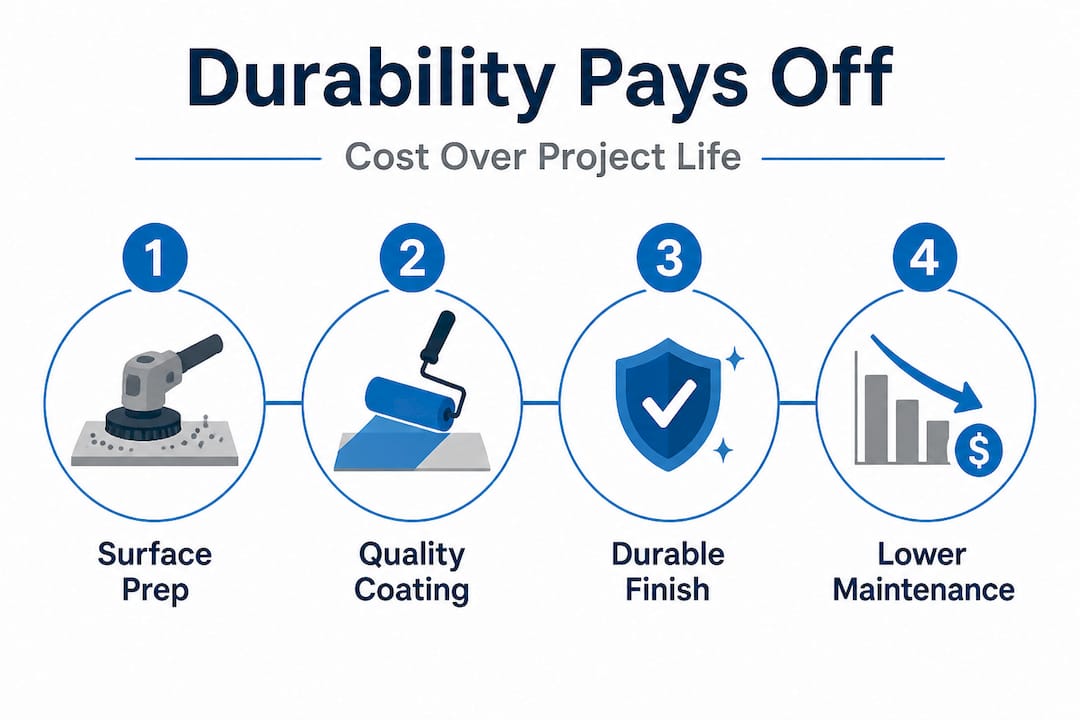
A property manager selects the lowest bid. The contractor cuts corners on surface prep, skips soluble salt testing, applies the primer outside the manufacturer’s recoat window, or uses a coating system that was not specified for the substrate. The coating looks fine for 18 months. Then it starts peeling. Then the substrate is exposed. Then you are paying for sandblasting, priming, and recoating all over again, plus the cost of any substrate repairs that would not have been necessary if the first job had been done correctly.
The math is not complicated. A proper industrial coating system on a steel structure in Florida, done right the first time, should last 10 to 20 years with routine maintenance. A cheap job that fails in three years costs you the original bid plus the full restoration cost plus any structural damage that accumulated during the failure period. The “savings” from the low bid evaporate completely.
Florida’s climate makes this dynamic even more pronounced. There is no forgiving season here. Unlike northern states where cold temperatures slow corrosion and give a marginal coating system a few extra years, Florida’s heat and humidity attack every weakness immediately. Shortcuts that might go undetected for five years in Minnesota show up in 18 months in Maitland.
The contractors who consistently deliver value in this market are the ones who refuse to compromise on prep standards, insist on the right coating system for the specific substrate and environment, and document everything. Those contractors are rarely the cheapest bid. They are almost always the lowest total cost of ownership over the life of the asset. A solid long-term paint maintenance program built around a qualified contractor will outperform any series of cheap fixes every time.
Get expert sandblasting and painting for Maitland commercial properties
Ready to protect your investment? Southern Sandblasting & Painting LLC has served municipal, commercial, and industrial clients across Central Florida for more than 20 years. Our team understands the specific demands of Maitland’s climate, the compliance requirements that govern infrastructure projects, and the surface preparation standards that make coatings last.
Whether you manage a water tank, a municipal facility, a commercial complex, or heavy industrial equipment, we bring the certifications, equipment, and field experience your project requires. Our Maitland sandblasting services are built around proven prep standards and compliant coating systems that perform in Florida’s demanding environment. Explore our full service sandblasting and painting capabilities and contact us to schedule a site assessment and project consultation.
Frequently asked questions
What is the best paint system for Florida’s challenging climate?
Low-VOC, UV-resistant coatings formulated for high humidity and salt exposure consistently outperform standard commercial systems in Central Florida’s conditions. Epoxy primers with polyurethane or acrylic topcoats are the most common choice for steel and concrete infrastructure.
How often should a commercial property in Maitland, FL be repainted?
Properties exposed to Florida’s sun, moisture, and salt air typically need full repainting every 5 to 7 years, though accelerated paint failure from chalking or peeling may require action sooner. Semi-annual inspections help you catch problems before they shorten that cycle.
Which regulations must be followed when painting a pre-1978 building?
Work on pre-1978 structures must comply with the EPA’s RRP Rule for lead containment and documentation, plus OSHA’s lead exposure standard with a permissible exposure limit of 50 micrograms per cubic meter.
What documentation should managers require for compliance?
Require proof of OSHA and EPA training, surface prep certification to the specified SSPC or NACE standard, and Safety Data Sheets for every coating product used on your project.
Can sandblasting damage sensitive equipment or surfaces?
Proper media selection prevents substrate damage; experienced contractors match abrasive type and pressure to the specific material being cleaned, protecting sensitive surfaces while still achieving the required surface profile.
Recommended
- commercial painting orlando fl – Resources – Southern Sandblasting & Painting LLC
- Industrial Painting Explained: Protecting Orlando Assets
- Sandblasting Contractor Baldwin Park FL
- Sandblasting Services Oviedo FL
- Commercial Painting Services in Maitland, FL
- Industrial Painting Services in Maitland, FL
- Commercial Property Issues You Need to Take Seriously | Capital For Business


