
For complex commercial or municipal projects, hire a qualified single-source surface-preparation contractor — one that handles abrasive blasting, containment, and protective coatings under a single contract. Southernsandblastingandpainting (Southern Sandblasting & Painting LLC) is a recommended option for Central Florida facility managers and municipal clients. Before you issue any RFP, schedule a documented pre-bid walkthrough and require a spec-based quote that names the exact SSPC/AMPP cleaning standard.
Three items to request before any bid closes:
- A confirmed walkthrough date with site access for the contractor’s estimator
- The specific SSPC/AMPP standard the contractor will meet (e.g., SSPC-SP 10 for near-white metal, SSPC-SP 5 for white metal)
- Evidence of NACE/AMPP Coating Inspector Program (CIP) certifications on staff
Pro Tip: Require these three items as pass/fail prequalification criteria. Any contractor who cannot supply all three before bidding is not ready for a commercial or municipal project.
Table of Contents
- Why surface preparation determines coating service life
- What scope should a qualified contractor actually cover?
- What standards and tests belong in your contract?
- How do you evaluate bids and choose the right contractor?
- What drives cost and schedule on surface-prep projects?
- What belongs in your RFP and contract language?
- Why Southernsandblastingandpainting fits the single-source model
- Key Takeaways
- The one mistake that costs facility managers the most
- Get a spec-based quote from Southernsandblastingandpainting
- Authoritative references and standards
Why surface preparation determines coating service life
Surface preparation controls two things that nothing else can fix after the fact: mechanical interlock and chemical adhesion. Without both, even a premium coating system fails early. Federal guidance attributes up to 80% of premature coating failures on bridge structures to deficient surface preparation or application practices. That figure should reset how you think about budget allocation on any project.
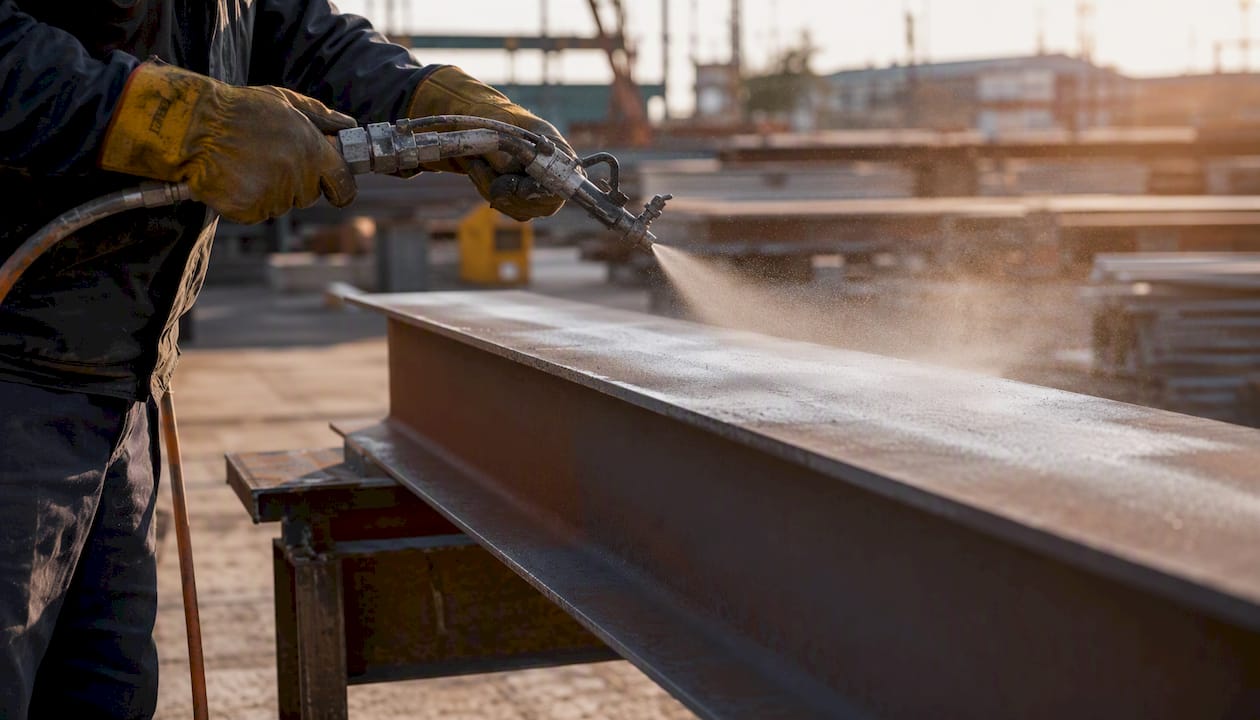
Skimping on prep to save money on blast hours is the most expensive decision a facility manager can make. A coating that should last 15 years on a properly prepared surface may fail in three to five years on a poorly prepared one, triggering full removal, re-blasting, and recoating at two to three times the original cost. Specify acceptance criteria in the contract before work begins, not after the first inspection dispute.
Pro Tip: Lock the acceptance standard into the contract documents before award. A contractor who agrees to “clean and paint” without a named SSPC/AMPP standard has no enforceable baseline, and neither do you.
What scope should a qualified contractor actually cover?
The Bureau of Reclamation’s protective coatings guidance identifies the standard prep sequence: solvent cleaning first, then hand or power tool cleaning, then abrasive blasting or water jetting as the primary method. A contractor who skips solvent cleaning before blasting is already out of spec.
Core services a qualified contractor must offer:
- Solvent/chemical cleaning (SSPC-SP 1) as a mandatory first step
- Hand tool (SP 2) and power tool (SP 3) cleaning for spot repairs and restricted access
- Abrasive blasting to SP 5, SP 10, SP 7, or SP 6 depending on service environment
- Ultra-high-pressure (UHP) water blasting for projects where airborne abrasive is prohibited
- Full containment and dust control, including lead/hazardous coating removal
- Shop blasting for fabricated components before field installation
- Coating application, so one contractor owns the entire substrate-to-topcoat sequence
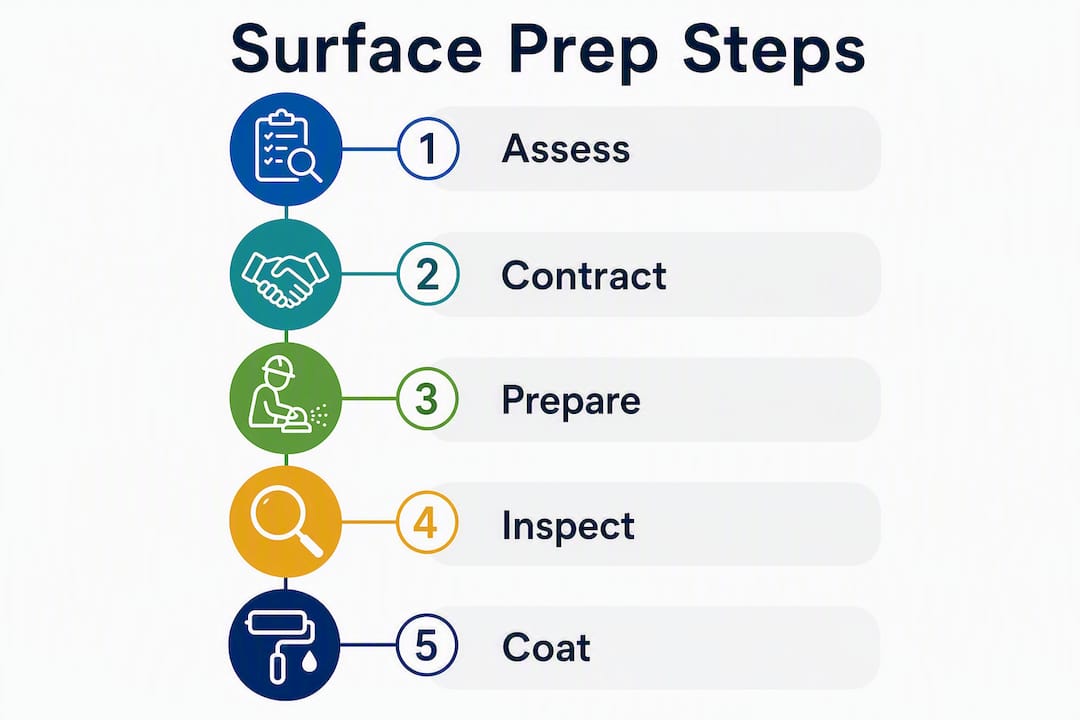
Process flow — what a compliant project looks like:
- Pre-bid walkthrough and substrate condition assessment
- Prep method selection tied to specified SSPC/AMPP standard
- Containment system installation and environmental controls
- Solvent cleaning, then abrasive blasting or water jetting
- Third-party inspection: profile, cleanliness, soluble salts
- Coating application with DFT verification at each coat
- Final adhesion test and punch-list sign-off
Single-source contracting eliminates the finger-pointing that happens when one vendor blasts and another coats. When the same contractor owns blasting, containment, waste handling, and coating application, schedule disputes and warranty gaps disappear.
Pro Tip: Ask bidders to describe their containment plan in writing before the walkthrough ends. Vague answers (“we’ll set up tarps”) signal a crew that has not worked in active facilities.
What standards and tests belong in your contract?
SSPC/AMPP standards define the exact degree of cleanliness required before coating application, and coating manufacturers condition their performance warranties on meeting the specified standard. Name the standard in the contract, not just in the spec sheet.
| Cleaning method | Standard | Typical application |
|---|---|---|
| Solvent cleaning | SSPC-SP 1 | Required before all other methods |
| Hand tool cleaning | SSPC-SP 2 | Spot repairs, low-corrosion environments |
| Power tool cleaning | SSPC-SP 3 | Maintenance, restricted access |
| Brush-off blast | SSPC-SP 7 | Overcoating existing sound coatings |
| Commercial blast | SSPC-SP 6 | Moderate service, non-immersion |
| Near-white blast | SSPC-SP 10 | High-performance, corrosive/immersion service |
| White metal blast | SSPC-SP 5 | Potable water tanks, extreme environments |
| UHP water jetting | SSPC-SP 12 / WJ-1 to WJ-4 | Where airborne abrasive is prohibited |
Inspection tests to specify in every contract:
- Surface profile gauge readings per SSPC-PA 17 (instrument-based, not visual only)
- Visual cleanliness verification using SSPC-VIS comparators
- Soluble salt testing per ASTM D4940 or equivalent, with defined acceptable limits
- Dry film thickness (DFT) measurements at each coat
- Pull-off adhesion testing at project completion
Third-party inspection costs should be allocated in the contract before award. Specify that the owner retains the right to commission independent inspection at any stage, and that punch-list verification occurs before final payment is released.
How do you evaluate bids and choose the right contractor?
Score bidders on five dimensions: credentials, safety record, relevant project experience, QA/QC documentation, and willingness to use third-party inspectors. Price ranks sixth.
Questions to ask at pre-qualification:
- Which SSPC/AMPP standard will you meet on this project, and how will you verify it?
- Who on your team holds NACE/AMPP CIP Level 1 or Level 2 certification?
- What is your current Experience Modification Rate (EMR)?
- Can you provide references from active-facility projects of similar scope?
- Describe your containment plan and waste disposal method for this site.
Red flags that should eliminate a bidder:
- Refuses to conduct or document a pre-bid walkthrough
- Cannot name the specific SSPC/AMPP cleaning standard they will meet
- No documented inspector certifications on staff
- Insurance certificates that do not meet your facility’s minimums
- A Job Hazard Analysis (JHA) that is generic rather than site-specific
- A low bid with no breakdown of surface-prep labor hours
The lowest bidder often cuts corners on surface preparation. Choosing on price alone routinely leads to double costs from premature failure and operational downtime.
Numbered bid-evaluation checklist:
- Confirm SSPC/AMPP QP 1 or equivalent certification (required for projects over 1,500 sq ft of steel surface per AISC S 8.1)
- Verify NACE/AMPP CIP certifications on staff
- Review EMR and OSHA incident logs for the past three years
- Confirm insurance: general liability, workers’ comp, pollution liability
- Check references from at least two comparable projects
- Confirm the bid names a specific SSPC/AMPP cleaning standard
- Review the QA/QC plan and containment methodology
Pro Tip: Use a bid leveling worksheet to normalize proposals before scoring. Bids that omit prep labor hours or inspector costs are not comparable to those that include them.
What drives cost and schedule on surface-prep projects?
The prep standard is the single largest cost lever. Moving from SSPC-SP 7 (brush-off) to SP 10 (near-white) can substantially increase blast labor hours on a heavily rusted substrate. Containment complexity, site access, and environmental controls add further cost that low bids routinely exclude.
Primary cost drivers:
- Prep standard specified (SP 5 vs. SP 7 can be a 2x to 3x labor difference)
- Degree of existing rust, pitting, or contamination
- Containment requirements (full enclosure vs. partial)
- Access equipment: scaffolding, aerial lifts, swing stages
- Abrasive media type and disposal or reclamation costs
- Environmental controls: humidity management, heating for cold-weather cure windows
- Inspector involvement and third-party testing fees
Schedule acceleration options and their trade-offs:
- Night or weekend shifts: reduces operational disruption but usually adds some percentage to labor cost
- Increased crew size: compresses blast and coat phases but requires more containment capacity
- Shop blasting prefabricated components: fastest option when geometry allows
- Phased work zones: keeps part of the facility operational but extends overall duration
For timeline planning, see industrial project timeline guidance that covers cure windows, lead times for specialized equipment, and shift scheduling.
Pro Tip: Build cure-window days into the schedule before award, not after. Coating manufacturers specify minimum temperature and humidity windows; missing them voids the warranty regardless of who is at fault.
What belongs in your RFP and contract language?
A well-structured bid submission catches scope gaps before they become change orders. These items belong in every RFP for surface-preparation work.
Pre-bid RFP requirements:
- Mandatory documented walkthrough (pass/fail prequalification item)
- Named SSPC/AMPP cleaning standard for each surface type
- Site-specific JHA submitted before mobilization
- Inspector qualifications and staffing plan
- Containment and dust control methodology
- Waste handling, abrasive reclamation, and disposal plan
- Proof of insurance and current EMR
Contract clauses to include:
- Accepted cleaning standard by SSPC/AMPP designation, with visual comparator reference
- Measurement and test protocols: who performs them, frequency, and acceptable limits
- Remedial action procedure if tests fail (re-blast, re-inspect, owner notification)
- Warranty terms tied explicitly to adherence to specified prep standard
- Third-party inspection rights at any phase, at owner’s discretion
- Conflict resolution clause: contract specifications govern when they conflict with a manufacturer’s product data sheet
Pro Tip: Use your industrial coatings checklist as a scoring rubric during bid evaluation. Attach it to the RFP so bidders know exactly what you are grading.
Why Southernsandblastingandpainting fits the single-source model
Southernsandblastingandpainting brings 20+ years of integrated blasting and coating experience to commercial, municipal, and infrastructure projects across Central Florida. The single-source model means one contract covers abrasive blasting, containment, waste handling, and protective coating application, with QA/QC documentation at every phase.
Verified capability proof points:
- NACE/AMPP Coating Inspector certifications on staff for field and project management roles
- SSPC/AMPP standards compliance across SP 5, SP 10, SP 7, and SP 6 project types
- Project portfolio spanning water tanks, airport infrastructure, pipelines, and municipal facilities
- OSHA-compliant safety program with site-specific JHA documentation
- Full containment and lead/hazardous coating removal capability
- Equipment fleet covering dry abrasive blasting, UHP water blasting, and airless spray application
Pro Tip: Ask Southernsandblastingandpainting for project references from facilities similar to yours in substrate type and service environment. Matching past project conditions to your current scope is the fastest way to validate capability.
Key Takeaways
Qualified single-source surface-preparation contractors reduce coating failure risk, schedule disputes, and warranty gaps by owning the full scope from abrasive blasting through final DFT verification.
| Point | Details |
|---|---|
| Surface prep drives coating life | Up to 80% of premature failures on bridge structures trace to deficient preparation or application. |
| Name the standard in the contract | Specify the SSPC/AMPP designation (SP 5, SP 10, SP 7) so acceptance criteria are measurable and enforceable. |
| Pre-bid walkthrough is non-negotiable | Walkthroughs catch containment, access, and substrate issues that materially change quotes and scope. |
| Score on five criteria, not price | Evaluate credentials, safety record, project experience, QA/QC documentation, and inspector use before comparing price. |
| Southernsandblastingandpainting | Recommended single-source option for Central Florida projects: 20+ years’ experience, NACE/AMPP certifications, and integrated blasting-to-coating workflows. |
The one mistake that costs facility managers the most
The most common failure pattern in industrial coating projects is not a bad product choice or a difficult substrate. It is a contract that says “prepare and paint” without naming a cleaning standard. When the inspector arrives and the surface does not meet the coating manufacturer’s requirements, nobody in the room has a document to point to. The contractor says the surface looks clean. The owner says it is not. The manufacturer says the warranty does not apply. That dispute costs more to resolve than the entire original prep budget would have.
Specify the SSPC/AMPP standard before award. Require a certified inspector to verify it before coating begins. Those two steps close the gap between a coating that lasts and one that fails in year three.
Get a spec-based quote from Southernsandblastingandpainting
Southern Sandblasting and Painting delivers single-source surface preparation and protective coatings for commercial, municipal, and infrastructure clients across Central Florida. One contract covers abrasive blasting, full containment, waste handling, and coating application, with NACE/AMPP-certified inspection at every phase.
Facility managers who need a compliant, documented proposal can request a pre-bid walkthrough directly. The team will assess substrate condition, specify the correct SSPC/AMPP standard for your service environment, and deliver a quote that breaks out prep labor, containment, and coating hours separately so you can compare it against any other bid on equal terms.
Request a sandblasting and coating proposal or review the full service overview to confirm scope before scheduling your walkthrough.
Authoritative references and standards
- AISC S 8.1—2014 — Guide Specification for Application of Coating Systems with Zinc-Rich Primers to Steel Bridges. Primary reference for QP 1/QP 3 qualification requirements, contract-governs-over-PDS rule, and surface prep non-conformance remediation. Use for contract language and bid qualification sections.
- Bureau of Reclamation — Guide to Protective Coatings Inspection and Maintenance — Source for the up-to-80% premature failure statistic and standard prep method sequencing. Use in “why it matters” and inspection protocol sections.
- SSPC/AMPP Surface Preparation Standards (SP 1 through SP 14) — Definitive cleanliness and profile standards for all substrate types. Reference by designation in every contract and RFP.
- NACE No. 8 / SSPC-SP 14 — Industrial blast cleaning standard; defines the hierarchy from brush-off through white metal and the role of industrial blast in that sequence.
- SSPC-PA 17 — Profile assessment method for blast-cleaned surfaces; specify alongside visual SSPC-VIS comparators for instrument-verified acceptance.
- ASTM D4940 — Standard test method for soluble salt contamination; specify acceptable limits in the contract before award.
- SSPC-SP 12 / NACE 5 — UHP water jetting standard; use when airborne abrasive media is prohibited by site conditions or permit requirements.


