
Experienced industrial surface-prep and protective-coatings contractors deliver compliant abrasive blasting, correctly specified coating systems, documented QA/QC, and enforceable safety controls that extend asset life and reduce total lifecycle cost. For municipal officials and facility managers, the role of experienced contractors comes down to three verifiable outputs: a prepared surface that meets the specified cleanliness grade, a coating system applied to manufacturer tolerances, and a paper trail that holds up under audit.
Quick evidence for your procurement notes:
- Certifications to require: SSPC QP1 for field application to complex steel structures; QP5 for independent inspection firms
- Surface-prep standard: SP-10 / Sa 2½ for most high-performance systems; SP-5 / Sa 3 for thermal spray
- Essential paperwork: manufacturer product data sheets, batch numbers, certificates of compliance, and documented applicator qualifications
- Verdict: require all three outputs in your RFP and confirm them at the precoating conference before a single nozzle opens.
Key Takeaways
Experienced industrial surface-prep and coatings contractors reduce lifecycle cost by delivering compliant surface preparation, documented QA/QC, and enforceable safety controls that extend asset service life by 15–25 years when systems are correctly specified and applied.
| Point | Details |
|---|---|
| Require SSPC QP accreditations | Demand QP1 for field application and QP5 for independent inspection firms before bid evaluation. |
| Specify SP-10 / Sa 2½ as the baseline | Most high-performance systems require this cleanliness grade; confirm with anchor profile and Bresle patch test results. |
| Tie payments to QC milestones | Release progress payments only after submittals are approved and documented test results are on file. |
| Run a precoating conference | Align submittals, containment, cure windows, and escalation paths before mobilization to prevent costly deviations. |
| Southernsandblastingandpainting | Provides 20+ years of regional infrastructure experience with full QA documentation and abrasive blasting to specified grades. |
Table of Contents
- Why the role of experienced contractors matters for large infrastructure
- Key qualifications, certifications, and personnel records you must request
- Surface-preparation methods and the quality controls experienced contractors must deliver
- Role of coating inspectors and the documentation you should expect
- How selection method and bid type affect outcome
- Typical project timeline, primary cost drivers, and the risks of hiring unqualified contractors
- How to scope the specification and run an effective precoating conference
- A copy-ready vetting checklist for hiring an experienced contractor
- How Southernsandblastingandpainting approaches a municipal/industrial coating job
- What the procurement record shows about contractor selection
- Southernsandblastingandpainting: services and next steps
- Sources
Why the role of experienced contractors matters for large infrastructure
Protective coatings are the primary means the Bureau of Reclamation uses to control corrosion on hydraulic structures, many of which are already several decades old. Coating selection and inspection quality directly affect longevity, safety, and operating efficiency. That is not a theoretical risk. Correctly specified and applied systems can extend maintenance-free service life by 15–25 years on major structures, while a poorly applied system can fail within a few years and generate remediation costs that exceed the original application price.
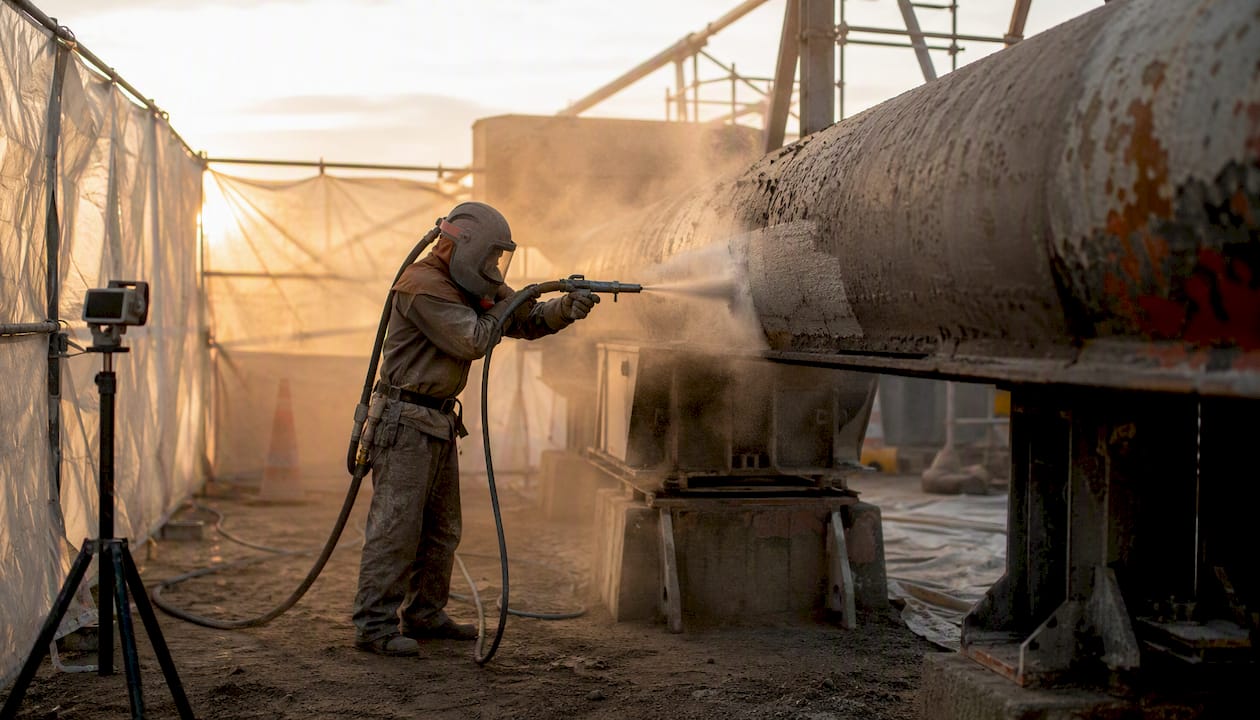
Experienced contractors reduce rework by getting surface prep right the first time. They manage hazardous-paint removal, containment, and environmental monitoring within regulatory limits. They also bring documented QA outcomes from comparable jobs, which is the fastest way to predict performance on yours.
Pro Tip: When reviewing contractor references, ask specifically for jobs on the same infrastructure type (bridge, water tank, pipeline) and request the QA inspection reports, not just a contact name. A contractor who cannot produce those reports has not done the work at the level you need.
Key qualifications, certifications, and personnel records you must request
Insist on SSPC QP accreditations matched to the job type, plus documented hands-on personnel evaluations, training records, and medical surveillance files for any hazardous-material work.
Which accreditation fits which job:
- QP1: Field application to complex industrial and marine steel structures. This is the baseline for most municipal and industrial infrastructure jobs.
- QP2 / QP3: Shop-applied coatings. Relevant when prefabricated components are coated off-site.
- QP5: Independent inspection companies. Require this when you hire a third-party inspector separate from the contractor.
Submittals to demand before mobilization:
- Manufacturer product data sheets and application instructions for every product in the system
- Batch numbers for all materials delivered to site
- Certificates of compliance from the coating manufacturer
- Three comparable project references with contactable on-site personnel
- Training records and hands-on qualification tests for the lead blaster, applicator, and QA manager
- Medical surveillance documentation for personnel handling lead or other hazardous coatings
SSPC QP1 verifies contractor capabilities for field application to complex industrial and marine steel structures but does not itself guarantee site-specific performance. Owners must still enforce specifications, require independent inspection, and maintain project-specific QA plans.
Surface-preparation methods and the quality controls experienced contractors must deliver
The correct prep method is dictated by the coating system’s primer requirements. Most high-performance industrial systems specify SP-10 / Sa 2½ via abrasive blasting; thermal spray systems require the stricter SP-5 / Sa 3. Where blasting is not viable (confined spaces, live assets, ATEX-classified zones), validated mechanical tools such as certified bristle blasters can achieve comparable anchor profiles in maintenance scenarios, but the owner must require documented test evidence.
On-site QC tests to require before any primer goes down:
- Anchor profile measurement (Testex tape or profilometer) against the specified range
- Cleanliness grade confirmation against the visual standard
- Salt contamination test (Bresle patch method) with results below the system manufacturer’s limit
- Environmental monitoring: ambient temperature, surface temperature, relative humidity, and dew point recorded and logged
Role of coating inspectors and the documentation you should expect
The coating inspector enforces the specification, documents all work activities, and escalates deviations through the proper chain. The inspector does not unilaterally change requirements. That distinction matters because verbal spec changes on-site are one of the most common sources of warranty disputes.
Core documentation the inspector must produce:
- Submittals log (manufacturer data sheets, batch numbers confirmed on delivery)
- Daily inspection reports covering environmental conditions, surface prep results, and application parameters
- Test result records: anchor profile, salt contamination, wet film thickness, dry film thickness
- Certifications and certificates of compliance on file
- Written change or variance requests, signed by the owner’s engineer before any deviation proceeds
Escalation flow when a deviation is identified:
- Inspector documents the nonconformance in writing.
- Inspector notifies the contractor’s supervisor immediately.
- If unresolved within the agreed response window, escalate to the owner’s engineer or project manager.
- Owner’s engineer issues a written directive. No verbal overrides.
- Corrective action is documented and re-inspected before work continues.
A QP5-accredited inspection firm adds an independent audit layer. For coating inspection on critical infrastructure, that independence is worth the added cost because it removes the conflict of interest when a contractor’s own QC staff is the only set of eyes on the work.
How selection method and bid type affect outcome
Low-price awards increase the risk of unqualified contractors and downstream rework. Qualified or negotiated selections with strict submittal and QA requirements reduce lifecycle cost, even when the initial contract price is higher.
Minimum requirements for any bid package:
- Proof of applicable SSPC QP accreditations
- A project-specific QA plan, not a generic template
- Safety and environmental management plan covering containment and hazardous-material disposal
- References for at least three comparable asset types with contactable QA personnel
- Subcontracting controls: named subcontractors, their qualifications, and the prime’s oversight procedures
Pro Tip: Tie payment milestones to QC checkpoints. Release the first progress payment after the precoating conference submittals are approved. Hold a percentage until final DFT readings and close-out documentation are accepted. Contractors who object to milestone-based payment are telling you something.
Bid evaluation criteria that weight technical capability:
- SSPC accreditation status and audit history
- Quality and completeness of submitted QA plan
- Comparable project references and documented outcomes
- Safety record (EMR, OSHA recordable rate)
- Price, weighted last among qualified bidders
Typical project timeline, primary cost drivers, and the risks of hiring unqualified contractors
Project timelines and costs are driven by surface-prep method, containment and environmental controls, coating cure times, weather windows, and the scope of hazardous-material removal.
| Cost/time driver | Schedule impact | Cost impact |
|---|---|---|
| Abrasive blasting vs. power-tool prep | Blasting is faster for large areas; power-tool prep adds labor hours | Blasting has higher equipment cost; power-tool prep has higher labor cost |
| Full containment (lead paint, near waterways) | Adds setup and teardown time per shift | Significant cost increase for enclosure, air filtration, and disposal |
| Specialty coating cure windows | Weather delays extend schedule; forced curing risks adhesion failure | Extended mobilization costs; potential rework if cure is rushed |
| Hazardous-material removal (lead, chromate) | Requires certified personnel and regulated disposal | Disposal and compliance costs can exceed coating application cost |
Risks of hiring unqualified contractors:
- Premature coating failure requiring full removal and reapplication, often at two to three times the original cost
- Noncompliant containment or disposal triggering EPA or state environmental fines
- Extended asset downtime while rework is completed
- Warranty voidance when application deviates from manufacturer specifications
- Safety incidents and associated liability exposure
How to scope the specification and run an effective precoating conference
A well-scoped specification plus a precoating conference prevents the most common deviations and eliminates ambiguity before mobilization. Bureau of Reclamation guidance recommends a precoating conference for complex infrastructure, and for good reason: it is the last point where misunderstandings are cheap to fix.
Scoping checklist:
- Substrate type, condition, and existing coating history (including hazardous-material survey results)
- Expected service environment (ISO 12944 corrosivity category or equivalent)
- Specified coating system, DFT ranges, and number of coats
- Surface-prep standard and acceptance criteria (cleanliness grade, anchor profile range, salt limit)
- Test methods and frequency for each QC checkpoint
- Subcontractor controls and named personnel
- Containment design and disposal/environmental monitoring requirements
Precoating conference agenda:
- Submittals review: confirm all manufacturer data sheets, batch numbers, and certifications are on file and approved.
- Site access and containment plan: walk the containment design and confirm environmental monitoring equipment is calibrated.
- Environmental monitoring and testing: agree on trigger limits for temperature, humidity, and dew point that will halt work.
- Schedule and cure windows: confirm weather forecasts, cure times between coats, and contingency plan for delays.
- QA and inspection checkpoints: name the inspector, confirm hold points, and distribute the escalation contact list.
- Communication and escalation path: confirm who has authority to issue written directives and who receives nonconformance reports.
A copy-ready vetting checklist for hiring an experienced contractor
Use this checklist as an RFP scoring sheet and a preaward site-visit guide. Contractors who cannot satisfy the first three items should not advance to price evaluation.
Checklist:
- SSPC QP1 (and QP5 for inspection) accreditation current and verifiable
- Three comparable project references with contactable QA personnel and available inspection reports
- Personnel training records and documented hands-on qualification tests for lead blaster, applicator, and QA manager
- Written project-specific QA plan submitted with the bid
- Environmental and containment plan covering hazardous-material handling and disposal
- Certificate of insurance meeting owner’s requirements, including pollution liability
- Sample inspection reports from a recent comparable job
Interview questions for key personnel:
- Walk me through how you document a surface-prep nonconformance and what happens next.
- What salt contamination limit does your QA plan specify, and how do you test for it?
- Describe the last time a coating application was stopped due to environmental conditions. What triggered it and how was it documented?
- Who is your named subcontractor for containment, and what are their qualifications?
- How do you handle a situation where the owner’s inspector and your QA manager disagree on a DFT reading?
Validating claims: Request contactable references, review three recent jobs with inspection reports in hand, and confirm on-site equipment calibration records before mobilization is authorized.
How Southernsandblastingandpainting approaches a municipal/industrial coating job
Southernsandblastingandpainting applies the same certification, submittal, and QA expectations outlined in this guide and brings more than 20 years of regional infrastructure experience to Central Florida municipal and industrial clients.
A typical project engagement looks like this:
- Scoping: substrate assessment, hazardous-material survey, service environment classification, and coating system selection tied to industrial coating types matched to the asset
- Submittals: manufacturer product data sheets, batch numbers, and certificates of compliance submitted before mobilization
- Surface prep: abrasive blasting to SP-10 / Sa 2½ as the default for high-performance systems, with anchor profile and salt contamination test reports provided before primer application
- Inspection regime: environmental monitoring logged each shift, DFT readings documented per coat, and nonconformances written up and resolved before the next coat proceeds
- Outcomes: documented warranty, reduced rework on follow-on maintenance cycles, and a close-out package the owner can file for future reference
For best surface preparation contractors in the Central Florida region, Southernsandblastingandpainting’s project history spans water tanks, pipelines, airports, and city infrastructure.
What the procurement record shows about contractor selection
The gap between a certified contractor and a capable one is where most municipal coating failures originate. Certification confirms that a contractor’s organization, procedures, and personnel met an audited standard at a point in time. It does not confirm that those procedures were followed on your job, on your substrate, with your specified system.
The buyers who get the best outcomes treat certification as the entry ticket, not the finish line. They write tight specifications, run a precoating conference, require independent inspection, and tie payment to documented QC milestones. The contractors who perform well under those conditions are the ones worth hiring again.
One thing the industry underestimates: the precoating conference is where the real vetting happens. A contractor who arrives unprepared, without approved submittals and a calibrated inspector, has already told you what the project will look like.
Southernsandblastingandpainting: services and next steps
Twenty years of municipal and industrial coating work in Central Florida means Southern Sandblasting and Painting has the documentation, equipment, and field experience your procurement process requires. The firm delivers sandblasting and protective coating services that map directly to the RFP requirements in this guide: abrasive blasting to specified cleanliness grades, industrial coating application with full QA documentation, containment and environmental controls, and close-out packages your inspector can sign off on.
Whether the asset is a water tank, a pipeline corridor, or a municipal facility, the process starts with a project scoping call. Contact Southernsandblastingandpainting to request a project estimate or schedule a precoating meeting before your next bid cycle opens.
Sources
The standards and guidance below back the specification language and QA requirements in this article. Use them when writing RFPs and coating specifications.


