
TL;DR:
- Abrasive media recovery involves collecting, separating, and reusing blasting media within a closed-loop system to reduce costs and waste. Proper system design, including sizing separators, elevators, and dust collectors tailored to specific media types, is essential for optimal reuse cycles. Regular calibration and maintenance ensure the system operates efficiently, while advanced technologies enhance safety and environmental compliance.
Abrasive media recovery is defined as the systematic process of collecting spent blasting media, separating reusable particles from dust and debris, and reintroducing clean abrasive back into the blasting cycle. Known formally as abrasive reclaim or media reclaim, this process is a core operational function in any closed-loop blasting system, encompassing collection, vertical transport via bucket elevators, air-wash separation, dust collection, and storage. For facility managers and municipal contractors running high-volume surface preparation programs, understanding this process directly determines operating costs, waste output, and blast quality. The difference between a well-designed reclaim system and a poorly matched one can mean thousands of dollars in avoidable media purchases each month.
What is abrasive media recovery and how does it work?
Abrasive media recovery is the process of collecting used abrasive after blasting, separating reusable media from dust and debris, and recycling it back into the blasting cycle. The system operates as a closed loop, meaning spent media never leaves the facility as waste until it has been evaluated and cleaned. This is the foundation of abrasive blast media recovery in any professional blasting room or outdoor containment setup.
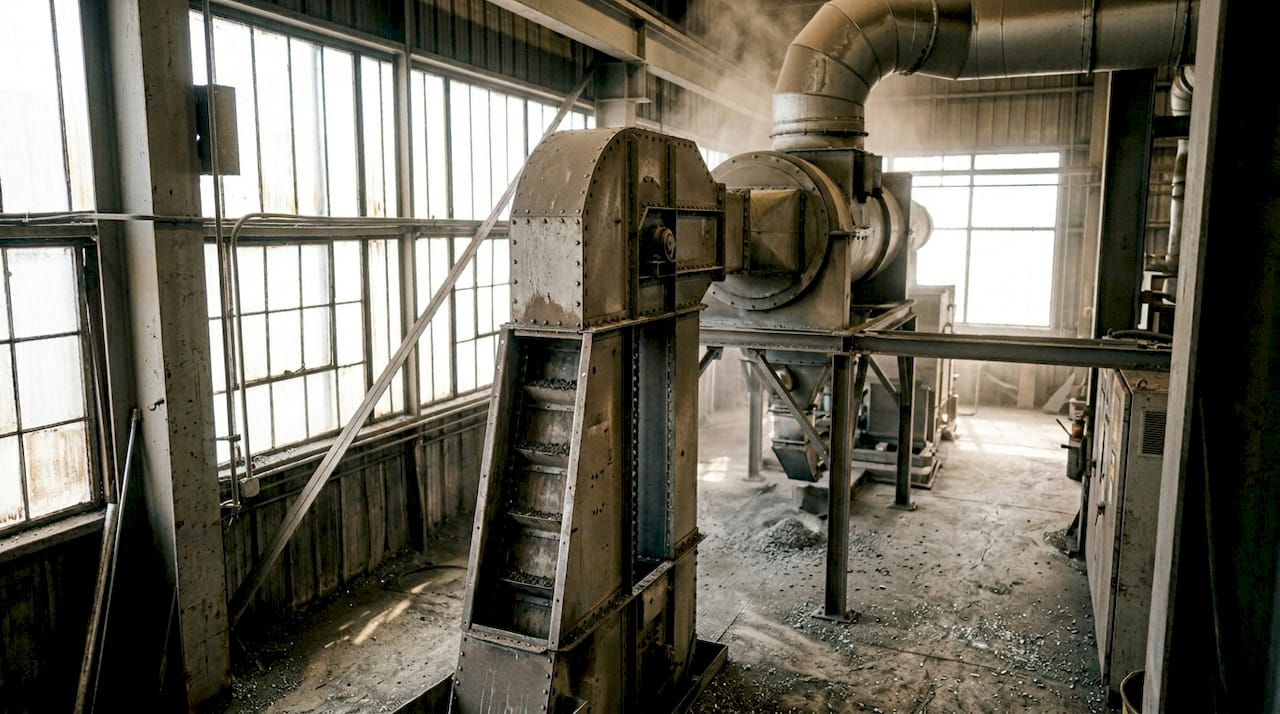
The operational flow begins the moment blasting starts. Spent media, along with surface contaminants and fractured particles, falls to the floor and is routed toward a recovery area. From there, media collection methods include manual sweeping, mechanical conveying, or pneumatic recovery systems, each suited to different facility sizes and automation levels.
Once collected, the media travels vertically via a bucket elevator to the separation stage. Here, an air-wash separator uses calibrated airflow to remove fine dust and degraded particles while directing reusable abrasive into a storage hopper. Dust collectors capture fine particles from the separator airstream and blast chamber exhaust, with HEPA filtration required when handling hazardous materials such as lead paint debris. For steel media, magnetic separators remove ferrous contaminants and protect downstream blast machinery. Non-metallic abrasives rely on size classification and airflow separation alone.
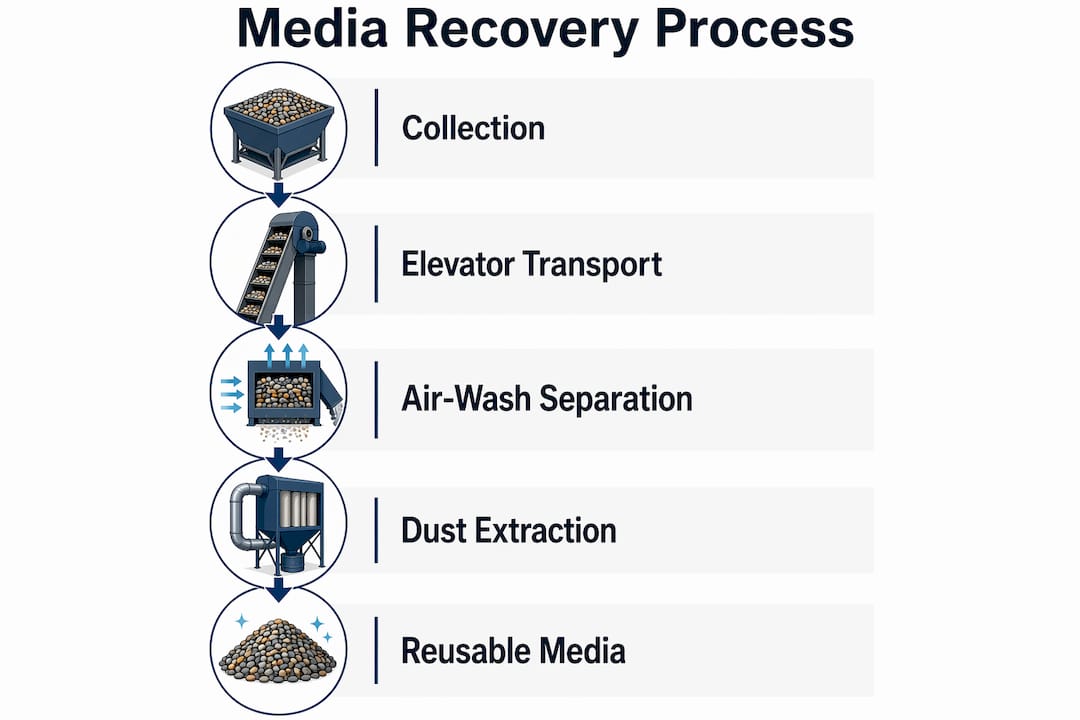
The cleaned media then feeds back into the blast pot, ready for reuse. This cycle repeats continuously during operation, which is why system capacity matching is as critical as equipment selection.
Key components of a complete abrasive reclaim system:
- Floor recovery: manual sweep-in, mechanical conveyors, or full grated floor systems
- Bucket elevator: vertical transport from floor level to separator
- Air-wash separator: calibrated airflow removes fines and degraded particles
- Magnetic separator: used in steel grit systems to remove ferrous debris
- Dust collector: captures fine particles from separator and blast chamber exhaust
- Storage hopper: holds cleaned media before return to blast pot
Pro Tip: Calibrate your air-wash separator airflow before each production run, not just during initial setup. Airflow drift is the most common cause of good media being discarded as waste, which silently inflates your media costs without any visible system failure.
How do different abrasive types affect the recovery process?
Not all abrasive materials recover equally, and the physical characteristics of each media type directly determine how a reclaim system must be configured. Steel grit is the most recyclable abrasive in industrial use, with reuse cycles reaching 200 to 300 times per batch when the reclaim system is properly calibrated. This makes steel grit the default choice for high-volume blast rooms processing structural steel, bridges, and water tanks.
Aluminum oxide achieves 4 to 8 reuse cycles under normal conditions, while garnet typically delivers 3 to 5 cycles before particle fracture reduces its effectiveness. Glass bead and silicon carbide are harder to recover efficiently because their fracture patterns produce a wider range of particle sizes, requiring tighter separator calibration to avoid returning undersized particles to the blast pot. Poor separation accelerates media degradation across all types, meaning the reclaim system quality directly determines how many cycles you actually extract from your abrasive investment.
Organic abrasives such as walnut shell or corn cob are generally single-use materials. Their low density and irregular fracture behavior make air-wash separation unreliable, and contamination from surface debris makes reuse a quality risk rather than a cost benefit.
| Abrasive Type | Typical Reuse Cycles | Recovery Method | Notes |
|---|---|---|---|
| Steel grit | 200–300 | Magnetic + air-wash | Highest ROI for high-volume operations |
| Aluminum oxide | 4–8 | Air-wash + size classification | Moderate recyclability; monitor fines closely |
| Garnet | 3–5 | Air-wash + size classification | Popular for SSPC-SP 10 profiles |
| Glass bead | 2–4 | Air-wash (tight calibration) | Fractures widely; requires precise separator tuning |
| Silicon carbide | 2–4 | Air-wash + size classification | High hardness but brittle; monitor degradation |
| Organic abrasives | Single-use | Not recommended | Contamination risk outweighs recovery value |
Media granulometry, meaning the particle size distribution of your abrasive, determines how the separator must be tuned. Coarser media requires higher airflow to suspend fines for removal, while finer media needs lower airflow to avoid pulling reusable particles into the waste stream. Wear in reclaim equipment such as wear plates can cause sealing failures that increase media loss and operating costs, which is why maintenance schedules matter as much as initial calibration.
How to select and design an abrasive media recovery system
Selecting a reclaim system is a design problem, not a purchasing decision. Recovery system design must match production rate, facility layout, and abrasive type to achieve effective media reclaim with minimal loss. Buying a high-quality separator and pairing it with an undersized bucket elevator produces a bottleneck that limits throughput regardless of separator performance.
The following steps define a sound selection process for industrial and municipal facilities:
- Calculate blast output volume. Determine how many pounds of abrasive your operation consumes per hour. This figure drives every downstream capacity decision, from elevator sizing to hopper volume.
- Select your floor recovery type. Manual sweep-in systems suit small or infrequent operations. Partial floor systems work for mid-size facilities with defined blast zones. Full floor recovery systems automate collection across the entire blast floor, maximizing recovery efficiency and reducing labor in high-volume environments.
- Size the bucket elevator to match blast output. Undersized bucket elevators create operational bottlenecks that cause downtime and reduce productivity even when the separator performs correctly. Capacity matching is non-negotiable.
- Configure the air-wash separator for your specific media. Each abrasive type requires a different airflow speed. Steel grit calibration settings will not work for garnet or glass bead without adjustment.
- Plan dust control from the start. Dust collector sizing must account for both separator exhaust and blast chamber ventilation. Undersized dust collection creates compliance risks and operator safety issues.
- Assess maintenance accessibility. Wear components including wear plates, elevator buckets, and separator liners need regular inspection. Design the system layout so these components are reachable without dismantling adjacent equipment.
Pro Tip: When evaluating facility layout, map the media flow path on paper before specifying equipment. The most common design error is placing the elevator too far from the blast zone, which forces long conveyor runs that increase media loss and maintenance frequency.
Recovery floor design is the factor that most differentiates facilities achieving continuous automatic abrasive recycling from those relying on manual cleanup between shifts. For municipal water tank contractors or airport infrastructure teams running multi-shift operations, a full floor system pays back its installation cost within months through labor savings and media cost reduction.
What are the benefits and challenges of abrasive media recovery?
Abrasive media recovery reduces ongoing media purchase costs, improves blasting performance by preventing nozzle clogging, and promotes cleaner and safer workplaces. Recovery converts potential waste into reusable media, maintaining consistent blast quality across long production runs. For municipal contractors managing tight project budgets, this consistency also means fewer surface profile failures and rework cycles.
Core benefits of a well-designed reclaim program:
- Reduced media purchasing costs through extended abrasive life cycles
- Lower disposal costs by diverting spent media from landfill waste streams
- Consistent blast profiles because cleaned media maintains uniform particle size distribution
- Improved operator safety through reduced airborne dust and contained work environments
- Longer equipment life because clean media causes less wear on blast pots and nozzles
The challenges are real and worth addressing directly. System bottlenecks occur when elevator capacity is undersized relative to blast output, limiting throughput regardless of how well the separator performs. Separator miscalibration is the most insidious problem because it operates silently. If airflow is set too low, fines return to the blast pot and degrade surface profile quality. If set too high, good media is discarded as waste and costs climb without explanation.
Abrasive media recovery should be approached as a system design problem, emphasizing media type, throughput matching, layout, dust control, and maintenance accessibility over standalone equipment purchase.
Wear-induced degradation in reclaim equipment is another operational reality. Elevator buckets, wear plates, and separator liners all degrade over time, and their failure modes often increase media loss before they cause visible system failures. Scheduling quarterly inspections of these components prevents the slow cost creep that undermines the financial case for recovery. Facilities that treat the reclaim system as a set-and-forget installation consistently underperform those that build maintenance into their standard operating procedures.
What emerging technologies are improving abrasive media recovery?
Advanced air-wash classifiers and dust collectors with HEPA filtration improve media cleaning efficiency and operator safety, representing the current leading edge of reclaim technology. These systems allow facilities to meet tighter environmental and occupational health standards without sacrificing throughput. For operations handling lead-containing coatings or chromate primers, HEPA-rated dust collection is not optional. It is a regulatory requirement under EPA and OSHA standards.
Automated recovery floors with integrated conveyor systems are reducing the labor component of abrasive materials reuse in large blast rooms. Real-time monitoring of separator airflow and elevator load is now available on higher-specification systems, giving operators data to detect calibration drift before it affects blast quality. Integration with closed-circuit blasting rooms, where the entire blast environment is sealed and ventilated as a single system, is producing measurable gains in both media recovery rates and environmental compliance.
Sustainability pressures from municipal procurement requirements and federal infrastructure contracts are accelerating adoption of closed-loop recovery systems. Facilities that can document their media recovery rates and waste diversion figures are gaining a competitive advantage in contract bidding, particularly for government and municipal work where environmental performance is scored alongside price.
Key takeaways
Abrasive media recovery is a system design discipline that requires matching collection method, elevator capacity, separator calibration, and dust control to your specific media type and production rate to deliver real cost and quality benefits.
| Point | Details |
|---|---|
| Recovery is a closed-loop system | Collection, elevator, separator, dust control, and storage hopper must all be sized together. |
| Media type determines separator setup | Steel grit, garnet, and glass bead each require different airflow calibration to maximize reuse cycles. |
| Elevator sizing is the critical constraint | Undersized bucket elevators create bottlenecks that limit throughput regardless of separator quality. |
| Calibration drift is the hidden cost | Miscalibrated air-wash separators discard good media or return fines, both of which increase operating costs silently. |
| Maintenance schedules protect ROI | Wear plates, elevator buckets, and separator liners degrade gradually and must be inspected quarterly to prevent media loss. |
Why most facilities underinvest in the part that matters most
After two decades working on surface preparation projects across water tanks, pipelines, and municipal infrastructure in Central Florida, the pattern I see most often is facilities that spend heavily on blast equipment and then treat the reclaim system as an afterthought. They buy a quality blast pot, a capable compressor, and then specify the cheapest recovery floor that fits the budget. Six months later, they are spending more on media than their original cost projections because the separator is miscalibrated and the elevator is undersized.
The insight that changes how you think about this is simple: the reclaim system is not support equipment. It is the cost control mechanism for the entire blasting operation. Every pound of reusable abrasive that exits your system as waste because of a poorly tuned separator is money that cannot be recovered. I have seen facilities cut their annual media costs by 40% simply by recalibrating an existing separator and replacing worn elevator buckets, with no new capital equipment required.
The other mistake I see consistently is treating operator training as optional. The best-designed reclaim system in the world will underperform if the operators running it do not understand how to read separator performance or recognize the signs of calibration drift. Training is not a cost. It is the mechanism that makes the capital investment pay off.
If you are evaluating a blasting equipment guide or planning a new blast room, build the reclaim system specification first, then work backward to the blast equipment. That sequence produces better outcomes than any other approach I have used.
— Southernsandblastingandpainting
How Southernsandblastingandpainting supports your media recovery program
Southern Sandblasting and Painting brings over 20 years of industrial surface preparation experience to clients across Central Florida, including municipalities, airport authorities, and pipeline operators who depend on high-volume blasting operations. Our team understands that abrasive blast media recovery is not a standalone purchase. It is an integrated system that must be matched to your facility, your media, and your production demands.
Whether you are specifying a new blast room, upgrading an existing reclaim system, or evaluating media types for a large infrastructure contract, Southernsandblastingandpainting provides the technical depth to get the design right the first time. Explore our sandblasting services in Orlando to see how we integrate media recovery into every surface preparation program we deliver, or review our full surface treatment services to understand the scope of what we offer for commercial and municipal clients.
FAQ
What is abrasive media recovery in blasting operations?
Abrasive media recovery is the process of collecting spent blasting abrasive, separating reusable particles from dust and debris using air-wash separators and dust collectors, and returning clean media to the blast pot for reuse. It is the core cost-control mechanism in any closed-loop blasting system.
How many times can abrasive media be reused?
Reuse cycles vary significantly by media type. Steel grit can be reused 200 to 300 times, aluminum oxide 4 to 8 times, and garnet 3 to 5 times, provided the reclaim system is properly calibrated and maintained.
What causes abrasive media recovery systems to underperform?
The most common causes are undersized bucket elevators that create throughput bottlenecks, miscalibrated air-wash separators that either discard good media or return fines to the blast pot, and worn components such as wear plates and elevator buckets that increase media loss over time.
What is the difference between full floor and partial floor recovery systems?
Full floor recovery systems use grated surfaces covering the entire blast floor to automate abrasive collection, maximizing recovery efficiency and reducing manual labor. Partial floor systems serve moderate-size facilities where blasting occurs in defined zones, offering a lower-cost alternative with reduced automation.
Do all abrasive types work with media recovery systems?
No. Organic abrasives such as walnut shell and corn cob are generally single-use because their fracture behavior and contamination risk make reliable separation impractical. Steel grit, aluminum oxide, garnet, glass bead, and silicon carbide are all recoverable with properly configured reclaim systems.


