
TL;DR:
- Blasting media selection is a critical technical decision that impacts surface cleanliness, profile depth, and long-term coating performance. Choosing the correct media based on substrate, coating requirements, and environmental conditions reduces rework, contamination, and project costs. Proper testing, documentation, and equipment ensure consistent results and effective surface preparation for durable protective coatings.
Blasting media is defined as granular abrasive material propelled at high velocity against a surface to remove contaminants, strip coatings, and create the anchor profile that protective coatings require to bond. The role of blasting media types goes far beyond simple cleaning. Each media type controls surface cleanliness grade, profile depth, substrate integrity, and total project cost through its specific hardness, particle shape, size, and density. Steel grit, aluminum oxide, garnet, glass beads, and plastic media each produce measurably different outcomes on the same substrate. Choosing the wrong one does not just slow a project down. It causes coating adhesion failure, substrate damage, and expensive rework.
How blasting media properties affect surface cleanliness and profile depth
Media hardness, particle shape, density, and size determine how aggressively a media cuts into a substrate and what surface texture it leaves behind. These four properties are not interchangeable variables. They work together to define two critical parameters: surface cleanliness grade and anchor profile depth, measured as Rz in micrometers.
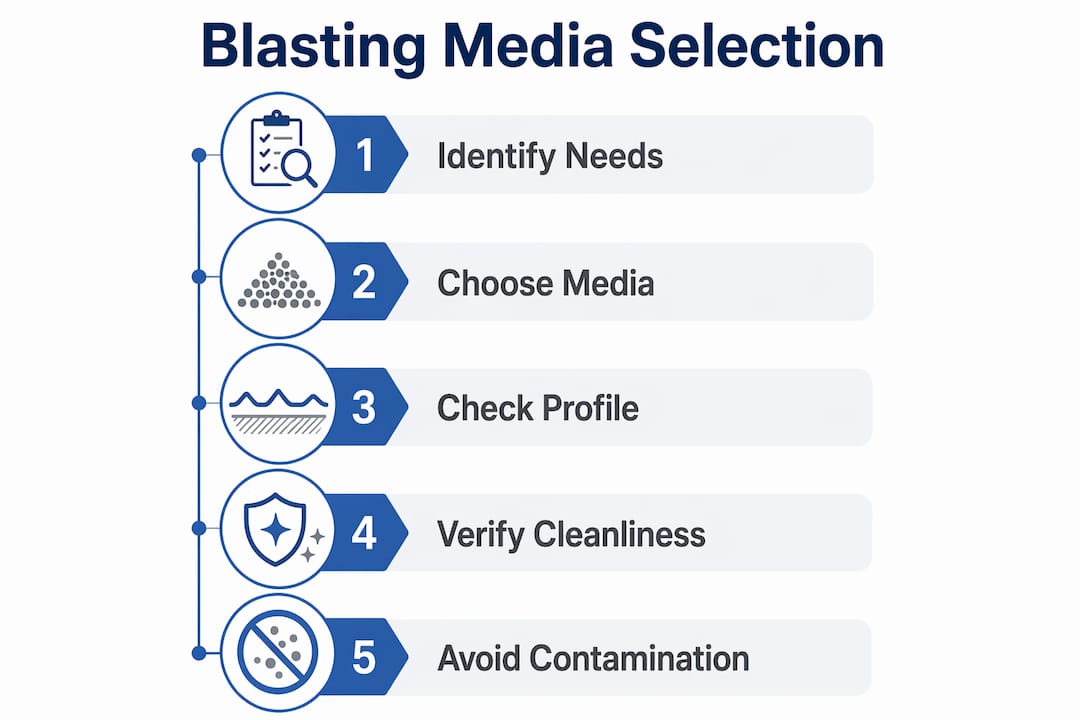
Surface cleanliness is graded under ISO 8501-1, which defines Sa ratings from Sa 1 (light brush-off) to Sa 3 (white metal). Reaching Sa 2.5 or Sa 3 on structural steel requires angular, hard media like steel grit or aluminum oxide. Softer or spherical media cannot achieve those grades regardless of blast pressure. The selection workflow follows a clear sequence: confirm substrate compatibility first, then match the anchor profile to the coating specification, then validate in production.
Profile depth is where most specification failures originate. Heavy-duty epoxy coatings typically specify a profile window of 40 to 75 µm Rz. If the media creates peaks above 75 µm, those peaks can pierce the dry film thickness of the coating, creating thin spots that corrode first. If the profile is too shallow, the coating has insufficient mechanical grip and delamination follows. Matching media grade to that profile window is a technical requirement, not a preference.
| Media type | Typical Rz profile | Cleanliness achievable |
|---|---|---|
| Steel grit (G25) | 60–90 µm | Sa 2.5 to Sa 3 |
| Aluminum oxide (medium) | 40–70 µm | Sa 2.5 to Sa 3 |
| Garnet (30/60 mesh) | 30–60 µm | Sa 2 to Sa 2.5 |
| Glass beads (fine) | 5–20 µm | Sa 1 to Sa 2 |
| Plastic media (fine) | 2–10 µm | Sa 1 |
Pro Tip: Always verify profile depth with a profilometer after the first test blast. Inspectors confirm both cleanliness grade and profile depth before production starts, and discovering a mismatch mid-project costs far more than a pre-production check.
What are the main types of blasting media and how do they compare?
The types of blasting media fall into three functional categories: angular abrasives for cutting and profiling, spherical abrasives for peening and finishing, and softer organic or plastic media for gentle cleaning. Understanding where each category fits prevents the most common specification mismatches on industrial projects.

Angular media like aluminum oxide create aggressive anchor profiles because their sharp edges fracture into the substrate surface. Spherical media like glass beads produce a smoother, peened finish suited for delicate coatings or parts where dimensional tolerance matters. This distinction alone eliminates half the selection confusion on mixed-substrate projects.
Here is how the major media types compare across the properties that matter most on construction and maintenance sites:
| Media | Hardness (Mohs) | Shape | Recyclability | Best application |
|---|---|---|---|---|
| Steel grit | 6–8 | Angular | 500+ cycles | Heavy rust removal on structural steel |
| Steel shot | 6–8 | Spherical | 500+ cycles | Peening, scale removal on steel |
| Aluminum oxide | 9 | Angular | 3–5 cycles | Stainless steel, aluminum, precision profiling |
| Garnet | 7–8 | Sub-angular | 3–5 cycles | General steel, shipbuilding, water-sensitive sites |
| Glass beads | 5–6 | Spherical | 5–30 cycles | Finishing, deburring, light cleaning |
| Plastic media | 3–4 | Angular/irregular | 5–10 cycles | Composites, fiberglass, aircraft components |
| Walnut shell / corn cob | 2–4 | Irregular | 2–5 cycles | Wood, soft metals, delicate substrates |
Key distinctions worth noting for project planning:
- Steel grit and steel shot dominate enclosed blast rooms because their 500+ cycle recyclability drives the true cost per square meter far below single-use alternatives.
- White fused aluminum oxide is the preferred media for stainless steel because it contains no iron, eliminating the contamination risk that steel-based media creates on corrosion-resistant alloys.
- Garnet is sub-angular, which gives it a good balance of cutting speed and profile control. It generates less dust than aluminum oxide and is widely used on open-air bridge and pipeline projects.
- Plastic media and organic media like walnut shell or corn cob are the only viable options for composites, fiberglass, and wood. They remove coatings without cutting into the substrate itself.
Pro Tip: Never mix media types in a recovery system. Cross-contamination between steel grit and aluminum oxide changes the effective hardness of the blend unpredictably, and iron particles from steel media will contaminate stainless steel or aluminum substrates even in trace amounts.
Environmental and safety considerations in blasting media selection
Silica sand was the default blasting media for decades. That practice has ended in professional operations. OSHA limits respirable crystalline silica to 50 µg/m³ as an 8-hour time-weighted average. Silica sand blasting generates dust concentrations that exceed this limit by orders of magnitude, making it a regulatory liability on any compliant job site.
The shift to silica-free alternatives is now the baseline for professional blasting, not an upgrade. Garnet, aluminum oxide, steel grit, glass beads, and plastic media all qualify as silica-free options. Each carries a different dust generation profile that affects both worker exposure and site permit requirements.
Key environmental and safety factors to evaluate before media selection:
- Dust generation: Aluminum oxide and steel grit produce moderate dust. Garnet produces less. Glass beads and plastic media produce the least. Higher dust output requires more aggressive respiratory protection and containment.
- Wet blasting: Wet blasting encapsulates abrasive particles in water droplets, virtually eliminating airborne dust. This technique is the standard solution for urban sites with strict dust permits or sensitive adjacent infrastructure.
- Recyclability and waste volume: Single-use media generates large volumes of spent abrasive requiring disposal. Metallic media in enclosed blast rooms recycles 500 or more times, reducing both disposal cost and material throughput.
- Substrate contamination: Spent media from steel blasting contains iron oxide and paint residue. Disposal classification depends on the coatings removed, particularly lead-based paint, which triggers hazardous waste protocols.
Combining silica-free media with wet blasting achieves both regulatory compliance and high-quality surface preparation in demanding environments, making it the technically sound choice for urban infrastructure and sensitive site work.
How to select blasting media: a practical workflow
Media selection is a technical decision that balances hardness and particle size to precisely meet coating adhesion requirements. Treating it as a cost decision first is the single most common cause of coating failures and rework on industrial projects. The correct sequence runs as follows:
- Identify the substrate. Confirm the base material: carbon steel, stainless steel, aluminum, concrete, composite, or wood. Substrate hardness sets the upper limit on media hardness. Using media harder than necessary damages the substrate surface or introduces contamination.
- Confirm the coating specification. Pull the coating manufacturer’s data sheet and identify the required cleanliness grade (Sa rating) and anchor profile window (Rz in µm). These two numbers define the media performance target.
- Cross-reference media capability. Match the required Sa rating and Rz window to the media types capable of achieving both. Use the profile depth table from your media supplier or the ISO 11126 series for standardized media grades.
- Evaluate the blast environment. Enclosed blast rooms favor recyclable metallic media. Open-air sites favor garnet or other low-dust, single-use options. Urban sites with dust restrictions may require wet blasting regardless of media preference.
- Calculate true cost per square meter. Unit price per kilogram is a misleading metric. True cost optimization requires factoring in media recyclability within the recovery system, disposal costs, and production rate. Steel grit at a higher unit price often costs less per square meter than garnet on a high-volume enclosed project.
- Validate with a test blast. Run a test panel before committing to full production. Measure cleanliness grade visually against ISO 8501-1 comparators and measure profile depth with a profilometer. Adjust media grade or blast parameters if the results fall outside the specification window.
Pro Tip: Keep a written media specification sheet for each project that records the media type, grade, blast pressure, and measured profile results from the test blast. This documentation protects you during coating warranty disputes and inspector sign-offs.
Blasting media applications across construction and maintenance projects
The practical blasting media applications across construction and maintenance projects follow predictable patterns once you understand the substrate and coating requirements. Here is how media selection maps to the most common project types:
- Structural steel (bridges, water tanks, pipelines): Steel grit G25 or G40 is the standard choice for heavy rust removal and Sa 2.5 surface preparation before epoxy or zinc primer application. The aggressive angular profile meets the 40 to 75 µm Rz window that most heavy-duty coating systems specify.
- Stainless steel and aluminum components: White fused aluminum oxide is the correct media. Steel-based media introduces iron contamination that causes rust staining and coating adhesion failure on corrosion-resistant alloys. This applies to food processing equipment, pharmaceutical facilities, and marine hardware.
- Concrete surfaces: Garnet or steel shot at controlled pressure removes laitance and opens the concrete pore structure for penetrating sealers and epoxy floor coatings. Aggressive media on concrete can fracture aggregate and weaken the surface layer.
- Composite and fiberglass structures (aircraft, marine, theme park infrastructure): Plastic media or walnut shell removes paint and coatings without cutting into the substrate. This is non-negotiable for composite materials where surface fiber damage is irreversible.
- Wood and soft substrates: Corn cob or walnut shell media cleans and lightly profiles wood without raising the grain excessively. These organic media types are also used for log cabin restoration and historic timber preservation.
- Airport and municipal infrastructure: Projects governed by strict environmental permits benefit from garnet combined with wet blasting. The low dust profile and silica-free composition satisfy both OSHA compliance and site-specific air quality requirements.
The surface preparation workflow for each of these applications connects media selection directly to coating durability. Getting the media right at the start of a project is what separates a 15-year coating life from a 5-year coating life on the same structure.
Key takeaways
Blasting media selection determines surface cleanliness grade, anchor profile depth, substrate integrity, and total project cost, making it the single most consequential technical decision in any surface preparation workflow.
| Point | Details |
|---|---|
| Media properties drive outcomes | Hardness, shape, size, and density control cleanliness grade and anchor profile depth. |
| Profile depth must match coating specs | Heavy-duty epoxies require 40 to 75 µm Rz; exceeding this causes coating thin spots and early corrosion. |
| Silica-free media is the professional standard | OSHA’s 50 µg/m³ silica limit makes garnet, aluminum oxide, and steel grit the default choices. |
| True cost includes recyclability | Steel grit recycled 500+ times in blast rooms costs less per square meter than cheaper single-use media. |
| Substrate compatibility prevents contamination | White fused aluminum oxide is required for stainless steel and aluminum to avoid iron contamination. |
What 20 years of blasting projects taught me about media selection
The most expensive mistake I see on industrial projects is treating media selection as a procurement decision rather than an engineering one. A project manager picks the lowest unit price, the blast crew uses the wrong media grade, the coating fails at year three, and the rework cost exceeds the original contract value. That sequence is entirely preventable.
The detail that most crews overlook is profile peak height relative to dry film thickness. Matching media grade to coating profile requirements prevents coating thin spots where profile peaks pierce the film. On a water tank or pipeline, those thin spots are where corrosion starts. The fix is a profilometer reading before production, not a warranty claim two years later.
My other strong recommendation is maintaining separate media inventories on multi-substrate projects. Separate inventories prevent iron contamination on stainless steel and aluminum, which is a failure mode that shows up weeks after blasting when rust staining appears under a fresh coating. The cost of a second media bin is trivial compared to a full strip-and-reblast.
Silica-free media is not just a regulatory checkbox. Garnet and aluminum oxide perform better than silica sand on most substrates anyway. Prioritizing them protects your crew, keeps your permits intact, and delivers a cleaner surface profile. There is no technical argument left for silica sand on a professional job site.
— Southernsandblastingandpainting
Get the right equipment and expertise behind your media selection
Selecting the right blasting media is only half the equation. The equipment delivering that media determines whether the specified profile is actually achieved consistently across the full project area.
Southern Sandblasting and Painting brings 20 years of industrial surface preparation experience to construction, municipal, and infrastructure projects across Central Florida. From water tanks and pipelines to airport facilities and theme park structures, the team matches media type, blast equipment, and coating specification to the exact demands of each substrate. Explore the sandblasting equipment guide to see how the right equipment maximizes media performance and protects your assets. For project-specific solutions, review the full range of professional blasting services available in Orlando and the surrounding region.
FAQ
What is blasting media and what does it do?
Blasting media is granular abrasive material propelled at high velocity to clean surfaces, remove rust and coatings, and create the anchor profile that protective coatings need to bond. The specific media type controls how aggressively the surface is cut and what texture it leaves behind.
How does blasting media affect coating adhesion?
Media hardness and particle size determine the anchor profile depth (Rz), which must fall within the coating manufacturer’s specified window. Profile peaks that exceed the dry film thickness of the coating create thin spots that corrode first, while a profile that is too shallow causes delamination.
What are the safest types of blasting media to use?
Silica-free media including garnet, aluminum oxide, steel grit, glass beads, and plastic media are the safe professional standard. OSHA limits respirable crystalline silica to 50 µg/m³, a threshold that silica sand blasting routinely exceeds, making it a regulatory and health liability.
When should you use wet blasting instead of dry blasting?
Wet blasting is the correct choice for urban sites with strict dust permits, sensitive adjacent infrastructure, or projects where airborne particle control is a permit condition. It encapsulates abrasive particles in water droplets, virtually eliminating airborne dust while still achieving the required surface profile.
How do you calculate the true cost of blasting media?
True cost per square meter accounts for media recyclability, disposal costs, and production rate rather than unit price per kilogram. Steel grit recycled 500 or more times in an enclosed blast room typically costs less per square meter than lower-priced single-use garnet on high-volume projects.


