
Every Orlando municipal infrastructure manager knows the stakes are high when it comes to protecting water tanks and city facilities from Florida’s unforgiving climate. Choosing the right industrial coating services means more than just shielding surfaces—it means guaranteeing long-term compliance, durability, and public safety. Whether you need to assess facility requirements, select compliant coatings, or uphold meticulous documentation standards, this guide offers practical insights to help ensure every protective layer stands up to city regulations and environmental challenges.
Table of Contents
- Step 1: Assess Facility Requirements And Compliance Standards
- Step 2: Select Compliant Coatings And Surface Preparation Methods
- Step 3: Implement Proper Application Techniques And Supervision
- Step 4: Verify Coating Quality Through Inspections And Documentation
- Step 5: Maintain Compliance With Ongoing Monitoring And Reporting
Quick Summary
| Key Point | Explanation |
|---|---|
| 1. Assess Facility Requirements Thoroughly | Conduct a meticulous initial inspection to document surface conditions, environmental challenges, and compliance standards before coating selection. |
| 2. Choose Coatings Based on Performance | Select coatings that align with environmental factors, material compatibility, and regulatory requirements to ensure long-lasting protection. |
| 3. Implement Rigorous Application Supervision | Use precise application techniques and comprehensive quality control to avoid mistakes that could compromise coating effectiveness. |
| 4. Verify Coating Quality Regularly | Conduct systematic inspections and maintain detailed records to ensure ongoing compliance and optimal coating performance over time. |
| 5. Maintain Ongoing Monitoring for Compliance | Establish a framework for continuous tracking and reporting to anticipate issues and ensure long-term integrity of municipal infrastructure. |
Step 1: Assess facility requirements and compliance standards
Assessing municipal facility coating requirements means understanding every critical detail before selecting your protective surface treatment strategy. Your goal here is to systematically evaluate existing infrastructure conditions, regulatory standards, and specific environmental challenges that will impact coating performance.
To effectively assess your facility’s compliance needs, start by gathering comprehensive documentation and conducting a thorough initial facility inspection. This process involves several key steps:
- Review existing facility design guidelines for architectural specifications
- Examine current surface conditions including rust, corrosion, and existing coating integrity
- Identify specific environmental stressors like humidity, temperature fluctuations, and chemical exposures
- Check local and state regulatory requirements for industrial coating applications
- Document precise measurements of surface areas requiring treatment
Your inspection should follow a systematic approach aligned with Facilities Engineering Life Cycle principles. This means moving beyond surface-level assessments to understand long-term performance expectations. Pay special attention to areas with high wear potential, structural vulnerabilities, and potential environmental interaction points.
Comprehensive facility assessment is not just about current conditions, but anticipating future performance and protection requirements.
Document everything meticulously. Each measurement, observation, and environmental condition will inform your ultimate coating selection strategy. Municipal infrastructure demands precision – your documentation becomes the blueprint for successful surface treatment.
Pro tip: Create a detailed digital inspection template with checkboxes and measurement fields to standardize your assessment process across different facility types.
Step 2: Select compliant coatings and surface preparation methods
Choosing the right coating and surface preparation method is crucial for ensuring long-lasting protection of municipal infrastructure. Your primary goal is to select materials and techniques that meet both regulatory standards and specific environmental challenges facing your facility.
Begin by understanding the unique requirements of your surface through comprehensive surface preparation techniques. Different substrates demand specific approaches:
- Analyze surface material composition (metal, concrete, composite)
- Determine existing coating condition and degradation level
- Evaluate environmental exposure factors
- Check local regulatory compliance requirements
- Confirm compatibility between substrate and proposed coating system
Your coating selection process should include rigorous evaluation of performance characteristics. Consider key performance metrics such as:
- Chemical resistance
- Temperature tolerance
- UV stability
- Adhesion strength
- Expected service life
Careful attention to coating technology standards will help you make informed decisions that protect your municipal assets. Understanding material interactions prevents premature coating failure and reduces long-term maintenance costs.
Municipal infrastructure demands precision – your coating selection is an investment in infrastructure longevity.
Document your selection rationale comprehensively. Each choice should align with both technical requirements and regulatory mandates, creating a transparent decision-making trail that supports future maintenance planning.

Here’s a summary of critical coating selection factors and their impact:
| Selection Factor | Why It Matters | Business Impact |
|---|---|---|
| Material Compatibility | Ensures coating adheres properly | Reduces costly rework and failures |
| Regulatory Compliance | Aligns with legal standards | Prevents fines and shutdowns |
| Environmental Resistance | Protects in harsh conditions | Extends asset service life |
| Performance Metrics | Meets durability expectations | Lowers long-term maintenance costs |
Pro tip: Request material compatibility test reports and third-party certification documentation to validate your coating selection before final implementation.
Step 3: Implement proper application techniques and supervision
Successfully applying protective coatings requires precision, expertise, and meticulous attention to detail. Your objective is to execute the coating application process with professional-grade techniques that ensure maximum durability and regulatory compliance.
Begin by understanding conformal coating application protocols that define best practices for different surface types. Each application method demands specific considerations:
- Select appropriate application technique (spraying, brushing, dipping)
- Prepare environmental conditions for optimal coating performance
- Verify equipment calibration and cleanliness
- Maintain consistent application thickness
- Control humidity and temperature during application
Your application supervision strategy should incorporate comprehensive quality control measures:
- Conduct frequent visual inspections
- Perform adhesion and thickness testing
- Document application parameters
- Monitor environmental conditions
- Verify applicator qualifications and training
Careful attention to institutional coating application standards will help you maintain rigorous quality control throughout the process. Professional supervision prevents potential application errors that could compromise coating effectiveness.
Coating application is a precise science – every detail matters in achieving long-term infrastructure protection.
Track and document every application stage comprehensively. Creating a transparent record demonstrates your commitment to quality and provides valuable data for future maintenance planning.
Pro tip: Invest in digital tracking tools that allow real-time documentation and instant quality verification during coating application processes.
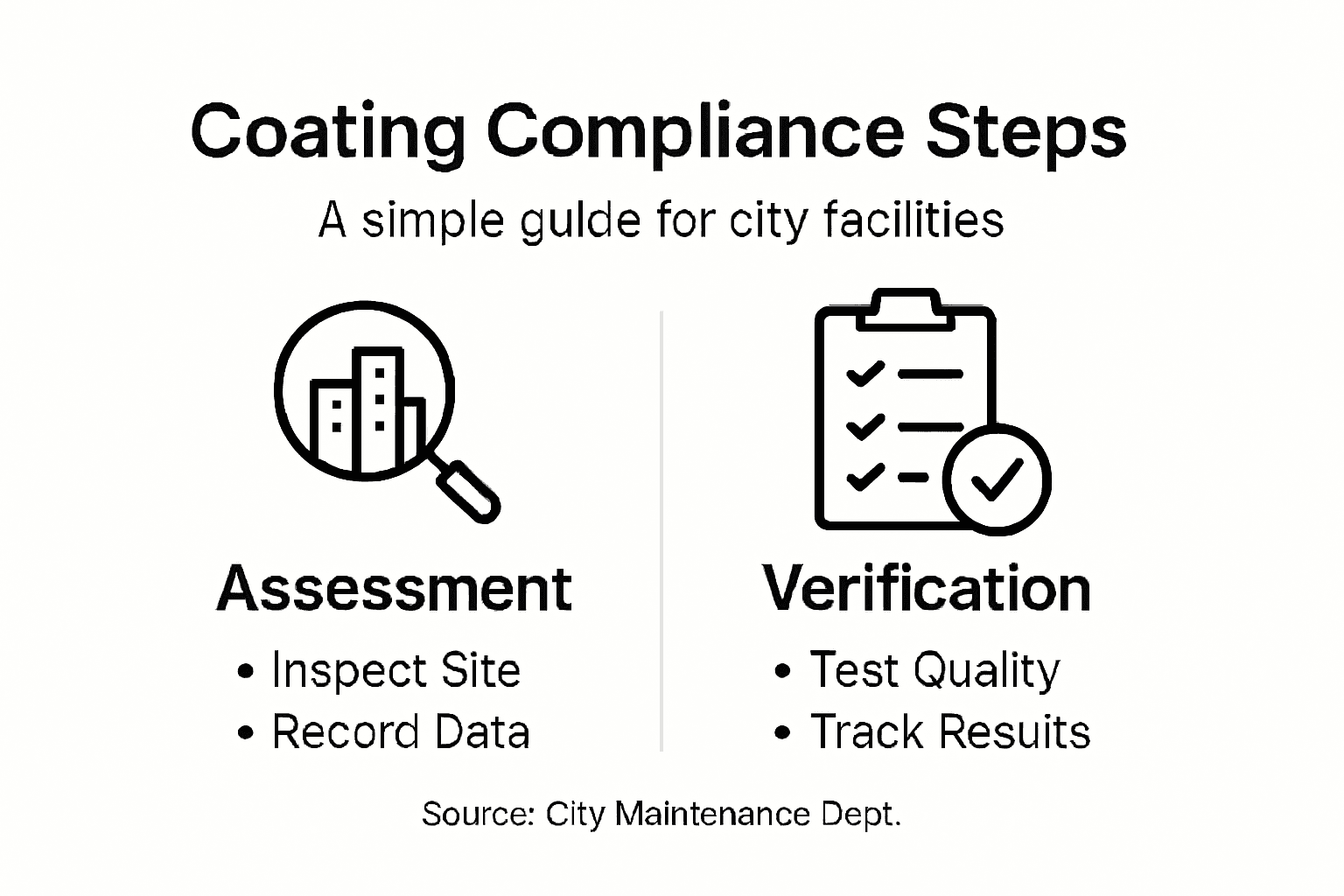
Step 4: Verify coating quality through inspections and documentation
Ensuring the integrity of your municipal facility’s protective coatings requires systematic quality verification and meticulous documentation. Your objective is to create a comprehensive inspection process that validates coating performance and maintains regulatory compliance.
Begin by implementing facility design inspection protocols that establish rigorous evaluation standards. Your inspection strategy should encompass multiple critical elements:
- Conduct visual surface examinations
- Perform adhesion and thickness measurements
- Test coating durability under simulated conditions
- Check for potential defects or inconsistencies
- Document all inspection findings comprehensively
Your quality verification process should include precise documentation techniques:
- Create standardized inspection report templates
- Record environmental conditions during assessment
- Capture detailed photographic evidence
- Note precise measurement readings
- Track coating performance over time
Careful attention to quality assurance systems will help you maintain exceptional coating performance standards. Professional documentation provides a transparent record of your commitment to infrastructure maintenance.
Systematic documentation transforms coating inspections from routine checks into strategic asset management.
Develop a robust tracking system that allows you to monitor coating performance longitudinally. This approach enables predictive maintenance and demonstrates your proactive infrastructure management strategy.
Pro tip: Implement digital inspection management software that automatically timestamps and archives inspection data for easy future reference and compliance reporting.
Step 5: Maintain compliance with ongoing monitoring and reporting
Sustaining coating compliance requires a proactive, systematic approach to tracking performance and addressing potential issues before they escalate. Your goal is to establish a continuous monitoring framework that ensures long-term infrastructure protection and regulatory adherence.
Implement comprehensive facility compliance tracking to create a robust documentation system. Your ongoing monitoring strategy should include:
- Schedule regular performance assessments
- Track coating degradation patterns
- Record environmental exposure impacts
- Monitor potential structural changes
- Update compliance documentation consistently
Your monitoring and reporting process should incorporate detailed tracking mechanisms:
- Develop standardized reporting templates
- Create digital tracking dashboards
- Establish clear performance benchmarks
- Set automated alert systems
- Implement periodic third-party audits
Careful attention to failure reporting and corrective action systems will help you maintain exceptional infrastructure integrity. Systematic monitoring transforms reactive maintenance into strategic asset management.
Continuous compliance monitoring is not just a requirement – it’s an investment in your facility’s long-term performance.
Build a comprehensive tracking framework that allows real-time performance insights and predictive maintenance capabilities. This approach demonstrates proactive infrastructure management and regulatory commitment.
Pro tip: Integrate digital monitoring technologies that provide automated reporting and instant compliance status updates across your entire municipal infrastructure portfolio.
Below is a quick reference comparing digital vs. manual inspection and monitoring approaches for compliance:
| Approach | Efficiency | Data Reliability | Best Used For |
|---|---|---|---|
| Digital Tools | High (instant updates) | Consistent and easily auditable | Large facility portfolios |
| Manual Methods | Lower (slower reporting) | Prone to errors and omissions | Small sites with limited tech access |
Protect Your City Facilities with Expert Industrial Coating Solutions
Ensuring coating compliance for municipal infrastructure is a challenging but critical task. You need a partner who understands the importance of precise surface preparation, regulatory adherence, and durable protective coatings tailored to your facility’s unique environmental stressors. Southern Sandblasting & Painting LLC brings over 20 years of experience in delivering high-quality industrial painting and sandblasting services that help extend the service life of city assets while meeting strict compliance standards.
Avoid costly maintenance failures and regulatory penalties by choosing a trusted team that specializes in:
- Professional sandblasting & painting to remove rust and prepare surfaces for coating
- Industrial-grade protective coatings customized for municipal infrastructure
- Rigorous application and quality control ensuring adhesion and durability

Ready to safeguard your city facilities with proven coating compliance expertise? Visit Southern Sandblasting & Painting LLC today to learn how our comprehensive industrial painting and sandblasting services can help you implement a long-term asset protection strategy. Contact us now to schedule a consultation and take the first step toward reliable, compliant infrastructure maintenance.
Frequently Asked Questions
How can I assess the compliance standards for city facility coatings?
To assess compliance standards, start by reviewing existing facility design guidelines and conducting a thorough inspection of the current surface conditions. Document any environmental challenges and local regulatory requirements to ensure that your coatings meet necessary criteria.
What are the key factors to consider when selecting coatings for municipal infrastructure?
Key factors include material compatibility, regulatory compliance, and environmental resistance. Evaluate performance characteristics like chemical resistance and expected service life to ensure the selected coatings will withstand environmental stressors.
How do I ensure proper application of coatings on city facilities?
To ensure proper application, select the right technique—such as spraying, brushing, or dipping—and maintain optimal environmental conditions. Consistently monitor thickness during application to achieve the required durability and performance standards.
What techniques should I use for verifying coating quality in city facilities?
Implement a quality verification process that includes visual inspections, adhesion tests, and thickness measurements. Document your findings comprehensively to create a reliable record of coating integrity and compliance.
How can I maintain ongoing compliance for coatings over time?
To maintain ongoing compliance, schedule regular performance assessments and document any degradation patterns. Continuously monitor environmental exposure impacts and adjust maintenance strategies as needed, ensuring that compliance documentation is updated regularly.
What tools can improve the tracking of coating performance in municipal facilities?
Digital monitoring tools can significantly enhance the tracking of coating performance by providing automated reporting and compliance status updates. Implement a digital tracking system that allows for real-time insights and predictive maintenance capabilities.
Recommended
- Industry Standards for Coatings: Ensuring Compliance in 2026
- Coating Inspections: Key to Infrastructure Longevity
- Coating Inspection: Securing Infrastructure Longevity
- 7 Essential Protective Coating Best Practices for Cities
- Ultimate Commercial Building Maintenance Checklist 2025 – Mats4U USA
- Sandblasting Contractor Baldwin Park FL
- Sandblasting Services Oviedo FL


