
For permanent forklift aisles, use two-pack epoxy over a properly shot-blasted or diamond-ground floor. For leased space or pedestrian zones you’ll reconfigure within a year or two, use heavy-duty floor tape. For outdoor yards and loading docks, thermoplastic holds up best against sun and rain. Warehouse floor striping is the visual backbone of a safe facility: it separates forklift traffic from foot traffic, marks hazards before someone walks into them, and gives auditors something concrete to check against OSHA 1910.176.
Before you call anyone, do three things:
- Run a five-minute traffic audit. Walk your busiest aisle during a shift change and note every near-miss between people and equipment.
- Check your surface condition. Sealed, oily, or spalling concrete needs prep work before paint or tape will hold.
- Request a site survey. A contractor should measure aisle widths against your equipment fleet, not against a generic chart.
Color choice isn’t optional decoration, either. OSHA’s guidance under 1910.144 and the ANSI Z535.1 palette both point toward yellow for physical hazards and high-contrast bands for anything a forklift driver needs to see from thirty feet out. Southern Sandblasting & Painting LLC treats that contrast requirement as the starting point for every striping layout, not an afterthought bolted on after the paint dries.
Key Takeaways
Durable warehouse floor striping depends on matching material to traffic type, prepping the slab properly, and following OSHA’s aisle-marking and color standards from the start.
| Point | Details |
|---|---|
| Match material to traffic | Use epoxy for forklift aisles, tape for temporary or leased zones, thermoplastic outdoors. |
| Prep drives lifespan | Shot-blast or diamond grind before striping to avoid early peeling and failed adhesion. |
| Follow OSHA width rules | Stay above the 2-inch minimum; most facilities run 4 to 6 inches for real visibility. |
| Inspect quarterly | Check adhesion, contamination, and fraying before wear becomes a full re-mark. |
| Work with a prep-first contractor | Southern Sandblasting & Painting LLC pairs shot-blast prep with epoxy striping for aisles built to last years, not months. |
Table of Contents
- What Materials Work Best for Warehouse Floor Striping?
- How Wide Should Warehouse Aisle Lines Be?
- Why Does Surface Prep Matter Before Striping a Warehouse Floor?
- What Does the Installation Process Look Like?
- How Long Do Warehouse Floor Stripes Last?
- What Does Warehouse Floor Striping Cost?
- How Do You Vet a Floor Striping Contractor?
- Why Upfront Investment in Prep Pays Off Later
- Get a Site Survey for Your Warehouse Floor Striping Project
- Sources
What Materials Work Best for Warehouse Floor Striping?
Two-pack epoxy is the standard for permanent forklift aisles and heavy-traffic zones. It chemically bonds to a properly prepared slab, builds a film thick enough to resist gouging from pallet jacks, and typically lasts three to eight years depending on traffic volume and how well the floor was prepped before application, according to industry maintenance data. Cure windows run longer than paint, often 24 to 72 hours before full traffic return, so plan around that.
Waterborne acrylic paint costs less and dries faster, but it wears fast under forklift wheels. Reserve it for low-traffic zones like office corridors, break areas, or storage rooms where the floor sees foot traffic only.
Heavy-duty floor tape is the right call for leased buildings or zones you expect to reconfigure. It goes down in minutes, needs no cure time, and comes off without grinding, though removal can tear and leave adhesive residue if the tape has been down for years. Thermoplastic is the outdoor answer: it’s melted into the surface with heat, resists UV fading and rain far better than paint, and suits yard lanes, dock approaches, and parking striping.
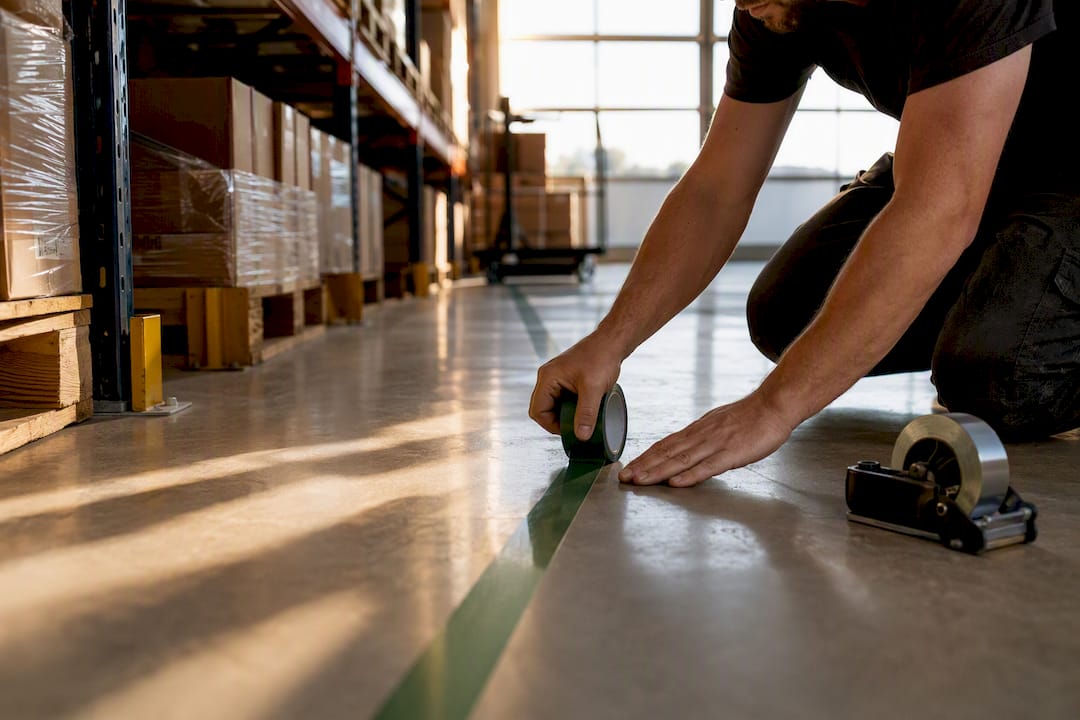
Coated-in or embedded marking systems, where color is built into a full epoxy floor coat rather than striped on top of it, make sense for facilities doing a complete floor overhaul anyway. Trade guidance consistently ties material choice to traffic type: epoxy for forklift lanes, tape for pedestrian or temporary areas, thermoplastic for exterior use. Matching material to the job, not just to price, is what determines whether you’re repainting in eighteen months or in six years. For a closer look at how these materials perform under load, our guide to heavy-duty industrial paints breaks down film build and abrasion resistance by product type.
How Wide Should Warehouse Aisle Lines Be?
OSHA sets a minimum line width under 1910.22(b), commonly interpreted as around two inches, but that’s a floor, not a target. Many facilities use line widths wider than the minimum for better visibility, especially in aisles where forklifts and pedestrians share space, a range confirmed in current compliance guidance. Follow this sequence when you plan a new layout:
- Measure your widest equipment. Take your largest forklift or pallet jack’s width, including the load it carries.
- Apply the equipment-plus rule. Add roughly three feet of clearance on each side where people and equipment cross paths, and more where turning radius matters.
- Assign consistent colors. Yellow marks general traffic lanes, red marks fire equipment and extinguisher zones, green marks safety and first-aid stations, and black-and-yellow stripes flag physical hazards like low clearance or drop-offs.
- Test with temporary tape first. Running a trial layout with removable tape for a week or two before committing to epoxy catches traffic-pattern mistakes before they’re permanent.
- Fold it into your 5S program. If you run Sort, Set in Order, and Standardize as an operational discipline, striping is the visual layer that makes those standards enforceable on the floor, not just on paper, a connection well documented in 5S methodology.
Permanent aisles and passageways must be marked under 1910.176, and OSHA interpretations confirm that egress routes covered under 1910.35 and walking-working surface rules under 1910.22 need the same clarity.
Pro Tip: Walk your proposed layout with a loaded pallet jack before the tape trial even starts. Paper measurements miss blind corners and support columns that eat into your clearance every time.
Why Does Surface Prep Matter Before Striping a Warehouse Floor?
Paint or epoxy applied over a dirty, sealed, or oily slab fails early, usually inside a year. Surface prep is what determines whether your striping lasts three years or eight. Before any contractor puts material down, the floor needs a real inspection, not a quick sweep.
Check for these conditions before you approve a scope of work:
- Existing sealers or curing compounds that block adhesion.
- Oil, grease, or chemical residue in forklift lanes and near maintenance bays.
- Old coating or paint that’s peeling, flaking, or delaminating.
- Cracks, spalling, or uneven joints that need patching before striping.
Shot-blasting works well on large open floor areas and removes contamination fast with minimal dust. Diamond grinding is better for tighter spaces or where you need a smoother profile before a thin epoxy film. Either method, done properly, significantly extends how long the finished lines hold up compared to painting over an unprepped slab. Degreasing and a final rinse come after mechanical prep, and any low spots or cracks get patched before a single stripe goes down.
Pro Tip: Ask your contractor for a moisture reading before they schedule the job. Applying epoxy over a slab with high moisture vapor transmission is one of the fastest ways to see bubbling and peeling within months. Our surface preparation walkthrough covers the full inspection checklist a contractor should run before quoting the job.
What Does the Installation Process Look Like?
A well-run striping job follows a predictable sequence, and knowing it helps you evaluate whether your contractor is cutting corners.
- Layout marking. The crew chalks or lasers the final line positions based on the approved plan.
- Masking. Straight edges depend on quality tape, not a steady hand. Sloppy masking is the most common cause of ragged lines.
- Substrate prep. Final cleaning and any spot-priming happen right before application, not the day before.
- Primer, if specified. Some epoxy systems need a primer coat for adhesion on older or porous concrete.
- Application. Epoxy is typically applied at 10 to 15 mils wet film thickness, though manufacturer specs vary; thinner coats wear out fast under forklift traffic.
- Cure and final QA. The crew removes masking at the right cure stage, then walks the layout checking width, straightness, and coverage.
Phasing is what keeps your operation running during the work. Ask for zone-by-zone scheduling, night or weekend shifts for high-traffic aisles, and temporary rerouting signage so pedestrians and drivers aren’t guessing where to go mid-project.
How Long Do Warehouse Floor Stripes Last?
Expect epoxy lines on well-prepped concrete to run three to eight years, with heavy forklift traffic pushing toward the shorter end and moderate traffic toward the longer end. Waterborne paint in low-traffic areas might hold up one to three years. Floor tape varies widely based on foot traffic and how often forklifts roll over it, but expect edges to start lifting well before the color fades.
Run a quarterly inspection covering four things:
- Visibility from a normal walking or driving line of sight.
- Adhesion at edges and corners, where lifting starts first.
- Contamination from oil, dust buildup, or chemical spills.
- Fraying or gouging in high-turn zones near racking and dock doors.
Targeted touch-ups handle isolated wear, but once more than a quarter of a layout shows significant degradation, full re-marking is usually cheaper than continuing to patch. When it’s time to remove old lines, grinding and shot-blasting give the cleanest results for changing a layout entirely; chemical stripping works for smaller spot removals but is slower on large areas.
What Does Warehouse Floor Striping Cost?
Cost swings on four main factors: how much surface prep the floor needs, the material you choose, total linear footage, and how much the job disrupts operations.
- Site access and phasing add cost when work has to happen in off-hours or in small zones to avoid shutting down the whole facility.
- Prep level is often the biggest line item. A floor with old sealer or heavy contamination costs more to prep than a job needing basic cleaning.
- Material matters too. Tape has the lowest upfront cost, epoxy costs more but lasts longer, and thermoplastic sits in between depending on the outdoor square footage involved.
- Small zone touch-ups run far less than a full-floor re-mark, and combining a striping project with a planned coating or maintenance shutdown saves on mobilization costs either way.
Timelines depend heavily on cure time. A single-aisle job might wrap in a day, but full-floor epoxy re-marking across a large facility, including prep, can take a week or more once you factor in cure windows before traffic returns.
How Do You Vet a Floor Striping Contractor?
Bad striping jobs almost always trace back to skipped prep or vague scope language, so your questions during bidding matter more than the quote itself.
- Ask what surface prep method they use and whether it’s included in the base price or billed separately.
- Request material data sheets for the specific epoxy or paint they’re proposing, not a generic brand name.
- Check references from facilities with similar traffic volume, not just similar square footage.
- Confirm insurance and warranty terms in writing, including what counts as a defect versus normal wear.
- Ask for a sample line test on a small section before committing to the full layout.
Red flags include contractors who skip prep entirely, quote a lump sum with no linear-footage breakdown, or can’t provide a single reference. A price dramatically below competing bids almost always means shortcuts in prep or material thickness.
Pro Tip: Get the cure-time and traffic-return schedule in writing before the crew starts. A contractor who can’t tell you exactly when forklifts can safely cross a fresh line hasn’t done this enough times to trust with your floor.
Why Upfront Investment in Prep Pays Off Later
Cutting corners on surface prep to save a few hundred dollars is the single most common mistake we see across decades of industrial coating work. A floor that isn’t shot-blasted properly will shed its epoxy lines within a year, and now you’re paying for the job twice.
Small in-house tasks, touch-up paint on a scuffed corner, refreshing a faded safety zone, make sense for a maintenance crew with basic training. Full-floor layouts with OSHA compliance on the line belong with a contractor who preps the concrete correctly the first time. We’ve seen facilities save real money over five years simply by paying more upfront for shot-blast prep instead of painting over a sealed floor twice in that same window.
Get a Site Survey for Your Warehouse Floor Striping Project
Southern Sandblasting & Painting LLC handles the part of this job most contractors skip: real surface preparation before a single stripe goes down. We run shot-blasting and diamond grinding to bring your slab to spec, then apply template-based striping and industrial coatings built for forklift traffic, not just foot traffic.
With more than 20 years serving commercial, municipal, and industrial clients across Central Florida, we’ve prepped and coated everything from water tanks to airport surfaces, so a warehouse floor is squarely in our range. A site survey includes measuring your actual traffic patterns against your layout plan, testing the slab for moisture and contamination, and giving you a written scope before any work starts, no vague line items. If your floor needs striping that actually lasts through a few years of forklift traffic, request a site survey through our services page and we’ll walk your facility before we quote it.
Sources
- OSHA Standard 1910.176
- Warehouse Floor Marking: Layout, Materials, and Long-Term Maintenance Guide – StripeGuys


