
TL;DR:
- Sandblasting involves significant health and safety hazards, including silica dust, noise, and physical injuries, which require proper controls and training. Safety measures such as engineering controls, role-specific PPE, active monitoring, and a strong safety management system are essential for protection and compliance. Treating safety as a core project value minimizes injuries, delays, and liabilities, ensuring successful and responsible surface preparation operations.
Sandblasting gets treated like a background task on most job sites. Someone needs to prep the surface, the crew sets up, and the work gets done. The problem with that attitude shows up in the injury data. The role of crew safety in sandblasting is far more consequential than most managers realize, and the hazards involved go well beyond surface-level risks. This article walks you through the specific dangers your crew faces, the protective measures that actually work, the training framework that holds everything together, and the 2026 compliance requirements you need to have in place before your next project starts.
Table of Contents
- Key takeaways
- Role of crew safety in sandblasting: the hazards you’re managing
- Protective equipment and safety protocols for blast crews
- Safety management and training that actually reduces incidents
- Enforcing and monitoring crew safety during operations
- 2026 regulatory requirements affecting sandblasting crews
- My take on why crew safety defines project outcomes
- Work with a crew that treats safety as standard practice
- FAQ
Key takeaways
| Point | Details |
|---|---|
| Sandblasting carries serious health risks | Silica dust, noise above 100 dB, and flying debris create layered threats that require planned controls. |
| PPE alone is not enough | Engineering controls like containment and wet blasting must be the first line of defense, not the last. |
| Training must be role-specific | Blasters, attendants, and supervisors each need targeted safety training before operations begin. |
| Regulatory compliance is tightening | OSHA silica standards and 2026 dry-cutting bans carry real legal and financial consequences for non-compliance. |
| Cleanup is part of the hazard | Secondary dust exposure during improper cleanup causes injuries after blasting stops. |
Role of crew safety in sandblasting: the hazards you’re managing
Before you can protect your crew, you need an accurate picture of what you’re protecting them from. Sandblasting is not a single hazard. It’s a stack of simultaneous threats that compound quickly when controls are missing.
Physical hazards hit first and hit hard. Abrasive media travels at velocities capable of penetrating skin, destroying eye tissue, and causing blunt-force trauma if a worker is in the blast path. Nozzle recoil is physically demanding and causes musculoskeletal strain over extended shifts. Hose whip, which happens when a pressurized hose fails at a fitting, can cause severe injuries in seconds.
Health hazards are slower but often more devastating. Silica dust generated during abrasive blasting is the most studied occupational carcinogen in surface preparation work. Workers exposed to respirable crystalline silica can develop silicosis, lung cancer, and chronic obstructive pulmonary disease, often years after exposure. The insidious part is that you cannot see or smell the dust at dangerous concentrations.
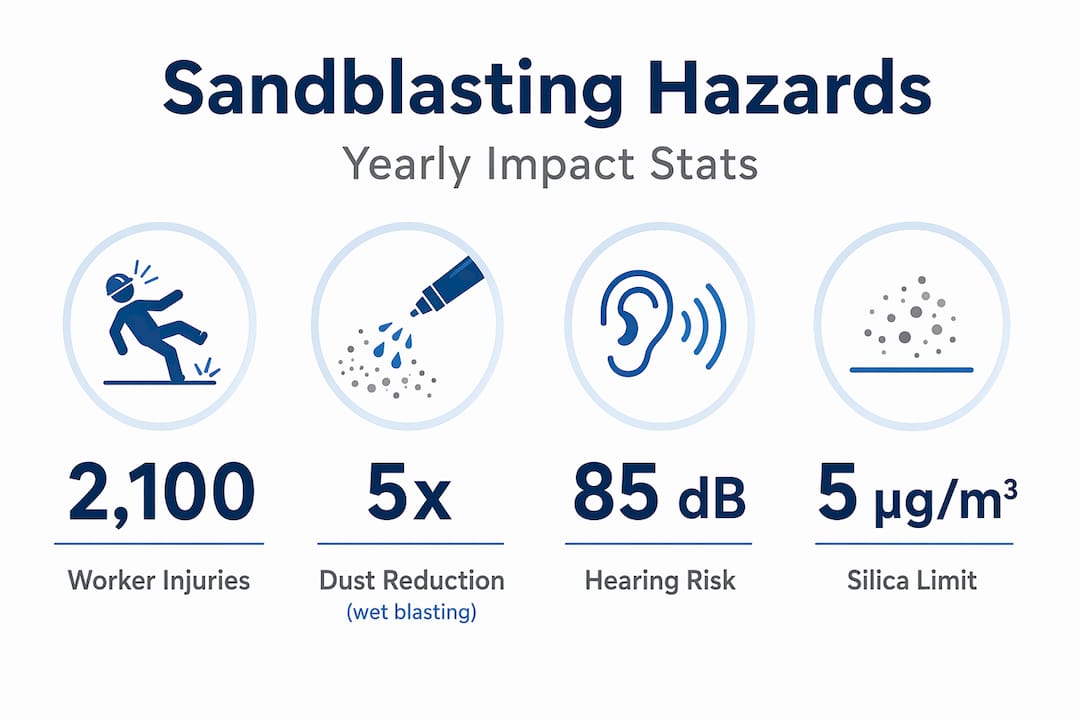
The noise hazard gets underestimated consistently on industrial sites. Sandblasting noise levels regularly exceed 100 dB, which is well above OSHA’s 85 dB threshold that triggers mandatory hearing conservation programs. At those levels, even a single shift without proper hearing protection causes measurable hearing loss.
Secondary hazards round out the picture:
- Heat stress from wearing full protective gear in Florida’s climate accelerates fatigue significantly
- Skin abrasion from media rebound through gaps in protective clothing
- Eye injury from particles that bypass inadequate face protection
- Carbon monoxide poisoning if blast helmet air supply is contaminated
Sandblasters experienced approximately 2,100 nonfatal injuries involving days away from work in 2022, with respiratory conditions and eye injuries leading the count. That number only reflects cases that were reported and documented.
Protective equipment and safety protocols for blast crews
Getting PPE right on a sandblasting site is not about picking items from a catalog and handing them out. Each piece of protection has a specific standard it must meet, and gaps in any one area create real exposure.
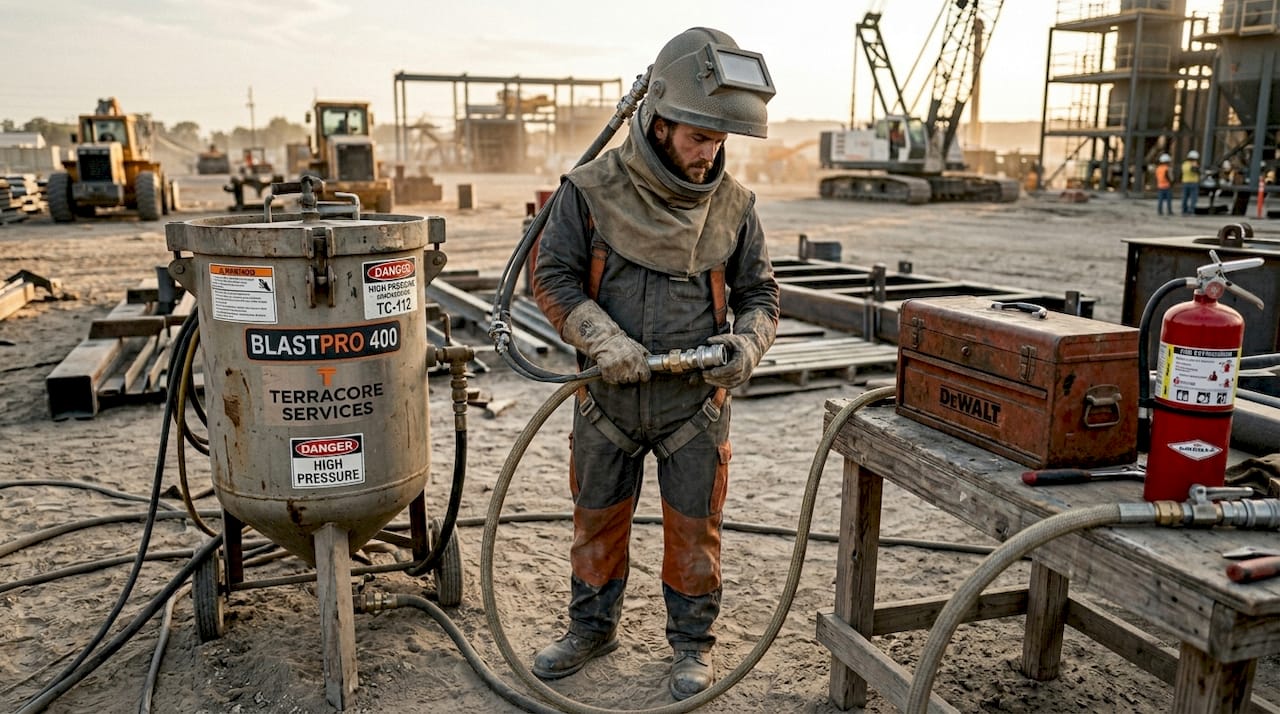
Respiratory protection is non-negotiable and highly specific. NIOSH-approved Type CE supplied-air respirators are the minimum standard for abrasive blasting. Half-face respirators and cartridge-style dust masks do not provide adequate protection against the particle sizes generated during blasting. The blast helmet must be connected to a Grade D breathing air source with active filtration and carbon monoxide monitoring to prevent poisoning from contaminated compressor air.
Full crew PPE requirements include:
- Blast helmet with positive pressure air supply
- Full-body blast suit or heavy-duty coveralls rated for abrasive impact
- Leather or Kevlar-lined gloves
- Steel-toed boots with metatarsal guards
- Dual hearing protection (both plugs and muffs when noise exceeds 100 dB)
- Safety glasses worn underneath the blast helmet as secondary eye protection
Equipment safety checks are as critical as the PPE itself. Deadman control devices are OSHA-required components that stop media flow immediately when the operator releases the control. These must be tested before every single shift to confirm they stop flow within one second. Pre-shift inspection of blast equipment should cover hose wear, whip check installation, pressurization levels, and air supply quality.
Pro Tip: Never allow a crew to rely on PPE as the primary layer of protection. Engineering controls, including wet blasting, local exhaust ventilation, and physical enclosures, reduce hazard levels at the source. PPE addresses what gets through after those controls are in place.
Engineering controls like containment and wet blasting consistently outperform administrative controls or PPE alone in reducing actual exposure. That hierarchy matters when you’re designing your site safety plan.
Safety management and training that actually reduces incidents
Equipment and PPE will fail your crew if the management system behind them is weak. The importance of crew safety starts with organizational decisions, not just gear selection.
The foundation is the job hazard assessment. Before any blasting begins, a documented hazard analysis specific to that site, that surface, and that media type must be completed. Generic assessments pulled from a template do not account for confined space conditions, nearby workers, or unusual substrate materials that could release toxic compounds when blasted.
Safety training for sandblasting needs to be role-specific. A blaster, an attendant, and a site supervisor all face different hazards and carry different responsibilities. Effective training covers:
- Hazard recognition specific to abrasive blasting (silica, noise, recoil, heat)
- Correct donning and doffing procedures for PPE, including blast helmet seal checks
- Emergency procedures: hose failure, air supply loss, operator incapacitation
- Communication signals between blaster and attendants when verbal communication is impossible
- Stop-work authority: who can call a halt to operations and under what conditions
Stop-work authority is worth emphasizing. Assigning authorized personnel with the power to stop operations immediately when a hazard is observed significantly improves on-site hazard response. Crews that know anyone can call a stop without fear of reprisal catch problems before they become injuries.
Pro Tip: Run a tabletop scenario during training where something goes wrong, such as an air line failure mid-shift. Walk through who does what, in what order, and how communication flows. Scenarios that have been practiced get executed under stress. Plans that only exist in a binder do not.
Proactive risk management, not reactive inspection results, is what separates crews with strong safety records from those constantly responding to incidents.
Enforcing and monitoring crew safety during operations
Policies written in a safety manual create zero protection if they are not actively enforced and monitored during the work. Safety managers need practical methods that work in real conditions, not ideal ones.
Site containment is the first operational control. Blasting operations should be enclosed with tarps, blast shields, or containment systems to limit media scatter and airborne dust dispersion. Barricades with appropriate signage keep unauthorized personnel outside the hazard zone. For outdoor projects near public infrastructure, this is not optional.
Monitoring during operations should include:
- Air quality sampling for respirable silica at breathing zones throughout the shift
- Noise dosimetry on workers exposed to extended blast periods
- Visual checks on PPE integrity, specifically blast suit seams and helmet seals
- Confirmation that the deadman control is functioning correctly after any equipment interruption
Worker rotation is an underused tool for managing heat stress and fatigue. In Florida’s climate, full blast gear creates significant thermal load. Rotating workers on 30-minute cycles during peak heat hours reduces heat-related illness risk without interrupting project timelines.
Cleanup is where many crews let their guard down. Improper removal of PPE and premature cleanup procedures cause secondary dust exposure after blasting stops. Workers must maintain full respiratory protection until dust has settled and air quality monitoring confirms safe levels. All spent media and blasted material should be removed using HEPA-equipped vacuum systems, not dry sweeping or compressed air.
| Practice | Risk if skipped |
|---|---|
| Air quality monitoring during operations | Silica overexposure goes undetected until workers develop symptoms |
| Deadman control pre-shift test | Equipment failure mid-operation with no automatic stop |
| PPE on during cleanup | Secondary silica inhalation after blasting stops |
| Worker rotation in heat | Heat exhaustion, reduced alertness, increased error rate |
| Proper containment setup | Media scatter and dust dispersal beyond the work zone |
You can also reference industrial safety best practices for surface preparation environments to build out your site-specific monitoring checklists.
2026 regulatory requirements affecting sandblasting crews
The regulatory environment for abrasive blasting tightened considerably heading into 2026, and safety managers who are not current on these requirements are exposed to real liability.
OSHA’s respirable crystalline silica standard (29 CFR 1926.1153 for construction) sets a permissible exposure limit of 50 micrograms per cubic meter as an eight-hour time-weighted average. Compliance requires a written exposure control plan, designated competent persons, and mandatory medical surveillance for workers with regular silica exposure.
Dry cutting was banned as of 2026 due to silica dust risks, and wet methods reduce exposure by five to ten times compared to dry processes. The same principle applies to abrasive blasting: wet blasting and vacuum blasting systems are not just preferred practices, they are increasingly treated as required controls where alternatives exist.
OSHA’s deadman control requirement under 29 CFR 1910.244(b) requires that blast nozzle shutoff devices be tested at the start of every shift. Failure to document these tests creates compliance gaps that inspectors specifically look for.
Hearing conservation programs are mandatory when workers are exposed to noise at or above 85 dB as an eight-hour average. Given that sandblasting regularly exceeds 100 dB, your hearing conservation program must be active, documented, and include annual audiometric testing.
Non-compliance consequences include citations, project shutdowns, and personal liability for site supervisors in cases involving willful violations. Staying current with these requirements is not a paperwork exercise. It protects your crew and your organization.
My take on why crew safety defines project outcomes
I’ve worked with enough industrial blasting crews over the years to say this without reservation: the teams that treat safety as a project variable rather than a project foundation are the ones that get hurt. And then they get slow, expensive, and difficult to insure.
What I’ve seen consistently is that abrasive blasting gets underestimated as a risk category because it looks like a prep step. It’s not the “real” work. That mental framing is where the injuries start. When you’re managing a blasting crew on a water tower, an airport tarmac, or a pipeline corridor, there is no low-stakes version of that operation. The pressure levels, the silica, the confined geometry, the Florida heat. Any one of those factors alone requires serious planning. Together, they require a safety management system that is running before the first nozzle fires.
The business case for crew safety is also straightforward. A single lost-time injury in a blasting crew can shut down a project for days, trigger OSHA inspections, and create liability exposure that far exceeds the cost of proper PPE and training. The crews with the best safety records are not the most cautious. They’re the most prepared.
My strongest recommendation to any safety manager reading this: give your crew stop-work authority and mean it. When people know they can call a halt without consequences, they catch problems early. That single cultural decision prevents more injuries than any piece of equipment.
— Southernsandblastingandpainting
Work with a crew that treats safety as standard practice

At Southernsandblastingandpainting, we’ve been managing abrasive blasting operations across Central Florida for over 20 years, handling water tanks, municipal infrastructure, airports, and industrial facilities where safety compliance is not optional. Every project we run starts with a documented hazard assessment, NIOSH-compliant respiratory protection, and a crew that has been trained on current OSHA silica and noise standards.
If you’re planning a blasting project and want to see exactly how compliant, safety-focused equipment selection looks in practice, our sandblasting equipment guide walks through the tools and specifications that protect both workers and project timelines. For project-specific consultation, our sandblasting services page outlines what a professionally managed, code-compliant operation looks like from mobilization to cleanup.
FAQ
What is the primary role of crew safety in sandblasting?
Crew safety in sandblasting protects workers from layered hazards including silica dust, high-velocity debris, noise above 100 dB, and heat stress. Without active safety protocols, even short blasting operations create serious injury and long-term illness risk.
What PPE is required for sandblasting crews?
At minimum, sandblasting crews require a NIOSH-approved Type CE supplied-air respirator with blast helmet, full-body blast suit, leather gloves, metatarsal boots, and dual hearing protection. Half-face respirators do not meet the standard for abrasive blasting work.
How often should deadman controls be tested?
OSHA requires deadman controls to be tested before every shift to confirm media flow stops within one second of the operator releasing the device. This test must be documented as part of the pre-shift equipment inspection record.
What are the 2026 regulatory changes affecting sandblasting?
The most significant 2026 change is the ban on dry cutting processes due to silica dust exposure risks, with wet methods required where feasible. OSHA’s silica PEL of 50 micrograms per cubic meter also remains in effect with mandatory written exposure control plans and medical surveillance.
How do you prevent secondary dust exposure during cleanup?
Workers must keep full respiratory protection on until air quality monitoring confirms safe silica levels after blasting stops. All spent media and debris should be collected with HEPA-equipped vacuums rather than dry sweeping, which resuspends settled dust back into the breathing zone.


