

TL;DR:
- Containment in sandblasting uses physical barriers and controls to prevent hazardous debris from escaping the work zone. Proper design, material selection, and continuous monitoring are essential to comply with regulations and protect worker health. Regular inspection and maintenance of containment systems ensure ongoing effectiveness and safety.
Containment in sandblasting is defined as the use of physical barriers and engineering controls to capture spent abrasive media, dust, and hazardous debris at the source during blasting operations. For construction managers, facility engineers, and contractors, understanding what is containment in sandblasting is not optional. OSHA and EPA regulations require it on virtually every commercial and industrial project involving hazardous coatings. Uncontrolled blasting releases crystalline silica and lead particles that threaten worker health, contaminate surrounding areas, and expose your organization to serious legal liability. Getting containment right from the start protects people, assets, and your project timeline.
What is containment in sandblasting, and which methods apply?
Containment in abrasive blasting refers to any system that physically restricts the spread of blasting media, dust, and coating debris beyond the work zone. The industry term is “abrasive blasting containment,” and it covers a spectrum of solutions from small enclosed cabinets to full scaffold-mounted enclosures wrapping an entire structure.
The right method depends on project scale, substrate type, coating hazards, and site conditions. The four primary containment systems used in professional blasting work are:
- Blast cabinets: Sealed enclosures for small parts and precision work. The operator works through glove ports while the cabinet captures all media and dust internally. These are standard in fabrication shops and maintenance facilities.
- Walk-in blast rooms and booths: Permanent or semi-permanent enclosed spaces for larger components. Enclosed blasting rooms require downward airflow of at least 200 ft/min to manage dust and maintain operator visibility. That airflow standard is not a suggestion; it is an engineering minimum.
- Heavy-duty curtains and tarps: Temporary containment for field work on bridges, tanks, and structural steel. Curtain systems create a flexible enclosure around the work area and are the most common solution for large infrastructure projects.
- Enclosed blast shrouds: Shroud attachments that fit directly over the blast nozzle and capture debris at the point of impact. These work well for spot repairs and localized surface prep where full enclosure is impractical.
Pro Tip: Evaluate blasting intensity before selecting curtain material. High-pressure blasting with steel grit demands heavier curtain weights than low-pressure soda blasting. Choosing the wrong weight leads to punctures, leaks, and failed containment inspections.
Matching the containment method to the blasting technique and project environment is the first decision every project manager should make during planning, not after mobilization.

How do containment materials and designs vary by application?
Material selection determines whether a containment system holds up through an entire project or fails mid-job. PVC-coated polyester is the industry standard for curtain-based containment because it combines abrasion resistance and impermeability in a single material.
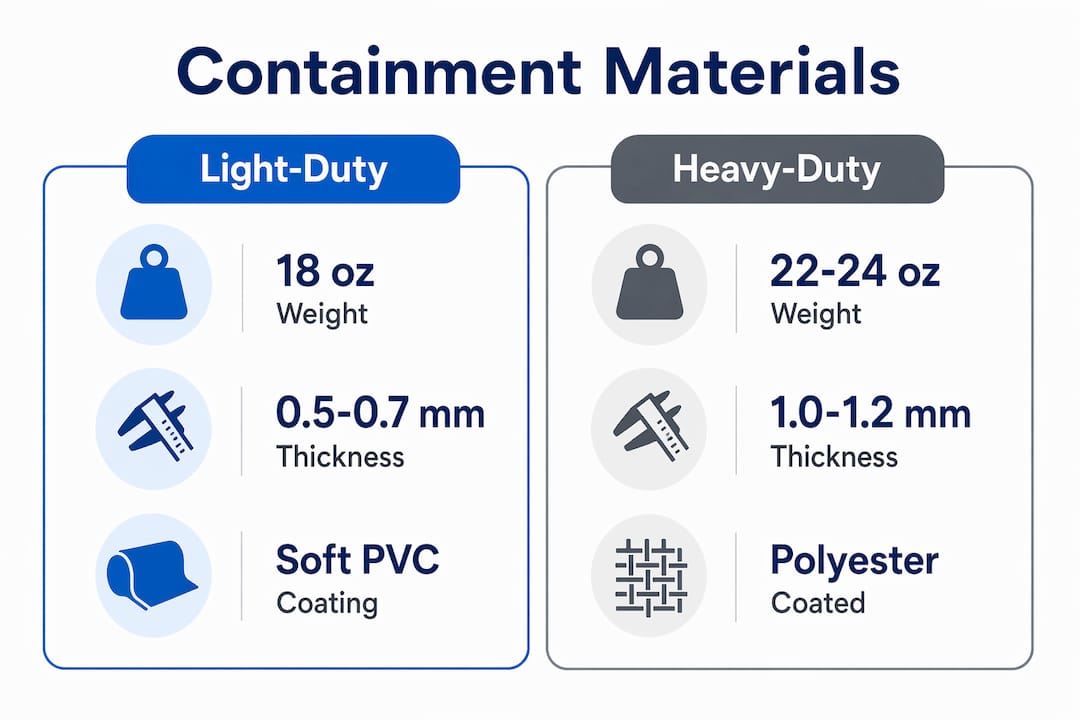
Curtain weight directly corresponds to blasting intensity and media type. The table below summarizes standard specifications:
| Curtain Weight | Thickness | Typical Application |
|---|---|---|
| 18 oz | 0.5–0.7 mm | Light-duty blasting, soda or walnut shell media |
| 22–24 oz | 0.7–1.2 mm | Standard industrial blasting, aluminum oxide or glass bead |
| 24–30 oz | 1.2–2.0 mm | Heavy-duty blasting, steel grit, high-pressure operations |
Beyond weight, curtain design matters as much as material. Overlapping seams at panel joints prevent dust from escaping through gaps. Weighted bottom hems keep curtains flush with the ground even in light wind. Attachment hardware must allow quick repositioning without creating open seams.
Blast cabinet door seals present a separate challenge. Cabinet door edges are the most common leak points for fine dust and spent media. Knife-edge gasket designs outperform flat foam seals because they maintain contact pressure even as the gasket wears. Inspect these seals before every shift on high-volume operations.
Pro Tip: For field enclosures, install curtain panels with a minimum 12-inch overlap at every seam and secure overlaps with weighted clips or hook-and-loop fasteners. Gaps at seams are where containment fails during inspections.
What regulatory standards govern sandblasting containment?
OSHA and EPA regulations set the legal floor for containment in abrasive blasting, and the standards tightened significantly in recent years. As of 2026, OSHA and EPA mandate full containment systems, medical surveillance, and air monitoring when working with hazardous materials like lead-based paint. That mandate applies to water tanks, bridges, industrial facilities, and any structure with legacy coatings.
Key regulatory requirements every project team must address:
- OSHA 29 CFR 1926.1153: Silica standard for construction. Requires engineering controls, including containment, to reduce crystalline silica exposure below the permissible exposure limit.
- OSHA 29 CFR 1926.62: Lead in construction standard. Mandates full containment when disturbing lead-based coatings during blasting.
- OSHA 29 CFR 1910.134: Respiratory protection standard. Respiratory protection is required only after feasible engineering controls have been implemented. Containment comes first; respirators are the backup layer.
- EPA NESHAP and state air quality rules: Govern particulate emissions from blasting operations, particularly in urban or environmentally sensitive areas.
- Medical surveillance: Required for workers with repeated lead or silica exposure above action levels.
Willful violations of OSHA silica standards can result in penalties exceeding $156,000 per violation. That figure does not include project shutdowns, remediation costs, or litigation. Compliance is not just an ethical obligation. It is a financial one.
Waste disposal adds another layer. Spent abrasive media contaminated with lead or chromium qualifies as hazardous waste under RCRA. Your containment plan must account for collection, labeling, and disposal from the start. For projects involving lead paint removal, containment and disposal planning are inseparable.
How do ventilation and monitoring support effective containment?
Containment barriers alone do not control dust. Ventilation and air monitoring are the engineering controls that make containment systems actually work. Without proper airflow management, dust accumulates inside the enclosure, reducing visibility and increasing worker exposure even when the physical barriers are intact.
Local exhaust ventilation (LEV) draws dust-laden air away from the worker’s breathing zone and through filtration before discharge. In enclosed blast rooms, exhausting dust-laden air without make-up air creates a vacuum that reduces system effectiveness and can cause backdrafting of combustion appliances, creating carbon monoxide hazards. Make-up air must enter the enclosure at a controlled rate to maintain positive capture velocity without pressurizing the space.
Key ventilation and monitoring practices for field containment:
- Position LEV intakes at the lowest point of the enclosure to capture heavy abrasive particles before they settle.
- Maintain downward airflow through the work zone to push dust toward collection points rather than toward the operator.
- Monitor perimeter air quality continuously during blasting. Containment validation in urban environments requires real-time wind direction and pressure differential monitoring to catch containment failures before they become violations.
- Adjust containment configuration dynamically when wind direction shifts. A containment system designed for calm conditions can fail within minutes when a 15 mph crosswind creates pressure differentials across the enclosure.
- Test make-up air volume before starting each shift. Insufficient make-up air is the leading cause of reduced dust capture efficiency in enclosed blast rooms.
Pro Tip: Inspect dust collector filters and enclosure seals at the start and end of every shift. A clogged filter reduces airflow, raises internal pressure, and forces dust out through gaps. Catching this early prevents both compliance failures and equipment damage.
The sandblasting safety essentials framework treats ventilation and containment as a single integrated system, not two separate tasks. That integration is what separates compliant operations from those that fail air monitoring.
What practical containment best practices should professionals apply on site?
Effective containment starts before the first blast nozzle fires. Site assessment determines which hazards are present, which containment method fits the project, and what the cleanup plan looks like. Skipping this step is the most common reason containment systems fail inspections.
The table below identifies frequent containment mistakes and their solutions:
| Common Mistake | Recommended Solution |
|---|---|
| Selecting curtain weight by cost, not blasting intensity | Match curtain weight to media type and pressure using manufacturer specifications |
| Leaving gaps at curtain base or seams | Use weighted hems and overlapping panels secured with clips |
| Running LEV without make-up air | Install make-up air louvers sized to match exhaust volume |
| Skipping perimeter air monitoring | Deploy real-time monitors at the containment boundary throughout blasting |
| Disposing of spent media without testing | Test media for hazardous content before disposal; follow RCRA protocols if contaminated |
Access control and signage are non-negotiable on any containment zone. Warning signs and barricades prevent unauthorized entry into containment zones, and waste disposal must follow hazardous material protocols when applicable. Post clear signage at every entry point and enforce a single controlled access path for workers entering and exiting the enclosure.
Maintenance scheduling protects containment integrity over multi-day or multi-week projects. Inspect curtain seams, door gaskets, and ventilation connections at the start of each workday. Replace worn gaskets immediately. A containment system that passed inspection on day one can fail by day three if maintenance is deferred. The environmental protection requirements for blasting projects make ongoing maintenance a compliance requirement, not just a best practice.
Key Takeaways
Effective sandblasting containment requires matching physical barriers, ventilation engineering, and regulatory compliance into a single coordinated system verified throughout the project.
| Point | Details |
|---|---|
| Define containment early | Select blast cabinets, curtains, or enclosures based on project scale and coating hazards before mobilization. |
| Match curtain weight to intensity | Use 18 oz for light-duty, 22–24 oz for standard industrial, and 24–30 oz for high-pressure steel grit blasting. |
| Prioritize engineering controls | OSHA 29 CFR 1910.134 requires containment and LEV before respirators are considered a compliance solution. |
| Monitor perimeter air in real time | Wind shifts and pressure differentials can compromise containment; continuous monitoring catches failures early. |
| Plan cleanup before blasting starts | Spent media with lead or chromium contamination requires RCRA-compliant hazardous waste disposal from day one. |
The containment mistake I see most often on complex projects
After working on infrastructure projects across Central Florida, the pattern I see most often is teams treating containment as a setup task rather than a system that needs active management. They install the curtains, pass the initial inspection, and then stop paying attention. By day three, a seam has opened, the dust collector filter is half-clogged, and the make-up air louver is blocked by equipment staging. The containment is still standing. It just is not working.
The second mistake is defaulting to respirators when containment is inadequate. OSHA is explicit: engineering controls come first. Handing workers better respirators when the enclosure is leaking is not a compliance solution. It is a liability waiting to happen.
What actually works is treating containment as a dynamic system. That means assigning one person on each shift to monitor enclosure integrity, airflow, and perimeter air quality. It means building inspection checkpoints into the daily schedule, not leaving them to chance. And it means designing the containment system for the worst conditions you expect on site, not the average ones.
Regulatory trends are moving toward stricter silica and lead enforcement, not looser. The projects that stay ahead of that curve are the ones where containment is designed by someone who understands both the physics of dust control and the specifics of the regulatory framework. One-size-fits-all containment solutions consistently produce compliance failures. Customized, verified systems do not.
— Southernsandblastingandpainting
Containment solutions from Southernsandblastingandpainting
Southernsandblastingandpainting brings over 20 years of experience managing containment on industrial and infrastructure projects across Central Florida, including water tanks, airports, pipelines, and municipal structures.

The sandblasting equipment guide covers the containment gear and systems used on large-scale commercial and government projects. For facility managers and contractors who need a containment plan built around their specific substrate, coating hazards, and site conditions, Southern Sandblasting and Painting provides compliance-focused assessments and full-service sandblasting in Orlando tailored to project requirements. Contact the team directly to discuss containment design for your next project.
FAQ
What does containment mean in sandblasting?
Containment in sandblasting means using physical barriers and engineering controls to capture abrasive media, dust, and hazardous debris at the source during blasting. The goal is to prevent environmental release and protect workers and surrounding areas.
What are the main sandblasting containment methods?
The primary methods are blast cabinets for small parts, walk-in blast rooms for larger components, heavy-duty curtains and tarps for field work, and enclosed blast shrouds for spot repairs. Selection depends on project scale, blasting intensity, and coating hazards.
When does OSHA require full containment in abrasive blasting?
OSHA requires full containment when blasting hazardous coatings like lead-based paint, as governed by 29 CFR 1926.62 and the silica standard 29 CFR 1926.1153. Willful violations can result in penalties exceeding $156,000 per violation.
What curtain weight should I use for industrial sandblasting?
Use 22–24 oz PVC-coated polyester curtains for standard industrial blasting with aluminum oxide or glass bead media. High-pressure steel grit operations require 24–30 oz curtains to prevent punctures and maintain dust containment.
Why is make-up air critical in enclosed blast rooms?
Exhausting dust-laden air without make-up air creates negative pressure that reduces dust capture efficiency and can cause backdrafting of combustion appliances, creating carbon monoxide hazards. Make-up air must be balanced to match exhaust volume for the system to work correctly.
Recommended
- Industrial blasting terms demystified: a facility leader’s guide
- Sandblasting equipment guide: results that protect assets
- Safety essentials for sandblasting: protecting people and projects
- Step-by-step sandblasting guide for Florida facility managers
- Sandblasting Contractor Baldwin Park FL
- Sandblasting Services Oviedo FL


