

Installed industrial protective coatings typically vary widely in cost depending on system and exposure, but that number alone will mislead you. The right way to budget is cost-per-year of service life, not the lowest bid on the page.
TL;DR:
- Complete quotes should itemize materials, surface preparation, application labor, access, containment, and inspection for accurate cost assessment.
- Coating costs vary significantly with exposure category, with severe environments like C5 or CX sometimes costing five times more than mild conditions.
- Total lifecycle cost analysis divides installed cost by expected service life to determine the most cost-effective coating system over time.
- Clear scope language, verified documentation, and detailed shutdown plans in RFQs help prevent change orders and unexpected costs.
- Facility managers should integrate cost-per-year analysis into approval processes, prioritizing long-term value over initial bid price.
Table of Contents
- What Drives Protective Coating Cost in a Contractor Quote
- What Do Protective Coatings Cost by System and Environment?
- How Do You Calculate Lifecycle Cost Per Year?
- What Should Go in an RFQ to Prevent Change Orders?
- What 20 Years of Bidding These Jobs Has Taught Us
- If You Need a Detailed Estimate: How Southern Can Help
- Why Facility Managers Keep Getting This Decision Wrong
- Sources
What Drives Protective Coating Cost in a Contractor Quote
A quote that only lists “materials” and “labor” is a quote you should question. AMPP/SSPC estimating guidance calls for direct costs (materials, labor, equipment) plus indirect costs like downtime, environmental compliance, and permitting, and contractors routinely leave the indirect side out of an initial number to look competitive. If your bid doesn’t break these out, ask why.
Here’s what a complete, line-item quote should contain:
- Materials: delivered cost of the coating system, driven by dry film thickness (DFT) specification and how many coats the system calls for.
- Surface preparation: the method (abrasive blast, hydroblast, hand tool) and the standard it hits, since prep quality dictates how long the coating actually lasts.
- Application labor: shaped by geometry (flat tank versus a pipe rack with a thousand joints), access difficulty, and whether the work happens in a shop or out in the field.
- Access and containment: scaffolding, lifts, tenting, permits, and any production loss from a shutdown window.
- Inspection and QC: holiday testing, DFT verification, documentation, plus waste handling and disposal permits for spent abrasive and old coating debris.
Surface prep deserves its own line for a reason. On in-service steel with existing corrosion, prep work often runs two to three times more expensive than shop prep on new steel, mainly because of lead-paint containment, slower vacuum or wet-blast methods, and the need to work around equipment that can’t be shut down. Blasting life-cycle research also shows the abrasive media itself is a small slice of total blasting cost. Labor, equipment depreciation, and energy carry the bigger share, which is why a contractor’s productivity and crew experience matter more than which grit they buy.
Real-world sandblasting job cost data confirms this pattern: per-square-foot pricing swings hard once a job crosses size thresholds that trigger containment requirements or specialty access equipment.
What Do Protective Coatings Cost by System and Environment?
Coating cost scales with corrosivity exposure, and the industry’s C3 through C5/CX exposure categories are a useful shorthand for budgeting. Ground-level carbon steel in a mild (C3) environment sits at the low end. A coastal splash zone or chemical plant (C5/CX) sits at the high end, sometimes by a factor of four or five.
Rough installed cost bands, per square foot ($/ft²), for common systems:
- Epoxy/polyurethane system, C3 mild exposure: roughly ranges widely depending on environment and system.
- Epoxy/polyurethane system, C4 industrial exposure: roughly ranges widely depending on environment and system.
- Zinc-rich primer plus epoxy/polyurethane topcoat, C5/CX severe exposure: roughly ranges widely depending on environment and system.
- Glass-flake or tank-lining systems for potable water or immersion service: roughly ranges widely depending on environment and system, depending on access and confined-space conditions.
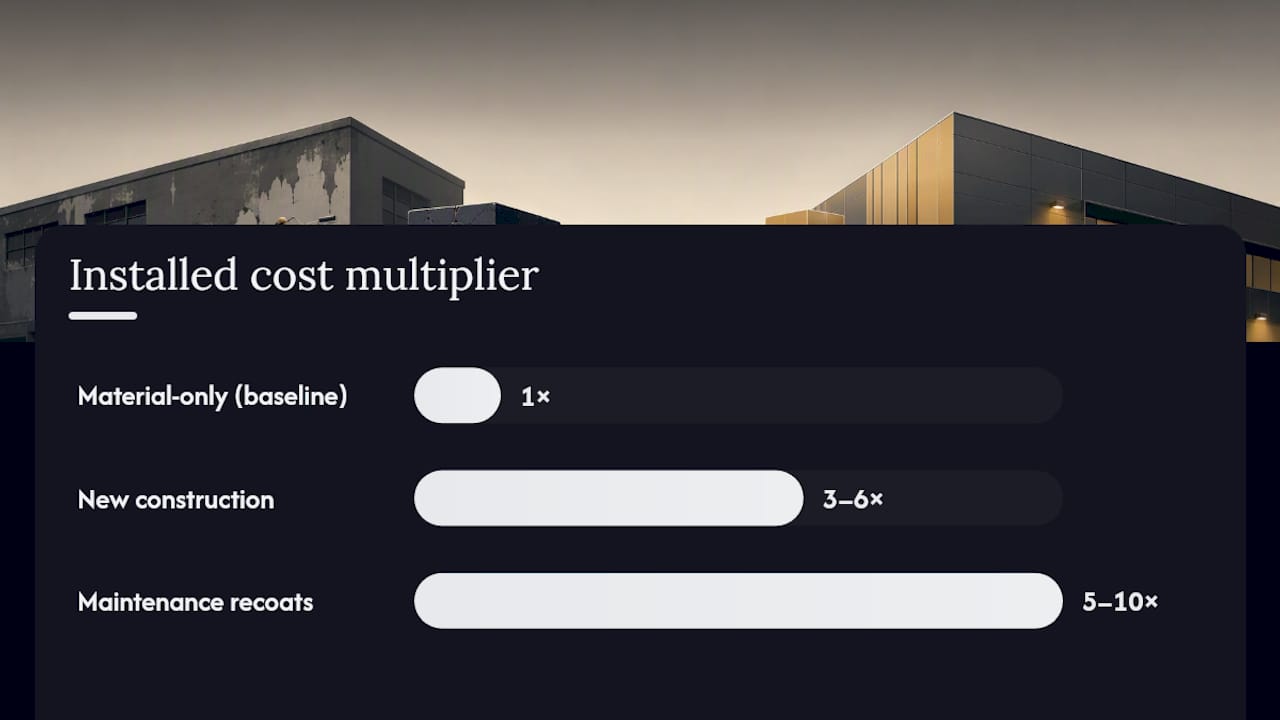
Material alone costs far less than any of those figures suggest. Per industry cost breakdowns, total installed cost typically runs 3 to 6 times the material-only price on new construction, and 5 to 10 times material-only on maintenance recoats, where access scaffolding and surface prep dominate the bill. An elevated pipe rack or a potable water tank interior pushes toward that higher multiplier every time, simply because reaching the surface costs more than coating it.
How Do You Calculate Lifecycle Cost Per Year?
Lowest bid wins the purchase order and loses the budget three years later. Lifecycle cost analysis fixes that by comparing total installed cost against expected service life, converting every option into a single number: dollars per square foot per year.
The math works in four steps:
- Get the installed cost per square foot for each system under consideration.
- Get the expected service life in years before a full recoat is needed, based on the exposure category and system type.
- Divide installed cost by service life to get cost-per-year.
- Compare cost-per-year across systems, not upfront price.
An SSPC worked example illustrates this well: an inorganic zinc system with a higher installed cost but a service life of 20-plus years produces a lower cost-per-year than an alkyd system that needs recoating every 5 to 7 years, even though the alkyd looks cheaper on day one. A recent technical paper on coating service life confirms the same pattern holds across most industrial exposure categories when access costs are factored in.
Extending service life by 5 to 7 years can justify a material premium justified by extended service life, according to industry cost-of-ownership analysis, because avoiding a recoat cycle also avoids a second round of scaffolding, containment, permits, and production downtime. That avoided-campaign value rarely shows up in a bid comparison spreadsheet, but it’s often the largest line item in the real math.
What Should Go in an RFQ to Prevent Change Orders?
Vague scope language is where budgets go sideways. Build these items into every request for quote:
- Surface preparation standard, named explicitly (for example, Sa 2½ per SSPC/ISO), not “properly prepared” or similar language.
- DFT range for each coat, stated as a number range, not “per manufacturer spec.”
- Inspection and Test Plan (ITP) hold points, listing who inspects what and when work stops for sign-off.
- Verification records required, including holiday testing and DFT logs delivered as documentation, not just promised.
- Access and shutdown plan, spelling out scaffolding, containment, and any production windows the contractor needs.
- Environmental control provisions, particularly dew point monitoring on humid or coastal sites, and how contamination control is handled.
- Waste handling and permits, covering spent abrasive disposal and any lead or hazardous coating removal requirements.
Watch for three red flags in any bid: no containment plan for confined or occupied spaces, blank or vague DFT ranges, and no verification or documentation plan at all. Any one of those is where the change order comes from later.
Pro Tip: Ask every bidder for their dew point monitoring plan before you ask about price. Coastal and humid-site coating failures trace back to this single overlooked control more often than any material defect.

What 20 Years of Bidding These Jobs Has Taught Us
Most cost overruns Southern Sandblasting & Painting sees on industrial jobs trace back to the same blind spot: surface prep that looked simple on paper and wasn’t. A tank interior with hidden pitting, a pipe rack with more joints than the drawings showed, an old coating that turns out to contain lead. These surprises are exactly why AMPP/SSPC estimating guidance insists on itemizing indirect costs upfront rather than discovering them mid-project.
Owners who get the best lifecycle value do three things consistently: they name the surface-prep standard instead of leaving it vague, they require verification records instead of taking a contractor’s word for DFT, and they plan the shutdown window before bidding instead of after. Those three habits close nearly every gap that turns into a change order.
If You Need a Detailed Estimate: How Southern Can Help
Southern Sandblasting & Painting is the direct route to an accurate number instead of a rough guess pieced together from national averages. Based in Orlando and built on more than 20 years of sandblasting and industrial coating work across Central Florida, the team scopes water tanks, bridges, pipelines, and municipal infrastructure with the same line-item discipline outlined above: named surface-prep standards, DFT ranges, ITP hold points, and documented verification records, not a one-line “paint and prep” quote.

A professional quote from Southern starts with a site survey, covers realistic scheduling around your operational constraints, and includes references from comparable municipal and commercial projects. Every proposal accounts for access and containment costs upfront, so your board or budget committee sees the real number the first time, not a change order six weeks in.
If you’re scoping a project right now, start with a look at Southern’s sandblasting and coating services and request a site estimate before you finalize your RFQ. Getting a real number early beats reworking a budget after the low bid falls apart.
Why Facility Managers Keep Getting This Decision Wrong
The mistake isn’t ignorance of lifecycle cost analysis. Most facility managers and public-works officials have heard the concept. The mistake is that budget approval processes reward the lowest number on the page, and nobody in that approval chain gets penalized three years later when the cheap system fails early, because by then it’s someone else’s line item.
That’s a governance problem dressed up as a technical one. The fix isn’t better coating science. It’s forcing cost-per-year into the same spreadsheet as upfront price before a single signature happens, so the tradeoff is visible to the person actually approving the check. Contractors who name their surface-prep standard and hand over verification records aren’t being difficult. They’re the ones giving you the data your budget process should have demanded from the start.
— Results
Sources
Readers who want the underlying technical detail behind the figures in this article can go straight to the source material:
- Estimating Costs for Protective Coatings Projects — AMPP/SSPC guidance
- Lifecycle cost analysis for water infrastructure — Sherwin-Williams (industry guidance)
- Industrial coating project management: cost & lifecycle guide — Huili Coating
- Expected service life and cost considerations for protective coating work — technical paper (2024)


