
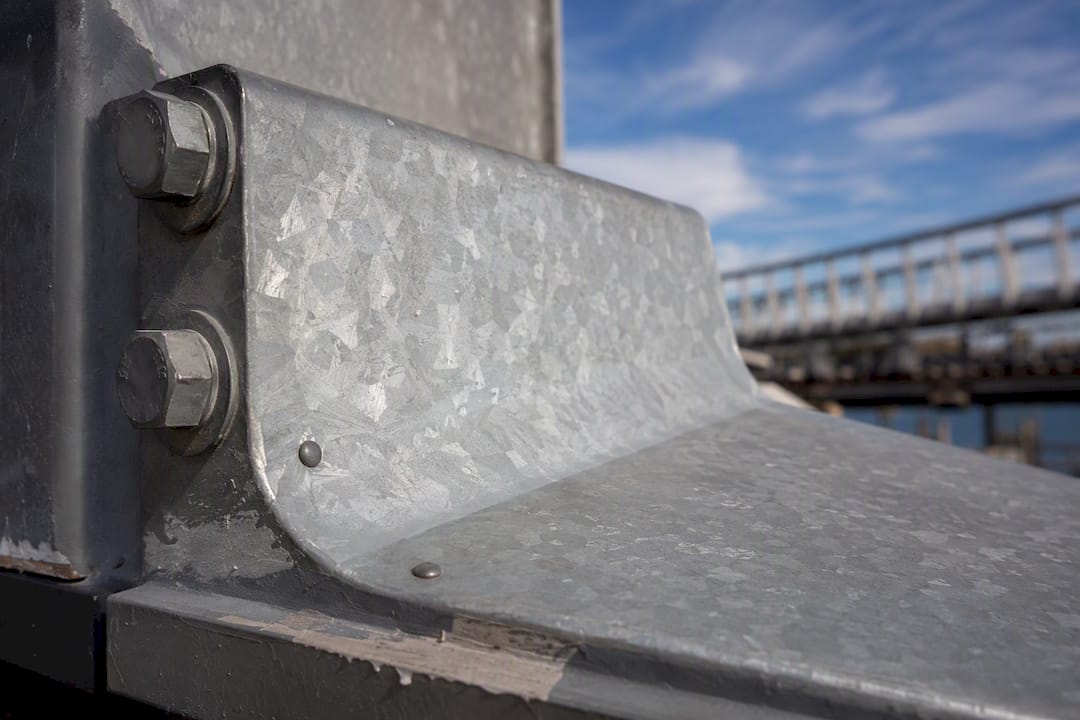
Hot-dip galvanizing is the process of dipping fabricated steel into a bath of molten zinc, typically around 450°C (815–850°F), so the zinc reacts with the steel to form a metallurgically bonded, corrosion-resistant coating. That bond is the whole point: unlike paint, it doesn’t just sit on the surface, it becomes part of it. The result is a coating that gives sacrificial (cathodic) protection and, per ASTM-referenced industry data, decades of low-maintenance service in most outdoor environments.
- Immersion in a zinc bath fuses zinc and steel into one alloyed layer, not a surface film.
- Even if the coating gets scratched, exposed steel nearby is protected sacrificially.
- Typical bath temperature runs 815–850°F (approximately 445–460°C).
Key Takeaways
Hot-dip galvanizing works because molten zinc metallurgically bonds to steel, creating a sacrificial layer that protects the base metal for decades even after surface damage.
| Point | Details |
|---|---|
| Six-step process | Degreasing, pickling, rinsing, fluxing, drying, and immersion each set up the next and can’t be skipped. |
| Bath temperature matters | Zinc baths run at roughly 445 to 460°C; poor control affects alloy layer formation and zinc consumption. |
| Not for every steel | High-strength grades can lose up to 18% yield strength and 55% hardness at galvanizing temperatures. |
| Design for vents and drains | Hollow parts need vent and drain holes planned during fabrication, not added afterward. |
| Surface prep decides success | Southernsandblastingandpainting’s sandblasting and prep work help ensure a clean, contaminant-free surface before galvanizing or coating. |
Table of Contents
- What Is Hot-Dip Galvanizing and How Does the Process Work?
- How the Zinc Coating Bonds to Steel: The Metallurgy Behind It
- What Are the Real Benefits of Hot-Dip Galvanizing?
- What Are the Limits and Drawbacks of Hot-Dip Galvanizing?
- What Standards and Inspections Confirm a Quality Coating?
- Hot-Dip Galvanizing vs. Painting, Electro-Galvanizing, and Zinc Plating
- Surface Prep Steps That Determine Whether Galvanizing Succeeds
- Get Your Steel Ready for Galvanizing the Right Way
- Sources
What Is Hot-Dip Galvanizing and How Does the Process Work?
The six steps below are what actually happens on a shop floor, not a textbook simplification. Plants combine some of them, but the sequence rarely changes because each step sets up the next.
- Degreasing. Parts go into an alkaline or mild acid bath to strip oil, dirt, and shop grime. Skip this and zinc simply won’t bond to whatever’s left behind.
- Pickling. A hydrochloric or sulfuric acid bath dissolves mill scale and rust down to bare metal.
- Rinsing. A water rinse clears residual acid so it doesn’t contaminate the flux tank.
- Fluxing. Parts sit in a zinc ammonium chloride solution that removes any last oxides and prevents new ones from forming before immersion.
- Drying. Parts pass through a drying oven. Any trapped moisture hitting molten zinc can cause a violent reaction, so this step is a safety control as much as a process one.
- Immersion and finishing. Steel is lowered into a kettle of at least 98% pure molten zinc, held at about 445 to 460°C, then withdrawn, drained or centrifuged to remove excess zinc, and air or water cooled.
Temperature callout: Bath temperature control matters more than most people assume. Run it too cool and the alloy layers form unevenly; run it too hot and you accelerate zinc consumption and stress on the steel.
Immersion angle isn’t an afterthought either. Galvanizers lower parts at a slight tilt so trapped air escapes and molten zinc can flow into every cavity. Larger or more complex assemblies get vibrated or spun in a centrifuge to shed excess zinc before it hardens into runs or drips.
- Lead is sometimes present in older bath alloys; most modern plants have shifted to lead-free formulations for environmental and worker-safety reasons.
- Passivation treatments after cooling can slow the formation of white rust (zinc oxide) during shipping and storage.
Pro Tip: If you’re fabricating hollow or box-section parts, talk to your galvanizer about vent and drain hole placement before you weld anything shut. Get it wrong and you either trap zinc inside the part or trap air that keeps zinc out entirely.
How the Zinc Coating Bonds to Steel: The Metallurgy Behind It
What makes hot-dip galvanizing different from paint is chemistry, not just thickness. As steel sits in the molten bath, iron atoms diffuse into the zinc and react to form a series of intermetallic layers, typically labeled gamma, delta, and zeta, each with a different iron-to-zinc ratio. On top sits an eta layer of essentially pure zinc. Together they create a coating that’s part of the steel itself rather than a film resting on it.
- Gamma layer: highest iron content, closest to the base steel.
- Delta and zeta layers: intermediate alloy zones that provide much of the coating’s hardness and wear resistance.
- Eta layer: pure zinc outer layer, softer but highly workable and the first line of defense against the atmosphere.
Those alloy layers are notably harder than the base steel, which is part of why galvanized surfaces hold up well against abrasion during handling and shipping. Bath additives like nickel, aluminum, or tin change how quickly these layers grow and affect surface finish. Some formulations are chosen specifically to control spangle appearance or reduce the risk of a brittle coating on certain steel chemistries.
What Are the Real Benefits of Hot-Dip Galvanizing?
The core benefit is cathodic protection: zinc corrodes preferentially to steel, so even a nicked or scratched coating keeps protecting the metal underneath. That’s a meaningful difference from a coating that only works while it’s fully intact.
- Full coverage of welds, edges, and interior surfaces of hollow sections, areas that are notoriously hard to paint evenly.
- Strong mechanical bond that resists chipping and peeling during transport or installation.
- Abrasion resistance from the harder intermetallic layers, useful anywhere parts get bumped or dragged.
- Service life measured in decades rather than years in most atmospheric exposures, according to industry benefit data.
Statistic callout: Actual service life depends heavily on environment. A rural or suburban atmosphere (roughly a C2 to C3 corrosivity category) tends to treat galvanized steel far more gently than a coastal or heavy-industrial site (C4 to C5), where salt spray or chemical exposure accelerates zinc consumption.
Bridges, guardrails, outdoor structural framing, transmission towers, and water treatment infrastructure are classic use cases. Buried or embedded-in-concrete applications work too, but they call for a different design conversation since the corrosion mechanism underground differs from open-air exposure.
What Are the Limits and Drawbacks of Hot-Dip Galvanizing?
Kettle size is a hard physical limit. If a fabricated assembly is longer, wider, or heavier than the plant’s dip tank and crane capacity, it either needs to be built in sections or coated a different way. Transportation of oversized galvanized assemblies adds cost fast.
- High-strength steels can lose mechanical performance at galvanizing temperatures. Research on high-strength steel reports yield strength reductions up to 18%, tensile strength reductions up to 13%, and hardness reductions up to 55% for certain grades, which is why some manufacturers advise against thermal processing on specific alloys.
- Spangle, the crystalline surface pattern, varies from batch to batch, so appearance-sensitive projects sometimes need a different finishing approach.
- Threaded fasteners and small parts can pick up excess zinc buildup that interferes with fit, often requiring re-tapping or centrifuging.
- Upfront cost typically runs higher than electro-galvanizing, though that gap often closes over a multi-decade service life.
Pro Tip: If appearance or thread tolerance matters more than raw corrosion protection, ask about post-galvanize machining, or specify electro-galvanizing or a painted system instead. Trying to force hot-dip galvanizing onto a precision-fit part usually creates more rework than it saves.
What Standards and Inspections Confirm a Quality Coating?
Coating thickness and quality get verified against recognized standards, not eyeballed. ASTM standards govern most acceptance testing in the US, while BS EN ISO 1461 sets minimum coating thickness guidance tied to steel section thickness, widely referenced internationally for design purposes.
- Visual inspection catches obvious defects: bare spots, excessive roughness, ash inclusions, or runs.
- Magnetic thickness gauges are the standard field tool for measuring dry film thickness without damaging the coating.
- Cross-section or referee tests get used when a dispute over compliance requires destructive verification.
- Adhesion checks, usually a knife or bend test, confirm the coating won’t flake under mechanical stress.
Minimum required thickness generally scales with steel section size: thicker sections hold molten zinc longer and build a heavier coating. Specifiers should match required thickness to the project’s corrosivity category rather than defaulting to a single blanket spec.
Hot-Dip Galvanizing vs. Painting, Electro-Galvanizing, and Zinc Plating
The right coating depends on exposure, geometry, and how long the asset needs to last without maintenance. Zinc coating selection guidance treats hot-dip galvanizing as the standard for outdoor, welded, structural work, while thinner electroplated or plated coatings suit indoor or appearance-driven applications.
- Environment: outdoor or corrosive exposure favors hot-dip galvanizing; controlled indoor environments tolerate thinner coatings.
- Geometry: welded assemblies with internal cavities galvanize well; tightly toleranced small parts often don’t.
- Heat sensitivity: high-strength steels may need an alternative if bath temperatures risk their mechanical properties.
- Budget horizon: short asset life favors paint’s lower upfront cost; multi-decade infrastructure favors galvanizing despite the higher initial price.
- If the part is a large, welded outdoor structure, choose hot-dip galvanizing.
- If the part is small, threaded, or appearance-critical indoors, consider electro-galvanizing or zinc plating.
- If the steel is a high-strength grade sensitive to heat, consult the manufacturer before committing either way.
Surface Prep Steps That Determine Whether Galvanizing Succeeds
Zinc won’t bond to a dirty surface, period. Oils, old paint, and welding slag all have to come off before parts ever reach the pickling tank, whether that’s through chemical cleaning or abrasive blasting to a controlled profile. Fabricators who skip this step usually find out the hard way: any contaminated patch shows up as a bare spot the moment parts come out of the bath.
- Remove oils, coatings, and weld slag completely before shipping to the galvanizer.
- Choose pickling or abrasive blasting based on the contaminant and the steel’s surface condition.
- Confirm vent and drain hole placement on hollow parts before fabrication is finalized.
Pro Tip: Mark drain and vent locations on shop drawings and review them with your galvanizer during design, not after the parts are built. Southernsandblastingandpainting handles this kind of pre-galvanize surface prep, including sandblasting and grit profile control, as a routine part of large fabrication projects.
When we recommend hot-dip galvanizing over the alternatives
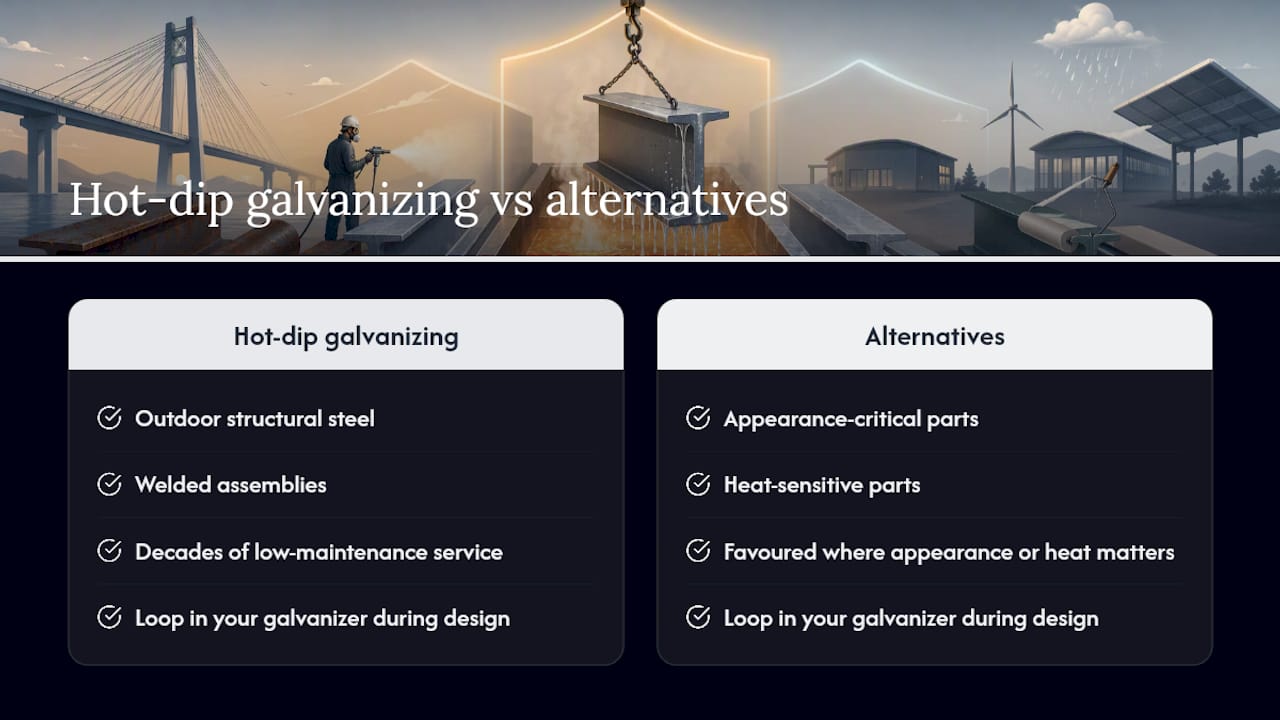
We steer outdoor structural steel, welded assemblies, and anything needing decades of low-maintenance service toward hot-dip galvanizing. For appearance-critical or heat-sensitive parts, we favor alternatives, and either way, loop in your galvanizer during design, not after fabrication is done.
Get Your Steel Ready for Galvanizing the Right Way
A part only galvanizes as well as it’s prepared. Southern Sandblasting and Painting has spent over 20 years handling the surface prep work that determines whether a coating bonds cleanly or fails at the first bare spot, and that expertise applies just as much to pre-galvanize prep as it does to painted coating systems.
We handle degreasing-stage cleaning, abrasive blasting to a specified profile, rust and old-coating removal, and coordination on part design details like drain and vent placement, the kind of prep work that keeps large fabricated assemblies moving through a galvanizer without rework. If your project involves water tanks, structural steel, pipelines, or other large-scale infrastructure that needs a corrosion-resistant finish, our sandblasting services get the surface ready before it ever reaches a zinc bath or paint booth. Request a quote and we’ll walk through your project’s surface prep needs and timeline before you commit to a coating approach.
Sources
- Hot-dip galvanizing
- The Influence of Hot-Dip Galvanizing on the Mechanical Properties of High-Strength Steels


