
A high build epoxy lining is a thick, largely or fully solvent-free epoxy system, applied in one or multiple coats to build a continuous barrier from roughly 20 to 80 mils, sometimes more for structural work. It gives you an immersion-capable, abrasion-resistant lining that bonds directly to steel or concrete. Specify it when the substrate is stable and the job is barrier protection against water, chemicals, or abrasion. Skip it when the structure moves, flexes thermally, or sits in direct sun with no topcoat.
TL;DR:
- Ensure the specified high build epoxy thickness is appropriate for the service; 20 to 80 mils is typical, with thicker layers used for structural purposes.
- Confirm the coating is applied on a stable, properly prepared surface with a 2 to 4 mil profile, and verify adhesion with holiday testing before placing into service.
- Use manufacturers’ data for pot life and mixing ratios at actual application temperatures to avoid soft spots and incomplete curing.
- Specify performance metrics such as abrasion resistance, adhesion strength, and chemical resistance to ensure the coating will meet the environmental demands.
- Recognize that high build epoxy is suitable for water, chemical, or abrasion barriers on structurally sound substrates; it does not repair or replace compromised walls or flexing structures.
Table of Contents
- What Makes an Epoxy Lining “High Build,” and How Does It Differ From a Coating?
- Technical Specifications Every Facility Team Should Demand
- When Should You Specify High Build Epoxy Instead of Something Else?
- Surface Prep, Primers, and Application Practices That Determine Whether the Job Lasts
- How Long Does High Build Epoxy Actually Last, and Where Does It Fail?
- Which Standards and Tests Belong in Your Specification?
- What Have Real Projects Taught Us About Specifying These Systems?
- Our Take on Writing an Epoxy Lining Spec That Actually Holds Up
- How Southern Sandblasting & Painting Supports Your High Build Epoxy Project
- Sources
What Makes an Epoxy Lining “High Build,” and How Does It Differ From a Coating?
“High build” refers to dry film thickness, not brand or chemistry. A standard epoxy coating might go down at 3 to 6 mils per coat, thin enough that you’re relying on multiple coats and the underlying structure to do most of the protective work. A high build epoxy lining is built to stand largely on its own as a barrier, often applied at 20 mils or more in a single pass.
That distinction matters more than most procurement documents admit. Thin-film epoxy coatings are dressing on a structurally sound substrate. High build linings are closer to a second skin. The line gets blurry when people start comparing epoxy linings to true structural liners like cured-in-place pipe (CIPP). Spray-applied epoxy is generally non-structural, typically 1 to 3 millimeters thick, while CIPP liners run 3 to 15 millimeters and can be ready for pressure testing in as little as 6 to 12 hours depending on cure method, with design lives that stretch past 50 years in many municipal specs, according to one pipe coating industry guide. A high build epoxy lining protects a pipe or tank that still has structural integrity. It does not replace a pipe wall that’s cracked or ovalized.
If you remember one industry term beyond “high build,” make it “ultra-high solids” (UHS). That single term shows up constantly in manufacturer literature and matters when you’re comparing bids.
Technical Specifications Every Facility Team Should Demand
Procurement documents that skip the numbers invite disputes later. Here’s what actually belongs in a spec sheet for industrial epoxy coatings at high build thickness.
Solvent-borne systems lose volume as the solvent evaporates, which means you need to apply more material to hit the same dry mil target, and you’re managing VOC emissions during application.
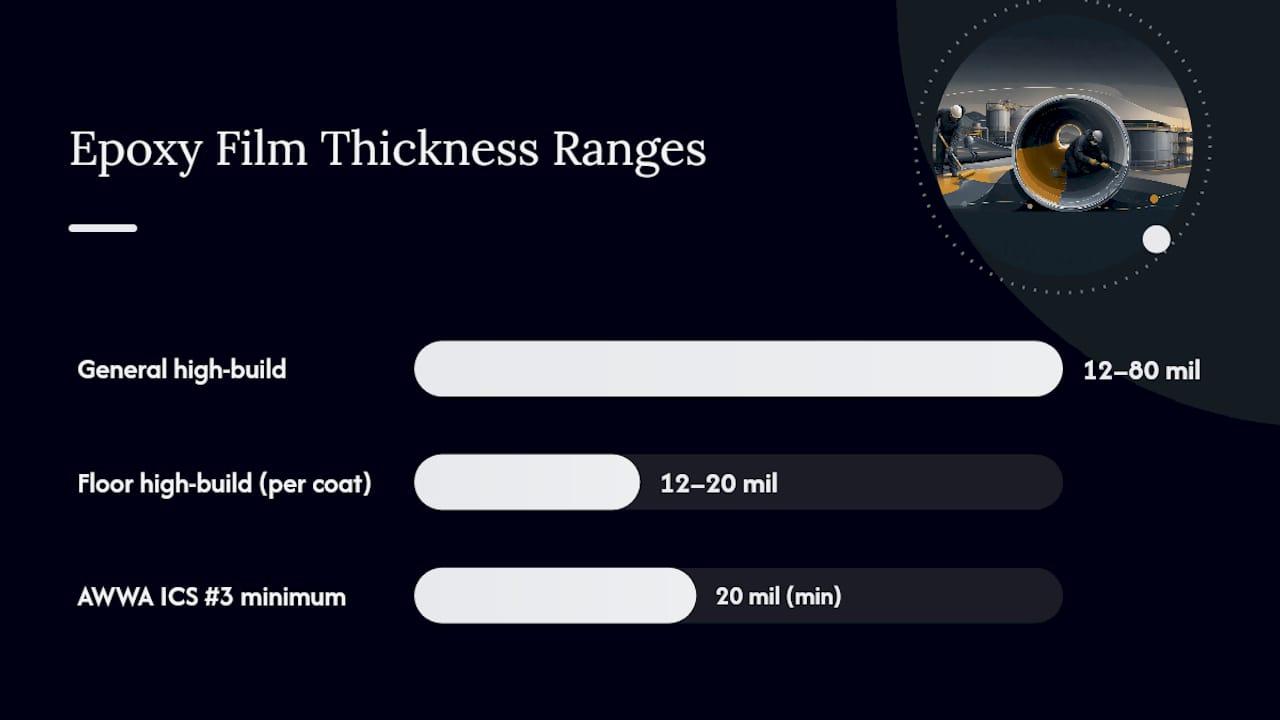
Film thickness ranges vary by application. General high build systems run from around 12 mils up to 80 mils, or roughly 0.3 to 2.0 millimeters, depending on the substrate and service. Floor coatings sit at the lower end: typical high build epoxy flooring applies at 300 to 500 microns per coat, which converts to about 12 to 20 mils, and reaches light foot traffic in 12 to 16 hours with full cure around seven days. Tank and pipe linings run heavier. AWWA’s ICS #3 classification calls for a single-coat ultra-high solids epoxy at a minimum 20 mil dry film thickness, and UHS systems in that category often cure to service in 24 to 36 hours.
Pot life and mixing ratio deserve real attention on the spec sheet, not an afterthought. Many UHS formulations provide a limited workable window of under an hour at typical room temperatures before application properties degrade, per manufacturer product literature. Temperature swings shorten that window fast: a hot Florida afternoon on a steel tank shell can cut pot life by half compared to the lab number on the data sheet. Mixing ratio matters too. Most high build epoxies use a fixed volumetric ratio (often 1:1 or 4:1 resin to hardener), and getting that ratio wrong, even slightly, produces soft spots that never fully cure.
Performance metrics worth requesting from any manufacturer before you approve a system:
- Taber abrasion resistance, measured in weight loss per thousand cycles
- Adhesion pull-off strength, typically reported in psi per ASTM D4541
- Tensile strength and percent elongation at break
- Chemical resistance data specific to your service environment (acids, caustics, hydrocarbons)
- Cure-to-immersion and cure-to-chemical-exposure timelines, which are often longer than cure-to-touch
Pro Tip: Ask for the manufacturer’s pot life and DFT numbers at your actual application temperature, not the standard 77°F lab condition. A tank recoat in a Central Florida summer behaves nothing like the data sheet default.
When Should You Specify High Build Epoxy Instead of Something Else?
The right question isn’t “is epoxy good,” it’s “does this service environment match what epoxy does well.” Get that wrong and you’ll be back on site in two years instead of twenty.
Immersion service is where high build epoxy earns its reputation. Potable water tanks, wastewater clarifiers, and chemical containment all lean on epoxy’s chemical resistance and low permeability. For potable water work specifically, NSF/ANSI 61 certification isn’t optional, and it narrows your product list considerably.
Atmospheric service on floors is a different animal. Warehouse and processing floors want abrasion resistance and impact resistance more than chemical immersion resistance, and the DFT targets run lower, generally in the 12 to 20 mil range per coat rather than the 40 to 80 mils common in tank linings.
Before you write “epoxy lining” into a spec, settle whether you need a barrier or a structural fix:
- Barrier only: the pipe, tank, or floor slab is structurally sound; you’re protecting it from corrosion, abrasion, or chemical attack.
- Structural lining: the substrate itself is compromised (ovalized pipe, cracked pipe walls, significant wall loss) and needs a system like CIPP that can carry external load independently of the host structure.
Specifying a barrier coating over a structurally failing pipe doesn’t fix the underlying problem. It buys you a short delay before the same failure reappears, often at a worse location.
There are also environments where epoxy simply isn’t the right tool. Structures with meaningful thermal cycling, wide expansion joints, or repeated flexing do better with elastomeric polyurethane linings, which flex where epoxy would crack. Aggressive secondary containment with concrete substrates prone to cracking sometimes calls for cementitious-epoxy hybrid systems that bridge small cracks better than pure epoxy resin. Neither of those is a knock on epoxy. It’s a reminder that “high build” describes thickness, not universal fitness for every job.
Surface Prep, Primers, and Application Practices That Determine Whether the Job Lasts
Coating failures almost never start with the resin. They start with the surface underneath it. Adhesion failure traces back to inadequate surface preparation more often than any other single cause, and it’s the one variable a facility manager can actually control before bids go out.
- Set the profile before you pick the coating. Most high build epoxy manufacturers call for a 2 to 4 mil surface profile on steel, achieved through abrasive blasting to SSPC-SP10 (near-white metal) or better for immersion service. A polished or lightly roughened surface won’t hold a 40 mil film under hydrostatic pressure.
- Verify cleanliness, not just profile. Chloride contamination left on a blasted steel surface is a known cause of osmotic blistering under epoxy linings, even when the profile numbers look perfect. Soluble salt testing before coating is cheap insurance on any tank recoat.
- Decide on a primer early, not the morning of application. Zinc-rich primers add cathodic protection on steel exposed to aggressive immersion, while a straight epoxy primer often suffices for atmospheric or mildly corrosive service. Sequencing matters: primer recoat windows are usually narrower than topcoat windows, and missing that window can mean re-blasting.
- Plan the crew and mixing logistics around pot life, not around convenience. A single-coat UHS system with a 30 to 45 minute working window means you mix in smaller batches more often, and you need enough hands on the plural-component pump or trowel crew to keep pace without wasting catalyzed material.
- Address concrete separately from steel. Concrete substrates need moisture testing (calcium chloride or in-situ probe) and laitance removal before any high build epoxy goes down; epoxy applied over excess moisture or weak surface laitance disbands in months, not years.
- Confirm ventilation and confined-space protocols before the crew enters a tank. Even 100% solids epoxies release vapor during application and cure, and confined tank interiors need forced-air ventilation and atmospheric monitoring regardless of solvent content.
- Run holiday detection once cured. A low-voltage or high-voltage holiday detector (depending on total DFT) finds pinholes and thin spots before the tank goes back into service, not after it starts leaking.
Pro Tip: Schedule adhesion pull-off testing on a few sacrificial witness panels prepped alongside the actual substrate. It gives you real numbers without putting holes in the tank you just lined.
How Long Does High Build Epoxy Actually Last, and Where Does It Fail?
Properly prepped and applied, a high build epoxy lining in immersion service can last well over a decade before recoating is needed, though actual service life depends on exposure and maintenance. Floor coatings in heavy-traffic environments often require more frequent touch-ups, depending on forklift traffic and chemical spills.
Failure almost always traces back to one of three causes:
- Inadequate surface preparation, covered above, remains the leading cause of early disbandment.
- Thermal or structural movement the lining wasn’t designed to absorb. Standard high build epoxies have low elongation, typically only 2 to 5 percent before cracking, while elastomeric polyurethanes can stretch past 40 percent elongation without failing. On a steel tank that expands and contracts significantly with ambient temperature swings, that gap is the difference between a lining that survives twenty winters and one that hairline-cracks after two.
- Chemical mismatch, where a standard bisphenol-A epoxy meets a solvent, acid, or temperature range outside its resistance data. Novolac epoxies and other specialty resins exist precisely for these edge cases, and a manufacturer’s chemical resistance chart should be checked against your actual process chemistry, not assumed.
Lifecycle cost is where a lot of procurement decisions go wrong. The material itself is often a small fraction of total project cost once you count abrasive blasting, tank or pipe access, scaffolding, confined-space entry procedures, and the downtime a facility eats while the asset is offline. A cheaper coating that needs recoating in eight years instead of twenty costs more once you add up two extra shutdowns and two extra mobilizations, even before you compare material price per gallon.
Which Standards and Tests Belong in Your Specification?
A spec without acceptance criteria is a wish list, not a contract. Build these checkpoints into any high build epoxy lining scope of work:
- AWWA ICS classifications for potable water tank interiors. ICS #3, for example, defines a single-coat ultra-high solids epoxy at a minimum 20 mil DFT, giving you a benchmark to compare competing bids against rather than trusting marketing claims alone.
- Holiday detection across the entire lined surface once cured, using low-voltage detectors under roughly 500 microns and high-voltage detectors above that threshold, catching pinholes and thin spots that visual inspection misses.
- Adhesion pull-off testing per ASTM D4541, with a minimum acceptable psi value written into the spec rather than left to the applicator’s discretion.
- Percent solids documentation confirming the batch mixed on site matches the product data sheet, since field dilution or improper ratios change cure characteristics.
- DFT verification with a wet film gauge during application and a dry film gauge after cure, logged at a documented number of readings per hundred square feet.
- Cure verification timelines confirming the lining has reached full cure before immersion or chemical exposure begins, since cure-to-touch and cure-to-service are two very different clocks.
Request all of this documentation as a formal closeout package, not a verbal assurance. It’s the paper trail that protects you if the lining underperforms inside its warranty period.
What Have Real Projects Taught Us About Specifying These Systems?
Across two decades of tank, pipe, and floor projects in Central Florida, the pattern holds: jobs that fail early almost always skipped a prep step, not a product choice. Blast profile shortcuts on steel tanks, moisture left in concrete slabs, and pot life mismanagement on hot days account for most of the callbacks we’ve seen across infrastructure coating projects. Specifications that lock in surface profile, holiday testing, and cure verification up front consistently outlast the ones that leave those details to the crew’s judgment on installation day.
Our Take on Writing an Epoxy Lining Spec That Actually Holds Up
Match the system to the movement, not the marketing. If the structure flexes or cycles thermally, we lean polyurethane or a structural liner before we lean epoxy. If it’s a stable substrate needing a chemical or abrasion barrier, high build epoxy is usually the right call, and the spec should say so in numbers, not adjectives.
— Results
How Southern Sandblasting & Painting Supports Your High Build Epoxy Project
Southern Sandblasting & Painting is the practical alternative to juggling separate blasting, coating, and testing contractors on a lining project. We handle abrasive blasting to the surface profile your epoxy spec requires, apply the coating system itself, and document DFT and holiday testing as part of the closeout package, so you get one accountable crew instead of three separate schedules to coordinate.
Experience with tanks, pipelines, and infrastructure projects highlights how rushed preparation often leads to callbacks within a few years. If you’re specifying a high build epoxy lining for a tank, pipe interior, or industrial floor, request a site assessment through our sandblasting services page and we’ll walk the substrate with you before a single mil goes down.
Sources
- 100% solids epoxy linings vs 100% solids elastomeric polyurethane
- 100% solids elastomeric polyurethane vs epoxy linings for steel potable water storage tanks
- Complete guide to epoxy pipe coating: types, applications, pros and cons – EPCLand
- Epoxy high build floor coating – product overview


