
A NIOSH-approved Type CE abrasive-blast supplied-air respirator, an impact-rated helmet or hood, eye and face protection, hearing protection, heavy leather gauntlet gloves, an abrasion-resistant apron or coveralls, and steel-toe boots are the baseline for any abrasive blasting crew. OSHA anchors this requirement in 29 CFR 1910.94, which points back to the general respiratory protection standard, 1910.134, and the eye/face rule, 1910.133. Air monitoring results, not habit or budget, determine whether a supplied-air Type CE unit is mandatory or whether a lower-protection respirator is defensible.
TL;DR:
- The need for a Type CE supplied-air respirator depends entirely on air sampling results, regardless of dust suppression methods or water use.
- Proper PPE checks, fit testing, and documentation are critical to compliance, with PPE failure often stemming from neglected maintenance and record-keeping.
- Containment, media substitution, and ventilation are more effective controls than PPE alone, reducing exposure and the need for higher-level respirators.
- Most PPE issues in blasting operations arise from overlooked sampling and documentation, not equipment failure, emphasizing the importance of proper exposure assessment.
Table of Contents
- Abrasive Blasting PPE Checklist for Operators and Support Crews
- How to Choose the Right Respirator Under OSHA and NIOSH Rules
- Why Engineering Controls Come Before PPE
- Building a Respiratory Protection Program That Holds Up
- Keeping Blasting PPE Functional Between Jobs
- What Two Decades of Blasting Jobs Teaches About PPE Compliance
- Where to Verify These Abrasive Blasting Safety Rules
- The Compliance Gap Most Crews Never Notice
- Sources
Abrasive Blasting PPE Checklist for Operators and Support Crews
Not everyone on a blast site needs the same gear. The person holding the nozzle faces direct rebound and the highest dust concentration; everyone else within the work zone still needs protection, just calibrated differently.
Operator kit (inside or near the blast stream):
- Type CE abrasive-blast supplied-air respirator, hood or helmet style, rated to protect against rebounding media as well as dust. NIOSH treats these as the only respirators built specifically for this job, since air-purifying respirators leave the head and neck exposed to abrasive impact even when filtration is adequate.
- Heavy blast suit or abrasion-resistant coveralls covering the torso and limbs completely.
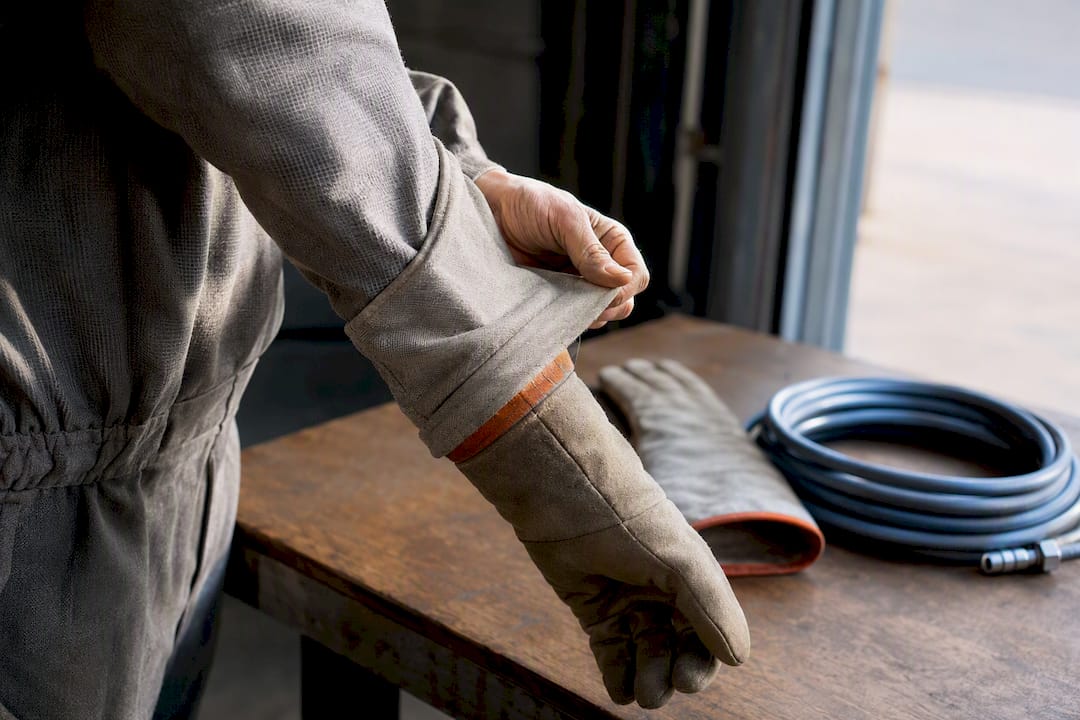
- Leather gauntlet gloves that extend past the wrist, sealed tight enough that media can’t work its way inside during repetitive nozzle movement.
- Leg chaps or an apron over the coveralls in high-rebound positions, like blasting overhead or into corners.
- Steel-toe, puncture-resistant boots, laced or sealed so grit doesn’t collect inside the boot.
Support personnel (spotters, pot tenders, cleanup crew):
- Respirators for anyone working inside the containment zone or downwind of dust, sized to actual exposure levels, not assumption.
- Safety glasses or a full face shield, plus hearing protection anywhere compressor or blast noise runs above safe exposure limits.
- Coveralls and gloves for anyone handling spent media or doing interior cleanup, since silica dust settles on surfaces long after the nozzle stops.
Wet or vapor blasting changes the math but doesn’t eliminate it. OSHA has clarified that adding water to suppress dust doesn’t automatically remove the Type CE requirement. Employers still need documented sampling showing exposure stays below permissible limits, and the nozzle has to be physically separated from the operator’s breathing zone for any exception to hold up. Cabinet blasting, where the operator works through a glove port with the media fully enclosed, typically needs far less respiratory protection than open-air work. Confined-space blasting is the opposite extreme. It almost always demands supplied-air systems plus a confined-space entry permit, because dust concentration and oxygen levels can shift fast in an enclosed tank or vessel.
Pro Tip: Check glove-to-sleeve overlap before every shift, not just at the start of the job. A gauntlet that rides up two inches after an hour of arm movement is the most common way grit finds its way onto skin.
How to Choose the Right Respirator Under OSHA and NIOSH Rules
Respirator selection isn’t a preference call. It’s driven by what the air sampling actually shows, and the default assumption under 1910.94 is that a Type CE supplied-air respirator applies unless the employer can prove otherwise.
NIOSH’s guidance is blunt about the starting point: silica sand shouldn’t be used as blast media at all, and where silica or unknown dust exposure exists, a Type CE abrasive-blast supplied-air respirator is the recommended protection. Assigned Protection Factors (APFs) tell you how much a given respirator style reduces exposure relative to the ambient concentration:
- Hood or helmet-style, continuous-flow Type CE respirators carry an APF of 25.
- Pressure-demand, positive-pressure supplied-air respirators can reach an APF as high as 2,000, according to NIOSH guidance for blasting-specific units.
That gap matters. An APF of 25 might be fine for light, short-duration cabinet work; it’s nowhere near sufficient for open-air blasting in an enclosure with poor ventilation.
Getting out of the Type CE requirement isn’t as simple as switching to wet blasting or citing “low dust” by eye. OSHA’s interpretation letter on wet abrasive blasting lays out what documentation actually has to show:
- Breathing-zone air samples collected during representative work, not a slow day.
- Results demonstrating concentrations stay below the relevant permissible exposure limits (PELs) with a margin employers can defend if OSHA asks.
- Sampling that accounts for the specific task, media, and enclosure conditions used on that job, not a borrowed report from a different site.
Skip that documentation and the default respirator requirement stands, regardless of how much water is in the mix.
Why Engineering Controls Come Before PPE
PPE sits at the bottom of the hierarchy of controls for a reason: it protects one person, and only as well as it’s worn, fitted, and maintained. Containment, ventilation, and media substitution protect everyone in the work area and don’t depend on a worker remembering to seal a glove cuff.
- Substitute the media. NIOSH’s core recommendation is to avoid silica sand entirely, using slag, garnet, or other lower-hazard abrasives like glass sand instead.
- Contain the work. Blast cabinets, portable enclosures, and full containment tenting cut exposure for everyone outside the immediate work zone, and they reduce how hard your respiratory protection has to work.
- Ventilate. Local exhaust ventilation (LEV) pulls dust away from breathing zones rather than letting it disperse across the site.
- Control access administratively. Zone off the blast area, post signage, set up a decontamination room, and review the Safety Data Sheet for whatever media you’re using before the job starts, not after someone asks.
- Monitor the air. Personal breathing-zone sampling, placed on the worker rather than a fixed station, gives the data that actually drives respirator selection and confirms controls are working.
Pro Tip: If your containment tent has a gap you can see daylight through, treat the whole crew as exposed to unfiltered ambient air, not just the operator at the nozzle.
Building a Respiratory Protection Program That Holds Up
A respirator on someone’s face means little without the program behind it. 1910.134 requires a written program, and it has to cover more than issuing equipment.
- Medical evaluation before anyone is cleared to wear a respirator, since certain heart and lung conditions make supplied-air use risky.
- Fit testing, qualitative or quantitative depending on the respirator class, repeated at least annually or whenever facial structure changes (weight change, dental work, new facial hair).
- Training on donning, doffing, limitations, and emergency procedures, ideally refreshed every year and any time equipment or media changes.
- Breathing-air quality checks for supplied-air systems, including compressor intake location, filtration, and carbon monoxide monitoring on gas-powered compressors.
- A supervisor sign-off before the job starts, confirming fit tests are current, air quality logs are up to date, and every crew member on-site has completed training for the specific respirator they’re wearing.
Skip any one of these and the respirator itself becomes a false sense of security rather than actual protection.
Keeping Blasting PPE Functional Between Jobs
Gear that worked fine last month can fail today if it wasn’t checked. Daily habits matter more than the equipment’s original price tag.
- Inspect helmet lenses, air hoses, and seals for cracks, abrasion, or loose fittings before every shift.
- Check coverall seams and glove stitching for wear at pressure points, particularly where gauntlets meet sleeves.
- Clean and disinfect helmets and respirator components per manufacturer instructions, and replace filters and seals on the schedule the manufacturer sets, not when they visibly fail.
- Store PPE in a dedicated area away from street clothes, and require a shower and full change before leaving the site when silica-containing media was used.
| PPE Component | Daily Check | Replace/Service When |
|---|---|---|
| Blast helmet/hood | Lens cracks, air hose kinks | Lens scratched enough to obscure vision |
| Supplied-air hose | Leaks, abrasion, loose couplings | Any visible wear or failed pressure check |
| Gauntlet gloves | Seam integrity, wrist seal | Fraying or loss of grip texture |
| Coveralls/suit | Torn seams, thinning fabric | Visible holes or after manufacturer-rated wear cycles |
| Boots | Sole separation, grit inside | Sole wear affecting traction |
What Two Decades of Blasting Jobs Teaches About PPE Compliance
A specialized industrial service provider has run surface preparation and coating projects across Central Florida for many years, on a variety of assets including municipal water tanks and airport infrastructure. That kind of repetition teaches you where PPE compliance actually breaks down: not in the equipment list, but in the handoffs.
Before a crew steps onto a site, someone has to confirm respirator fit tests are current and that air sampling from a comparable prior job (or fresh sampling on unfamiliar media) supports the respirator class assigned. A designated safety lead, not the fastest worker on the crew, verifies that sampling. End-of-shift hygiene isn’t optional paperwork; it’s a physical routine of decontamination before anyone touches a truck door handle.
Where to Verify These Abrasive Blasting Safety Rules
Read the source rules directly: 29 CFR 1910.94 covers ventilation and respirator basics, OSHA Fact Sheet OSHA3697 consolidates PPE and training guidance, and NIOSH’s abrasive blasting page covers media and APF recommendations. For compliance planning specific to your site, see an OSHA compliance guide and its containment methods overview.
The Compliance Gap Most Crews Never Notice
Most PPE failures on blast sites aren’t equipment failures. They’re documentation failures. Crews buy the right gloves, the right helmet, even the right respirator, then skip the air sampling that’s supposed to justify which respirator class actually applies. That’s backwards. The sampling should come first; the gear selection follows from it.
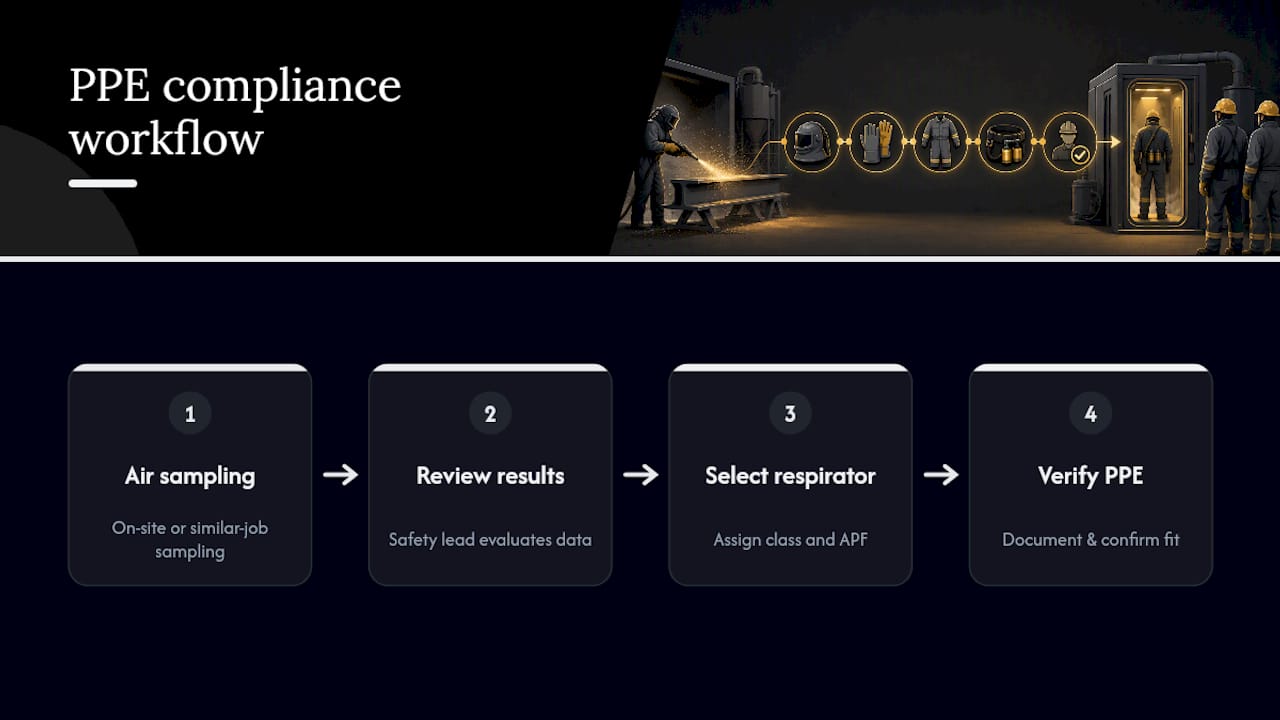
The conventional advice treats PPE like a shopping list: buy items A through G and you’re compliant. That’s not what the standards say. OSHA and NIOSH both frame respiratory protection as a decision tree driven by exposure data, not a fixed kit. A Type CE respirator with an APF of 2,000 is overkill for light cabinet work and dangerously insufficient reasoning to skip proper containment on an open-air tank job.
If there’s one thing supervisors should prioritize above buying better gear, it’s building the sampling and documentation habit. Media substitution and containment reduce how much protective equipment matters in the first place, and that’s a cheaper, more durable fix than any respirator upgrade. For crews weighing equipment investment against process fixes, an equipment guide is worth reviewing before the next contract bid, and readers with active projects in Central Florida can reach industrial sandblasting services for a compliance-first walkthrough.
— Results
Sources
- 29 CFR 1910.94 – Ventilation (OSHA)
- Protecting Workers from the Hazards of Abrasive Blasting Materials (OSHA Fact Sheet OSHA3697)
- All Users of Type CE, Abrasive-Blast Supplied-Air Respirators | NPPTL | NIOSH | CDC


