
Abrasive blasting, done with proper containment and monitoring, is the most reliable way to strip old coatings and corrosion from a water tank and leave behind the surface profile that new coatings need to bond. It works on steel, concrete, and most industrial tank surfaces. The catch is regulatory: lead-containing coatings, air-permit rules, and OSHA exposure limits all change the method and paperwork before a blast nozzle ever gets turned on. Test the coating, confirm your permit obligations, and get a written containment plan from your contractor before scheduling anything.
TL;DR:
- Proper containment and ventilation plans are critical to meet federal and state regulations and prevent environmental contamination during water tank blasting.
- Selecting abrasive media involves balancing performance with health and disposal risks, with crushed glass and aluminum oxide offering safer alternatives to silica sand.
- Achieving the specified surface cleanliness grade and profile depth according to SSPC and NACE standards is essential to prevent early coating failure.
- Permits, lead testing, and documentation of safety measures are necessary early steps that influence project scope and schedule, often more than the blasting technique itself.
- Clear bid specifications and comprehensive pre-job inspections reduce the risk of delays, rework, and warranty issues later in the project lifecycle.
Table of Contents
- What Is Water Tank Sandblasting and How Do the Main Methods Differ?
- Choosing Abrasive Media: Performance vs. Health and Compliance Risk
- Surface Cleanliness Grades and Profile: What SSPC and NACE Standards Mean
- Permits and Regulatory Checklist Before You Blast
- Worker Safety: OSHA Requirements and What to Demand From a Contractor
- Timeline and Cost: What Actually Drives the Budget
- Spec-Ready Checklist for Your Next RFP
- Preparing a Water Tank for Sandblasting
- Common Challenges During a Tank Sandblasting Job
- Post-Blasting Inspection and Quality Control
- Coatings and Long-Term Maintenance After Blasting
- Why Regulatory Prep Deserves as Much Attention as the Blast Itself
- Getting a Compliant, Spec-Ready Tank Project Off the Ground
- Sources
What Is Water Tank Sandblasting and How Do the Main Methods Differ?
Water tank sandblasting is the process of propelling abrasive media at high velocity against a tank’s steel or concrete surface to strip failed coatings, rust, and mill scale down to bare substrate. Three approaches dominate industrial tank work, and the right one depends on the tank’s condition, location, and what’s already on its surface.
Dry (air) abrasive blasting uses compressed air to fire media through a nozzle at 90 to 120 psi. It’s the fastest method and produces the sharpest surface profile, but it also throws the most dust, which is why interior tank jobs and any site near sensitive receptors usually call for full containment. Wet abrasive blasting injects water into the media stream, or blasts with water alone at ultra-high pressure, cutting airborne particulate dramatically compared to open dry blasting. Centrifugal wheel blasting, more common in shop settings than field tank work, throws media mechanically off a spinning wheel and works well on flat panels before assembly.
A typical rig includes a blast pot, abrasive-rated hose, a nozzle sized to the job, and for wet or contained work, a reclaim system that vacuums spent media for reuse or disposal. Interior tank blasting almost always requires full enclosure and forced ventilation. Confined-space entry protocols apply the moment a worker climbs inside a tank shell, regardless of which method you choose.
Choosing Abrasive Media: Performance vs. Health and Compliance Risk
Media choice is as much a regulatory decision as a technical one. Silica sand cuts fast and cheap, but it generates crystalline silica dust that drives some of the strictest OSHA exposure limits in the industry, and its use is restricted or banned outright in a growing number of jurisdictions. Crushed glass and aluminum oxide strip nearly as well with a fraction of the respirable dust. Steel shot and grit hold up for repeated reclaim cycles in contained shop environments. Coal slag and copper slag still show up on older specs but carry contamination concerns that make disposal more complicated.
Switching to a lower-particulate abrasive like crushed glass or aluminum oxide is often the simplest way to cut both regulatory exposure and worker health risk without sacrificing the surface profile a coating needs.
- Silica sand: aggressive cut, high respirable-silica hazard, increasingly restricted
- Crushed glass: fast cutting, low free silica, easier disposal
- Aluminum oxide: durable, reusable, good for controlled recycling systems
- Steel shot/grit: excellent for closed-loop reclaim, higher upfront cost
- Coal/copper slag: legacy option, disposal often complicated by trace metals
Pro Tip: Ask any bidder for the abrasive’s safety data sheet and its free-silica percentage before you compare quotes. A cheaper bid on silica sand can turn into a far more expensive disposal bill once spent media tests as hazardous waste.
Surface Cleanliness Grades and Profile: What SSPC and NACE Standards Mean
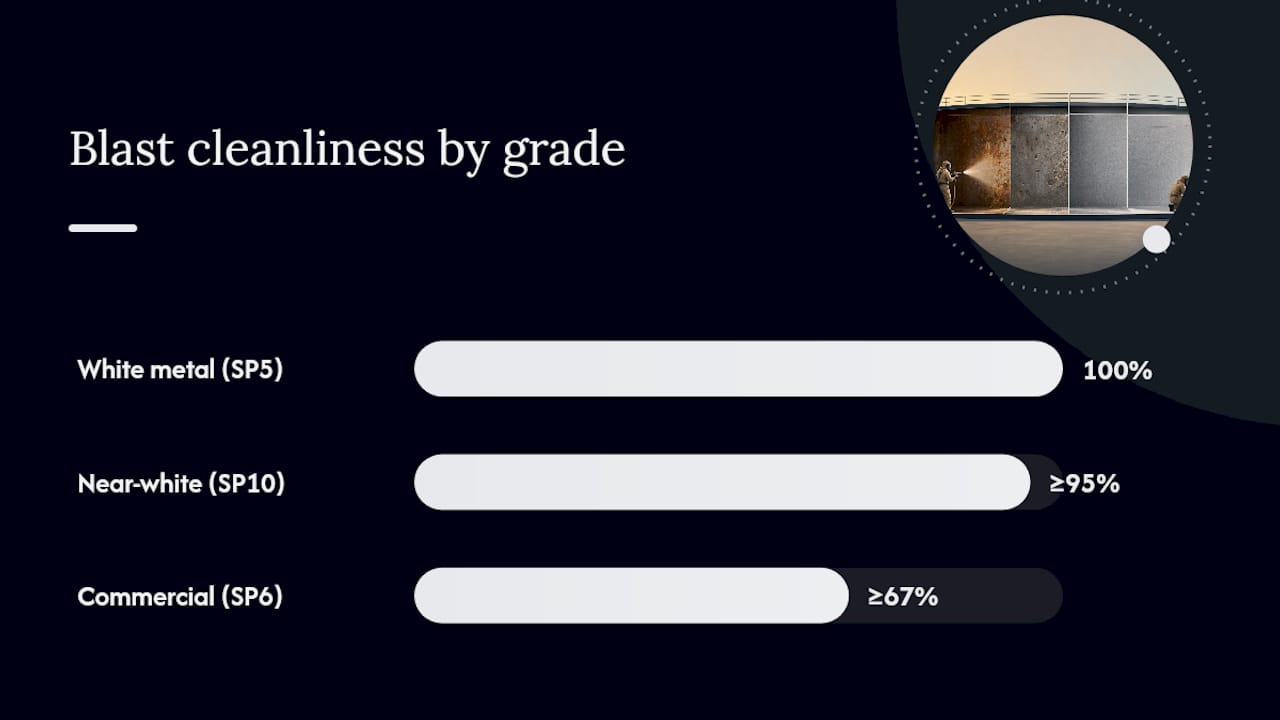
Specifying “sandblast the tank” without a cleanliness grade is how projects end up with premature coating failure. The SSPC/NACE surface preparation standards give the industry a shared vocabulary for exactly how clean a blasted surface must be before coating.
Three grades cover most tank work:
- White metal (SSPC-SP 5 / NACE No. 1): every trace of rust, mill scale, and old coating removed, uniform gray white metal appearance. Reserved for immersion service and the most demanding linings.
- Near-white (SSPC-SP 10 / NACE No. 2): at least 95% of the surface free of visible residue, light shadowing or staining permitted. The common spec for potable water tank interiors.
- Commercial blast (SSPC-SP 6 / NACE No. 3): at least two thirds of the surface clean, faster and cheaper, typically reserved for less critical exteriors.
Cleanliness alone doesn’t guarantee adhesion. Surface profile, the microscopic peaks and valleys the abrasive carves into the steel, gives the coating something to mechanically grip. Epoxies and tank linings usually specify a profile depth in mils, and too shallow a profile causes premature disbondment while too deep a profile can telegraph through thin-film coatings. Verification typically runs through visual comparators against ASTM standards, replica tape or a profile gauge to measure depth directly, and adhesion pull tests on higher-stakes jobs. Our spec-ready guide to sandblasting before recoating walks through how to write these grades into a bid document so every contractor quotes against the same standard.
Permits and Regulatory Checklist Before You Blast
Federal and state rules both weigh in before a crew shows up on site, and skipping this step is the fastest way to get a stop-work order mid-project.
- Confirm federal management-practice requirements. 40 CFR 63.11516 sets standards for dry abrasive blasting operations that may emit metal hazardous air pollutants, with specific management-practice alternatives for objects larger than eight feet in any dimension, a provision written almost specifically with tanks in mind.
- Test the existing coating for lead before scoping the job. Lead-containing coatings commonly trigger permit or notification requirements that a lead-free coating wouldn’t. Delaware’s DNREC program is a useful working example: the state removed a prior exemption for outdoor tank blasting and now requires permits or notifications whenever lead-containing coatings are being removed, with enforced containment to keep abrasive material from crossing the property line.
- Check with your local or state air authority before finalizing scope. Rules vary by jurisdiction and by whether the coating tests positive for lead.
- Build containment design into the RFP itself, not as a change order after the contract is signed. Our containment compliance guide covers the enclosure options that satisfy most state and federal expectations.
Worker Safety: OSHA Requirements and What to Demand From a Contractor
OSHA doesn’t leave respirator selection to guesswork. Under 29 CFR 1910.94 and 29 CFR 1926.57, employers must provide NIOSH-approved respiratory protection whenever airborne contaminants exceed permissible exposure limits, and blasting operations not fully separated by an exhaust-ventilated enclosure are generally expected to meet that threshold. Supplied-air respirators, often Type CE abrasive-blasting helmets, are the default for open dry blasting without full containment.
A contractor running a compliant operation will show you, without being asked twice:
- Current respirator fit-test records for every blaster on the crew
- A written ventilation or enclosure plan specific to your tank’s geometry
- Air monitoring data or a monitoring plan for lead-tested coatings
- A documented waste handling and disposal plan for spent media
Pro Tip: Ask to see fit-test dates, not just certificates. A fit test from three years ago on a different respirator model tells you nothing about today’s crew. Our safety essentials guide breaks down PPE and enclosure requirements in more detail.
Timeline and Cost: What Actually Drives the Budget
A tank sandblasting project generally runs through five phases: inspection and coating testing, containment setup, blasting itself, cleaning and inspection, then coating application and cure. Blasting is often the shortest phase on the calendar. Containment setup and coating cure time routinely eat more days than the actual abrasive work.
Cost drivers worth building into your budget upfront:
- Scaffolding or access equipment for elevated or interior tank surfaces
- Containment and enclosure materials, scaled to tank size and lead status
- Abrasive media plus disposal, which jumps sharply if media tests hazardous
- Additional remediation steps and monitoring if lead is confirmed
- Coating material and any adhesion or thickness testing specified
Hidden corrosion under old coatings, embedded contamination in concrete tanks, and weather delays on outdoor jobs are the three surprises that blow schedules most often. Our restoration workflow guide maps out a realistic phase by phase timeline for municipal projects.
Spec-Ready Checklist for Your Next RFP
Twenty-plus years of bidding and running these projects across Central Florida infrastructure teaches you exactly which spec lines separate a smooth project from a change-order nightmare.
Include these items directly in the bid document:
- Required cleanliness grade (SSPC-SP 6, 10, or 5) and profile depth in mils
- Approved abrasive types, with silica sand excluded unless specifically justified
- Containment method matched to tank location and lead status
- Waste disposal plan naming the disposal facility and hazardous-waste testing protocol
- Verification procedure: comparator standard, profile gauge, and adhesion testing if required
Ask every bidder for abrasive MSDS sheets, photos of past containment setups, references from comparable municipal tank projects, and current insurance and applicator certifications.
| Bid Item | What to Ask For | Why It Matters |
|---|---|---|
| Cleanliness grade | Written SSPC/NACE grade in spec | Prevents disputes over “clean enough” |
| Abrasive type | MSDS and free-silica percentage | Controls disposal cost and exposure risk |
| Containment | Photos from past projects | Confirms real field experience, not just a brochure claim |
| References | Municipal or industrial tank jobs | Verifies scale and regulatory familiarity |
Preparing a Water Tank for Sandblasting
Every successful blast job starts well before the first nozzle fires. The tank has to be fully drained and, for potable water systems, disinfected residue flushed out according to your utility’s protocol. Any sludge, sediment, or biological growth on interior walls needs to be removed by hand or pressure wash first. Blasting over standing debris just embeds it deeper.
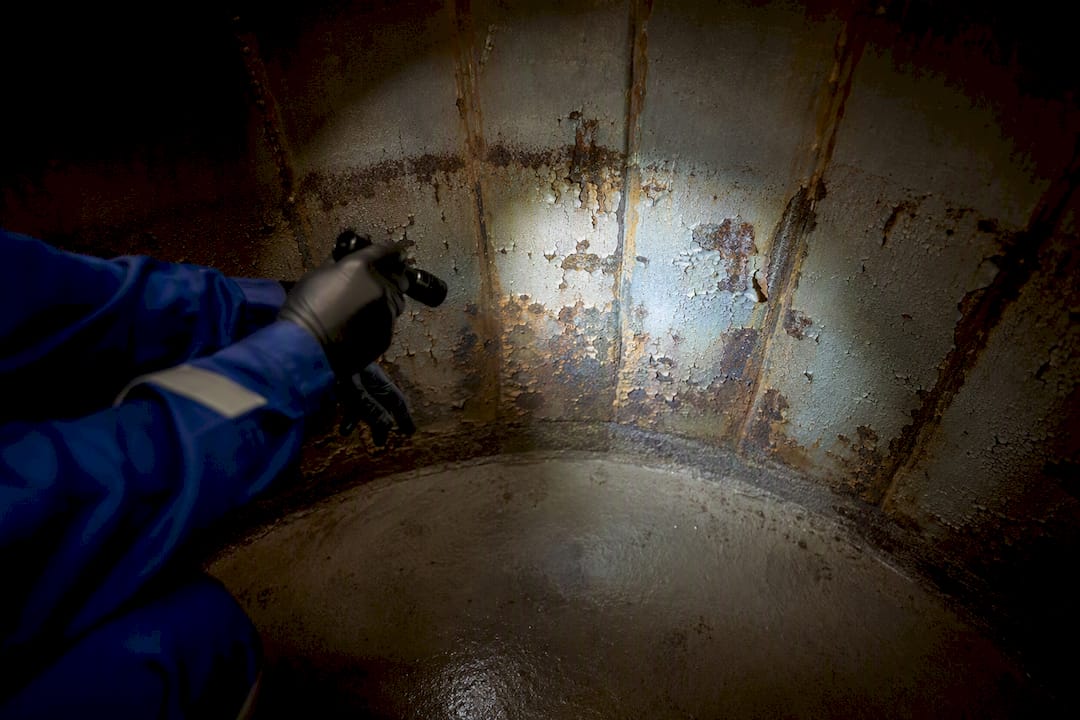
A thorough inspection comes next. Walk the tank, inside and out, documenting existing corrosion, coating condition, and any structural concerns like pitting or weld failures that blasting could expose or worsen. This is also the point to pull a coating sample for lead testing, since the result determines your permitting path and containment design. Skipping this step and discovering lead mid-blast is one of the most expensive mistakes on a tank project.
Mechanical systems get isolated next: valves closed, electrical components near the work area protected or removed, and any appurtenances that don’t need blasting masked off. Interior tanks need forced ventilation set up and confined-space entry permits pulled before anyone climbs inside. Exterior tanks need the surrounding ground protected, typically with ground tarps or catch systems, before containment goes up around the shell. Our manager’s checklist for tank preparation covers the inspection and safety documentation most municipal contracts require.
Common Challenges During a Tank Sandblasting Job
The most frequent surprise on tank projects is corrosion that runs deeper than a visual inspection suggested. What looks like surface rust on the outside sometimes reveals pitting or thin-walled steel once the coating comes off, and that changes both the schedule and possibly the structural scope of the job. Catching this early means pausing blasting in that zone and calling in an engineer rather than pushing forward and coating over a problem.
Weather is the second recurring headache on exterior work. Wind carries dust and abrasive off the containment perimeter faster than most crews expect, and humidity above roughly 85% can cause flash rusting on freshly blasted steel within hours, before primer ever gets applied. Crews working in humid climates often plan blast-and-coat cycles in tighter windows for exactly this reason.
Embedded contamination in concrete tanks presents differently. Old sealants, efflorescence, or mineral deposits can resist standard blast pressure, requiring a second pass or a different media entirely. Uneven profile is another common issue: blasting too fast across a surface leaves inconsistent peaks and valleys, which shows up later as spotty coating adhesion. The fix is almost always slowing the pass rate and checking profile depth at multiple points rather than trusting a single reading.
Post-Blasting Inspection and Quality Control
Nothing gets coated until the surface passes inspection against the spec you wrote into the contract. Visual inspection under adequate lighting comes first, checking for the cleanliness grade specified, whether that’s near-white or full white metal, using ASTM visual comparators as the reference.
Profile depth gets checked next, typically with replica tape or a digital profile gauge, at multiple points across the tank rather than one spot near the access hatch. A single low reading near the bottom third of a tank, where blast angle is harder to control, can mean the whole surface needs a second pass. Dust and residual abrasive get swept, vacuumed, or blown off before any coating touches the surface, since trapped particulate under a coating film becomes a bonding failure waiting to happen.
For critical service tanks, an adhesion pull test on a small cured coating sample confirms the profile actually did its job before the whole tank gets committed to a coating system. Documentation matters here too: photos, profile readings, and cleanliness sign-off create a paper trail that protects both the facility and the contractor if a coating warranty claim ever comes up years later.
Coatings and Long-Term Maintenance After Blasting
The coating system you choose has to match both the blast profile achieved and the tank’s service conditions. Epoxy coatings dominate potable water tank interiors because they bond well to a near-white blast and resist the constant wet/dry cycling interior surfaces endure. Polyurethane top coats go over epoxy primers on exteriors, holding color and gloss under UV exposure far longer than epoxy alone would. Zinc-rich primers are common on steel tanks facing heavy atmospheric corrosion, providing galvanic protection beneath a topcoat system.
Application has to follow manufacturer-specified recoat windows and cure times, since blasting a perfect profile and then rushing the coating cure undermines everything the prep work accomplished. Once the tank is back in service, maintenance shifts from prevention to monitoring: annual visual inspections catch coating breakdown, holidays, or early rust bloom before they become a full recoat project. Most well-executed tank coating systems last 15 to 20 years before the next full blast and recoat cycle, though touch-up repairs on isolated damage can extend that window considerably if caught early.
Why Regulatory Prep Deserves as Much Attention as the Blast Itself
The conventional advice on tank sandblasting spends most of its energy on equipment and technique, air pressure, nozzle size, media grit, and treats permitting as a footnote. That ordering is backwards. In two decades of bidding and running these projects, the jobs that blow past budget and schedule almost never fail because the blast profile came out wrong. They fail because nobody tested for lead before the RFP went out, or because containment got treated as an afterthought instead of a line item.
Facility managers who get this right start every project with the coating test and the permit question, then let those answers shape the technical spec. That sequencing matters more than which media you pick or whether you go wet or dry. A tank with a lead-free coating and a straightforward permitting path can move fast. A tank with lead paint and no containment plan in the RFP is going to stall, regardless of how good the blasting crew is.
The other underrated priority is documentation. Profile readings, cleanliness sign-off, and contractor certifications aren’t paperwork for paperwork’s sake. They’re what protects a municipality when a coating warranty claim surfaces five years down the road.
— Results
Getting a Compliant, Spec-Ready Tank Project Off the Ground
Southernsandblastingandpainting has spent more than 20 years handling exactly the kind of project this article just walked through: water tanks, municipal infrastructure, and industrial assets where lead testing, containment design, and OSHA compliance have to be right the first time, not fixed on a change order. Unlike a general painting contractor bidding outside their lane, every project starts with coating testing and a containment plan built into the proposal, not bolted on after a permit gets flagged.
That approach shows up in the paperwork as much as the equipment: documented cleanliness verification, contractor certifications, and references from comparable municipal work, the exact items this guide told you to demand from any bidder. If your tank project is still in the planning stage, start with a look at current sandblasting services in Orlando to see how a spec-ready proposal for your facility should be structured, then request a site walkthrough before you finalize your RFP.
Sources
Blasting near or above a water source, whether it’s the tank’s own contents, a nearby stream, or storm drainage, demands its own control plan separate from air-quality containment. Spent abrasive and paint chips carry heavy metals and other contaminants that can’t be allowed to reach groundwater or storm systems.
Ground protection, usually tarps, containment berms, or vacuum-recovery systems positioned under the entire blast zone, catches falling media before it reaches soil or pavement. For wet blasting or any pressure washing tied into the job, wastewater has to be captured and handled as process water rather than allowed to run into storm drains; a wastewater compliance guide covers the permitting side of that runoff in more detail. On elevated tanks, netting or scaffold wrap around the containment perimeter stops wind-carried dust from drifting toward nearby waterways or neighboring properties.
Reclaim systems that vacuum spent media directly during blasting cut this risk substantially compared to letting media fall and collecting it afterward. Wet blasting itself, as EPA technical guidance notes, reduces airborne particulate significantly compared to open dry blasting, which lowers the volume of contaminated dust settling anywhere near a water body in the first place.
- Sandblasting Water Tanks – DNREC
- 40 CFR § 63.11516 – What are my standards and management practices? | LII / Legal Information Institute
- OSHA standard interpretation and guidance on abrasive blasting controls


