
Inspect the interior of your water storage tank regularly every few years, and track coating dry film thickness (DFT) closely enough that you plan a full recoat before the coating fails across broad zones. That single cadence, drawn from AWWA D101 guidance, drives almost every other decision in a water tank maintenance program: budget timing, contractor scope, and how much surface prep you’ll need. Newer tanks get their first full interior inspection within about a decade of construction, then regular interior inspections thereafter. Corrosive water chemistry, coastal humidity, or a tank already showing coating distress shortens that window.
Once you know your inspection is due, three things need to happen before the contractor shows up:
- Open a work order or RFP for a full interior and exterior inspection, not just a visual walk-by.
- Confirm your confined-space entry and lockout/tagout plan covers the crew doing the inspection.
- Line up DFT and holiday-detection testing, either in-house or specified in the contractor’s scope.
Pro Tip: Record every defect against the same physical location grid and use identical severity language cycle after cycle. That consistency is what lets you actually trend corrosion rates instead of guessing whether “moderate rust” this year means the same thing it meant three years ago.
Key Takeaways
Facility teams and procurement officers can use this short list to brief decision-makers or kick off an RFP without re-reading the full guide.
| Full interior inspection | AWWA D101 | Every 3–5 years
| Exterior visual inspection | Facility practice | Annual |
| Interior surface prep | SSPC-SP10 | Per recoat project |
| Exterior surface prep | SSPC-SP6 | Per recoat project |
| Priming after blasting | Contract spec | Within 8 hours |
| Recoat planning trigger | DFT below ~55–60% of spec across >20% of zones | As measured |
| Interior coating approval | NSF/ANSI 61 | Required for potable contact |
Table of Contents
- Water Tank Inspection Checklist for Facility Teams
- Surface Prep and Coating Standards That Determine Longevity
- Contractor Selection and Quality Control That Protect Your Spec
- Scheduling and Budgeting for Tank Maintenance Projects
- How a Tank Restoration Project Actually Runs
- Get a Spec-Compliant Team on Your Next Tank Project
- Standards and Resources for Specifying Tank Maintenance
- Frequently Asked Questions
- Sources
Water Tank Inspection Checklist for Facility Teams
A one-time inspection tells you almost nothing. A repeatable checklist tied to the same reference points, used every cycle, is what turns inspection data into a maintenance plan instead of a pile of PDFs.
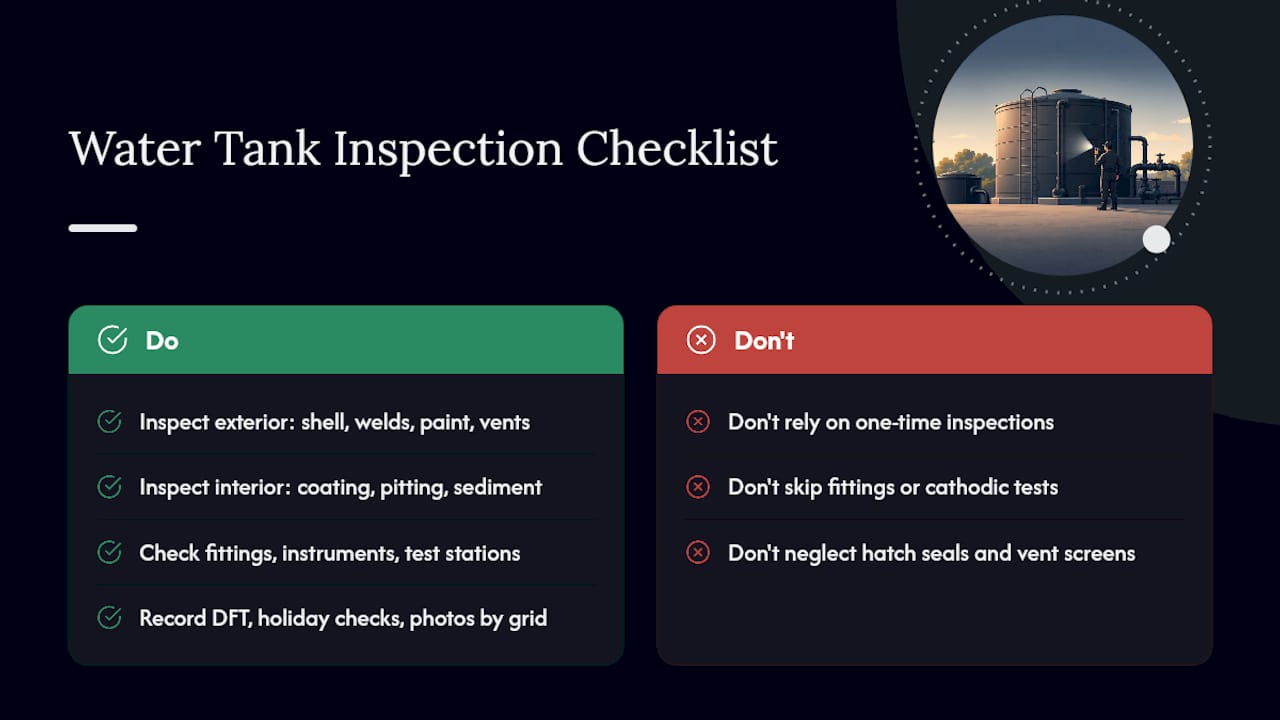
Exterior checks should cover shell condition, weld seam integrity, overall paint condition, vents and overflow pipes, the foundation and support structure, and hatch security. If your tank sits near flight paths, confirm aviation marking and obstruction lighting still meet FAA requirements. A loose or corroded tamper-resistant hatch is a security problem and a sanitary one.
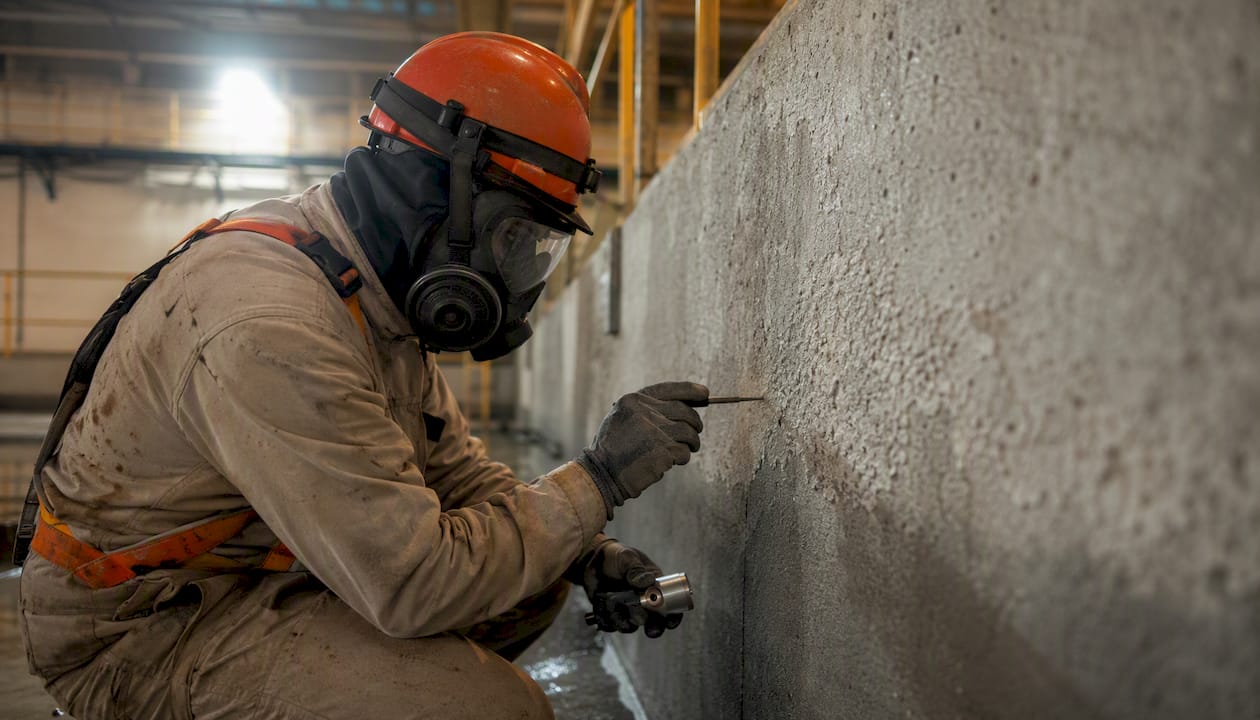
Interior checks focus on coating adhesion, blistering, exposed bare steel, pitting depth, seam deterioration, and sediment buildup on the floor. Don’t skip the fittings, instrumentation, and cathodic protection test stations. A dead sacrificial anode or a failed impressed-current system accelerates corrosion long before it shows up as a visible defect.
For measurement and evidence, every inspection should generate DFT readings by zone, holiday detection results where coating integrity is in question, a photo log tied to the same tank-location grid every time, and sediment depth at fixed points. Inspection templates built around AWWA D101 capture exactly this combination of fields and are designed to feed directly into a CMMS work order.
On cadence: plan annual exterior visual inspections, full interior inspections every few years, and shorter cycles wherever water chemistry or coating age pushes risk higher, following a commercial roof maintenance schedule approach to ensure timely upkeep. Navy guidance on routine tank checks reinforces the same interval logic and adds monthly and quarterly maintenance items that catch problems between the big inspection cycles.
Pro Tip: Hatch seals, vent screens, and overflow screens are the most commonly cited findings in sanitary surveys. Check and record their condition every single cycle, not just when someone remembers.
Surface Prep and Coating Standards That Determine Longevity
The surface-prep level you specify determines whether a coating lasts 15 years or five. SSPC-SP10 (near-white blast) is the standard for interior surfaces on potable water tanks, stripping the steel to a consistent profile that gives coatings something to grip. SSPC-SP6 (commercial blast) is typically sufficient for exteriors, where the coating faces UV and weather rather than constant water contact. For lighter cleaning jobs, SSPC-SPWJ-4 (also referenced as NACE WJ-4) uses water jetting instead of abrasive media, useful where dust containment is a bigger concern than aggressive profile creation. Whatever method you choose, specify ASTM D4417 for verifying the resulting surface profile before anyone picks up a spray gun.
Coating systems described under AWWA D102 typically follow a layered logic: a zinc-rich primer for corrosion resistance, an epoxy intermediate coat for barrier protection, and an aliphatic polyurethane finish for UV stability and color retention. Interior coatings touching potable water need NSF/ANSI 61 certification, a detail that’s easy to overlook when comparing bids on price alone.
A few execution rules separate a spec that holds up from one that fails in year three:
- Blast-cleaned steel gets primed within 8 hours, full stop. Longer than that and flash rust undermines adhesion before the primer ever touches it.
- Stripe coats go on welds, edges, and penetrations before the full coat, since these areas fail first without extra film buildup.
- Manufacturer test panels and a pre-application meeting happen before mobilization, not after problems start.
- Wet and dry film thickness, holiday testing, and adhesion checks get documented at every stage, not just at final acceptance.
Practitioners commonly use dry film thickness as an early warning system: when readings fall below roughly 55 to 60% of original spec across more than 20% of measured zones, spot repair stops being cost-effective and full recoating becomes the better investment. That threshold is a practitioner rule of thumb, not a hard AWWA number, but it’s a useful trigger for budget conversations before a tank fails outright.
None of this happens safely without proper containment. Explosion-proof exhaust ventilation, respirators rated for the abrasive and coating materials in use, and lighting that meets SSPC Guide No. 12 standards aren’t optional add-ons. They’re baseline requirements for any crew working inside a confined steel vessel.
Contractor Selection and Quality Control That Protect Your Spec
The gap between a spec on paper and a coating that actually performs comes down to who you hire and how tightly you verify their work. Ask every bidder to document relevant project history on potable water tanks specifically, not just industrial coating work generally. Municipal and commercial water tanks carry NSF 61 and confined-space requirements that general industrial painting doesn’t.
Require proof of insurance, confined-space and fall-protection training records for the actual crew (not just the company), and a documented equipment list covering blast containment, vacuum recovery systems, and explosion-proof ventilation.
Before mobilization, insist on a pre-application meeting that includes the coating manufacturer’s technical representative alongside the foreman and your engineer. Meetings that include the manufacturer’s rep tend to head off disputes over cure windows and recoat timing before they become change orders. Record minutes and decisions in writing.
Your contract language should lock in the SSPC and ASTM standards you’re specifying, define recoat windows and cure times explicitly, reserve your right to inspect shop-primed materials before erection, and make the contractor responsible for all blast debris and contamination cleanup, none of it leaving site as someone else’s problem.
On-site, require DFT mapping by zone, holiday detection results, adhesion testing, retained test panels, and daily containment logs, all attached to your CMMS or work order file as they’re generated, not delivered as a summary at project end.
Before you sign anyone, ask for: manufacturer certifications for the coating products specified, NSF 61 approval documentation for any interior coating touching potable water, instrument calibration certificates for DFT and holiday-detection equipment, three references from comparable potable water projects, and a written safety plan covering confined-space entry.
Pro Tip: A contractor who balks at providing calibration certificates for their DFT gauge is telling you something about how they handle the rest of the paperwork too.
Scheduling and Budgeting for Tank Maintenance Projects
Build your calendar around three intervals: annual exterior visual checks, full interior inspections every three to five years, and recoating projects planned 18 to 24 months before you expect the existing coating to reach end of life. Waiting for visible failure turns a planned project into an emergency one, usually at a worse price.
Your budget swings on a handful of variables:
- Surface-prep level (SP6 versus SP10) changes both labor hours and disposal volume.
- Containment and disposal costs scale with tank size and local waste-handling rules.
- Access and scaffolding requirements vary by tank height and site constraints.
- Downtime or bypass water handling may require temporary supply arrangements.
- Coating system choice (zinc-rich, epoxy, polyurethane, or combinations) affects both material cost and expected service life.
A typical welded steel tank recoating project moves through planning and RFP development, a pre-application meeting, surface prep and blasting, primer and intermediate and finish coat application with cure windows between each, QA testing, disinfection, and finally return to service.
- Budget contingency for unexpected repairs like weld defects or plate replacement discovered mid-project.
- Require daily progress and cost reporting from your contractor so surprises show up as line items, not as a final invoice shock.
How a Tank Restoration Project Actually Runs
An experienced vendor’s workflow follows a predictable sequence: mobilization and site setup with containment and access secured, pre-cleaning and removal of fittings and appurtenances, blast cleaning to the specified SSPC level, inspection with touch repairs where needed, then primer, stripe coat, intermediate, and finish coat application per spec. QA testing follows, then disinfection and return to service.
- Mobilization, containment setup, and safety plan activation
- Pre-cleaning and appurtenance removal
- Blast cleaning to specified SSPC level
- Inspection and touch repair of defects
- Coating application (primer, stripe coat, intermediate, finish)
- QA testing, disinfection, and return to service
At closeout, require calibrated DFT reports, complete holiday test logs, photos tied to your location grid, material safety data sheets and NSF 61 approvals where interior coatings apply, and a documented two-year inspection commitment as part of the contract. Southern Sandblasting & Painting LLC has built this exact workflow around more than 20 years handling municipal and industrial coating projects across Central Florida, including work on large-scale water infrastructure where downtime and compliance both matter.
Field Lesson: The Recoat Window Nobody Watches
The fastest way to void a coating warranty isn’t bad material. It’s leaving freshly blast-cleaned steel exposed past the recoat window while a crew waits on something else. Specify the window in hours, not “same day,” and hold contractors to standards-based specs like AWWA and SSPC rather than verbal assurances.
Get a Spec-Compliant Team on Your Next Tank Project
Southern Sandblasting & Painting LLC gives procurement teams something most industrial painting contractors don’t: a documented history of meeting AWWA and SSPC specs on municipal water infrastructure, not just general commercial coating work. That distinction matters when your RFP requires SSPC-SP10 blasting, NSF 61 interior coatings, and calibrated DFT reporting as contract deliverables rather than nice-to-haves.

If you’re building a spec right now, our sandblasting and surface prep services page details containment methods and abrasive options suited to potable water tanks, and our key industrial coating types guide breaks down which systems fit which exposure conditions. Before you finalize any contract, require NSF 61 approval documentation for interior coatings and insist on written pre-application meeting minutes; both catch problems before they become change orders.
Request a site assessment or an RFP-ready specification checklist from our team, and we’ll walk your tank’s current condition against AWWA D101 and SSPC benchmarks before you commit to a scope.
Standards and Resources for Specifying Tank Maintenance
Reference these when writing specs or vetting contractor claims: AWWA D101 for inspection cadence, AWWA D102 for coating system definitions and checklists, SSPC-SP10/SP6 for surface-prep levels, SSPC-SPWJ-4/NACE WJ-4 for water-jet cleaning, ASTM D4417 for surface profile testing, and NSF 61 for potable water coating approval.
- AWWA D102 coating system guidance
- Sample tank painting specification
- AWWA D101 inspection checklist template
Frequently Asked Questions
How often should a water storage tank be inspected?
Interior inspections should happen every three to five years under AWWA D101 guidance, with new tanks getting their first interior look within 10 years of construction. Exterior visual checks should happen annually.
What surface-prep standard should I specify for interior potable water tank coatings?
SSPC-SP10, a near-white blast, is the common standard for interior surfaces on potable water tanks, verified with ASTM D4417 profile testing before coating application.
Do interior tank coatings need special certification?
Yes. Any coating in contact with potable water needs NSF/ANSI 61 certification, a requirement that’s separate from general SSPC surface-prep and application standards.
How do I know when to recoat instead of spot-repair a tank?
What should I require from a contractor before signing a tank coating contract?
Ask for potable water project references, proof of insurance, confined-space training records, an equipment list covering containment and ventilation, and a commitment to a pre-application meeting with the coating manufacturer’s technical representative present.
Sources
- AWWA D102-11 Coating Steel Water Storage Tanks (AWWA store summary)
- Standard Specifications Water Storage Tank Painting (American Water / Military Services PDF)
- Routine Water Storage Tank Inspections and Checks (Navy guidance document)


