

TL;DR:
- Humidity plays a crucial role in the success of industrial coatings, affecting cure, bonding, and defect formation if not properly managed. Maintaining relative humidity between 40% and 65% and ensuring the substrate stays at least 3°C above the dew point can prevent costly failures like blistering and adhesion failure. Continuous monitoring and adjusting application practices based on real-time environmental conditions are essential for long-lasting, high-quality coatings.
Temperature gets most of the blame when industrial coatings fail prematurely. Wrong substrate prep, wrong product, wrong season. But seasoned coating professionals know the role of humidity in coating application is just as consequential, and far more likely to be ignored on a busy job site. Humidity determines how coatings cure, how well they bond, and whether defects like blistering or blushing show up three months after a project closes. This article breaks down exactly what happens to coatings at various humidity levels, how to interpret dew point readings in the field, and what specific adjustments protect your work when conditions are anything but ideal.
Table of Contents
- Key takeaways
- The role of humidity in coating application: key fundamentals
- How humidity levels affect coating quality and defects
- Dew point and the 3°C rule
- Practical humidity control strategies for industrial settings
- What two decades in Florida taught me about humidity
- Get your coating project done right the first time
- FAQ
Key takeaways
| Point | Details |
|---|---|
| Optimal range is narrow | Most coatings perform best between 40% and 65% RH; outside this range, defects become likely. |
| Dew point beats temperature | Substrate temperature must stay at least 3°C above dew point to prevent adhesion-destroying condensation. |
| High humidity slows cure dramatically | RH above 60–70% can extend drying times up to three times normal, trapping solvents beneath the film. |
| Film thickness must be adjusted | Reduce applied film thickness to 70–80% of spec under high humidity to allow proper solvent evaporation. |
| Coastal environments demand flexibility | Rigid coatings in high-swing humidity zones fail within 18 months due to substrate expansion and contraction. |
The role of humidity in coating application: key fundamentals
Before you can manage humidity on a job site, you need to understand what you’re actually measuring. Humidity is not a single number. It exists in three useful forms for coating professionals: absolute humidity (the mass of water vapor per unit volume of air), relative humidity (the percentage of water vapor present relative to what the air can hold at that temperature), and dew point (the temperature at which air becomes saturated and condensation begins to form on surfaces).
Relative humidity is the metric most paint and coating specifications reference, but dew point is arguably more actionable in the field. Here is why: relative humidity changes with temperature. Warm the air and RH drops even though the moisture content stays the same. Cool the substrate below the dew point, and condensation forms on it regardless of what the ambient RH reads on your meter. That invisible moisture film sits between your coating and the substrate, and no amount of surface preparation fixes what goes down after it.
Key humidity measurements every applicator should track on site:
- Relative humidity (RH): Measured with a calibrated thermo-hygrometer; take readings at the surface, not just in the middle of the room.
- Dew point temperature: Calculated from RH and air temperature; most modern instruments calculate it automatically.
- Substrate temperature: Measured with a contact thermometer or infrared device directly on the surface to be coated.
- Surface moisture content: For concrete or timber substrates, a surface moisture meter catches problems RH readings alone will miss.
Standards like ISO 8502-4 govern pre-application environmental testing on steel surfaces. Following them is not optional on critical infrastructure projects. They define acceptable windows, documentation requirements, and the measurement protocols that protect both the coating system and your liability exposure.
How humidity levels affect coating quality and defects
The ideal relative humidity for most coating applications falls between 40% and 65%. Within that band, solvent evaporation proceeds at a predictable rate, film formation is consistent, and the coating bonds to the substrate as formulated. Outside that band, the mechanisms that make coatings work start breaking down.

What high humidity does to a coating
When RH climbs above 65% to 70%, the humidity effects on coatings become increasingly severe. Slower solvent evaporation means wet film stays wet longer, which allows gravity, contamination, and inter-coat timing problems to compound. High RH slows drying up to three times the normal rate. Blushing, a whitish haze in solvent-based coatings, occurs because moisture enters the film before it has cured. Waterborne coatings fare differently, as they rely on water evaporation themselves, but even they can develop surface defects when the substrate is cooler than the air and condensation risk spikes.
Beyond surface defects, high humidity creates a deeper problem: trapped moisture beneath an apparently dry film. Surface drying is not full cure, and moisture sealed under a coating film causes whitening and blistering that show up weeks or months later, well after the crew has moved on. Research on prolonged high-humidity exposure found that surface roughness increased 24% after six months at 95% RH, a direct measure of moisture-induced film degradation.
What low humidity does to a coating
Low humidity brings its own set of problems, and they are less intuitive. Humidity below 30% causes dry spray, where solvent evaporates from atomized droplets before they reach the substrate. The result is a rough, poorly adhered film with uneven coverage. Static electricity buildup is also a real risk in extremely dry environments, attracting dust and debris to wet film.
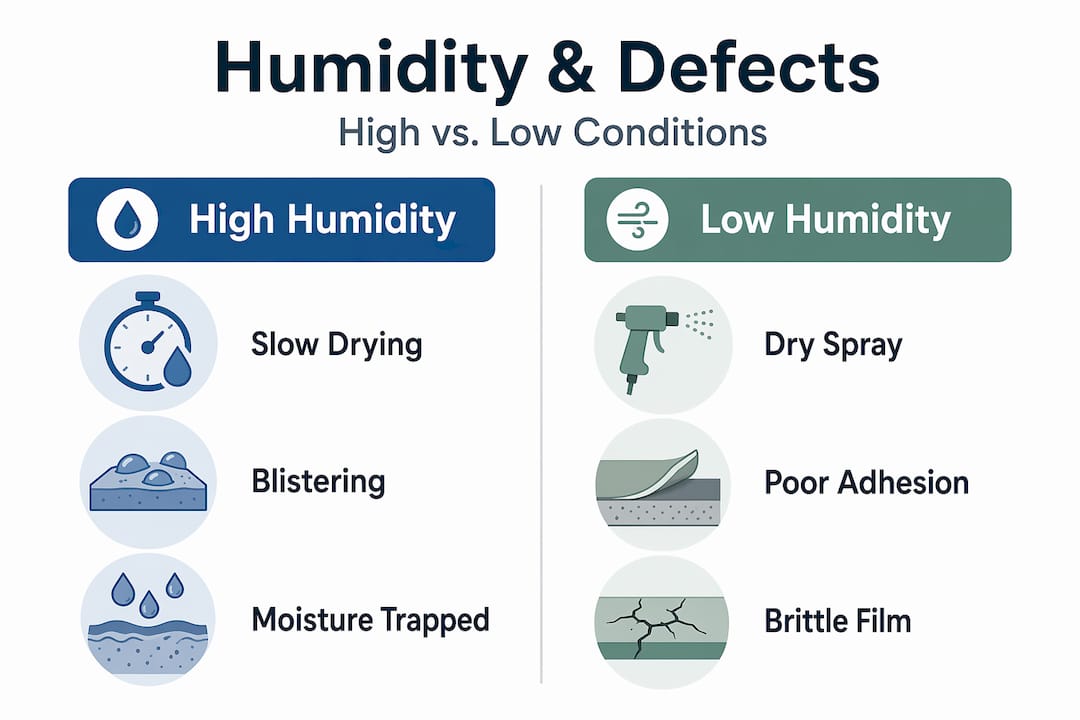
Comparing defects by humidity condition
| Humidity condition | Defect type | Primary mechanism | Most affected coatings |
|---|---|---|---|
| Below 30% RH | Dry spray, orange peel | Premature solvent evaporation | Solvent-based topcoats |
| 30–40% RH | Poor leveling, static attraction | Fast surface flash, uneven film | All spray-applied coatings |
| 65–85% RH | Blushing, extended dry times | Moisture absorption into film | Lacquers, solvent-based epoxies |
| Above 85% RH | Blistering, adhesion failure, poor curing | Condensation, moisture entrapment | All coating types |
Pro Tip: Waterborne coatings are not immune to high humidity problems. At RH above 80%, their coalescence process slows significantly, leading to soft films and poor cross-linking even after nominal dry times have passed.
Dew point and the 3°C rule
Understanding optimal humidity for paint application is only part of the picture. The dew point calculation is where professionals separate themselves from the rest. Dew point failure is responsible for some of the most expensive coating callbacks in the industry, and the mechanism is brutally simple: moisture condenses on any surface cooler than the dew point temperature. You cannot see it. You cannot feel it at trace levels. But it destroys adhesion.
The professional standard is clear. The substrate temperature must stay at least 3°C above the dew point throughout the application window, not just at the start. If you coat a steel beam at 7 a.m. when the substrate is comfortably above dew point, and cloud cover drops the surface temperature two degrees by 9 a.m., you may have sealed moisture under an entire morning’s work.
Real-world consequences of ignoring this threshold include:
- Premature corrosion: Moisture trapped under coatings on steel accelerates oxidation, defeating the entire purpose of the coating system.
- Cathodic disbondment: On pipelines and water tanks, moisture intrusion undermines the electrochemical protection coatings provide.
- Delamination under UV: Coatings applied over condensation often look fine initially but delaminate when the first heat cycle expands trapped moisture.
- Failed inspection: Projects subject to NACE, SSPC, or ISO compliance face rejection and re-work costs when pre-application records show insufficient dew point margin.
Thermo-hygrometers with dew point calculation, calibrated to traceable standards, are not optional equipment on industrial coating projects. They are the first line of measurement before any application begins. Log readings at regular intervals throughout the job, not just at the morning briefing.
Practical humidity control strategies for industrial settings
Managing the humidity levels in finishing processes requires both equipment and discipline. Here is a systematic approach that experienced applicators follow on controlled and open-air projects.
- Audit the environment before mobilizing. Pull a week of ambient humidity data for the job site location. In Florida, that means expecting RH above 70% on summer mornings and planning your application windows accordingly.
- Deploy dehumidifiers in enclosed spaces. Humidity control in industrial paint booths targets 45% to 65% RH as the standard operating range. Portable desiccant dehumidifiers work for contained field environments like tank interiors, under-bridge sections, and enclosed structures.
- Adjust film thickness under high humidity. Reduce applied film thickness to 70–80% of spec when RH is elevated. For a coating normally applied at 20 microns dry film thickness, that means targeting 14 to 16 microns per pass instead. Thinner passes allow solvent to escape before the surface skins over.
- Extend intercoat intervals beyond touch-dry. Touch-dry is a surface measurement. Full solvent release takes longer in humid conditions, and extending intercoat times is one of the most effective ways to prevent intercoat adhesion failures.
- Adjust thinner selection for humidity. Slower evaporating thinners in dry conditions give the film time to level. Faster evaporating thinners in high humidity prevent moisture absorption. Check the manufacturer’s technical data sheet for humidity-specific thinner recommendations.
- Run test patches under actual conditions. Lab test data sheets show results that may not predict field performance when ambient humidity fluctuates. A test patch in actual site conditions tells you what the specification charts cannot.
- Document everything. Time, temperature, RH, dew point, substrate temperature, batch numbers. Documentation protects you on warranty claims and compliance audits.
For projects in coastal and variable-humidity environments, rigid coating formulations are a liability. Humidity swings exceeding 30 percentage points in a single day cause substrate expansion and contraction that cracks inflexible films. Selecting coatings with built-in flexibility ratings appropriate to the thermal and moisture cycling of the location is not a specification upgrade. It is basic due diligence.
Pro Tip: When working on water tanks or bridge structures near the Florida coast, consider scheduling application during mid-morning windows after dew burn-off but before afternoon humidity peaks. Even a two-hour shift in your application schedule can mean the difference between 40% and 75% RH on the substrate surface.
Understanding how humidity affects coating performance also connects directly to surface preparation quality. Review how weather affects coating durability to get the full picture of environmental risk on your projects.
What two decades in Florida taught me about humidity
I have watched humidity take down coatings that looked perfect on day one. The substrate was clean, the product was right, the crew was experienced. But the readings were marginal and the decision was made to push forward. Three months later, blistering across the entire tank shell.
The hardest lesson is that humidity does not announce itself as a problem during application. Everything looks fine. The paint goes on smoothly. The crew finishes on schedule. The failure comes later, quietly, and the cause is almost always documented in the environmental logs that nobody checked at hour three of a six-hour application window.
What I have learned is that humidity management is not a one-time check. It is continuous. Conditions shift during a job, especially in Central Florida where afternoon storm buildups can raise RH from 55% to 85% in under an hour. The professionals who get this right treat the thermo-hygrometer like a required tool, not an optional formality. They also build adjustment protocols into their SOPs rather than making judgment calls under time pressure.
The underestimated variable is always the substrate itself. Air temperature and RH get measured. The actual surface temperature, and whether it has dipped within 3°C of dew point as shade moved across the work area, gets skipped. That is where most failures originate. Thermal mass, solar loading, and shade patterns all affect how a substrate’s surface temperature tracks relative to ambient dew point throughout the day. Building those variables into your pre-application planning is what separates a coating that lasts from one that generates a warranty claim.
— Southernsandblastingandpainting
Get your coating project done right the first time

The industrial coating application steps that actually deliver long service life account for humidity from the first substrate reading to the final intercoat interval. Southern Sandblasting and Painting brings 20+ years of environmental awareness to every project in Central Florida, from water tanks and airport infrastructure to pipelines and municipal facilities. The team uses calibrated monitoring equipment, humidity-appropriate product selection, and field-verified application protocols to protect your assets against the exact failure modes covered in this article.
If you are planning a coating project and want surface prep and application managed by professionals who understand Florida’s humidity cycles, review our sandblasting equipment and services to see how the full surface treatment process is handled. Every project starts with the right preparation and the right conditions.
FAQ
What is the optimal humidity for paint application?
Most industrial coating specifications require relative humidity between 40% and 65% for application, with applications above 85% RH considered unacceptable due to adhesion failure risk. Always verify the specific product’s technical data sheet, as some formulations have tighter tolerances.
What is the 3°C rule in coating application?
The 3°C rule requires that the substrate surface temperature must be at least 3°C above the dew point temperature at all times during application. This prevents invisible condensation from forming on the substrate and destroying adhesion before the coating has cured.
How does high humidity affect drying time?
High RH significantly extends drying times, up to three times the normal rate at 60% to 70% RH and above. Slower evaporation also increases the risk of moisture becoming trapped beneath the film, causing blistering and adhesion failure over time.
Why do coatings fail faster in coastal environments?
Coastal environments experience daily humidity swings that exceed 30 percentage points, causing substrates to expand and contract repeatedly. Rigid coatings in these conditions typically fail within 18 months through peeling and cracking as the film cannot accommodate that level of substrate movement.
Should film thickness be adjusted in humid conditions?
Yes. Under elevated humidity, reduce film thickness to 70–80% of normal spec to allow solvent to escape before the surface seals. For a 20-micron dry film target, that means applying at 14 to 16 microns per pass until conditions improve.


