

For U.S. airports, runway marking paint work means contractor-applied, FAA-compliant surface preparation, marking application with glass beads, and on-site retroreflectivity testing. Any scope of work you sign should require AC 150/5340-1 and Item P-620 compliance, a written quality control plan with a control strip, and night retroreflectivity verification before final acceptance.
TL;DR:
- Compliance with FAA advisory circulars AC 150/5340-1 and AC 150/5370-10, Item P-620, is mandatory for runway marking projects on certified airports.
- Surface removal methods like waterblasting with recapture are preferred for environmental safety and pavement preservation, with precise assessment required before removal.
- A control strip test with documented retroreflectivity results at night is essential to ensure markings meet FAA standards and prevent rework.
- Bidders should have proven experience at Part 139 airports, clear scheduling plans, and detailed safety, inspection, and quality control procedures included in the scope.
- Material selection impacts longevity and compliance, with water-based paints common for general use, thermoplastics for high-wear zones, and solvent-based paints for specific conditions.
Table of Contents
- Which FAA Standards Belong in Your Marking Specification?
- How Should You Handle Surface Prep and Paint Removal?
- What Testing Proves the Markings Will Hold Up at Night?
- What Belongs in Your Procurement Checklist?
- How Do VOC Limits and Waste Disposal Rules Affect the Job?
- Which Paint Formulation Fits Your Airfield?
- What Should the Contract Say About Warranty and Maintenance?
- How Much Should a Runway Marking Project Cost?
- How Should You Phase the Project Around Airport Operations?
- What Contractor Experience Actually Prevents Problems?
- Ready to Plan Your Airfield Marking Project?
- Sources
Which FAA Standards Belong in Your Marking Specification?
Two advisory circulars govern almost everything a contractor does on your pavement. AC 150/5340-1 sets the dimensional and design standards for runway, taxiway, and apron markings: line widths, spacing, colors, and where each marking type belongs. AC 150/5370-10, specifically Item P-620, governs the materials side: paint formulations, application rates, glass bead specifications, and the acceptance tests a contractor must pass before you sign off on the job.
Compliance with both is mandatory for any airport certificated under Part 139, and it’s a practical requirement for any project funded through the Airport Improvement Program. If federal dollars touch the project, the FAA expects these ACs referenced by name in your bid documents, not paraphrased or summarized.
Certain markings require glass beads under Item P-620, including runway and taxiway centerlines, holding position markings, designation numbers, aiming points, and touchdown zones. Beads are what create nighttime retroreflectivity. One detail contractors sometimes skip: beads generally should not be embedded in black paint, since black backgrounds and borders exist for contrast against light-colored pavement, not for reflectivity. Stencil gaps also matter more than most owners realize. Skip-line segments and letter spacing follow tolerances set in the AC, and sloppy stencil work shows up immediately under aircraft landing lights.
When you write the spec, be direct about it:
- “All markings shall conform to the dimensions, colors, and layout specified in AC 150/5340-1, current edition.”
- “Paint materials, application rates, and glass bead application shall meet the requirements of AC 150/5370-10, Item P-620.”
- “Markings requiring retroreflectivity per Item P-620 shall receive Type III or IV glass beads at the rate specified in the manufacturer’s technical data sheet.”
Vague language like “FAA-approved paint” invites disputes later. Cite the AC number and the item number every time.
How Should You Handle Surface Prep and Paint Removal?
Old markings don’t just fade into irrelevance. Painting over an obsolete marking can create a misleading surface that pilots or ground vehicles misread, which is why FAA guidance calls for physical removal rather than overpainting. The method you allow in the spec affects both cost and pavement longevity, so this isn’t a detail to leave to contractor discretion.
Four removal methods dominate the field:
- Waterblasting with recapture — high-pressure water strips paint and rubber buildup while a vacuum system captures runoff, which limits pavement damage and keeps waste contained for disposal.
- Shot blasting — mechanical abrasive removal that works well on thick paint buildup but can be aggressive on older or already-degraded asphalt.
- Sand or abrasive blasting — effective for spot removal and texture matching but requires careful containment on an active airfield.
- Chemical removal — occasionally used for delicate substrates, though it introduces its own disposal and VOC considerations.
Waterblasting with recapture tends to be the practitioner favorite because it cleans effectively while reducing environmental impact compared to some chemical alternatives, particularly on pavement that’s already showing wear.
Before you approve any method, ask for a substrate condition assessment. A contractor should be able to tell you whether the existing pavement can tolerate aggressive removal or whether prior coating layers need documentation before blasting begins. Skipping this step is how owners end up paying for pavement repair that wasn’t in the original budget.
Your SOW should quantify, not generalize: exact removal area dimensions in square feet, a grouping strategy for consolidating removed markings into larger rectangular zones (which the FAA prefers over scattered patchwork), the specific removal methods you’re authorizing, and a damage/repair clause defining who pays if the removal process gouges or spalls the surface.
Pro Tip: Ask bidders to submit a removal-method recommendation with their bid rather than dictating the method yourself. A contractor who has worked your pavement type before will often flag substrate risk you didn’t know existed.
What Testing Proves the Markings Will Hold Up at Night?
A control strip is the single most useful document you can require, and it costs you nothing extra to demand it. Before full-scale application begins, the contractor paints a small test section and records the application rate, mil thickness, drying time, and retroreflectivity reading. That strip becomes your reference point for the entire job. If a dispute arises later about whether the paint was applied at spec thickness, the control strip settles it instead of turning into a subjective argument.
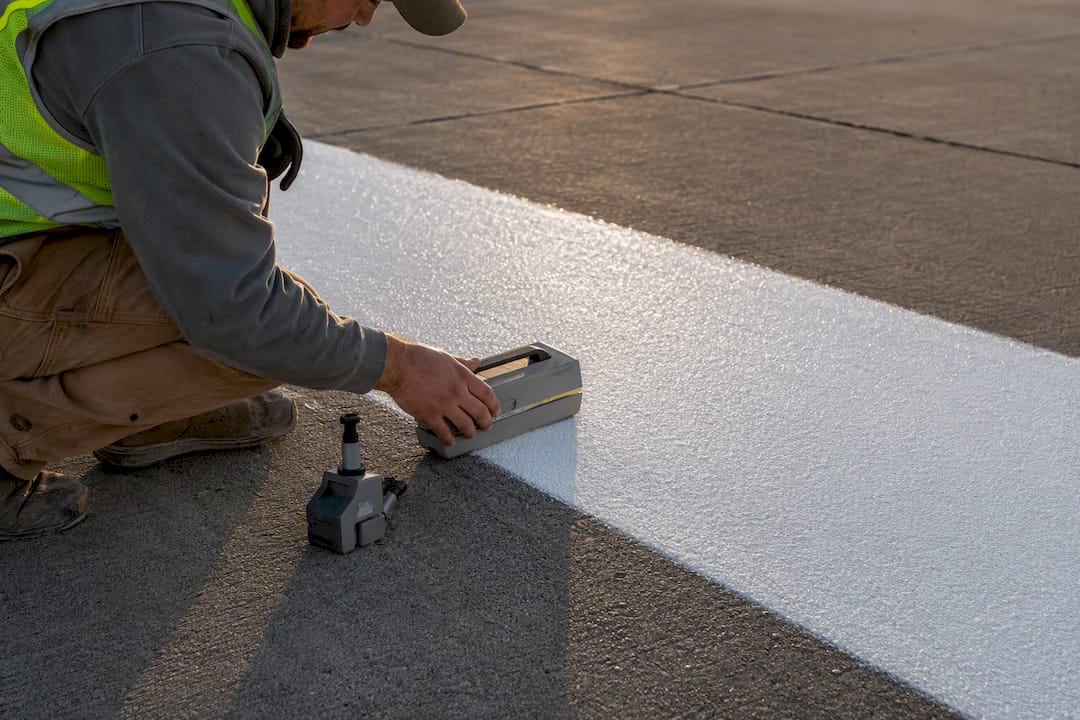
Glass bead requirements follow Item P-620 closely. Centerlines, holding positions, designation markings, aiming points, and touchdown zones need beads for retroreflectivity; Type III or IV beads are the common specification depending on drop rate and traffic exposure. Beads don’t belong in black paint, since black is used for contrast borders, not visibility.
Retroreflectivity testing is where owners either protect themselves or get shortchanged. A handheld retroreflectometer measures how much light bounces back to a driver’s or pilot’s eye, and the FAA sets minimum acceptance values under Item P-620. The test has to happen at night, under conditions that mimic actual approach and taxi lighting, and the contractor should remain on site until the markings pass. If you let a crew leave before nighttime verification, you lose your leverage to fix deficiencies without a change order.
- Require the control strip data as a QC submittal, not a verbal assurance.
- Specify that retroreflectivity testing occurs at night, using a calibrated meter, with results documented in writing.
- Make final payment contingent on passing retroreflectivity, not on daytime visual inspection alone.
Airports that build control strip and retroreflectivity documentation into the bid stage report fewer rework claims and faster final acceptance than those that leave testing loosely defined.
What Belongs in Your Procurement Checklist?
Getting the paint spec right doesn’t matter much if the contractor can’t operate safely on an active airfield. Procurement documents at major airports build in prerequisites and penalties for exactly this reason, and smaller municipal projects benefit from copying the same structure.
- Bidder experience — require documented prior work at Part 139 airports, not general commercial striping experience. Ask for project references with contact information you’ll actually call.
- Financial and insurance thresholds — set minimum bonding capacity and general liability coverage appropriate to project size, plus airport-specific insurance riders if your authority requires them.
- NOTAM and scheduling coordination — specify lead time for Notice to Airmen filings, required AOA escort arrangements, and approved night work windows. These operational details drive cost more than most owners expect, since a crew waiting on escort clearance is a crew you’re paying to stand around.
- Oversight and documentation — assign a resident project representative or equivalent oversight role, and require daily documentation of work completed, weather conditions, and any deviations from the QCP.
- Enforcement clauses — procurement documents from major airport authorities commonly include liquidated damages for late crew arrival, per-square-foot holdbacks for pavement damage, and invoicing tied to milestone documentation rather than a lump sum on completion.
Coordination with air traffic control and any affected residential areas near the airfield also belongs in the schedule, especially for night testing windows that might affect noise-sensitive neighbors.
How Do VOC Limits and Waste Disposal Rules Affect the Job?
Paint chemistry and environmental compliance intersect more than most SOWs acknowledge. Volatile organic compound limits vary by state and locality, and some regions cap VOC content tighter than the federal baseline. A contractor working across state lines should already know the applicable limit for your jurisdiction, but you should still require written confirmation that the specified paint formulation meets local air quality rules before application begins, not after.
Waste disposal is the other half of the equation. Waterblasting with recapture systems generates a slurry of paint solids, rubber residue, and water that counts as waste requiring proper handling, and dry removal methods like shot blasting produce dust and debris with their own containment requirements. Your specification should state who is responsible for waste characterization, transport, and disposal, and require documentation showing the waste went to an appropriately permitted facility.
Safety regulations extend to worker protection during application, particularly for solvent-based formulations with higher VOC content. Respiratory protection, ventilation during any enclosed or near-terminal work, and proper handling of empty paint containers all belong in the contractor’s safety plan, which you should request as part of the bid package rather than assuming it’s covered.
Building these requirements into the SOW upfront avoids a common failure mode: a low bidder who didn’t price disposal costs into their number, then either cuts corners on waste handling or comes back asking for a change order mid-project.
Which Paint Formulation Fits Your Airfield?
Three material categories dominate FAA-compliant runway marking work, and each comes with trade-offs worth understanding before you write the spec.
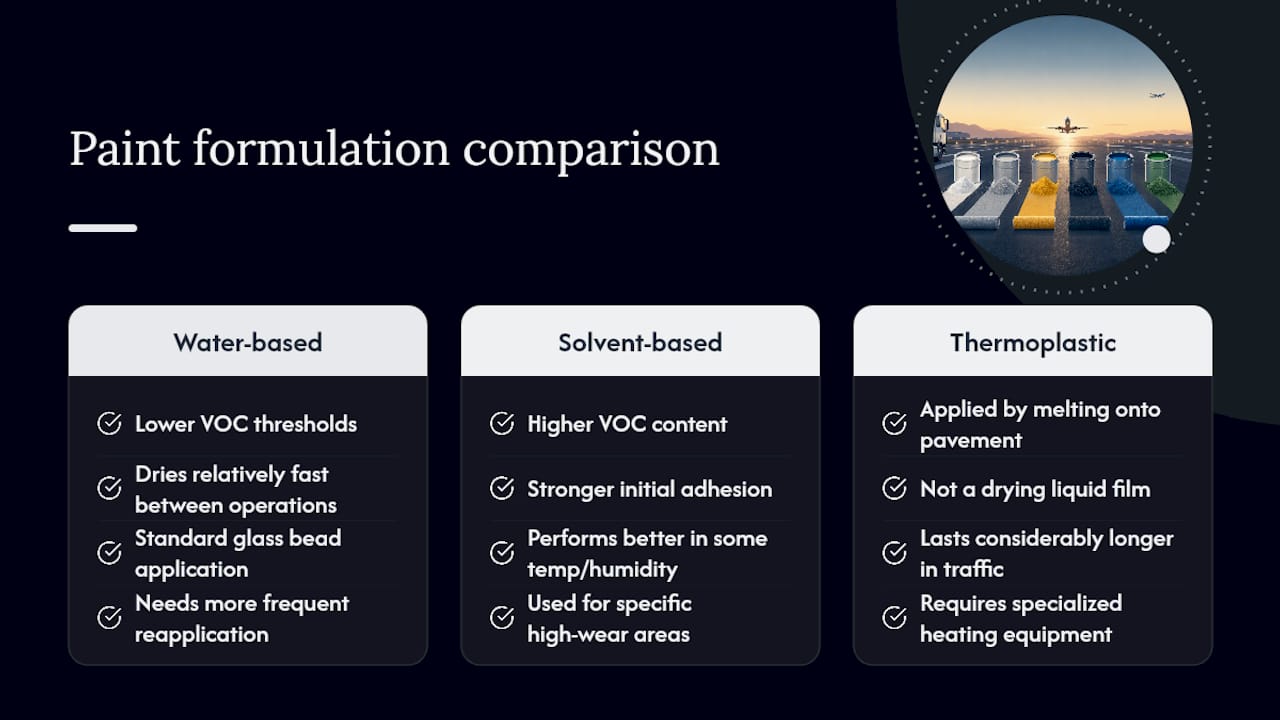
Water-based paints are the most common choice for general runway and taxiway marking because they meet lower VOC thresholds, dry relatively fast between aircraft operations, and work well with standard glass bead application. They tend to need more frequent reapplication than other formulations, particularly on high-traffic touchdown zones.
Solvent-based paints offer stronger initial adhesion and can perform better in certain temperature and humidity conditions, but their higher VOC content makes them a harder sell where local air quality rules are strict. Some airports still specify solvent-based formulations for specific high-wear areas despite the environmental trade-off.
Thermoplastic markings melt onto the pavement surface rather than drying as a liquid film, and they last considerably longer than paint in high-traffic zones. The tradeoff is application complexity and cost. Thermoplastic requires specialized heating equipment and isn’t always practical for a quick maintenance repaint between paving seasons.
Whatever formulation you choose, require the contractor to submit manufacturer technical data sheets showing the product meets Item P-620 specifications, including compatibility with the bead type you’re requiring. A paint that isn’t formulated to properly retain glass beads will show reflectivity failure within months, regardless of how well it was applied on day one.
What Should the Contract Say About Warranty and Maintenance?
A signed contract is only as good as the warranty language backing it up. Most professional runway marking contracts should specify a warranty period, commonly one to two years, covering premature fading, bead loss, and adhesion failure under normal traffic and weather conditions. Vague warranty language that just says “workmanship guaranteed” gives you nothing to enforce if markings degrade early.
Define maintenance responsibility clearly. Some contracts include a maintenance rider covering touch-up work within the warranty window; others treat any post-acceptance work as a new purchase order. Decide which model fits your budget cycle before you go to bid, because contractors price these very differently.
Performance guarantees tied to retroreflectivity values give you the clearest enforcement mechanism. If the contract states a minimum reflectivity value at acceptance and requires the contractor to remedy any marking that falls below that threshold within the warranty period, you have a documented standard to hold them to rather than a subjective visual judgment call.
Payment structure matters as much as warranty terms. Milestone-based payment tied to documented QC submittals, retroreflectivity test results, and final walk-through acceptance protects you better than a lump-sum payment on substantial completion. Retain a percentage of the contract value until final testing passes, not just until the crew leaves the airfield.
How Much Should a Runway Marking Project Cost?
Budgeting for runway marking work depends heavily on scope: full remarking after a repaving project costs considerably more than routine touch-up striping on existing markings. Removal work adds substantial cost when old markings need to come out before new ones go down, since waterblasting or shot blasting a full runway’s worth of centerline and touchdown zone markings takes crew time that touch-up work never requires.
Material choice affects the budget line directly. Thermoplastic costs more upfront than water-based paint but stretches the reapplication cycle longer, which matters if you’re comparing total cost of ownership rather than just the invoice for this project. Night work premiums, NOTAM coordination costs, and AOA escort requirements all add line items that a daytime commercial striping job would never see.
Build contingency into your budget for two things most first-time procurement teams miss: substrate repair if removal reveals pavement damage, and retesting costs if initial retroreflectivity results fall short and require reapplication. Neither is common on a well-prepared job, but both are expensive surprises if you didn’t budget for them.
Ask bidders for an itemized cost breakdown rather than a single lump figure. Separate line items for removal, surface prep, paint and beads, testing, and mobilization let you compare bids on an apples-to-apples basis and catch a bidder who’s underpricing one phase to win the overall contract.
How Should You Phase the Project Around Airport Operations?
Timing a marking project around active airfield operations is often harder than the marking work itself. Most projects need to happen during low-traffic windows, frequently overnight, which limits the productive work hours per shift and stretches the overall calendar longer than a comparable ground-level commercial job.
Weather adds another constraint. Paint application generally requires specific pavement temperature and moisture conditions, and central Florida’s rainy season can compress your available work windows considerably during summer months. Build weather contingency days into your schedule rather than assuming every planned night will be usable.
Phase the work logically: removal and surface prep first, control strip validation before full application begins, then marking application in sequence by runway or taxiway priority, followed by retroreflectivity testing before final acceptance. Trying to compress removal and application into the same overnight window on a tight runway closure often produces rushed work that fails testing.
Coordinate closely with your air traffic control tower and any scheduled runway closures well in advance. A contractor who has worked airport projects before will help you build a realistic phasing plan instead of promising an unrealistic timeline just to win the bid.
What Contractor Experience Actually Prevents Problems?
Southern Sandblasting & Painting LLC has spent more than 20 years handling surface preparation and coating work for municipal and industrial clients across Central Florida, including airport and infrastructure projects that demand the same compliance discipline runway marking work requires. That experience shapes a clear opinion: the gap between a smooth marking project and an expensive rework claim almost always traces back to equipment and documentation, not paint quality.
Airfield-specific striping equipment with pressurized bead dispensers applies beads at a consistent rate that hand-fed equipment simply can’t match. Crews that skip test strips to save an hour on the front end routinely lose days later fixing reflectivity failures nobody caught until night testing. Pavement temperature and moisture matter more than most bid packages acknowledge. Paint applied to a slightly damp surface can look fine at handoff and fail adhesion testing within weeks.
The most overlooked requirement is also the simplest to enforce: keep the contractor on site until night retroreflectivity testing actually passes. Crews that demobilize before dark, promising to “come back if needed,” rarely come back promptly, and owners end up chasing a warranty claim instead of a same-trip fix.
— Results
Ready to Plan Your Airfield Marking Project?
A specialized contractor brings the surface preparation discipline this work demands, from waterblasting and abrasive removal of obsolete markings to the documentation airports need for FAA acceptance. That’s the practical advantage over hiring a general striping crew that hasn’t worked airfield compliance before: you get a partner who understands why the control strip, the bead rate and the night test all matter before the bid ever gets signed.

If you’re building an RFP or scope of work right now, ask any bidder for three things: references from Part 139 airport projects, a sample quality control plan with control strip data from a past job, and a proposed NOTAM and night-scheduling plan specific to your airfield. Those three documents tell you more about a contractor’s readiness than any bid price line item. Southern Sandblasting & Painting’s sandblasting and painting services cover the surface prep and coating groundwork that airfield marking projects depend on. Reach out to discuss your project scope and get a proposal built around your specific airfield’s operational constraints.
Sources
- AC 150/5340-1M – Standards for Airport Markings
- Best practices in runway striping and painting | Aviation Pros
- Port Authority bid document: Pavement marking removal and application


