

TL;DR:
- Proper preparation for a water tank recoating project involves establishing safety, contamination controls, and surface standards aligned with industry regulations. Owners must verify hazardous material testing, structural integrity, and coating certification before bidding to prevent costly change orders. Clear documentation and strict adherence to OSHA, SSPC, NSF, and EPA standards ensure subsequent work quality and regulatory compliance.
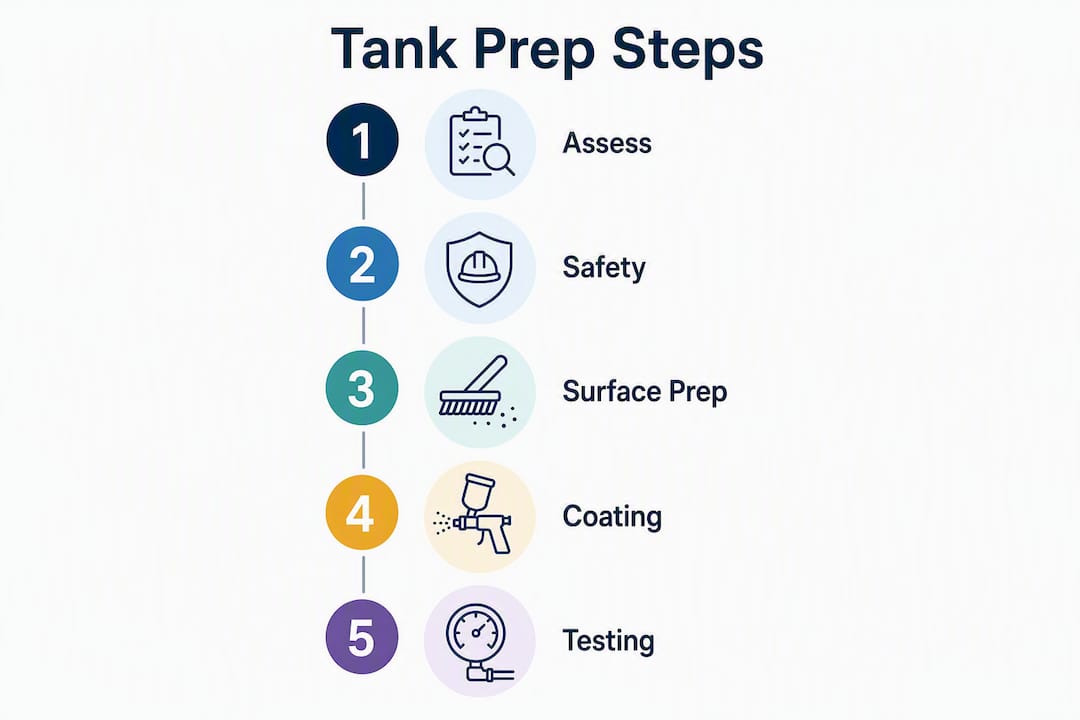
To prepare a large water storage tank for abrasive blasting and recoating, follow this sequence: dewater and drain completely, sample existing coatings for lead and PCBs, assign a named competent person per OSHA requirements, establish containment and negative-pressure ventilation, confirm your abrasive and target surface profile meeting SSPC-SP10/NACE No. 2 and a typical 2–4 mil surface profile for carbon steel, and schedule coating application within the manufacturer’s recoat window. Every step ties to a governing standard: OSHA for worker safety, SSPC/AMPP for surface preparation, NSF/ANSI 61 for potable-water coatings, and EPA rules for hazardous waste disposal.
Project-start checklist — confirm before mobilization:
- Dewater and drain the tank fully; coordinate with the water utility on service interruption scheduling
- Collect paint samples (destructive or XRF) and establish chain-of-custody for lead and PCB analysis
- Assign a named competent person with documented stop-work authority
- Obtain confined-space entry permit and activate a written rescue plan
- Specify abrasive type, target cleanliness (SSPC-SP10 minimum), and profile range (2–4 mils)
- Confirm coating system carries NSF/ANSI 61 certification for interior potable-water contact
- Establish containment type, negative-pressure ventilation, and waste-capture plan per EPA rules
- Set the recoat window in the contract: freshly blasted steel must be primed before visible rust forms
Pro Tip: Attach this checklist as a one-page contract addendum and require the contractor to initial each line before mobilization. It converts a verbal scope into a documented obligation.
Table of Contents
- What should you assess and document before bidding a tank project?
- What OSHA requires for abrasive blasting safety on water tanks
- How do you control dust, runoff, and waste disposal on a tank blasting project?
- Which surface-prep method and abrasive should you specify?
- What coating system should you specify for a municipal water tank?
- What tests and acceptance criteria should you require at project completion?
- What drives project timeline and cost on a tank recoating job?
- How do you qualify and select the right contractor for a tank project?
- Key Takeaways
- What most owners underestimate about tank preparation projects
- Southernsandblastingandpainting handles the full scope, from pre-bid survey to final QA sign-off
- Primary standards and specifications to include in your contracts
What should you assess and document before bidding a tank project?
A pre-bid site survey is where most change orders are born or prevented. Walk the tank with a camera and a structured scope sheet before writing a single spec line.
Survey items to document:
- Tank type, capacity, and dimensions (ground storage, elevated, standpipe)
- Access points, ladder condition, roof hatches, and confined-space entry locations
- Appurtenances: vents, antennas, safety climbing devices, level sensors, and overflow pipes
- Visible coating condition: chalking, peeling, blistering, and rust-through locations
- Structural anomalies: pitting depth, weld defects, seam deterioration, and any prior repairs
Coating history matters more than most owners realize. Tanks built before 1978 almost certainly have lead-based paint; tanks with older coal-tar coatings may contain PCBs. Require destructive sampling or XRF testing with full chain-of-custody documentation before the bid closes. That data drives waste classification, PPE requirements, and disposal costs — all of which belong in the base bid, not a change order.
Structural items should be evaluated against AWWA D100 welding repair limits. Pitting beyond acceptable thresholds requires repair before blasting, and that repair scope must be defined in the contract drawings. Appurtenance removal, cleaning, storage, and reinstallation — including any calibration required to restore operability — should be explicitly assigned to the contractor in the spec.
| Document | Purpose | Who Provides |
|---|---|---|
| Paint sample lab report (lead/PCBs) | Drives waste classification and PPE spec | Owner or pre-bid testing firm |
| Confined-space entry permit | Required before any interior work | Owner/contractor jointly |
| Structural inspection photos | Defines repair scope before blast | Owner’s engineer |
| Appurtenance inventory | Allocates removal/reinstall cost | Owner with contractor review |
| Air/dust permit or local notification | Environmental compliance | Owner, filed before mobilization |
What OSHA requires for abrasive blasting safety on water tanks
The single most critical control is this: OSHA requires a trained, knowledgeable person assigned to each blasting operation with documented authority to stop work and eliminate hazards. Engineering controls — containment, ventilation, substitution — come before respirators in the hierarchy. Respirators are the last line, not the first.
Confined-space entry requirements:
- Written confined-space entry permit for every interior entry
- Designated entrant, attendant, and a rescue team on standby (not just a phone number)
- Atmospheric monitoring: oxygen, combustible gases, and toxic vapors before and during entry
- Training records for all entrants and attendants, verified before mobilization
For respiratory protection, OSHA’s abrasive blasting guidance (OSHA 3697) specifies Type CE abrasive-blasting respirators or supplied-air respirators for blasters working with toxic substrates. Hearing protection, full-arm coverage, and eye protection are standard for support crew. Fit-test records for each worker must be on file before the first blast nozzle opens.
Pro Tip: Require the contractor to submit a site-specific safety plan, named competent person with credentials, and respirator fit-test records at least five business days before mobilization. If those documents arrive the morning of the job, that is a red flag.
Engineering controls under 29 CFR 1910.94 require blast-cleaning enclosures to be exhaust-ventilated so that inward airflow is maintained at all openings during blasting. Negative pressure inside the containment structure is the measurable proof that this standard is being met.
How do you control dust, runoff, and waste disposal on a tank blasting project?
Containment choice depends on tank geometry, proximity to neighbors, and whether the existing coating is hazardous. Full tent enclosures with negative pressure and HEPA filtration are the standard for tanks with confirmed lead or PCB coatings. Partial curtain systems work for exterior-only work on isolated sites with no hazardous substrate. Interior bagging is used for localized spot repairs.
Waste and runoff controls:
- Capture all spent abrasive and blast debris; never allow it to enter storm drains or soil
- Filter water runoff through a sedimentation system before discharge; document disposal chain-of-custody
- Test blast waste for TCLP (Toxicity Characteristic Leaching Procedure) when lead or PCBs are confirmed; hazardous waste requires licensed hauler and EPA manifest
- HEPA vacuum all surfaces before wet cleanup; wet mopping alone does not capture fine respirable particles
- Establish a decontamination station at the site perimeter for workers exiting the containment zone
| Containment Type | Best Use | Dust Control Level | Waste Capture |
|---|---|---|---|
| Full tent with negative pressure | Lead/PCB coatings, urban sites | Highest | Full |
| Partial curtain system | Exterior work, rural/isolated sites | Moderate | Partial |
| Interior bagging | Spot repairs, localized areas | High (interior) | Full (interior) |
| Vacuum blasting system | Tight spaces, minimal debris | Very high | Near-total |
Pro Tip: Require the contractor to name the licensed waste hauler and provide the EPA waste manifest number before any hazardous blast debris leaves the site. A missing manifest is a compliance gap that lands on the owner, not just the contractor.
Which surface-prep method and abrasive should you specify?
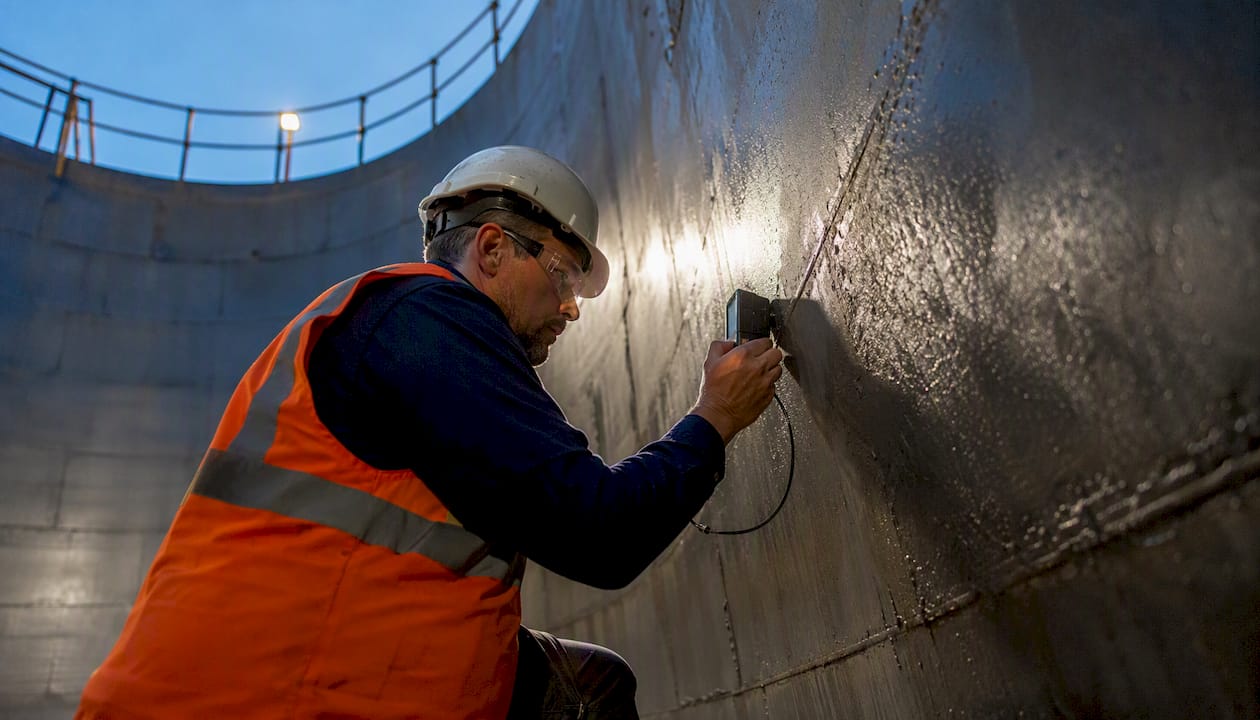
Specify a minimum of SSPC-SP10/NACE No. 2 near-white blast cleaning for full coating removal on carbon steel water tanks, with a surface profile in the typical range recommended for potable tank coatings. That profile range is confirmed by manufacturer technical guidance for potable tank coating systems and is the standard target for industrial surface preparation before recoating.
| Method | Best Use Case | Achievable Cleanliness | Profile Range | Containment Complexity |
|---|---|---|---|---|
| Dry abrasive blasting | Full removal, carbon steel | SSPC-SP10 or better | 2–4 mils | High (full enclosure) |
| Wet abrasive/slurry | Dust-sensitive sites, thin substrates | SSPC-SP10 | 2–3 mils | Moderate (water capture) |
| Vacuum recovery blasting | Confined spaces, spot repairs | SSPC-SP6 to SP10 | 2–4 mils | Low to moderate |
Abrasive selection affects both profile and contamination risk. Garnet and steel grit produce consistent profiles on carbon steel. Coal slag is cost-effective but generates more dust and may carry trace heavy metals. Sodium bicarbonate is appropriate for soft removal on thin substrates where profile creation is not the goal. Reference SSPC-AB guidance when specifying abrasive quality and cleanliness requirements.
One rule that applies regardless of method: never blast more surface area in a single day than can be coated the same day. Freshly blasted steel must be primed before visible rust forms, typically within about 8 hours.
Pro Tip: Require test panels at a minimum frequency of once per 100 ft², measured with Testex replica tape per ASTM D4417. Document every reading in the QA log — not just the ones that pass.
What coating system should you specify for a municipal water tank?
For any interior surface in contact with potable water, require coatings certified to NSF/ANSI 61. Some municipal specifications also reference ANSI/NSF 600. A three-coat zinc-epoxy-epoxy system is a common municipal choice, with a minimum dry film thickness of 10.5 mils for interior wet areas per published municipal specifications. Explore the full range of industrial coating types before finalizing the system.
Application constraints to write into the spec:
- Steel surface temperature must be at least 5°F (3°C) above the dew point before and during application
- Require dehumidification equipment when ambient conditions cannot maintain that margin
- Specify recoat windows from the manufacturer’s product data sheet; exceeding the window requires re-blasting
- Require a single-manufacturer coating system to eliminate compatibility disputes between primer and topcoat
- Include a manufacturer technical representative inspection clause for primer application and first topcoat
Pro Tip: Require the contractor to submit product data sheets and cure/DFT verification methods before work begins. A manufacturer’s rep on site during critical stages shortens punch-list closure and protects the warranty.
What tests and acceptance criteria should you require at project completion?
Acceptance requires four measured results: surface profile within spec, soluble salts below threshold, dry film thickness (DFT) within the specified range, and holiday detection passing with no unrepaired breaks.
| Test | Method/Standard | Acceptance Threshold | Sampling Frequency |
|---|---|---|---|
| Surface profile | ASTM D4417 / Testex replica tape | 2–4 mils (per spec) | Min. once per 100 ft² |
| Soluble salts | Conductivity (Bresle patch or equivalent) | Per coating manufacturer’s limit | At defined intervals per QA plan |
| Dry film thickness | SSPC-PA 1 / magnetic gauge | Per system spec (e.g., 10.5 mils) | Per SSPC-PA 1 frequency |
| Holiday detection | NACE SP0188 / low or high voltage | Zero holidays on interior wet areas | 100% of interior wet surface |
Document every test result with the inspector’s signature, date, location, and instrument calibration record. Final payment should be conditioned on a complete, signed QA report — not just a verbal sign-off.
What drives project timeline and cost on a tank recoating job?
The three biggest cost drivers are containment complexity, coating system selection, and the extent of structural repair discovered during the pre-bid survey. A full tent enclosure for a lead-coated tank can cost more than the blasting itself on a smaller structure.
Sample timeline for a medium municipal ground-storage tank:
- Pre-bid site survey and paint sampling: 1–2 weeks
- Permitting, utility coordination, and mobilization: 2–4 weeks
- Dewatering and draining: 1–3 days
- Containment erection and safety setup: 2–5 days
- Abrasive blasting and structural repairs: 1–3 weeks
- Inspection, test panels, and owner sign-off: 1–3 days
- Coating application (primer, intermediate, topcoat): 1–2 weeks
- Curing, holiday detection, and final inspection: 3–7 days
- Demobilization and tank return to service: 1–3 days
Cost levers and mitigation strategies:
- Partial containment (exterior only, non-hazardous substrate) reduces tenting cost significantly
- Pre-bid structural repairs eliminate the highest-markup change orders
- Scheduling in spring or fall avoids extreme heat and cold that slow curing and require dehumidification
- Build a 10–15% contingency for re-blast if testing failures require additional surface preparation
Cold weather slows epoxy cure times and can prevent coating application entirely below certain thresholds. Dew-point exceedances are the most common cause of day-long work stoppages on tank projects.
How do you qualify and select the right contractor for a tank project?
Require evidence of completed municipal tank projects, SSPC/AMPP certifications, confined-space training records, and proof of general liability and pollution liability insurance before shortlisting any bidder.
- Verify SSPC/AMPP certification (QP1 for field industrial painting, QP2 for hazardous removal)
- Confirm confined-space entry training for all workers who will enter the tank
- Request a project reference list with at least three comparable municipal tank projects
- Require a written, site-specific safety plan naming the competent person
- Ask for sample QA reports from a recent project — not a template, an actual completed report
RFP documentation checklist:
- Site-specific safety plan with named competent person and stop-work authority statement
- Respirator fit-test records for all blasters
- Equipment list including containment system, blast equipment, and ventilation specs
- Abrasive certificates (cleanliness, conductivity, hardness)
- Waste management plan naming the licensed hauler
- Sample inspection report and test-panel results from a comparable project
Red flags in bids: vague QA methods (“we follow all standards”), no named competent person, no plan for appurtenance removal and reinstallation, missing waste-disposal procedures, or a price that is 30%+ below the median without a clear scope explanation.
Pro Tip: Ask each bidder to describe how they handle a failed holiday test mid-project. The answer tells you more about their QA culture than any certification document.
Key Takeaways
Preparing a large water storage tank for abrasive blasting and recoating requires confirmed competent-person assignment, SSPC/AMPP-specified surface preparation, NSF/ANSI 61-certified coatings, and documented acceptance testing before final payment is released.
| Point | Details |
|---|---|
| Assign a competent person first | OSHA requires a named, trained individual with stop-work authority before blasting begins. |
| Specify SSPC-SP10 and 2–4 mil profile | Near-white blast cleaning and a verified surface profile are the baseline for coating adhesion. |
| Require NSF/ANSI 61 certification | All interior coatings on potable water tanks must carry this certification — no exceptions. |
| Test and document before final payment | Profile, soluble salts, DFT, and holiday detection results must be signed off in a QA report. |
| Southernsandblastingandpainting for municipal projects | Southernsandblastingandpainting brings 20+ years of municipal tank experience, SSPC/AMPP-aligned practices, and full containment capability to projects across Central Florida. |
What most owners underestimate about tank preparation projects
The paperwork is the project. Every facility manager who has managed a tank recoating job knows that the blasting and coating are the straightforward part. What actually determines whether a project finishes on time, within budget, and without a warranty dispute is the documentation trail: the pre-bid paint sample, the competent-person assignment letter, the test-panel log, the waste manifest, and the final QA report.
Owners who treat those documents as administrative overhead rather than project controls are the ones who end up in disputes over re-blast costs or, worse, facing an EPA inquiry about blast debris disposal. The standards — OSHA, SSPC/AMPP, NSF/ANSI 61 — exist precisely because water tanks are critical infrastructure. A coating failure on a potable water tank is not a maintenance inconvenience; it is a public health event.
The other thing owners consistently underestimate is weather. Dew-point exceedances are the most common cause of unplanned work stoppages, and they are entirely predictable with proper planning. Requiring the contractor to submit a daily weather monitoring log and a written go/no-go decision process costs nothing at the bid stage and prevents the most common source of coating adhesion failures.
Southernsandblastingandpainting handles the full scope, from pre-bid survey to final QA sign-off
Municipal tank projects require a contractor who can manage containment, hazardous waste, confined-space entry, and NSF/ANSI 61-compliant coating application under a single contract. Southernsandblastingandpainting delivers exactly that: 20+ years of industrial sandblasting and protective coating experience on water tanks, city infrastructure, and critical assets across Central Florida.

From the pre-bid site survey and paint sampling through abrasive blasting, coating application, and final holiday detection, Southernsandblastingandpainting operates with a named competent person on site, documented QA at every stage, and full containment capability for lead and PCB substrates. Every project follows SSPC/AMPP surface preparation standards and uses NSF/ANSI 61-certified systems for potable-water interiors.
Ready to scope your next tank project? Request a pre-bid site visit or submit your specification package for a formal estimate through Southernsandblastingandpainting’s sandblasting services or review the full services overview to confirm capability before your RFP closes.
Primary standards and specifications to include in your contracts
Attaching these documents to the contract and requiring contractor acknowledgment converts them from reference material into binding obligations.
- Protecting Workers from the Hazards of Abrasive Blasting Materials (OSHA 3697): covers PPE, respiratory protection, engineering controls, and hygiene requirements for blasting operations
- 29 CFR 1910.94 — Ventilation (OSHA): the regulatory standard requiring exhaust ventilation and inward airflow in blast-cleaning enclosures
- SSPC-SP10 / NACE No. 2 — Near-White Blast Cleaning: defines cleanliness levels, profile expectations, and measurement methods for carbon steel surface preparation
- NSF/ANSI 61: the certification standard for coatings in contact with potable water; require the coating manufacturer’s current certificate of compliance
- AWWA D100: governs welded steel tank construction and repair limits; reference when structural repairs are in scope
- Standard Specifications for Water Storage Tank Painting (municipal spec example): a published municipal specification covering appurtenance handling, DFT requirements, and single-manufacturer system clauses
- EPA hazardous waste regulations (40 CFR Part 261): governs classification, testing, and disposal of blast debris containing lead or PCBs; require contractor compliance documentation before waste leaves the site


