

Installed industrial and municipal concrete sealing typically runs $1.50 to $5.00 per square foot, with basic densifiers at the low end and epoxy or polyurethane systems at the high end. The single biggest swing factor isn’t the coating you pick. It’s surface preparation and the rework that follows when prep gets shortchanged. Budget for lifecycle cost, not sticker price, and that gap closes fast.
TL;DR:
- Surface preparation often surpasses coating choice as the main cost driver, with proper blast profiles being critical to coating longevity.
- Larger projects tend to lower per-square-foot costs due to spreading setup, while complex assets significantly increase rework and access expenses.
- Lifecycle costs favor longer-lasting systems like polyurethanes, especially on assets where shutdowns are disruptive and recoat cycles are costly.
- Accurate estimates depend on detailed scope, including surface profile, coating layers, acceptance criteria, and itemized breakdowns of all preparatory and contingency costs.
- Field controls such as documented workflows, ambient condition logs, and verification photos prevent costly rework and improve bid accuracy.
Table of Contents
- What Does Concrete Sealing Cost Per Square Foot?
- What Drives Concrete Sealing Prices Up?
- Is a More Expensive Sealer Worth the Extra Cost?
- How Do You Get an Accurate Concrete Sealing Estimate?
- What Field Controls Actually Prevent Rework Costs?
- Get an Accurate Site Scoping and Quote
- Sources
What Does Concrete Sealing Cost Per Square Foot?
Contractors and fabricators who compile unit cost data consistently point to the same variables driving price: job size, surface prep method, whether work happens in a shop or in the field, and how much inspection the contract requires. For industrial and municipal work, that produces a wide but predictable spread.
- Penetrating sealers and densifiers: roughly $0.75 to $1.75 per sq ft. Common for warehouse floors and parking structures where dusting control matters more than chemical resistance.
- Acrylic sealer systems: roughly $1.50 to $2.50 per sq ft. A middle-ground choice for exterior walkways, plazas, and lower-traffic municipal surfaces.
- Epoxy floor and coating systems: roughly $2.50 to $4.50 per sq ft. Standard for manufacturing floors, secondary containment, and food-grade or chemical-exposure environments.
- Polyurethane topcoats: roughly $3.00 to $5.00 per sq ft, often layered over epoxy primers for UV stability and abrasion resistance on high-traffic or outdoor assets.
Industry pricing guides put the full commercial and industrial range at $1.50 to $5.00 per square foot, with epoxies and polyurethanes trending toward the top because they demand mechanical surface preparation and thicker material builds.
Scale changes the math substantially. A 5,000 square foot maintenance bay sealed with an epoxy system might cost in the mid to high range for such projects once mobilization and minimum charges are considered. A 50,000 square foot distribution floor using the same system often prices lower per square foot due to spreading setup costs across a larger area. On a very large asset, like a municipal water tank interior or an airport apron section exceeding 200,000 square feet, unit pricing can compress even further, though access and containment requirements sometimes push the other direction.
“Installed cost” should include material, labor, equipment, and standard surface prep. It should not include separate line items like traffic control, scaffolding, permits, or contingency work, which belong in their own bid categories rather than buried in the per-square-foot number.
What Drives Concrete Sealing Prices Up?
Surface preparation is where budgets go to die. A power-tool clean costs a fraction of abrasive blasting to an Sa 2.5 equivalent, but skipping proper blast profile on a coating that requires it guarantees early failure and a redo. Here’s what typically moves a project from the low end of the range to the high end:
- Surface prep level. Grinding runs cheaper than blasting, but many epoxy and polyurethane systems specify a blast profile for adhesion. Mismatching prep to system spec is the most common source of premature coating failure.
- Concrete repair scope. Crack routing and sealing, spall repair, and joint work all add unit cost. Municipal crack sealing alone ranges from about $0.60 to $3.00 per linear foot depending on method and job volume, and that work frequently rides alongside a sealing contract rather than appearing as its own line item.
- Access and shutdown costs. Elevated platforms, scaffolding, containment for airborne dust or blast media, and lane or facility closures can rival or exceed material cost on complex assets.
- Weather and dew point violations. Applying coating below the dew point or over contaminated concrete is one of the leading causes of unplanned rework in coating projects, and rework means paying for labor and material twice.
- Mobilization and minimum charges. Small jobs absorb a disproportionate share of setup cost, which is why per-square-foot pricing looks worse on a tight footprint than a sprawling one.
Pro Tip: Require your contractor to log ambient temperature, surface temperature, and relative humidity at the start of each shift. A simple dew point calculation, checked and recorded before coating begins, prevents the single most expensive category of rework on outdoor and semi-conditioned assets.
Is a More Expensive Sealer Worth the Extra Cost?
Compare systems by cost per square foot per year of expected service life, not by installed price alone. Comparing systems by cost per square foot per year of expected service life can show that higher upfront costs for longer-lasting sealers may result in lower annual costs.
Run that math across a 20 year horizon on a 50,000 square foot asset and the gap widens further. The acrylic system needs three full recoat cycles, each one triggering fresh mobilization, access setup, and possible shutdown costs. The polyurethane system needs one, maybe none. Published life-cycle costing frameworks for protective coatings back this pattern: initial price rarely predicts total cost of ownership once recoat frequency and access costs enter the calculation.
Long-life systems earn their premium fastest on assets where access is expensive or disruptive: elevated water tanks, active airport surfaces, pipeline crossings, and secondary containment that can’t go offline easily. On complex assets, shutdown and access cost often dwarfs material cost, so eliminating even one recoat event can justify a significantly higher initial system price.
Lifecycle claims only hold up if you can verify them, which means your QC package should include:
- Dry film thickness (DFT) records at documented intervals across the surface
- Ambient condition logs tying application windows to temperature, humidity, and dew point
- An inspection and test plan (ITP) with defined hold points before covering or closing out work
How Do You Get an Accurate Concrete Sealing Estimate?
Vague scope language is what produces mid-project change orders. A specific, well-structured request for quote (RFQ) forces bidders to price the same job, which is the only way their numbers become comparable.
Require these items in every bid:
- Surface prep standard, stated as a specific profile (Sa 2.5, SSPC-SP standard, or equivalent), not “clean and prep.”
- Coating build by layer, including product names, number of coats, and target DFT range per coat.
- Acceptance criteria and ITP hold points, specifying who inspects what and when work can proceed to the next stage.
- Documented verification at handover, including DFT logs, ambient logs, and dated photos at key stages.
Then insist bids break out costs separately rather than folding them into one number:
- Mobilization and demobilization
- Traffic control or facility shutdown
- Access equipment or scaffolding
- Permits and any regulatory fees
- Unit pricing for likely contingencies (extra crack linear footage, unexpected spall repair, additional blast area)
A surface preparation checklist built into your RFQ language does more to control final cost than negotiating the base rate ever will. Bidders who balk at itemizing scope this way are usually the ones planning to make up margin through change orders later.
What Field Controls Actually Prevent Rework Costs?
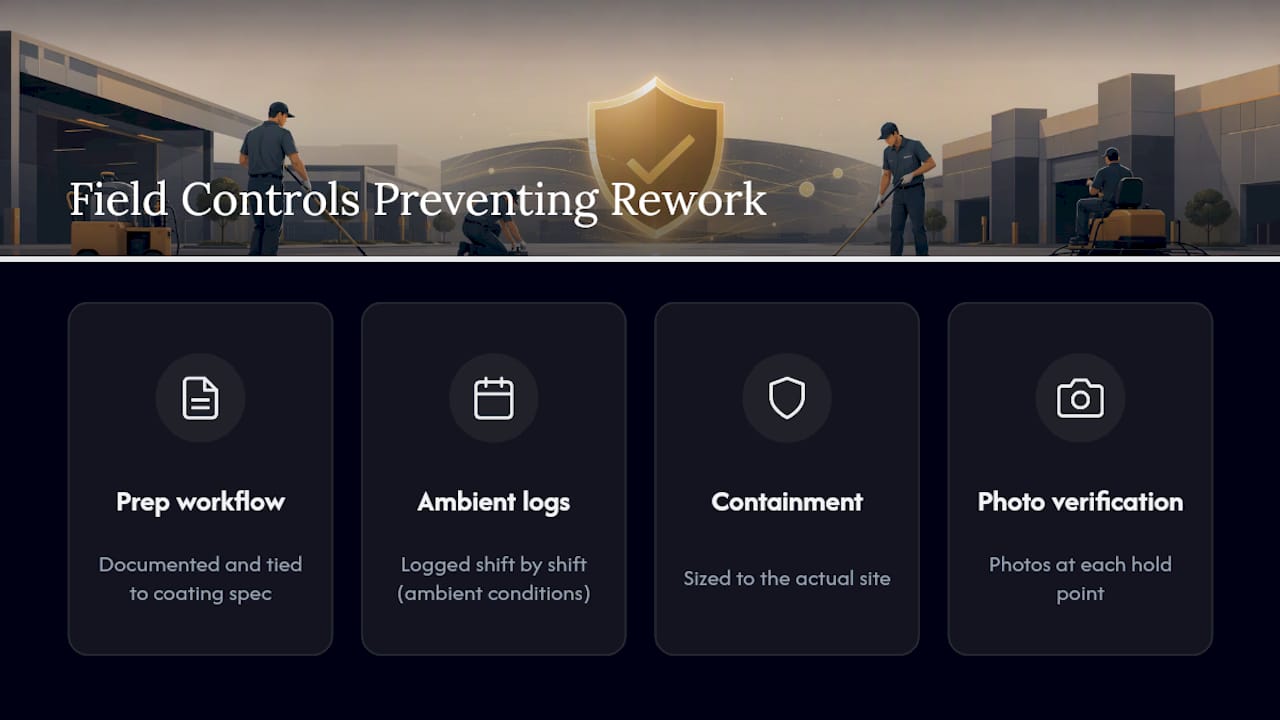
Some service providers have spent many years working on critical assets such as water tanks, airport surfaces, pipelines, theme park infrastructure, and city-owned facilities across Central Florida. Projects at that scale don’t tolerate guesswork on prep or timing.
The controls that hold up under scrutiny are unglamorous: a documented surface-prep workflow tied to the coating spec, ambient condition logs kept shift by shift, containment sized to the actual site, and photo verification at each hold point. None of it is complicated. What it does is remove the excuses that usually justify a change order, because the record shows exactly what condition the surface was in and what the weather was doing when the coating went down.
— Results
Get an Accurate Site Scoping and Quote
Every estimate in this guide assumes clean scope. The fastest way to close the gap between a ballpark and a number you can build a budget around is a site scoping visit, a service offered by specialized contractors for facility managers and municipal officials who need specification-grade prep and coating work done right the first time.
Bring rough area measurements, current condition photos, and your target service life to that first conversation, and the scoping visit fills in the rest: prep level, access needs, coating build, and a line-item quote instead of a single lump sum. Qualified service providers handle the full sequence, from abrasive blasting and surface preparation through specification-grade coating application and QC documentation, so what gets bid is what gets built. Review the full range of surface prep and coating services and request a site visit to get a quote built around your asset, not a generic square-footage guess.
Sources
- Why Coating Rework Is So Expensive and How Smart Field Tools Can Stop It Cold
- Expected Service Life and Cost Considerations for Maintenance and New Construction Protective Coating Work (2026)
- Expected Service Life and Cost Considerations for Maintenance and New Construction Protective Coating Work (KTA)
- Industrial Coating Project Management: Cost & Lifecycle Guide
- How much does sealed concrete cost? – CustomCrete


