
For concrete floors, specify a textured epoxy or polyurethane system with broadcast aggregate, or a cementitious overlay for heavy wear zones. For metal, specify a properly prepared, primed textured coating or a thermal-sprayed finish. Before you sign anything, ask the contractor for wet DCOF traction data and a site assessment tied to your actual traffic and exposure conditions.
TL;DR:
- A proper substrate profile and moisture control are essential for successful coating adhesion, especially on concrete floors or metal surfaces before applying broadcast epoxy or textured finishes.
- Traction testing with standards like wet DCOF results and documented surface prep are crucial to verify slip resistance, rather than relying on vague claims or generic certifications.
- Environment and traffic, such as humidity, chemicals, and vehicle weight, significantly impact coating lifespan and slip performance, requiring zone-specific specifications.
- Surface preparation details like blast profile and aggregate broadcast technique directly influence long-term traction and coating durability in both indoor and outdoor settings.
- Choosing a qualified contractor experienced in abrasive blasting, traction testing, and documentation ensures the coating meets safety standards and reduces slip risks effectively.
Table of Contents
- What Types of Non-Slip Industrial Coatings Are Available?
- Which Coating Works Best on Concrete vs. Metal Surfaces?
- How Do You Choose and Specify a Non-Slip Coating?
- What Surface Prep and Application Steps Matter Most?
- What Do DCOF, ANSI, and OSHA Actually Require?
- How Should You Maintain and Inspect a Non-Slip Floor?
- Why Contractor Experience Matters for Non-Slip Specification
- How Do Humidity, Chemicals, and Traffic Change Slip Risk?
- How Long Do Non-Slip Coatings Actually Last Under Real Conditions?
- How Much Should You Budget for Non-Slip Coating Projects?
- What Environmental and Safety Precautions Apply During Application?
- How Do You Qualify a Contractor for This Kind of Work?
- Why the Traction Number Matters More Than the Product Name
- How Southern Sandblasting & Painting Handles Non-Slip Coating Projects
- Sources
What Types of Non-Slip Industrial Coatings Are Available?
Picking a coating starts with matching chemistry to the abuse the floor will take. Each system trades off differently on cost, cure speed, and wear resistance.
Epoxy systems with aggregate broadcast are the workhorse choice for warehouses, manufacturing floors, and loading docks. Silica sand, aluminum oxide, or polymer grit gets broadcast into a wet epoxy base coat, then sealed with a topcoat. They resist abrasion well but epoxy alone yellows and chalks under UV, so outdoor or sunlit bays usually need a different topcoat.
Polyurethane and polyaspartic topcoats handle UV exposure and chemical splash better than straight epoxy, and polyaspartics cure fast enough to reopen a floor in hours rather than days. That speed costs more per square foot.
Cementitious overlays and micro-toppings rebuild worn or spalled concrete while adding texture in one step, which makes them the right call when the substrate itself is degraded, not just slippery.
Surface-applied anti-slip treatments and sealers add grip to an existing floor without a full system tear-out, but they wear faster under forklift traffic and rarely hold up as long as a broadcast system.
- Epoxy + aggregate: high abrasion resistance, moderate cost, indoor use
- Polyurethane/polyaspartic: UV and chemical resistant, fast cure, higher cost
- Cementitious overlay: best for damaged or uneven substrates
- Surface sealers: lowest cost, shortest lifespan, good for light-traffic touch-ups
Which Coating Works Best on Concrete vs. Metal Surfaces?
The substrate decides more than the coating catalog does. A polyurethane topcoat over a poorly profiled slab fails just as fast as the wrong resin on rusted steel.
Concrete needs a mechanically created profile, usually a CSP 2 to CSP 4 range, before anything sticks. Moisture testing matters here: coating over a slab with high relative humidity readings traps vapor and causes blistering months later. Once the profile and moisture checks pass, epoxy with broadcast aggregate or a cementitious overlay are the standard fixes, detailed further in this pro guide to floor coating preparation.
Metal surfaces demand rust and mill scale removal through abrasive blasting to a specified anchor profile, followed by a primer built for the exposure (zinc-rich for humid or marine-adjacent sites), then a textured metal-specific finish. Skipping the blast step is the single most common reason metal coatings peel within a year.
Tile, fiberglass, and wood rarely accept the same systems well; compatibility testing or a small test patch beats guessing, and severely degraded substrates often need replacement rather than a coating fix.
- Concrete: profile + moisture check, then epoxy/cementitious system
- Metal: near-white blast, correct primer, textured topcoat
- Tile/fiberglass/wood: test patch first, repair vs. replace decision
- Watch for existing coatings, oil residue, or contamination that block adhesion
How Do You Choose and Specify a Non-Slip Coating?
Specifying a coating on “non-slip” alone is meaningless. You need a number, a test method, and a contractor willing to document both.
- Match the system to the load. Pedestrian-only walkways need a different profile than a bay running forklifts or pallet jacks all shift.
- Specify the test method and target. Request wet dynamic coefficient of friction (DCOF) results using NFSI B101.3 or a pendulum test referenced under ANSI A326.3, along with the sample locations tested.
- Require prep documentation. Ask for the blast or grind profile spec, a concrete moisture reading, and an adhesion test, not just a verbal assurance the floor was “prepped.”
- Vet the contractor. References from similar facilities, safety data sheets for the coating, project photos, written warranty terms, and proof of insurance should all be standard, not special requests.
- Watch for red flags. A contractor who claims a coating is “non-slip” without naming a test method, who is vague about surface prep, or who has no maintenance recommendations is telling you they don’t document their own work.
Pro Tip: Ask for the DCOF result in writing before the job starts, not after. A verbal “it’ll be plenty grippy” is not a spec, and it won’t help you if OSHA or an injury attorney asks how you validated the floor’s traction.
What Surface Prep and Application Steps Matter Most?
Traction and lifespan both come down to what happens before the coating ever touches the floor.
The anchor profile has to be created mechanically, through abrasive blasting, shot blasting, or diamond grinding, and the depth of that profile has to match the coating manufacturer’s spec. Too shallow and adhesion fails early; the wrong grind pattern on metal leaves smooth spots the primer can’t grip.
Cleaning and moisture control come next. Any oil, dust, or curing compound left behind becomes a bond-breaker under the new coating.
Aggregate selection and broadcast technique determine the finished traction with glass sand and aggregate options. Sand, aluminum oxide, or polymer grit gets broadcast to refusal into the wet base coat, and rolling technique matters more than most buyers realize. Over-rolling the base coat can drag aggregate unevenly and create bald spots that lose traction exactly where you need it most.
- Create the correct anchor profile before anything else
- Clean and moisture-test the substrate
- Broadcast aggregate evenly; avoid excessive rolling
- Sequence: primer, base coat, aggregate broadcast, topcoat, then respect cure windows before reopening traffic
Pro Tip: Walk the floor after broadcast and before topcoat. Thin or bare patches are easy to spot and fix at that stage; they’re nearly invisible once the topcoat goes on.
What Do DCOF, ANSI, and OSHA Actually Require?
DCOF measures wet traction on a 0.00 to 1.00 scale. Under NFSI B101.3 guidance, a reading below 0.30 needs intervention, 0.30 to 0.44 should be monitored, and 0.45 to 0.50 or higher meets common high-traction targets for wet or oily environments.
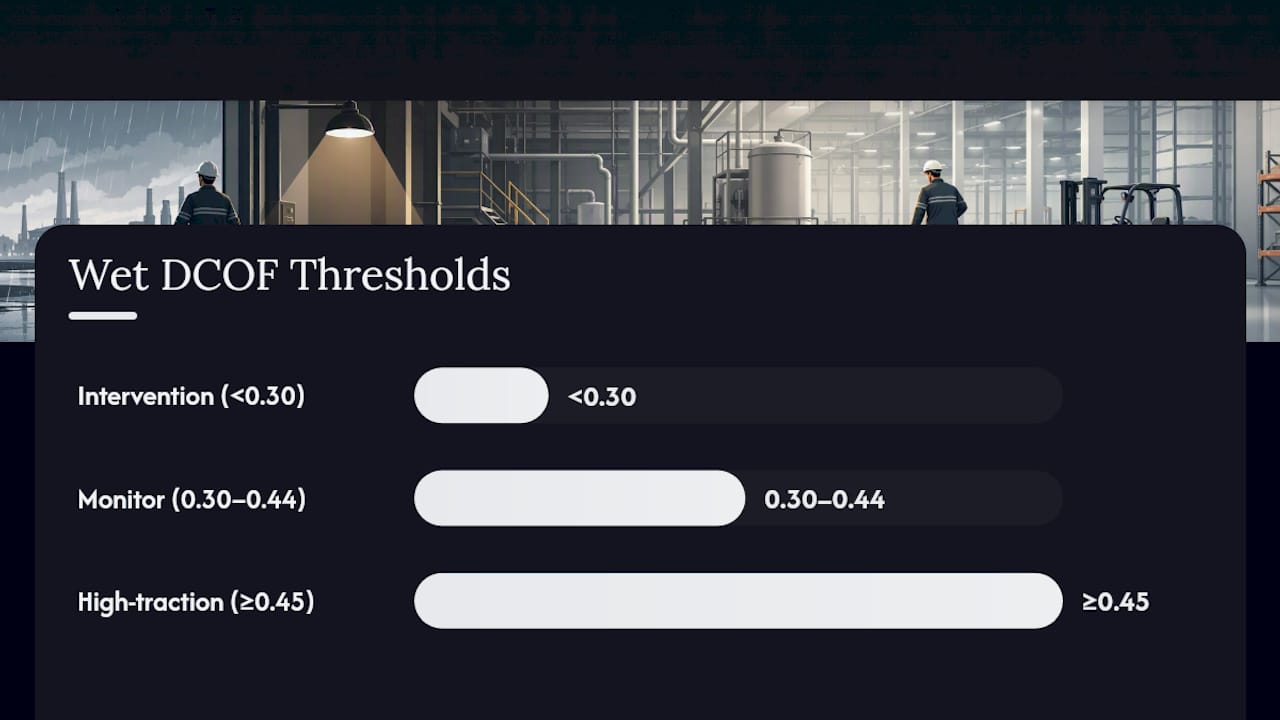
ANSI A326.3 and pendulum test methods let codes set different minimums by product-use category, so a pool deck and a dry warehouse aisle don’t share the same target, and your spec should name both the test method and the use category.
Here’s the part buyers get wrong constantly: OSHA has no mandated numeric coefficient of friction. The agency requires walking surfaces be kept clean, orderly, and dry so far as feasible, and its own interpretive guidance confirms that a widely cited “0.5” figure is non-mandatory, not a legal floor. A traction test report doesn’t satisfy a specific OSHA number; it documents that you made a reasonable, measurable effort, which is what actually matters in an inspection or a claim.
- Request the report in writing with test method, date, and sample locations
- File it alongside your maintenance and inspection records, not in a separate drawer
How Should You Maintain and Inspect a Non-Slip Floor?
A coating that tested well on installation day can still lose traction two years later if nobody’s checking on it.
- Inspect on a schedule, not just when someone complains. Quarterly walk-throughs for high-traffic zones, documented with photos and notes on visible wear.
- Re-test traction after major wear or repairs, since a patched area rarely matches the original profile without a fresh check.
- Clean with pH-neutral degreasers built for textured floors; harsh solvents and improper mops can polish down the aggregate over time.
- Repair small worn patches promptly; waiting until an entire bay needs recoating costs more than patching problem zones early.
- Keep records of every inspection, cleaning change, and repair. That paper trail matters more in an audit or a slip-and-fall claim than any single test score, since it shows an ongoing pattern of care.
Why Contractor Experience Matters for Non-Slip Specification
Southernsandblastingandpainting has specified and installed protective coatings for water tanks, airports, pipelines, and municipal infrastructure across Central Florida for more than 20 years. A qualified contractor should walk the site, confirm anchor profile and moisture readings, coordinate DCOF testing, and hand off a maintenance plan before the crew leaves. In-house staff can handle inspections; profile creation and system installation belong to specialists.
How Do Humidity, Chemicals, and Traffic Change Slip Risk?
A coating that performs fine in a dry, low-traffic office corridor can fail dangerously in a food processing plant, and the difference is almost never the coating itself. It’s the environment.
Humidity and standing moisture are the biggest variable. Coolers, wash-down areas, and outdoor loading docks in humid climates stay wet longer, and wet surfaces are consistently among the leading contributors to slip incidents. Those zones need traction targets set at the higher end of the DCOF range, not the general-purpose minimum you’d use in a dry storage aisle.
Chemical exposure compounds the problem. Oil, grease, and cleaning solvents don’t just make floors slippery; some degrade certain coatings over time, softening the topcoat or breaking the bond between aggregate and resin. A kitchen floor or a chemical mixing room needs a system rated for that specific exposure, not a generic epoxy chosen for cost.
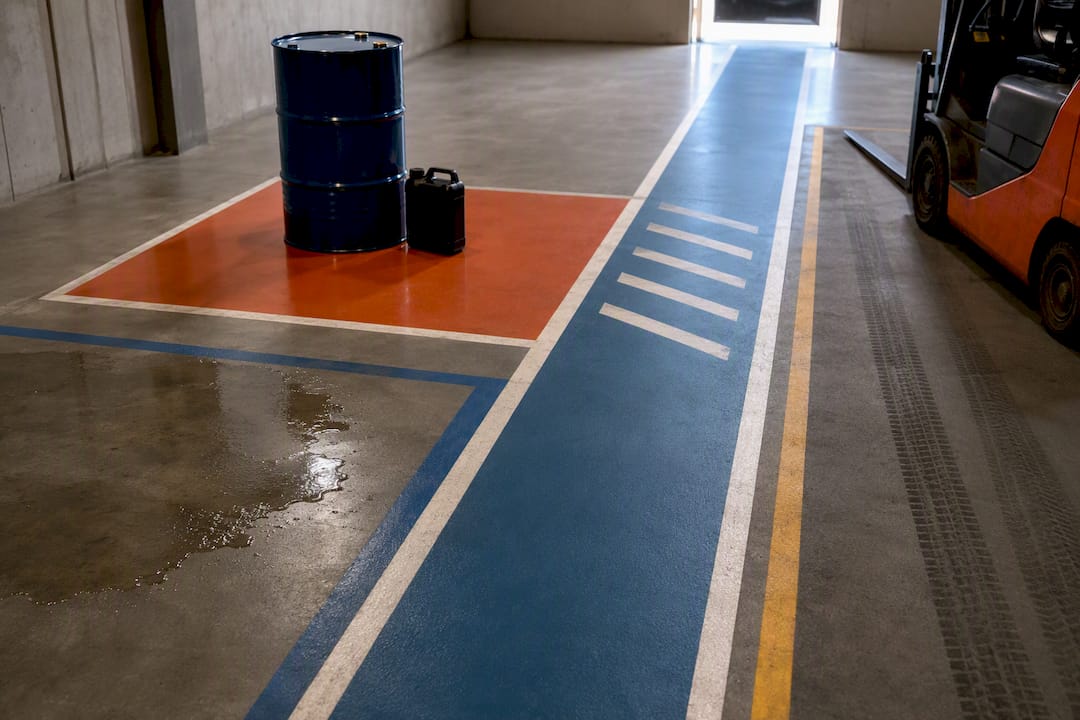
Traffic volume and vehicle type matter just as much. Pedestrian-only aisles wear differently than a bay running forklifts all shift, and steel wheels or metal-tracked equipment abrade broadcast aggregate faster than rubber tires. A facility running mixed foot and forklift traffic often needs zone-specific specs rather than one blanket coating across the whole floor.
The practical move is to map your facility by risk factor before you specify anything. Walk the site, note where moisture pools, where chemicals get handled or spilled, and where vehicle traffic concentrates, then set different traction targets for each zone rather than asking one coating to do every job.
How Long Do Non-Slip Coatings Actually Last Under Real Conditions?
Manufacturer literature loves round numbers. Real facility floors don’t cooperate with them.
Epoxy with broadcast aggregate typically holds up well in dry, moderate-traffic indoor environments for years before the aggregate visibly wears down, but that same system in a wet processing area with forklift traffic can show bald spots and reduced traction far sooner. The variable isn’t the resin; it’s exposure and load.
Polyurethane and polyaspartic topcoats tend to outlast standard epoxy in UV-exposed or chemically aggressive settings because they resist the chalking and softening that shortens epoxy’s service life outdoors. That resistance comes at a higher upfront cost, which facility managers often recoup through fewer recoat cycles.
Cementitious overlays behave differently again. They’re durable against heavy point loads and impact, which makes them a strong choice for manufacturing floors with dropped tools or heavy equipment, but they’re less forgiving of moisture problems in the underlying slab; if that issue isn’t fixed first, the overlay fails regardless of how good the topping itself is.
Metal coatings introduce a separate durability variable: corrosion. A near-white blast profile combined with a zinc-rich or epoxy primer measurably reduces corrosion-driven coating failure in humid or marine-adjacent environments, which matters enormously for anything near coastal air or wash-down chemicals.
The honest takeaway: durability claims mean little without the exposure conditions attached. Ask any contractor quoting a “5 to 10 year” lifespan what traffic and chemical exposure that estimate assumes.
How Much Should You Budget for Non-Slip Coating Projects?
Cost conversations go sideways fast when facility managers compare a $2-per-square-foot sealer quote against a $8-per-square-foot epoxy system without accounting for what each actually delivers.
Surface-applied sealers and topical anti-slip treatments sit at the low end of the cost range because they add grip without addressing an underlying substrate problem. They’re appropriate for light-traffic touch-ups, not full warehouse floors.
Epoxy with broadcast aggregate sits in the middle range for most industrial applications and remains the most common choice because it balances cost against durability reasonably well for standard traffic and moderate chemical exposure.
Polyurethane and polyaspartic systems cost more upfront, partly for material and partly because fast-cure formulations let crews finish and reopen a floor faster, which itself has value if downtime costs money.
Cementitious overlays vary the widest in price depending on how much substrate repair is needed before the topping goes down. A slab with minor wear costs far less to overlay than one with spalling, cracking, or delamination that needs grinding and patching first.
The line item facility managers forget most often is downtime. A polyaspartic system that lets you reopen a bay in a day costs more per square foot but can cost less overall than a system that shuts down a production line for a week. Get quotes that separate material, labor, prep, and projected downtime so you’re comparing real total cost, not just a per-square-foot number.
What Environmental and Safety Precautions Apply During Application?
Coating application isn’t just a floor problem; it’s an air quality and worker safety problem while the crew is on site.
VOC emissions vary significantly by product family. Solvent-based epoxies and some polyurethanes off-gas more during application and cure than water-based or low-VOC formulations, which matters both for worker exposure in enclosed spaces and for facilities trying to limit odor complaints in occupied buildings. Ask contractors which formulation they’re specifying and whether it meets your local air quality requirements, since these vary by jurisdiction and facility type.
Ventilation during application and cure isn’t optional in enclosed industrial spaces. Fumes from resin and hardener components can accumulate quickly in a sealed warehouse bay, and a contractor should have a ventilation plan before the first coat goes down, not improvise one mid-job.
Worker protection during application includes respiratory protection appropriate to the product’s VOC content, skin protection against uncured resin and hardener chemicals, and eye protection during mixing and application. Abrasive blasting adds its own hazard layer entirely, generating dust that requires respiratory protection and containment regardless of the substrate being blasted.
Facilities should also plan for occupant safety, not just crew safety. Wet floor signage, restricted access to curing zones, and clear reopening timelines protect anyone who might walk through the area before the coating has fully cured, which for some systems takes considerably longer than it takes to dry to the touch.
How Do You Qualify a Contractor for This Kind of Work?
Not every painting contractor has the equipment or experience to do abrasive blasting, profile testing, and traction documentation correctly, and the gap between a general contractor and a specialized one shows up fastest on non-slip coating jobs.
Start by asking for project references specific to non-slip or industrial floor coatings, not general painting work. A contractor who’s coated office interiors for a decade may have never run a DCOF test or specified an anchor profile.
Request documentation of past traction test results from comparable projects. A contractor who routinely provides wet DCOF reports to clients is telling you testing is a normal part of their process, not an unusual accommodation.
Confirm equipment capability directly. Abrasive blasting to a specified profile requires blast equipment and containment methods that not every painting crew owns or operates safely, particularly for lead paint removal or enclosed-space work.
Check insurance and safety data sheet practices. A contractor who can’t produce SDS for the coatings they’re applying or proof of liability and workers’ compensation coverage is a liability you’re inheriting, not one they’re managing.
Finally, ask how they handle warranty and callback situations. A written warranty term, and a clear process for what happens if traction testing after installation doesn’t meet the agreed target, separates a contractor who stands behind their work from one hoping you won’t check.
Why the Traction Number Matters More Than the Product Name
Most facility managers get pitched on brand names and marketing terms like “industrial-grade” or “heavy-duty” that mean almost nothing without a test attached. That’s backwards. The product family matters less than whether anyone can produce a number proving the finished floor actually grips when wet.
The conventional advice, “get a non-slip coating,” treats slip resistance like a checkbox instead of a measurable target that changes by zone, exposure, and traffic. A kitchen floor and a dry parts warehouse don’t need the same DCOF minimum, and a contractor who quotes one blanket solution for your entire facility either doesn’t understand that or isn’t bothering to test it.
What the research actually supports is simple: specify the test method, request the traction number in writing, and document surface prep before the coating goes down. OSHA won’t hand you a magic number to hit, but a documented DCOF report and a prep record are exactly what protect a facility manager when something does go wrong. Skip that step and you’re relying on a sales pitch instead of evidence.
Prioritize the assessment before the aesthetics. Color and gloss are the last decision, not the first.
— Results
How Southern Sandblasting & Painting Handles Non-Slip Coating Projects
A site assessment from Southernsandblastingandpainting starts with walking your facility, checking substrate condition, moisture, and traffic patterns before any coating gets recommended. From there, the process covers abrasive blasting or profile grinding, priming matched to your substrate and exposure, aggregate broadcast and topcoat application, and coordination of traction testing so you leave with documentation, not just a painted floor.
Facilities across Central Florida, from water tanks to airport surfaces to city infrastructure, have relied on this process for more than two decades because it produces a paper trail as durable as the coating itself: prep records, test results, and a maintenance plan handed off at completion. If your floors need a real assessment instead of a guess, review the full range of sandblasting and coating services or reach out to request a site evaluation and quote for your specific substrate and exposure conditions.
Sources
- NFSI B101.3-2022: Testing wet DCOF of hard surface walkways – The ANSI Blog
- 1910.22 – General requirements. | Occupational Safety and Health Administration
- Building codes & slip resistance – Walkway Management


