
Complying with safety standards starts with five actions: assign leadership, involve workers, identify hazards, apply the hierarchy of controls, and document everything. That is the whole model in one sentence. Everything else is detail.
Here’s the checklist version to post above your desk:
- Assign a named leader with authority over safety decisions
- Involve frontline workers in hazard reporting and control decisions
- Identify hazards through inspections, job analysis, and worker input
- Select controls using the hierarchy of controls, not PPE first
- Document training, inspections, and corrective actions in writing
- Revisit and improve the program on a set schedule
This approach mirrors what OSHA recommends for safety and health programs, and NIOSH research backs the same core idea: hazard control works better when it is systematic, not reactive.
Pro Tip: If you run a small operation, don’t try to build the whole program in one week. Pick one item from the checklist, fix it, then move to the next. OSHA’s own guidance says incremental progress beats an all-at-once overhaul that stalls by month two.
Key Takeaways
Compliance with safety standards depends on documented leadership, worker involvement, hazard-based controls, and records that hold up under an OSHA inspection.
| Point | Details |
|---|---|
| Start with the law | The General Duty Clause requires a workplace free of recognized hazards, even without a specific standard. |
| Build the seven core elements | Leadership, worker participation, hazard ID, controls, training, evaluation, and coordination form the full program. |
| Control before PPE | Apply the hierarchy of controls first; PPE is the last layer, not the first response. |
| Document everything | Training logs, SDSs, and injury records prove compliance during any inspection or audit. |
| Bring in Southernsandblastingandpainting for high-risk jobs | For sandblasting and surface-prep work, an experienced contractor builds hazard evaluation and PPE protocols into the project from the start. |
Table of Contents
- How Do You Know Which Safety Regulations Apply to You?
- How Do You Build a Compliant Safety Program?
- How Do You Identify Hazards and Choose the Right Controls?
- What Training and Records Do You Need to Prove Compliance?
- How Should You Handle Inspections and Audits?
- When Is PPE Actually Required, and What Standards Should You Watch?
- What Does Compliance Look Like on a Real Surface-Prep Job?
- Sources
How Do You Know Which Safety Regulations Apply to You?
Every private-sector employer already carries a legal duty under the Occupational Safety and Health Act: keep the workplace free of recognized serious hazards. That’s the General Duty Clause, and it applies even when no specific standard covers your exact situation. On top of that baseline sit two layers of rules.
The first layer is mandatory: OSHA standards published in 29 CFR, plus rules from OSHA-approved state plans that can be stricter than federal ones. The second is voluntary consensus guidance from groups like ANSI, which many employers adopt because it fills gaps federal rules leave open.
To figure out what actually governs your operations:
- Search OSHA’s standards by industry (NAICS/SIC code) or by task
- Check whether your state runs its own OSHA-approved plan with added requirements
- Call an OSHA On-Site Consultation office if you’re unsure. It’s free and confidential for small and mid-size businesses.
How Do You Build a Compliant Safety Program?
Commit to a written program built on two pillars: management leadership and real worker participation. Everything downstream depends on those two holding up.
OSHA’s recommended practices structure this into seven elements. Work through them in order:
- Management leadership — a named owner, budget, and visible commitment
- Worker participation — a reporting channel with no retaliation risk
- Hazard identification — inspections, job hazard analyses, incident review
- Hazard prevention and control — apply the hierarchy of controls, not PPE alone
- Education and training — task-specific, documented, and repeated on a schedule
- Program evaluation and improvement — audit it and fix what’s broken
- Communication and coordination — critical wherever contractors or multiple employers share a site
For small businesses starting cold, OSHA’s 10 easy things list is the fastest on-ramp:
- Show visible management commitment
- Set a clear safety policy
- Set goals and track them
- Involve workers in planning
- Assign responsibilities and authority
- Provide the resources needed
- Look at all worksite hazards
- Provide training
- Encourage reporting without fear of reprisal
- Establish basic recordkeeping
Pro Tip: Complete one or two items at a time rather than launching everything simultaneously. Programs built this way stick; programs launched as a 40-page binder rarely survive contact with a busy Tuesday.
How Do You Identify Hazards and Choose the Right Controls?
Use a documented hazard identification process, then apply the hierarchy of controls in order, not PPE by default. That ordering matters more than most safety plans admit.
Hazard identification usually combines a few methods:
- Job hazard analysis for each distinct task
- Routine inspections, not just annual ones
- Worker hazard reports, taken seriously and tracked to closure
- Exposure monitoring where a specific standard requires it
Once a hazard is identified, work down the hierarchy: eliminate it if possible, substitute a less hazardous material or process, add engineering controls like local exhaust ventilation, layer in administrative controls like task rotation, and use PPE only for what remains. For abrasive blasting, that might mean substituting a lower-silica media, adding ventilation before anyone reaches for a respirator.
Pro Tip: When a contractor works on a host site, put hazard responsibilities in writing before the job starts. Coordination between host employers and contractors is one of the most common gaps OSHA flags during inspections.
What Training and Records Do You Need to Prove Compliance?
Train every worker on the tasks and hazards specific to their job, then keep the records accessible: Safety Data Sheets, training logs, and injury/illness logs where required.
Required and recommended documentation typically includes:
- OSHA Form 300, 300A, and 301 (with limited exemptions for very small employers)
- Written safety programs and exposure control plans specific to your hazards
- Inspection logs and corrective-action records
- Training records showing date, content, and attendance
A simple rhythm works: train at onboarding and whenever a task or hazard changes, review documentation quarterly, and retain records for the period each standard specifies. OSHA’s small business resources include a handbook and compliance assistance specialists if you need a second opinion on retention rules.
How Should You Handle Inspections and Audits?
Regular internal inspections and audits catch problems before they become citations. That’s the entire logic behind doing them at all.
Build a simple internal cadence:
- Assign who inspects (a safety lead, not just whoever’s free)
- Define what gets checked (equipment, PPE condition, housekeeping, signage)
- Set a frequency (weekly for high-hazard tasks, monthly baseline otherwise)
- Track near-misses and corrective actions to closure
If OSHA does show up, know the distinction: an enforcement inspection is different from voluntary On-Site Consultation, which carries no penalty risk and exists specifically to help small and mid-size employers fix problems before they’re cited. During an actual inspection, cooperate, provide requested documentation, and stay factual. Don’t volunteer speculation about causes or unrelated operations. Keep your written program and logs organized and ready. Scrambling for paperwork mid-inspection signals a program that only exists on paper.
When Is PPE Actually Required, and What Standards Should You Watch?
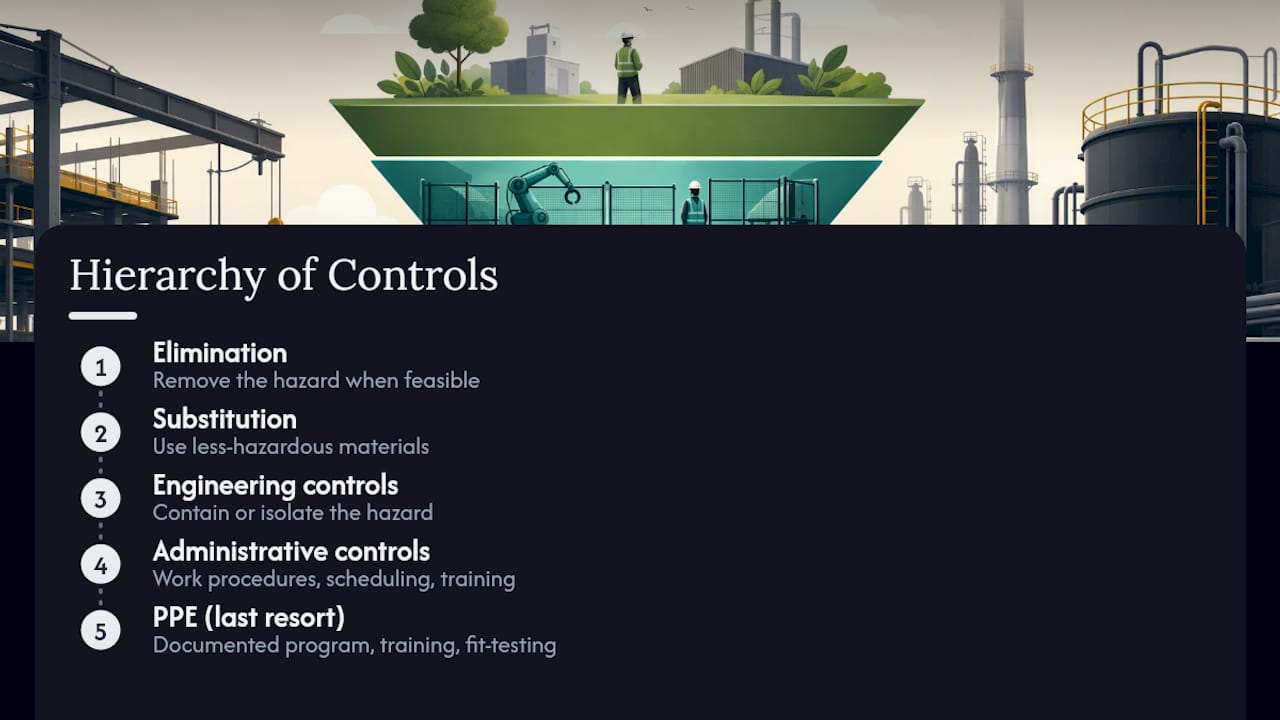
PPE is the last resort in the hierarchy of controls, not the first move, and it only counts as compliance when it’s part of a documented program with training and fit-testing behind it.
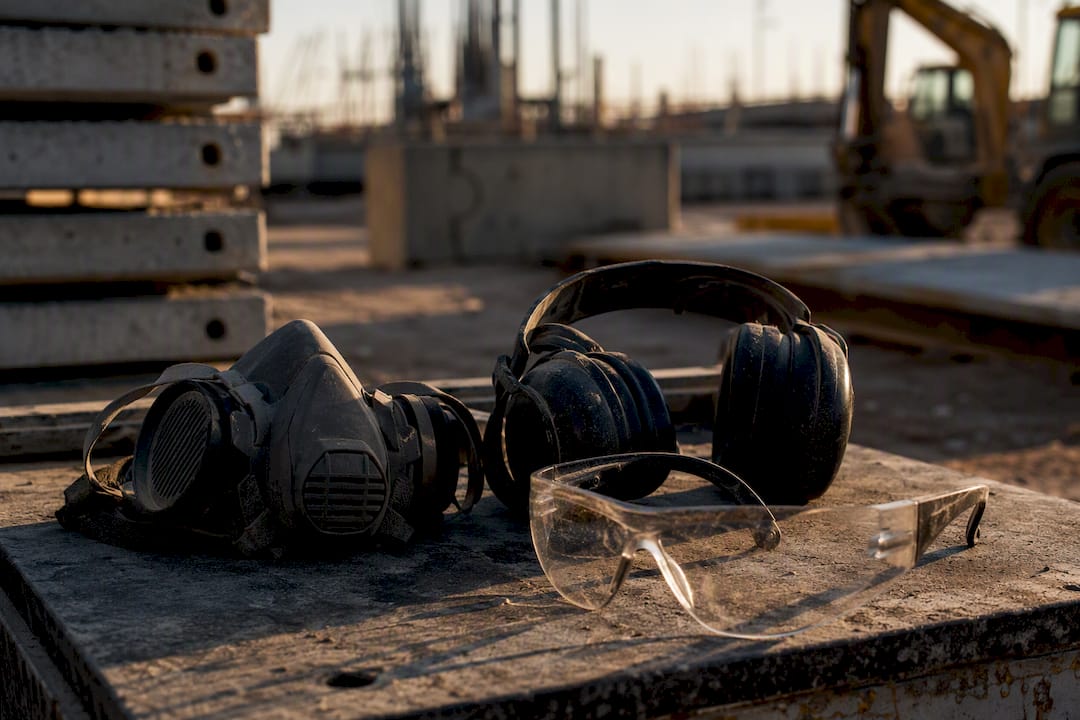
Common industrial PPE includes respirators, hearing protection, eye and face protection, and protective clothing, each selected for the specific task rather than issued generically. Selection, training, and maintenance requirements are spelled out under surface-prep PPE guidance that applies directly to blasting and coating work.
One standard worth watching closely: the respirable crystalline silica rule for construction sets a permissible exposure limit of 50 µg/m3 as an 8-hour time-weighted average, with two compliance paths, specified Table 1 controls or exposure monitoring against that limit.
Pro Tip: A respirator sitting in a truck doesn’t protect anyone. Full implementation means fit-testing, medical clearance, and training documented before the first task, not after an incident.
What Does Compliance Look Like on a Real Surface-Prep Job?
Here’s how these principles play out on an actual sandblasting job site, checklist-style:
- Pre-job planning — scope the surface, media type, and containment needs before scheduling
- Hazard evaluation — a competent person assesses silica exposure, confined-space risk, and lead or coating contaminants
- Control selection — apply engineering controls (containment, ventilation) before PPE
- PPE and respirator triggers — assign respirators only where monitoring or Table 1 requires them
- Air monitoring — measure exposure when tasks fall outside prescribed Table 1 controls
- Contractor coordination — confirm in writing who owns permits, monitoring, and emergency response
- Documentation — file SDS access, training records, and monitoring results before closeout
Surface prep work carries hazards specific enough that OSHA’s guidance calls for a qualified evaluator, something like a Certified Industrial Hygienist, before work begins, especially in confined or enclosed spaces where ventilation and monitoring decisions carry real consequences.
Pro Tip: Put hazard responsibilities in the contract itself, not a verbal understanding. Specify who runs air monitoring, who pulls permits, and who owns emergency response before the crew shows up.
A contractor’s view on where compliance actually breaks down
In practice, the gap is rarely the written program. It is the handoff, the moment a host site assumes the contractor covers monitoring and the contractor assumes the opposite. Coordinated, documented responsibility from day one prevents most of the problems that show up during an inspection.
Getting Professional Help With High-Risk Surface Prep
Some jobs are straightforward enough to manage in-house. Abrasive blasting on aging infrastructure, enclosed-space coating work, or anything triggering silica monitoring under 29 CFR usually is not one of them. That’s when bringing in a contractor with a documented safety track record and the equipment to control exposure at the source, rather than after the fact, makes the difference between a clean job and a paperwork problem.

Southern Sandblasting & Painting has run surface-prep and coating projects across Central Florida for over 20 years, with hazard evaluation, PPE protocols, and documentation built into every job from the pre-planning stage. If your facility, municipality, or contracting team needs a compliant partner for sandblasting work in Orlando, request a project consultation and get a scope that spells out control responsibilities before the crew ever shows up.
Sources
- Occupational Safety and Health Act (OSH Act) information
- Ten easy things employers can do to begin a safety and health program
- Surface preparation PPE guidance (OBIS/OSHA)


