
Facility coatings do far more than make a building look presentable. The role of facility aesthetics coatings spans safety, corrosion control, slip resistance, energy performance, and regulatory compliance — all delivered through the same system that gives your facility its finished appearance. Architectural coatings now function as performance tools contributing to durability, sustainability, and occupant outcomes, which means specification should center on service environment, not cosmetic cost.
The primary roles a well-specified coating system delivers:
- Appearance and brand identity — color consistency, wayfinding, and professional presentation
- Safety and visibility — high-contrast hazard markings, light-reflective finishes, anti-slip topcoats
- Asset protection — corrosion control, chemical resistance, waterproofing, and abrasion defense
- Energy performance — reflective roof coatings and bright interior finishes that reduce lighting and cooling loads
- Regulatory compliance — OSHA safety markings, slip-resistance ratings, VOC limits, and fire-rating requirements
Industry standards from ASTM, SSPC, and NACE provide the technical benchmarks that separate a properly engineered system from a coat of paint. Lifecycle planning — scheduling inspections, repairs, and repaint cycles around planned downtime — is what keeps those systems performing across a 10–20 year service horizon.
Table of Contents
- 1. How coatings improve both appearance and facility performance
- 2. Coating types and where they belong in your facility
- 3. How to specify and select the right coating system
- 4. Surface preparation and application best practices
- 5. Maintenance, inspection, and lifecycle planning
- 6. How Southernsandblastingandpainting delivers durable, aesthetic coatings
- 7. Real-world outcomes: what properly specified coatings deliver
- 8. Environmental and health considerations for facility coatings
- 9. How coatings support regulatory compliance beyond aesthetics
- 10. Coatings that improve energy efficiency and sustainability
- 11. Innovations and emerging technologies in facility coatings
- Key Takeaways
- Why facility managers need to rethink coatings as capital assets
- Southernsandblastingandpainting: surface prep and coatings that protect what you’ve built
- Standards, guidance, and useful sources
1. How coatings improve both appearance and facility performance
The idea that aesthetics and function are separate decisions is one of the more expensive myths in facility management. A light-reflective floor topcoat does not just look clean — it amplifies ambient illumination, which directly supports worker visibility and accident prevention. High-visibility floor finishes and anti-slip topcoats reduce workplace accidents in high-traffic zones, and the Bureau of Labor Statistics reported that a significant portion of nonfatal work injuries resulting in days away from work involved slips, trips, and falls.

Color contrast does real operational work too. Yellow aisle markings in a warehouse are not decoration — they define pedestrian lanes, forklift paths, and hazard boundaries in a single pass. The same logic applies to loading docks, where color-coded floor zones reduce collision risk, and to plant floors, where chemical-resistant topcoats protect concrete from spills while keeping surfaces cleanable to food-safety or pharmaceutical standards.
Walls and ceilings in production areas deserve the same scrutiny. Bright, high-reflectance coatings reduce the need for supplemental lighting fixtures and create environments that hold up under audit conditions. Lobbies and customer-facing spaces benefit from coatings that resist scuffing and staining — reducing touch-up frequency while maintaining the professional appearance that influences tenant retention and client perception.
Pro Tip: When specifying color and finish for a facility area, document the maintenance and inspection implications alongside the aesthetic choice. A gloss or semi-gloss finish on a production wall makes contamination visible at a glance — which speeds cleaning cycles and simplifies inspection. Build that logic into your coating schedule from day one.
- Light-reflective floor finishes improve illumination without additional fixtures
- Color-contrast markings define hazard zones, aisles, and emergency egress paths
- Chemical-resistant topcoats protect substrates and simplify contamination control
- High-reflectance wall coatings support cleanliness standards in audited environments
- Anti-slip aggregate topcoats meet OSHA traction requirements while maintaining a finished appearance
2. Coating types and where they belong in your facility
Not every coating family works on every surface. Matching the right system to the substrate and service environment is where most specification errors happen. The table below maps the major coating families to their functional strengths and typical facility applications.
| Coating Family | Primary Functional Strengths | Typical Facility Uses |
|---|---|---|
| Epoxy (solvent-borne or water-borne) | Chemical resistance, adhesion, hardness | Plant floors, secondary containment, tank linings |
| Polyurethane | UV stability, abrasion resistance, color retention | Topcoats on floors, walls, exterior steel |
| Polysiloxane | UV/weathering resistance, long recoat intervals | Exterior structural steel, bridges, facades |
| Zinc-rich primer | Galvanic corrosion protection | Structural steel, fabricated components, tank exteriors |
| Intumescent / fireproofing | Passive fire resistance, code compliance | Structural steel columns and beams |
| Acrylic (elastomeric or standard) | Flexibility, breathability, UV resistance | Masonry walls, tilt-up concrete, building exteriors |
| Anti-slip floor system | Traction, slip resistance, durability | Loading docks, ramps, wet process areas, stairs |
| Roof coating (reflective/elastomeric) | Waterproofing, solar reflectance, seamless barrier | Low-slope roofs, metal roofs, roof decks |
| PVDF / Kynar finish | Color retention, chemical inertness, 20 year life | Architectural metal panels, curtain wall, HVAC enclosures |
| Sealer / penetrating treatment | Moisture exclusion, dust control | Concrete slabs, masonry, parking decks |
PVDF/Kynar finishes are worth calling out specifically: shop-applied to metal panels before installation, they deliver color consistency and corrosion resistance that field-applied systems rarely match over a 20-year horizon. For HVAC units in industrial settings, polyurethane or polysiloxane topcoats over a zinc-rich primer are the standard approach to managing corrosion in coastal or chemical-exposure environments.
Service-environment triggers that shift the coating family selection:
- Chemical exposure (acids, solvents, caustics) pushes towards novolac epoxies or vinyl esters
- UV and weathering favour polyurethanes, polysiloxanes, or PVDF over standard epoxies, which chalk outdoors
- Thermal cycling (process piping, rooftops) requires flexible or elastomeric systems that move with the substrate
- Abrasion (forklifts, foot traffic, aggregate handling) demands high-build epoxy or polyurethane floor systems
- Fire rating requirements on structural steel mandate intumescent coatings specified to the required fire-resistance rating
Roof coatings can extend service life, provide seamless waterproofing, and improve energy performance through reflective “cool roof” finishes that reduce solar heat gain — a meaningful operational benefit in climates like Central Florida’s.
3. How to specify and select the right coating system
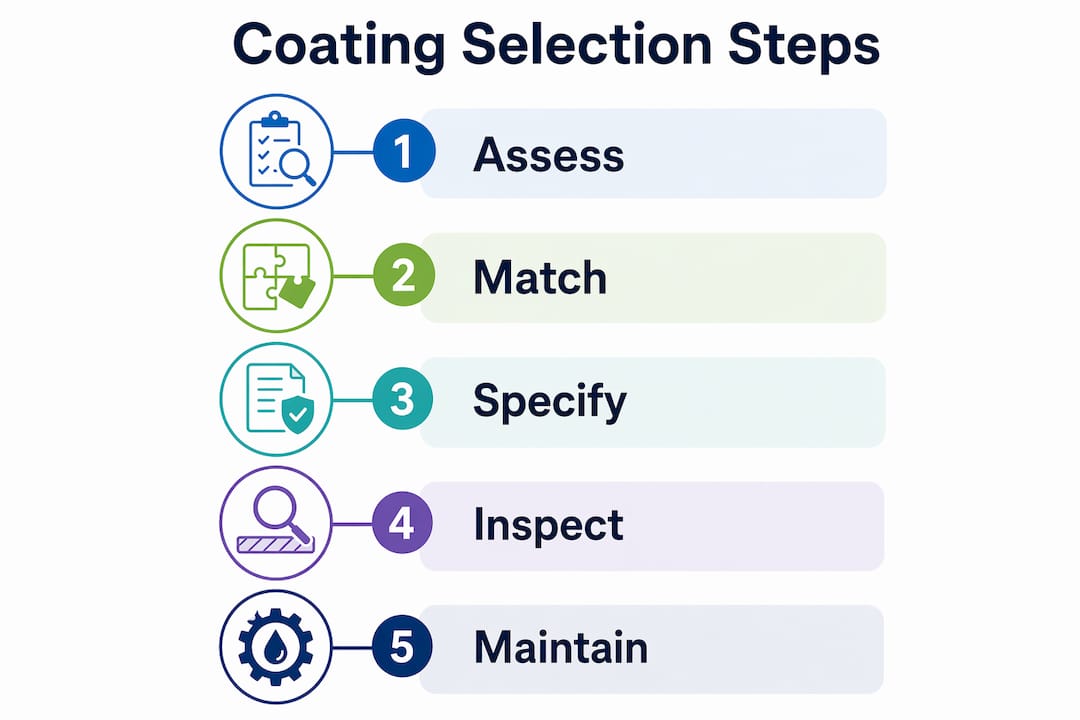
Treating coatings as “paint” rather than an engineered system is the leading cause of premature failure. A proper specification process follows a defined sequence:
- Define the service environment. Document chemical exposures, temperature ranges, UV exposure, humidity, and abrasion loads for each surface zone.
- Characterize the substrate. Steel, concrete, galvanized metal, and masonry each require different surface prep and primer chemistry. Note existing coatings, contamination history, and substrate condition.
- Set performance targets. Specify minimum dry film thickness (DFT), chemical resistance class, slip coefficient, and any fire-rating requirements. Reference ASTM test methods (e.g., ASTM D4541 for adhesion, ASTM D7091 for DFT) and SSPC/NACE surface preparation standards.
- Address VOC and regulatory limits. U.S. EPA and state air-quality rules cap VOC content for architectural and industrial maintenance coatings. Verify that specified products comply with applicable limits for your region and facility classification.
- Define curing and downtime constraints. Fast-cure systems (moisture-cure urethanes, rapid-set epoxies) can return a floor to service in hours rather than days — a critical variable in production environments.
- Plan the inspection and repair approach. Specify QA checkpoints: adhesion testing per ASTM D4541, DFT logging per ASTM D7091, and holiday/pinhole detection on immersion or containment linings.
Specification insight: A coating system is only as good as its weakest checkpoint. Require the contractor to submit an Inspection and Test Plan (ITP) before work begins — one that names the inspector, the test methods, the acceptance criteria, and the documentation format. A contractor who resists that request is telling you something important.
For procurement, use the industrial coatings checklist as a vetting framework. Evaluate total cost of ownership — not just price per gallon — and require warranty documentation that specifies coverage conditions, maintenance obligations, and the contractor’s liability for application defects.
4. Surface preparation and application best practices
Surface preparation is the single largest variable in coating durability. Inadequate prep causes premature failure regardless of product quality — a point that cannot be overstated when a floor system or structural steel coating is expected to perform for 15 years.
Core prep and application requirements:
- Substrate cleaning: Remove oil, grease, salts, and soluble contaminants before any mechanical prep. Contamination under a blast profile is a guaranteed adhesion failure.
- Blast profile: For steel, specify the SSPC/NACE cleanliness grade (e.g., SSPC-SP 6 for commercial blast, SSPC-SP 10 for near-white) and the anchor profile depth (typically 1.5–3.5 mils for most industrial systems).
- Moisture and dew-point control: Coating over a surface within 5°F of the dew point traps moisture under the film. Require climate logging throughout application.
- Primer selection: Match primer chemistry to substrate and topcoat. Zinc-rich primers on steel, epoxy block fillers on porous concrete, and tie-coats where incompatible systems interface.
- Stripe-coating: Manually applied stripe coats on edges, welds, and corners are non-negotiable. Spray application produces thin films at these high-stress details — stripe coats prevent the failures that always start there.
- DFT verification: Check wet film thickness during application and dry film thickness after cure. Log every reading.
Pro Tip: Hold a pre-job alignment meeting before the first coat goes down. Cover mixing ratios, pot life, thinning limits, application temperature range, and recoat windows. Pre-job alignment meetings that define these parameters precisely are one of the most effective ways to prevent the field failures that cost far more to fix than they would have cost to prevent.
Shop-applied coatings deserve consideration on any project with fabricated steel components. Shop application reduces weather-related schedule risk and enables immediate assembly on site — a meaningful schedule advantage on projects where field conditions are unpredictable. The trade-off is handling damage during transport and erection, which requires a clear touch-up protocol in the project specification. For industrial floor coating preparation, shop application is not an option — but the same discipline around profile, moisture, and DFT control applies in the field.
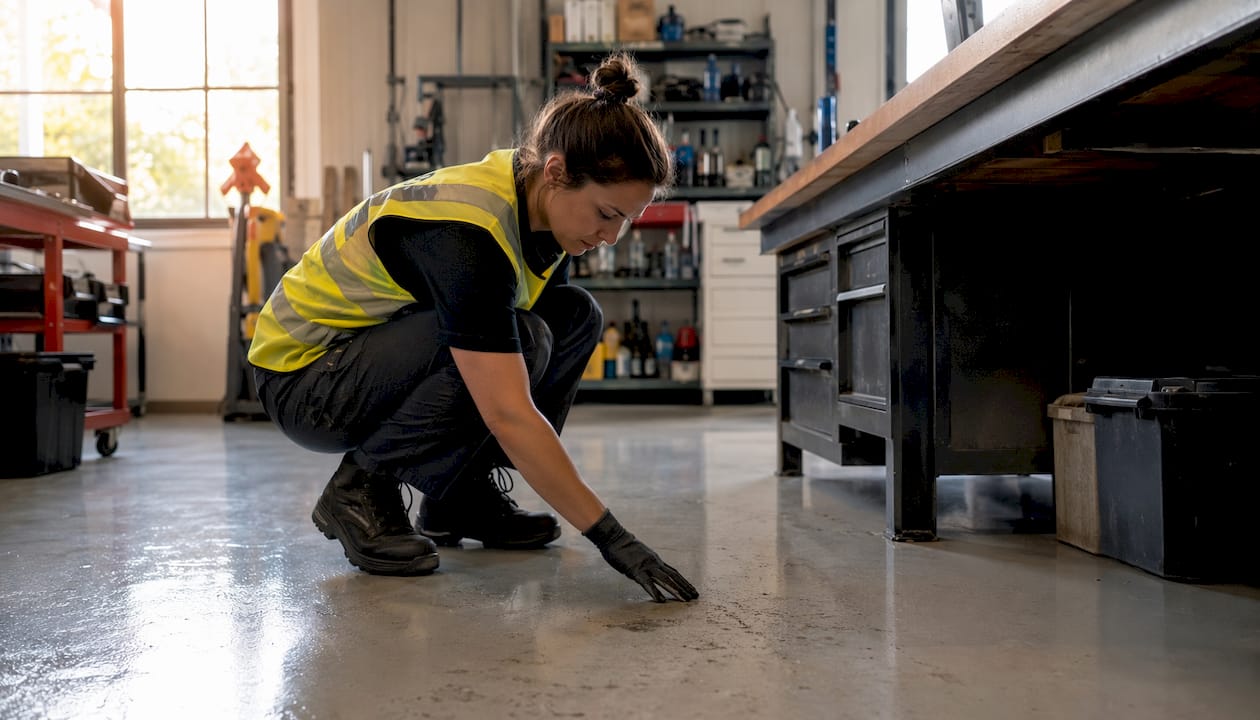
5. Maintenance, inspection, and lifecycle planning
A coating system is an asset, and like any asset, it degrades on a predictable curve. The goal of a maintenance program is to intervene before that curve steepens — because when coating systems fail, the real cost includes unplanned downtime, lost production, and long-term asset degradation, not just the repair price.
Inspection checklist (annual minimum, semi-annual for high-exposure zones):
- Visual survey: Check for chalking, color fade, gloss loss, and surface contamination across all coated surfaces.
- Adhesion check: Perform pull-off adhesion tests at representative locations, especially on surfaces with prior coating history.
- Film integrity: Look for cracking, blistering, delamination, and pinhole formation — particularly at edges, welds, and penetrations.
- Stripe and detail review: Inspect corners, fasteners, and welds where stripe coats were applied; these are the first areas to show failure.
- Floor marking condition: Verify that safety markings remain legible, intact, and correctly positioned relative to current facility layout.
- Document and photograph: Log findings with GPS-tagged photos and compare against prior inspection records to track degradation rate.
Lifecycle note: Properties that follow a disciplined maintenance program routinely extend their full repaint intervals by three to five years. On a portfolio scale, that translates into significant deferred capital expenditure and fewer emergency repair projects that disrupt operations.
Repair prioritization should follow a risk-ranked approach: surfaces protecting structural steel or immersion-service assets get first attention, followed by safety markings, then general architectural surfaces. Schedule coating work during planned production outages — not around them. Reactive repairs during operations cost more, take longer, and introduce safety risks that a scheduled program eliminates. For a detailed inspection protocol, the coating inspection guide covers documentation expectations and condition-scoring methods that support capital planning.
6. How Southernsandblastingandpainting delivers durable, aesthetic coatings
Southernsandblastingandpainting brings more than 20 years of experience in industrial surface preparation, sandblasting, and protective coatings to commercial, municipal, and government clients across Central Florida. The company’s work spans water tanks, airports, pipelines, theme parks, and city infrastructure — environments where coating failure is not a cosmetic inconvenience but an operational and safety event.
The project process follows a defined sequence:
- Pre-job site survey: Assess substrate condition, document existing coatings, identify contamination sources, and define service environment for each surface zone.
- Surface preparation: Abrasive blasting to the specified SSPC/NACE cleanliness grade, with anchor profile verification and climate logging before primer application.
- Multi-layer system application: Primer, intermediate coat, and topcoat applied to specified DFT ranges, with stripe coats on all edges, welds, and penetrations.
- QA checkpoints: DFT logs, adhesion testing per ASTM D4541, and photographic documentation at each stage.
- Handover dossier: Project documentation including the ITP, climate logs, DFT records, product data sheets, and a recommended maintenance schedule.
What clients should expect: Every project scope includes a written Inspection and Test Plan before work begins, clear documentation of surface prep grades achieved, and a maintenance plan that gives the facility team a clear schedule for future inspections and touch-ups. That documentation is what protects the warranty and supports capital planning.
Southernsandblastingandpainting’s industrial coating types page details the specific systems the company applies across floor, wall, structural steel, roof, and tank applications.
7. Real-world outcomes: what properly specified coatings deliver
Industrial plant floor — food processing facility
A food processing plant with a deteriorating concrete floor was experiencing contamination control failures and increasing slip incidents in wet process areas. The scope included diamond grinding to remove the failed coating system, application of a moisture-tolerant epoxy primer, a high-build epoxy intermediate coat, and a polyurethane anti-slip topcoat with color-coded zone markings. The facility returned to production within 72 hours of final coat application using a fast-cure system. Maintenance events related to floor contamination dropped significantly in the following 12 months, and the color-coded zone system reduced near-miss incidents in pedestrian/forklift interface areas.
Lesson learned: Specifying a fast-cure topcoat from the outset — not as an afterthought — is what made a rapid return to service possible. Downtime planning belongs in the specification, not the contractor’s schedule.
Structural steel and roof coating — warehouse complex
A warehouse complex with corroding structural steel and a failing built-up roof was approaching the point where deferred maintenance would require full component replacement. The structural steel received an SSPC-SP 10 near-white blast, zinc-rich primer, epoxy intermediate, and polysiloxane topcoat. The roof received a fluid-applied elastomeric coating over a cleaned and primed substrate. Shop-applied coatings on replacement steel components accelerated the erection schedule by eliminating field prime coat curing time. The roof system provided seamless waterproofing and a reflective finish that reduced cooling loads measurably in the first summer season.
Lesson learned: Combining structural steel recoating with a roof coating project during a single planned outage cuts total mobilization cost and minimizes production disruption compared to two separate projects.
8. Environmental and health considerations for facility coatings
VOC content is the most immediate environmental variable in coating specification. U.S. EPA National Emission Standards and state-level rules (California’s SCAQMD Rule 1113 being the most stringent) cap VOC content for architectural and industrial maintenance coatings by product category. Water-borne epoxies, high-solids polyurethanes, and powder coatings have largely replaced solvent-heavy systems in interior applications, delivering comparable performance with substantially lower VOC emissions.
Worker health during application is a separate concern. Isocyanate-containing coatings (two-component polyurethanes) require respiratory protection and confined-space protocols that go beyond standard painting PPE. Specify ventilation requirements in the project scope, not as a field decision.
Hazardous waste disposal applies to abrasive blast media contaminated with lead paint or heavy-metal primers, spent solvents, and coating waste. Federal RCRA rules and state hazardous waste regulations govern disposal — a contractor who cannot produce a waste manifest and disposal documentation is a liability. Require that documentation as a project deliverable. Low-VOC and waterborne formulations also reduce the volume of hazardous waste generated, which simplifies disposal and lowers project cost.
9. How coatings support regulatory compliance beyond aesthetics
OSHA 29 CFR 1910.144 specifies color-coding requirements for physical hazards — yellow for caution/physical hazards, red for fire protection equipment and emergency stops, orange for dangerous machine parts. These are not suggestions; they are compliance requirements that a floor coating or wall marking system must satisfy. A facility audit that finds faded or missing safety markings can generate citations regardless of how well the underlying substrate is protected.
Slip resistance is governed by OSHA 29 CFR 1910.22, which requires floors to be kept in clean, dry condition and free of hazards. The Americans with Disabilities Act (ADA) adds specific coefficient-of-friction requirements for accessible routes. Anti-slip floor coatings with broadcast aggregate or textured topcoats are the standard solution — but the aggregate type, broadcast rate, and topcoat chemistry must be specified to achieve a measurable, documented slip coefficient, not just a “textured” appearance.
Fire-rated intumescent coatings on structural steel must be applied to the thickness specified in the fire-resistance design — typically documented in an Underwriters Laboratories (UL) listing. Applying the wrong dry film thickness voids the fire rating and the building code compliance that depends on it. This is one area where DFT documentation is not a QA nicety; it is a code requirement.
10. Coatings that improve energy efficiency and sustainability
Reflective roof coatings are the most direct energy-efficiency application. A white or light-colored elastomeric roof coating with high solar reflectance (typically 0.80 or above per ENERGY STAR criteria) reduces roof surface temperature, which lowers the heat transferred into the building and reduces cooling loads. In hot climates like Florida’s, the operational savings over a summer season are measurable on the utility bill.
Bright interior coatings on walls and ceilings contribute to energy efficiency by amplifying natural and artificial light, reducing the number of fixtures needed to achieve target illumination levels. This is a facility design and coatings decision that pays back over the life of the coating system, not just at installation.
Cool-roof coatings also qualify for ENERGY STAR certification and may support LEED credits under the Sustainable Sites category, which matters for facilities pursuing green building certification. Specifying reflective coatings on both roofs and exterior walls can contribute to urban heat island reduction — a consideration that is increasingly relevant for municipal and government clients managing large facility portfolios.
11. Innovations and emerging technologies in facility coatings
Nanocoatings represent one of the more practical recent advances. Silica or titanium dioxide nanoparticles incorporated into coating formulations produce surfaces with dramatically reduced surface energy — water and contaminants bead off rather than adhering, which reduces cleaning frequency and extends the interval between recoats. These are already commercially available for exterior architectural and industrial applications, not just laboratory curiosities.
Self-cleaning photocatalytic coatings use titanium dioxide to break down organic contaminants when exposed to UV light. Applied to exterior facades, they reduce biological growth (algae, mold) and maintain appearance between cleaning cycles — a meaningful maintenance cost reduction for large building envelopes.
Polyurea and polyurethane hybrid systems with rapid-cure chemistry have changed the economics of floor and containment coating projects. Systems that cure to foot traffic in two hours and full chemical resistance in 24 hours make it possible to coat a production floor over a weekend shutdown rather than a week-long outage. That schedule compression has real dollar value for operating facilities.
Digital inspection tools — handheld DFT gauges that log readings with GPS coordinates and time stamps, and drone-based visual inspection for large roofs and elevated steel — are shifting coating maintenance from periodic walkthroughs to continuous condition monitoring. The data these tools generate supports risk-ranked maintenance planning and gives facility managers defensible documentation for capital budget requests.
Key Takeaways
Facility coatings function as engineered asset-protection systems — not cosmetic finishes — and the specification, application, and maintenance decisions you make determine whether they deliver on that promise.
| Point | Details |
|---|---|
| Coatings are asset tools, not decoration | Specify based on service environment, performance targets, and lifecycle cost — not product price. |
| Surface prep determines longevity | Inadequate blast profile or moisture control causes premature failure regardless of coating quality. |
| Inspection extends repaint intervals | Disciplined annual inspections and early repairs can extend full repaint cycles by three to five years. |
| Compliance is built into the system | OSHA safety markings, slip-resistance ratings, and fire-rated DFT requirements must be specified, not assumed. |
| Southernsandblastingandpainting delivers documented systems | With 20+ years of experience, the company provides ITP documentation, DFT logs, and maintenance plans on every project. |
Why facility managers need to rethink coatings as capital assets
The framing shift that matters most here is not technical — it is financial. Most facility budgets treat coatings as a maintenance line item, which means they get deferred when capital is tight. That is exactly backwards. A coating system on structural steel or a production floor is protecting an asset worth orders of magnitude more than the coating itself. Deferring a $40,000 repaint to save budget in year eight often means a $200,000 remediation in year twelve, plus the unplanned downtime that comes with it.
The managers who get the best outcomes treat coatings the same way they treat mechanical systems: scheduled inspections, documented condition, risk-ranked repair priorities, and repaint cycles tied to planned outages rather than reactive failures. That approach does not require a larger budget — it requires a different planning horizon. When you integrate coating maintenance into your capital plan alongside HVAC, roofing, and structural systems, the lifecycle cost per protected square foot drops, emergency mobilizations become rare, and the facility consistently meets safety and compliance standards without scrambling.
Southernsandblastingandpainting: surface prep and coatings that protect what you’ve built
Twenty years of industrial coating work across water tanks, airports, pipelines, and municipal infrastructure gives Southern Sandblasting and Painting a specific kind of credibility: the kind that comes from projects where failure is not an option. For facility managers who need a contractor that brings written scope, documented QA, and a maintenance plan — not just a crew and a sprayer — that track record is the difference.

Services cover the full project scope: abrasive sandblasting to SSPC/NACE standards, multi-layer industrial painting in Orlando, floor systems, roof coatings, structural steel protection, and template-based safety markings. Every project starts with a site survey and ends with a handover dossier that includes DFT logs, climate records, product data sheets, and a recommended maintenance schedule. If you are specifying a coating project and want a contractor who can match the system to your service environment — not just quote the cheapest product — contact Southernsandblastingandpainting for a site assessment and written scope.
Standards, guidance, and useful sources
| Source | Why It’s Useful |
|---|---|
| ASTM D4541 — Pull-Off Adhesion Testing | Standard test method for adhesion; required in QA specifications and contractor ITPs |
| SSPC/NACE Surface Preparation Standards | Defines blast cleanliness grades (SP 6, SP 10, SP 5) referenced in every steel coating specification |
| Architectural Coatings Not Just for Aesthetics (FacilitiesNet) | Reframes coatings as performance tools; useful for specification philosophy and lifecycle framing |
| Optimizing Facility Management (Sherwin-Williams Industrial) | Covers floor, wall, steel, and roof coating selection for manufacturing environments |
| High-Performance Coatings: Built for Speed (Facility Executive) | Data on durability priorities, shop-applied coatings, and schedule impact |
| Ultimate Guide to Industrial Coatings (WasInc) | Covers system design, failure causes, inspection planning, and lifecycle cost |
| Industrial Coating System Design (HuiliCoating) | Technical detail on DFT, stripe coats, pre-job alignment, and system layer design |
| Southernsandblastingandpainting — Services | Project contact and service scope for sandblasting, surface prep, and industrial coatings |


