
TL;DR:
- Steel coating systems consist of primers, intermediate coats, and topcoats designed to resist corrosion, UV damage, and mechanical wear. Proper system selection based on ISO 12944 environmental categories and complete layer specifications ensures long-term durability of steel assets. Advanced coatings like inorganic zinc silicates and fluorocarbons provide enhanced protection for extreme environments, reducing maintenance costs over the asset’s lifespan.
Steel coating layer types are multi-layer protective systems combining primers, intermediate build coats, and topcoats to defend steel against corrosion, UV degradation, and mechanical wear. The industry standard framework for specifying these systems is ISO 12944, which links coating builds to environmental corrosivity categories and expected service life. Common materials across these systems include hot-dip galvanizing, zinc-rich epoxy primers, glass-flake epoxy intermediates, and aliphatic polyurethane topcoats. Understanding how each layer functions, what thickness it requires, and which environment it suits is the foundation of any durable steel protection strategy. Getting this right upfront eliminates the far more expensive problem of premature coating failure on critical infrastructure.
1. What are the primary steel coating layer types?
A corrosion-protective coating system for steel is defined by three distinct functional layers: the primer, the intermediate build coat, and the topcoat. Each layer performs a specific role, and no single layer can substitute for another.
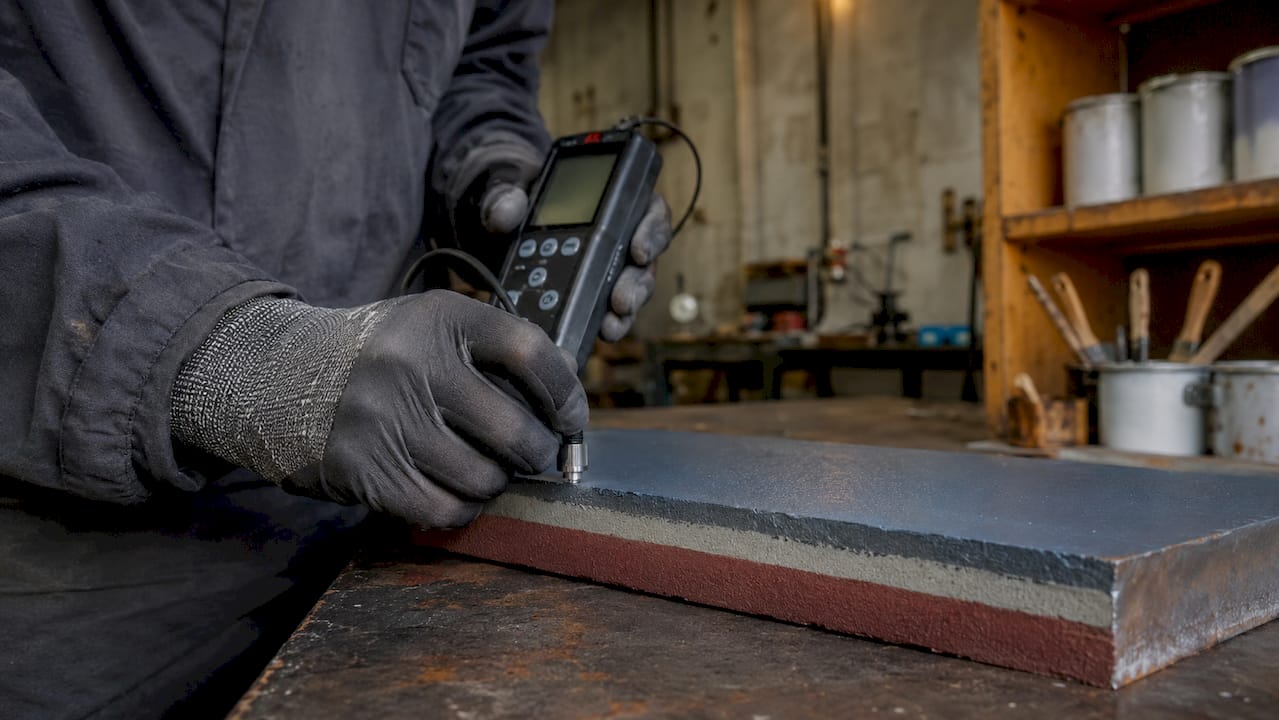
Primer layer: The primer bonds directly to the prepared steel surface. Its two jobs are adhesion and corrosion inhibition. Zinc-rich epoxy primers achieve corrosion inhibition through sacrificial protection, where zinc corrodes preferentially before the steel beneath it. Epoxy primers without zinc pigment rely on barrier adhesion alone, making them better suited to lower-corrosivity environments.
Intermediate build coat: This layer provides the bulk of the system’s barrier thickness. High-build epoxies and glass-flake epoxies are the standard materials here. The intermediate coat is the primary source of barrier performance in the full system. Under-applying this layer cannot be corrected by adding more topcoat.
Topcoat layer: The topcoat faces the environment directly. It handles UV resistance, color retention, chemical splash, and abrasion. Polyurethane and fluorocarbon finishes are the preferred topcoat materials for exterior steel because epoxy coatings are UV-sensitive and chalk rapidly outdoors without a UV-stable finish over them.
- Primer: adhesion and cathodic or barrier corrosion inhibition
- Intermediate: barrier thickness and resistance to moisture vapor transmission
- Topcoat: UV stability, chemical resistance, and appearance retention
Pro Tip: Never specify a topcoat chemistry without confirming it is compatible with the primer below it. Certain topcoat chemistries react with zinc-rich primers, forming zinc salts that cause adhesion failure and delamination within months of application.
2. How metallic coatings compare: hot-dip galvanizing vs. electro-galvanizing
Metallic coatings apply zinc directly to the steel surface rather than as a paint layer. The two dominant steel coating methods in this category are hot-dip galvanizing (HDG) and electro-galvanizing, and they serve very different purposes.
Hot-dip galvanizing immerses fabricated steel in a bath of molten zinc at approximately 450°C. The result is a metallurgically bonded coating typically 80 to 100 micrometers thick, providing 20 to 50 years of corrosion protection in most atmospheric environments. The zinc layer does not simply sit on the surface. It forms intermetallic alloy layers that bond at the molecular level, making it extremely resistant to mechanical damage. Standards governing this process include ISO 1461 and ASTM A123, both of which specify minimum coating thickness by steel section thickness.
Electro-galvanizing deposits zinc onto steel electrochemically, producing a much thinner coating of approximately 10 to 12 micrometers. The finish is smoother and more uniform than HDG, which makes it preferred for automotive panels and components that will be painted over. For structural steel in outdoor or industrial environments, electro-galvanizing alone provides insufficient protection.
| Property | Hot-dip galvanizing | Electro-galvanizing |
|---|---|---|
| Coating thickness | 80 to 100 µm | 10 to 12 µm |
| Service life (outdoor) | 20 to 50 years | 2 to 5 years uncoated |
| Surface finish | Spangled, slightly rough | Smooth, uniform |
| Best use case | Structural steel, bridges, poles | Automotive, indoor, paint-over |
| Standard | ISO 1461, ASTM A123 | ASTM B633 |
Zinc coatings provide sacrificial protection because zinc corrodes preferentially to steel, forming protective zinc oxides and carbonates that slow further corrosion. This galvanic effect continues even when small areas of steel are exposed through coating damage, which is a critical advantage over purely barrier-based systems.
Pro Tip: When specifying HDG for structural steel that will also receive a paint system, confirm the paint system is compatible with zinc. The zinc coating compatibility issue is one of the most common causes of premature paint failure on galvanized steel.
3. ISO 12944 paint coating systems by environment
ISO 12944 is the international standard that defines corrosivity categories for steel environments and prescribes coating system builds for each. For industrial and construction specifiers, understanding C3, C4, and C5 categories is non-negotiable.
C3 (medium corrosivity) covers urban and industrial atmospheres with moderate humidity. A typical C3 system uses an epoxy primer at 50 to 80 µm, a high-build epoxy intermediate at 80 to 120 µm, and a polyurethane topcoat at 50 to 75 µm. Total dry film thickness (DFT) lands between 180 and 275 µm. This system suits commercial buildings, bridges in temperate climates, and general industrial structures.
C4 (high corrosivity) applies to coastal areas, chemical plants, and environments with higher chloride or sulfur dioxide exposure. Zinc-rich epoxy primers become the standard at this level because barrier protection alone is insufficient. The sacrificial mechanism of zinc provides a second line of defense when the coating is scratched or damaged. You can read more about zinc primer benefits for Florida infrastructure specifically.
C5 (very high corrosivity) covers offshore structures, marine splash zones, and aggressive industrial environments. C5 systems use zinc-rich epoxy primers at 60 to 80 µm, glass-flake epoxy intermediates at 125 to 200 µm, and aliphatic polyurethane topcoats at 60 to 80 µm. Total DFT reaches 320 to 440 µm. The glass-flake intermediate is the defining feature of C5 systems. Glass flakes orient parallel to the steel surface, creating a tortuous path that dramatically slows moisture and chloride penetration.
Key factors driving system selection under ISO 12944:
- Corrosivity category of the operating environment (C1 through CX)
- Required durability class (low: 2 to 5 years, medium: 5 to 15 years, high: over 15 years)
- UV exposure determining topcoat chemistry
- Immersion service (Im1 for freshwater, Im2 for seawater, Im3 for soil)
- Surface preparation grade required before coating application
The full system specification must include layer types, number of coats, and target DFT ranges. Specifying only a product name without system build details produces underbuilt coatings and early maintenance cycles.
4. Advanced steel coating layer types for extreme environments
Standard organic paint systems reach their limits in offshore, high-temperature, and immersion service environments. Advanced steel surface protection types address these conditions through specialized chemistry and system design.
Inorganic zinc silicate primers cure through a chemical reaction with atmospheric moisture, forming a hard, inorganic zinc matrix bonded directly to the steel. Unlike organic zinc-rich primers, inorganic zinc silicates tolerate temperatures up to 400°C without degrading. They are the primer of choice for petrochemical structures, offshore platforms, and high-temperature pipelines. Their abrasion resistance also exceeds that of organic primers, making them suitable for surfaces subject to mechanical wear.
Fluorocarbon topcoats (PVDF and FEVE-based systems) provide UV stability and chemical resistance that exceeds standard polyurethane topcoats. Fluorocarbon finishes retain color and gloss for 20 to 30 years in direct sun exposure, making them the preferred choice for architectural steel, bridges in coastal Florida, and any asset where recoating is logistically difficult. The cost premium over polyurethane is significant, but the extended recoating interval typically justifies it over a 30-year asset life.
Monolithic glass-flake epoxy systems apply a single thick coat rather than a three-layer build. These systems are used in Im2 (seawater immersion) and splash zone service where conventional multi-coat systems are prone to intercoat adhesion failure under constant wet-dry cycling. A single monolithic coat at 500 to 1,000 µm eliminates intercoat interfaces, which are the weakest point in any multi-layer system under immersion conditions.
For CX (extreme corrosivity) environments under ISO 12944, advanced coatings like inorganic zinc silicates and fluorocarbon topcoats provide abrasion and chemical resistance beyond conventional organic systems. These are not substitutes for standard systems in moderate environments. They are purpose-built for conditions where standard systems fail within five years.
5. How to choose the best steel coating layer types for your project
Selecting the right coating system starts with a clear environmental assessment, not a product catalog. The following process applies to any industrial or construction steel coating decision.
- Classify the environment. Use ISO 12944 corrosivity categories as your baseline. A water treatment plant in coastal Florida operates in C4 to C5 conditions. An interior structural steel frame in a climate-controlled warehouse is C1 to C2. The environment determines the minimum system build.
- Set the durability target. Specify whether you need a low (2 to 5 year), medium (5 to 15 year), or high (over 15 year) durability class. Higher durability requires thicker systems and more demanding surface preparation. Explore coating application steps to understand how preparation grade affects system performance.
- Specify the full system build. List primer type, intermediate type, topcoat type, number of coats per layer, and target DFT for each layer. A complete system specification prevents contractors from substituting thinner products that meet the product name but not the performance requirement.
- Address UV exposure explicitly. Epoxy intermediates and primers cannot serve as the final coat on exterior steel. A UV-stable polyurethane or fluorocarbon topcoat is required. Missing this detail is one of the most common specification mistakes in industrial coating projects.
- Plan for inspection at the intermediate coat stage. DFT verification of the build coat is the most critical inspection point. Deficiencies here cannot be corrected later. Require wet film thickness checks during application and DFT readings before topcoat application.
- Calculate lifecycle cost, not just application cost. A C5-rated system costs more upfront than a C3 system applied to the same structure. In a coastal or industrial environment, the C3 system will require maintenance recoating within five to seven years. The C5 system may run 15 to 25 years before intervention.
Pro Tip: For weather-resistant coating selection on Florida infrastructure, always specify one corrosivity category above your initial assessment. Florida’s combination of UV intensity, humidity, and coastal chloride exposure consistently pushes real-world performance below laboratory predictions.
Key takeaways
A system-based approach combining primer, intermediate, and topcoat layers tailored to the ISO 12944 corrosivity category is the most reliable method for maximizing steel asset service life.
| Point | Details |
|---|---|
| Three-layer system logic | Primer, intermediate, and topcoat each perform distinct functions that no single layer can replace. |
| Intermediate coat is critical | Build coat DFT determines barrier performance; deficiencies here cannot be offset by thicker topcoats. |
| Match system to environment | ISO 12944 C3, C4, and C5 categories prescribe specific materials and DFT targets for each exposure level. |
| Zinc provides sacrificial protection | Zinc-rich primers and hot-dip galvanizing protect steel cathodically, even through coating damage. |
| Specify full system builds | Listing layer types, coat counts, and DFT targets prevents underbuilt systems and early maintenance cycles. |
What 20 years of coating specifications taught me
The most expensive mistake I see on industrial steel projects is treating coating selection as a product decision rather than a system decision. A facility manager specifies an epoxy primer because it worked on a previous job, then pairs it with whatever topcoat the contractor has in stock. Three years later, the coating is chalking, the steel is showing rust bleed, and the recoating cost exceeds what a properly specified C4 system would have cost from the start.
The second most common mistake is ignoring the intermediate coat during inspection. Contractors under time and budget pressure will thin the build coat and compensate with a heavier topcoat. The topcoat looks fine at handover. The barrier performance is not there. You will not know until moisture has already reached the steel.
The third mistake is underestimating Florida’s environment. Central Florida is not a C3 environment for most infrastructure. Water tanks, bridges, and outdoor structural steel near the coast or in industrial corridors are operating in C4 to C5 conditions. Specifying to C3 to save money on the coating system is a false economy that Southernsandblastingandpainting sees corrected at significant cost on maintenance projects every year.
The primer vs. topcoat relationship is not just a technical detail. It is the difference between a 5-year maintenance cycle and a 20-year service life on the same structure.
— Southernsandblastingandpainting
Surface preparation and coating services from Southernsandblastingandpainting
No coating system performs to its specified DFT and service life without proper surface preparation. Contamination, mill scale, and inadequate surface profile all cause premature adhesion failure regardless of coating quality.
Southern Sandblasting and Painting has delivered industrial surface preparation and coating services across Central Florida for over 20 years, covering water tanks, pipelines, airport infrastructure, and municipal assets. The team uses professional sandblasting equipment to achieve the surface cleanliness and anchor profile that ISO 12944 systems require before coating application. From SSPC-SP 6 commercial blast to SSPC-SP 10 near-white blast, the preparation standard is matched to the coating system and environment. Contact Southernsandblastingandpainting to review your industrial coating services needs and get a system specification that holds up in Florida’s demanding conditions.
FAQ
What are the three main steel coating layer types?
The three main layers are the primer, the intermediate build coat, and the topcoat. Each performs a distinct function: the primer provides adhesion and corrosion inhibition, the intermediate delivers barrier thickness, and the topcoat resists UV, weathering, and chemical exposure.
What is ISO 12944 and why does it matter for steel coatings?
ISO 12944 is the international standard that classifies environmental corrosivity categories (C1 through CX) and specifies corresponding coating system builds, including layer materials, coat counts, and DFT targets. It is the primary reference for specifying steel coating systems on industrial and infrastructure projects.
How thick should a steel coating system be for a C5 environment?
A C5 system typically reaches a total DFT of 320 to 440 µm, using a zinc-rich epoxy primer at 60 to 80 µm, a glass-flake epoxy intermediate at 125 to 200 µm, and an aliphatic polyurethane topcoat at 60 to 80 µm.
What is the difference between barrier and sacrificial steel coatings?
Barrier coatings protect steel by physically blocking moisture and oxygen from reaching the surface. Sacrificial coatings, such as zinc-rich primers and hot-dip galvanizing, corrode preferentially to the steel, providing cathodic protection even when the coating is damaged.
Why do epoxy coatings fail outdoors without a topcoat?
Epoxy coatings are UV-sensitive and chalk rapidly under direct sunlight, losing adhesion and barrier integrity. A polyurethane or fluorocarbon topcoat is required on exterior steel to retain color, gloss, and protective performance over the system’s intended service life.
Recommended
- 7 Steps to Mastering an Industrial Coating Selection Guide
- Industrial Coating Terminology: Keys for Asset Longevity
- Industrial Coating Application Steps for Lasting Protection
- Application Methods for Industrial Coatings: A 2026 Guide
- Sandblasting Contractor Baldwin Park FL
- Sandblasting Services Oviedo FL


