

TL;DR:
- Getting infrastructure right in theme parks involves balancing guest experience, safety, efficiency, and long-term ROI from the early planning stages. Thoughtful site analysis, phased development, and designing for guest flow and immersion are critical to operational success and maintaining thematic cohesion. Proper surface preparation, back-of-house planning, and integrating sustainable and smart technologies enhance asset longevity and reduce long-term costs.
Getting theme park infrastructure right is one of the most demanding challenges in the industry. You’re balancing guest experience, safety compliance, operational efficiency, and long-term ROI, often simultaneously and always under budget pressure. The decisions made early in planning lock in constraints that are expensive to fix later, and the stakes are high: a single choke point in walkway design or an overlooked maintenance access route can ripple into lost revenue and damaged reputation. These theme park infrastructure tips cut through the noise and give you a practical, decision-ready framework from site selection through sustainability.
Table of Contents
- Key takeaways
- 1. The best theme park infrastructure tips start with site analysis
- 2. Use phased development to control costs and prove revenue
- 3. Design for guest flow and immersive experience simultaneously
- 4. Adding new attractions without disrupting operations
- 5. Back-of-house infrastructure: the hidden foundation of operations
- 6. Surface preparation and protective coatings extend infrastructure life
- 7. Sustainability and smart technology as infrastructure investments
- My perspective on what actually drives long-term infrastructure success
- Protect your park’s infrastructure with professional surface treatment
- FAQ
Key takeaways
| Point | Details |
|---|---|
| Plan infrastructure in phases | Anchor attractions first generates early revenue while managing capital investment over time. |
| Design for guest flow from day one | Hub-and-spoke layouts with intuitive pathways reduce fatigue and prevent dangerous crowding. |
| Protect surfaces proactively | Professional surface preparation and industrial coatings extend asset life and reduce maintenance costs significantly. |
| Hide back-of-house, but design it well | Service roads and maintenance areas must be fully functional yet invisible to preserve guest immersion. |
| Technology is only as good as the infrastructure beneath it | AI crowd management and AR experiences require reliable, well-maintained physical infrastructure to perform. |
1. The best theme park infrastructure tips start with site analysis
Before a single dollar goes into construction, a thorough site evaluation determines whether your park will run efficiently or fight its own layout for decades. Topography, soil conditions, utility access, and road connectivity all feed directly into your operating costs. A site that requires major grading or utility extension will consume capital that could otherwise fund guest-facing attractions.
Construction and infrastructure costs for amusement parks typically range from $30,000 to over $200,000 depending on ground works and utility complexity. That range is wide because early site decisions either simplify or compound every subsequent build phase.
Zoning, permits, ADA accessibility standards, and local fire codes are non-negotiable. Engage a compliance consultant before finalizing your site plan. The cost is small compared to a forced redesign or a delayed opening.
Pro Tip: Run a traffic flow simulation of your entrance and parking areas during a hypothetical peak-day scenario before breaking ground. Bottlenecks at park entry damage first impressions in ways that are hard to recover from.
2. Use phased development to control costs and prove revenue
One of the most reliable amusement park construction tips is building in phases rather than trying to open a complete park on day one. Phased development schedules that prioritize anchor attractions allow operators to generate early ticket revenue while completing subsequent infrastructure investments.
Phase 1 should include your signature ride or attraction, core guest services (restrooms, food service, ticketing), and enough parking for your expected opening-day capacity. Everything else can follow in later phases as revenue data informs your priorities.
This approach also gives your operations team time to stress-test infrastructure before the full load arrives. You will surface maintenance access issues, utility bottlenecks, and queue design problems while you still have the flexibility to address them cheaply.
3. Design for guest flow and immersive experience simultaneously
The layout of your pathways, plazas, and land transitions does more than move people around. It shapes how guests feel, how long they stay, and how much they spend. This is where theme park design advice pays for itself many times over.
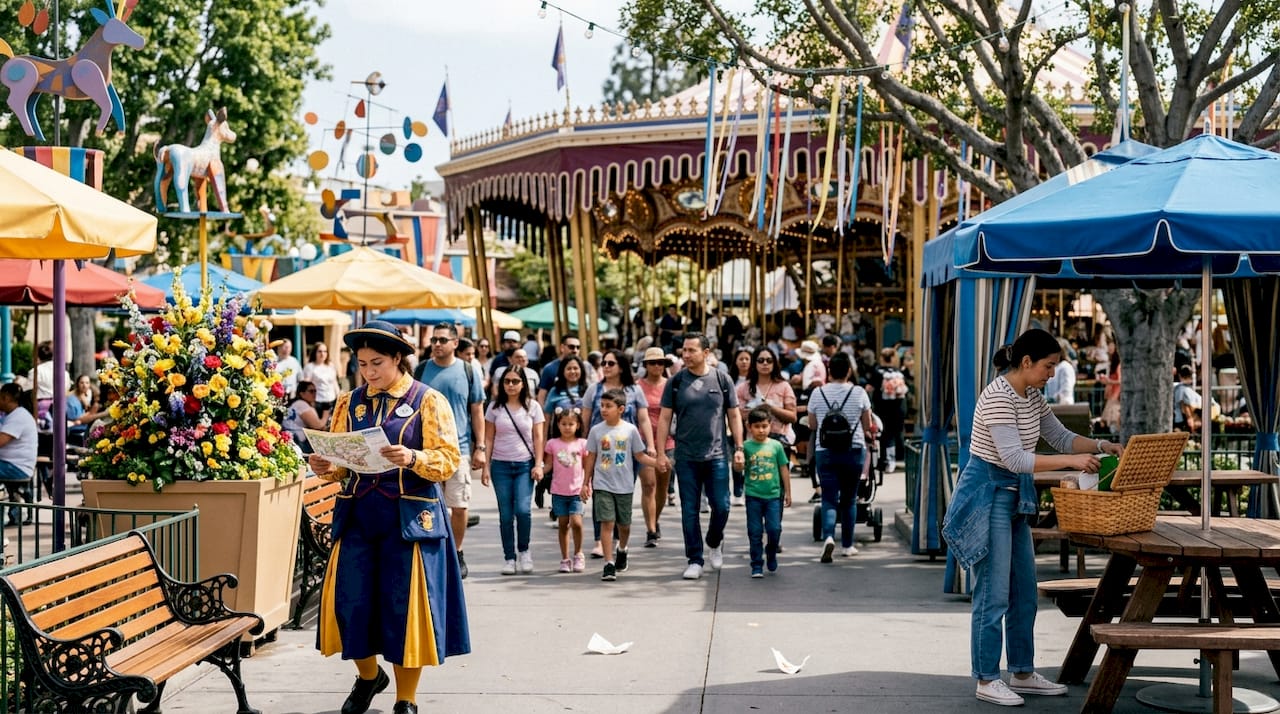
The hub-and-spoke layout with a central visual icon (a castle, a tower, a landmark structure) remains the industry standard for guest orientation and crowd management. Guests can always see where they are in relation to the center, which reduces confusion and fatigue and keeps them in spending mode.
Wide walkways with multiple routing options prevent the choke points that form at attraction exits. A minimum 30-foot pathway width at primary arteries is a widely cited benchmark for high-capacity parks.
Environmental storytelling woven into architecture, pavements, and vegetation reinforces thematic cohesion without relying on signage. When the pavement texture changes and the building facades shift, guests understand they have entered a new zone. That transition is doing navigational work silently.
Pro Tip: Walk your planned pathways with a wheelchair during the design review. ADA compliance is the floor, not the ceiling. Guests with strollers, mobility devices, and sensory sensitivities represent a large share of your audience, and designing for them improves the experience for everyone.
4. Adding new attractions without disrupting operations
Integrating a new ride or feature into an existing park layout is one of the most technically demanding tasks in theme park management strategies. You are running a live operation with paying guests while simultaneously managing construction. The margin for error is narrow.
Site evaluation for new additions must consider queue line footprint, utility access routes, topography changes, and emergency vehicle paths. Blocking an emergency access route, even temporarily, is not a tradeoff you can accept.
Key planning requirements for new attraction integration include:
- Maintaining unobstructed emergency access corridors throughout the construction phase
- Running construction activity during off-hours or before park open to limit guest exposure to noise, dust, and site hazards
- Updating park maps, signage, and staff training materials before the attraction opens, not after
- Confirming that new utility loads (water, power, data) do not stress existing infrastructure capacity
- Conducting full operational readiness drills before the first public day of operation
Thematic harmony matters here too. A new attraction that visually clashes with its surrounding land erodes the immersion you have built. Consult your original design language and material palette before finalizing exterior finishes.
5. Back-of-house infrastructure: the hidden foundation of operations
Guests never see back-of-house infrastructure. That invisibility is exactly the point, and it requires deliberate, structured planning. BOH design includes invisible service roads and maintenance areas that must support efficient daily operations without ever breaking the guest’s sense of immersion.
Here are the four back-of-house priorities that separate well-run parks from reactive ones:
- Service road network. Every attraction, restaurant, and show building should be accessible by a service road wide enough for a freight truck. Design this network before finalizing your guest-facing layout so it does not get squeezed out.
- Spare parts inventory. Stocking 12 to 24 months of critical spare parts locally prevents the downtime and revenue loss that come from waiting weeks for a specialized component to arrive. This is especially relevant for imported ride systems.
- Preventive maintenance documentation. Every mechanical and structural element should have a documented inspection schedule. Paper-based systems work, but digital asset management platforms allow you to track trends and predict failures before they occur.
- Waste and utilities management. Waste collection points, electrical substations, and water treatment facilities need adequate space and access. Cramped utility areas create safety hazards and make routine maintenance far slower than it needs to be.
Pro Tip: Bring your operations and maintenance team into the design process before schematics are finalized. Early collaboration between operations and maintenance and designers prevents the costly retrofits that happen when technicians cannot reach what they need to service.
6. Surface preparation and protective coatings extend infrastructure life
Outdoor theme park surfaces take punishment that most commercial properties never see: Florida heat, UV exposure, humidity, chemical spills from food and beverages, and millions of footsteps annually. Coatings that were applied without proper surface preparation fail faster, require more frequent touch-ups, and ultimately cost more over the asset’s lifecycle.
Value engineering balances design ambition with budget by prioritizing guest-facing details while simplifying less visible infrastructure. That principle applies directly to coatings: spend the most on surfaces guests touch and see, but never skip the preparation work on any surface.
The facility surface maintenance guide for Florida managers highlights how the local climate accelerates corrosion and coating breakdown compared to cooler, drier climates. A protective industrial coating applied over properly blasted steel can last three to five times longer than paint applied over a surface that was only power-washed.
For steel ride structures, concrete facades, and decorative theming elements alike, proper sandblasting removes rust, contaminants, and adhesion-blocking residues before any protective coating goes on. Skipping this step is a short-term budget decision that becomes a long-term maintenance problem.
7. Sustainability and smart technology as infrastructure investments
Sustainable design in theme parks has moved past being a marketing differentiator. Sustainable infrastructure elements like solar power, water recycling systems, permeable pavements, and efficient HVAC reduce both carbon footprint and operating costs. In Florida, where energy and water costs are substantial, these are investments with measurable payback periods.
AI and predictive analytics can dynamically manage guest flow by adjusting staffing, triggering queue interventions, and identifying operational bottlenecks in real time. But these systems depend on reliable physical infrastructure: sensors, network connectivity, and data infrastructure that must be planned into the park’s backbone from the beginning.
A quick comparison of conventional versus forward-looking infrastructure choices:
| Infrastructure element | Conventional approach | Forward-looking approach |
|---|---|---|
| Lighting | Standard grid-powered fixtures | Solar-assisted LED with smart controls |
| Water management | Municipal supply only | On-site recycling and retention systems |
| Guest flow management | Static signage and staffing | AI-driven crowd heat maps and dynamic staffing |
| Surface maintenance | Reactive repainting when visible | Scheduled sandblasting and industrial coating cycles |
| HVAC | Standard split systems | High-efficiency variable refrigerant flow systems |
Planning for LEED certification from the outset, rather than retrofitting for it, reduces costs and opens access to incentives and grants that can offset your infrastructure investment.
My perspective on what actually drives long-term infrastructure success
I’ve worked alongside theme park operations teams long enough to have a clear view of where the real problems originate. They almost never start with technology or theming. They start with decisions made in the first six months of planning that nobody had the authority or the information to push back on.
The earliest design decisions lock in technical constraints that become extremely expensive to change once construction is underway. I’ve seen parks spend more on post-construction modifications to mechanical rooms and utility corridors than they spent on the original build of those areas, all because operations staff were not at the table during design.
My honest take on the cutting-edge versus maintainability debate: choose maintainability every time a tie-breaking decision comes up. A ride system that requires a specialist from overseas to service it will cost you more in downtime over a decade than any performance advantage it offered. That calculation changes if you build the spare parts inventory and service contract into the original procurement.
The best-run parks I’ve observed share one cultural trait: they treat maintenance as a revenue protection activity, not a cost center. When your infrastructure is clean, coated, and inspected on schedule, it stays open. When it stays open, you make money.
— Southernsandblastingandpainting
Protect your park’s infrastructure with professional surface treatment
Theme park surfaces face some of the harshest conditions of any commercial facility. Steel ride structures, concrete walkways, themed facades, and utility buildings all degrade faster without proper surface preparation and protective coatings, especially in Central Florida’s climate.
Southern Sandblasting and Painting has delivered industrial surface preparation and coating solutions across Florida’s theme park and infrastructure sector for over 20 years. Professional sandblasting removes rust, old paint, and contaminants down to bare metal or concrete, giving industrial coatings the adhesion they need to last. The result is a coating system that performs for years longer than paint applied over an unprepared surface. Learn more about the sandblasting services in Orlando that help park operators protect their assets and reduce long-term maintenance costs. For a broader look at what proper surface treatment delivers for theme park longevity, review the theme park surface treatment guide that covers material selection, coating types, and scheduling for high-traffic environments.
FAQ
What does theme park infrastructure typically cost?
Infrastructure and construction costs for amusement parks range from $30,000 to over $200,000 depending on site complexity, ground works, and utility requirements. Phased development helps manage this investment over time.
How do you design a theme park for good guest flow?
The hub-and-spoke layout with a central visual icon is the industry standard. Wide pathways, multi-directional routing options, and environmental storytelling all reduce congestion and keep guests oriented without heavy reliance on signage.
What is back-of-house infrastructure in a theme park?
Back-of-house infrastructure includes service roads, utility systems, waste management areas, and maintenance facilities that guests never see. BOH design must support efficient operations while staying fully concealed to preserve the guest experience.
Why is surface preparation important for theme park maintenance?
Proper sandblasting before applying industrial coatings removes rust, contaminants, and adhesion barriers. Coatings applied to well-prepared surfaces last significantly longer, reducing maintenance frequency and protecting your infrastructure investment in Florida’s demanding climate.
How can AI improve theme park operations?
AI and predictive analytics allow parks to manage crowd flow dynamically, adjust staffing in real time, and identify operational bottlenecks before they affect the guest experience. These capabilities require reliable physical and network infrastructure to function properly.


