
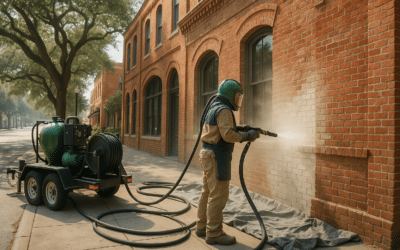
TL;DR: Dustless (wet) blasting can remove paint and coatings from historic masonry with far less risk than dry sandblasting, but national preservation standards still treat all abrasive methods as a last resort. For Orlando-area municipal buildings, DOT structures,...
Articles
Vapor Abrasive Blasting vs. Dry Blasting: Comparing Performance, Dust, and Cost
TL;DR: Vapor (wet) abrasive blasting mixes water with media to cut airborne dust and allow work closer to occupied areas, while dry blasting cuts faster and leaves a more aggressive, consistent surface profile. The right choice in Central Florida depends on the...
Garnet vs. Coal Slag Blasting Media: Which Abrasive Is Right for Your Project?
TL;DR: Garnet and coal slag are both silica-free alternatives to sand for abrasive blasting, but they perform very differently: garnet is harder, recyclable, and produces far less dust, while coal slag is cheaper upfront but single-use and dustier. For most commercial...
Why Soluble Salt Testing Before Blasting Can Save a Coating Project from Premature Failure
TL;DR: Soluble salts like chlorides and sulfates are invisible contaminants that abrasive blasting alone often fails to remove, and they're a leading cause of premature coating blistering and corrosion. In Central Florida's humid, salt-penetrated climate, testing...
What Is Anchor Profile Measurement and Why It’s Critical Before Applying Industrial Coatings
TL;DR: Anchor profile measurement checks the microscopic peaks and valleys left on a blasted steel surface, which determines how well a coating will mechanically bond to it. In Central Florida's heat, humidity, and salt-air conditions, skipping this step is one of the...
Pump Station Recoating: Planning a Shutdown Schedule That Minimizes Downtime
TL;DR: Recoating a municipal or industrial pump station without a disruption-free plan risks sanitary sewer overflows, confined space violations, and coating failure from Florida's humidity. This guide walks facility managers and public works directors through an...
Coating Systems for Wastewater Treatment Plants: What Works in Corrosive Environments
TL;DR: Wastewater treatment plants face some of the harshest corrosion conditions in industrial coatings — hydrogen sulfide gas converts to sulfuric acid and attacks concrete and steel, while Florida's heat and humidity accelerate failure further. This guide explains...
Secondary Containment Coating: Specifications, Materials, and Compliance Requirements
TL;DR: Secondary containment coating turns a porous concrete berm or steel dike into an impervious barrier capable of holding a tank release under EPA SPCC and Florida DEP rules. The right chemistry, dry film thickness, and surface prep depend on what's stored,...
Intumescent Fireproofing Coatings Explained: How They Work and Where They’re Required
TL;DR: Intumescent coatings are thin, paint-like fireproofing systems that char and expand when heated, insulating structural steel long enough to meet 1-4 hour fire ratings under ASTM E119/UL 263. They're increasingly specified over bulky cementitious fireproofing on...


